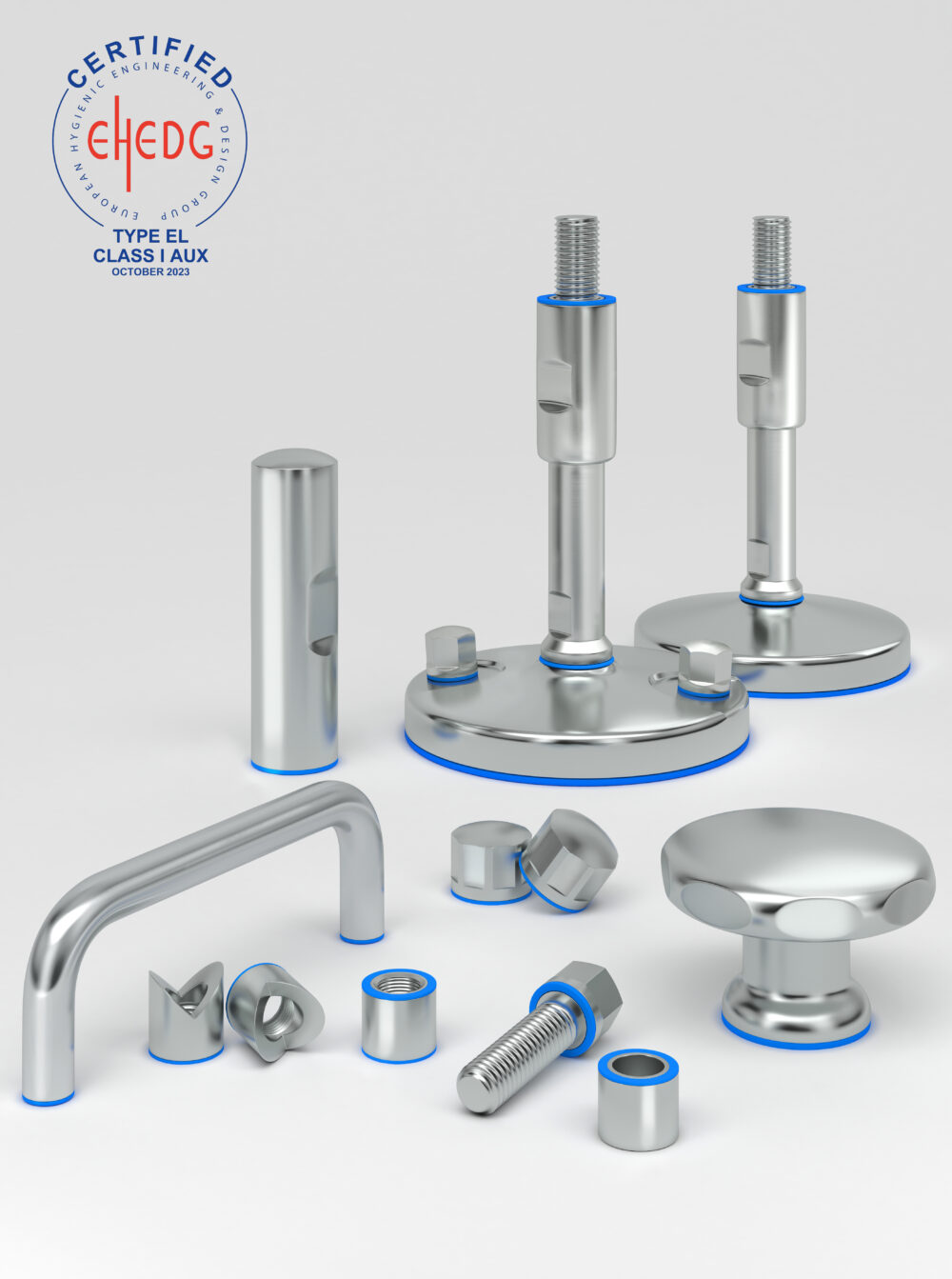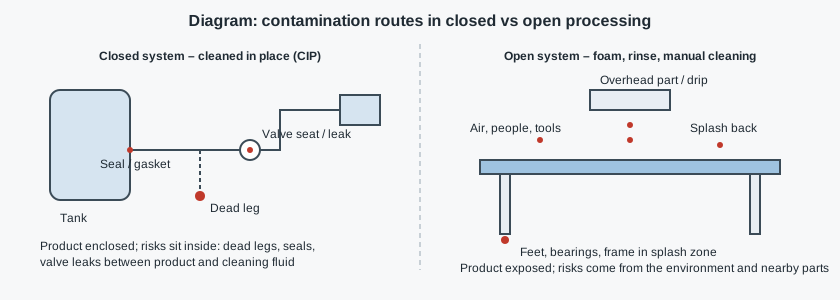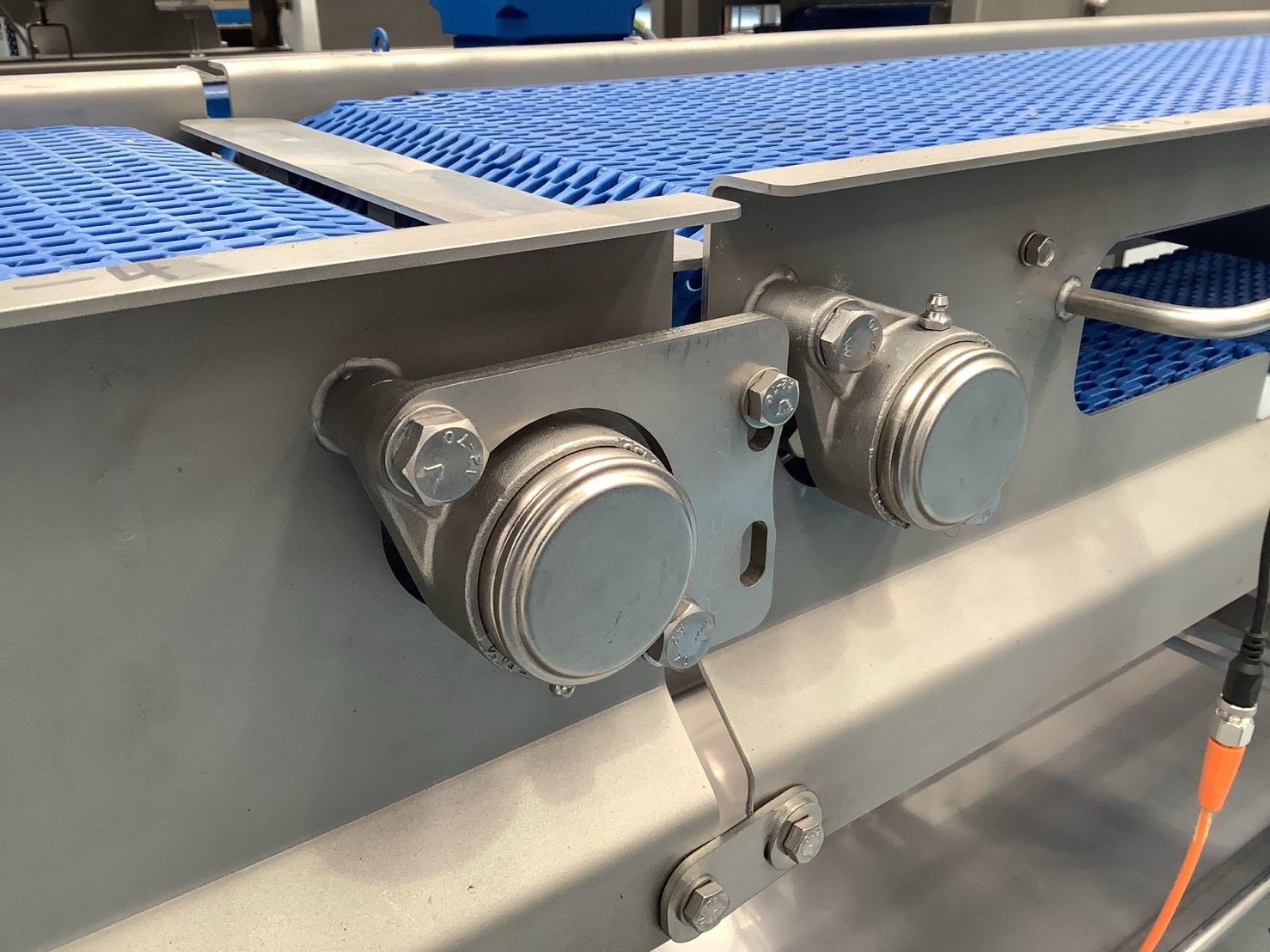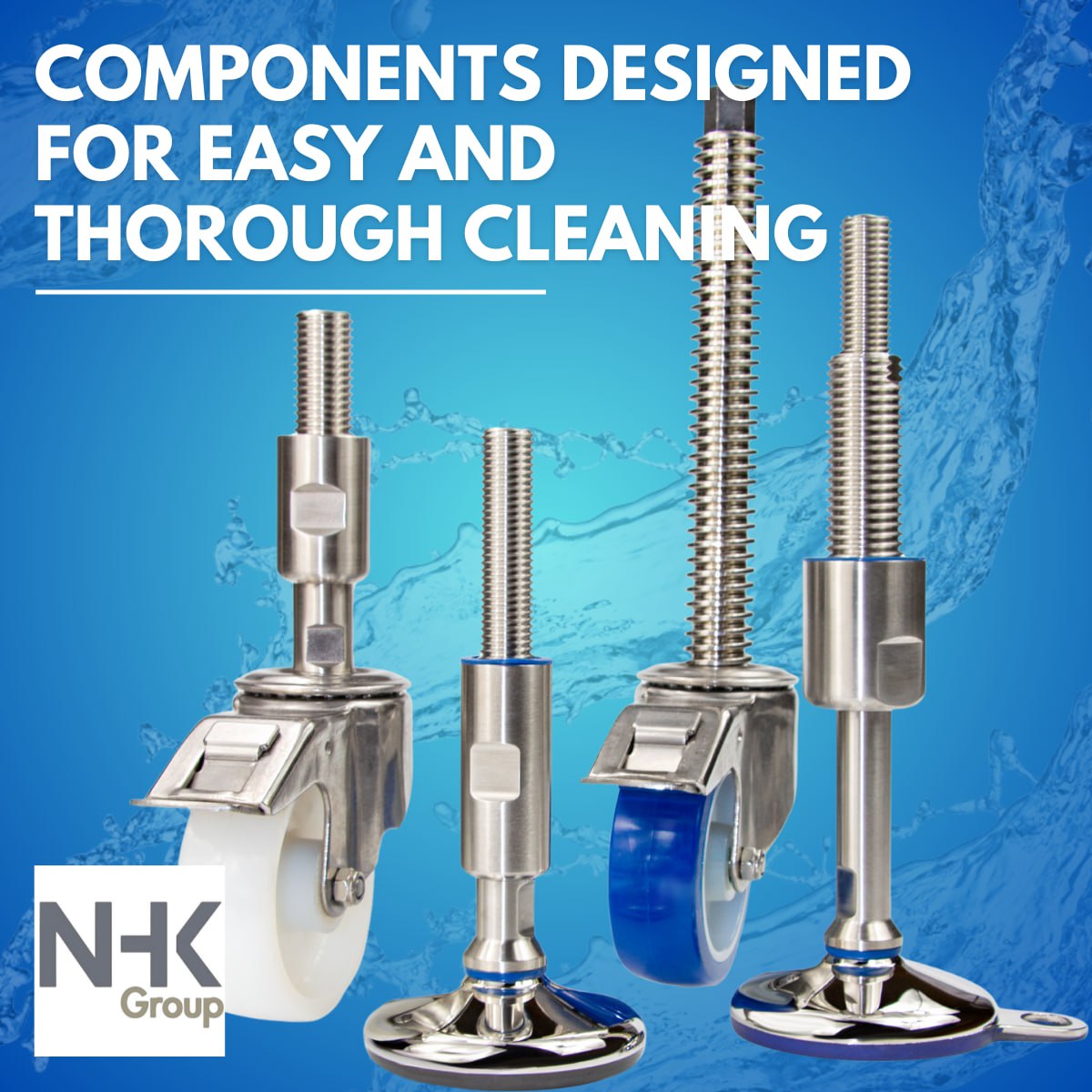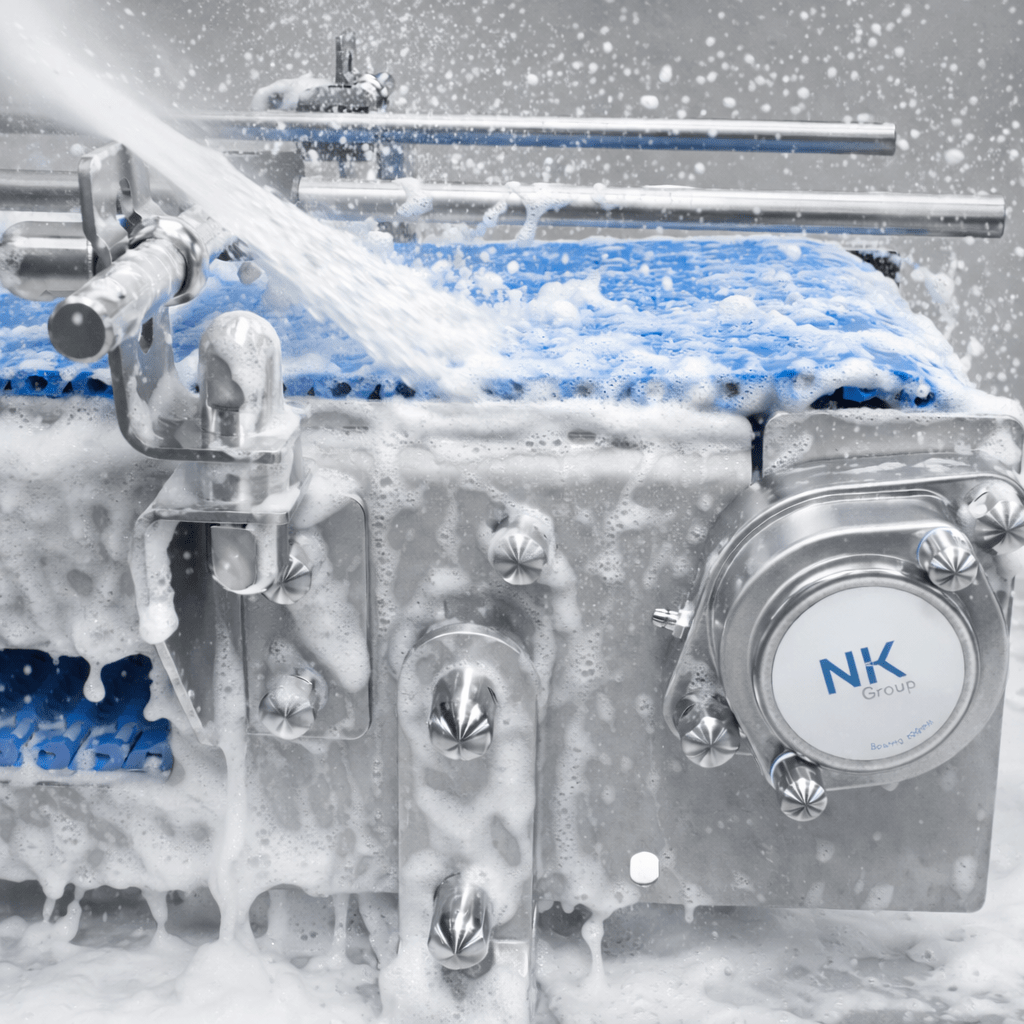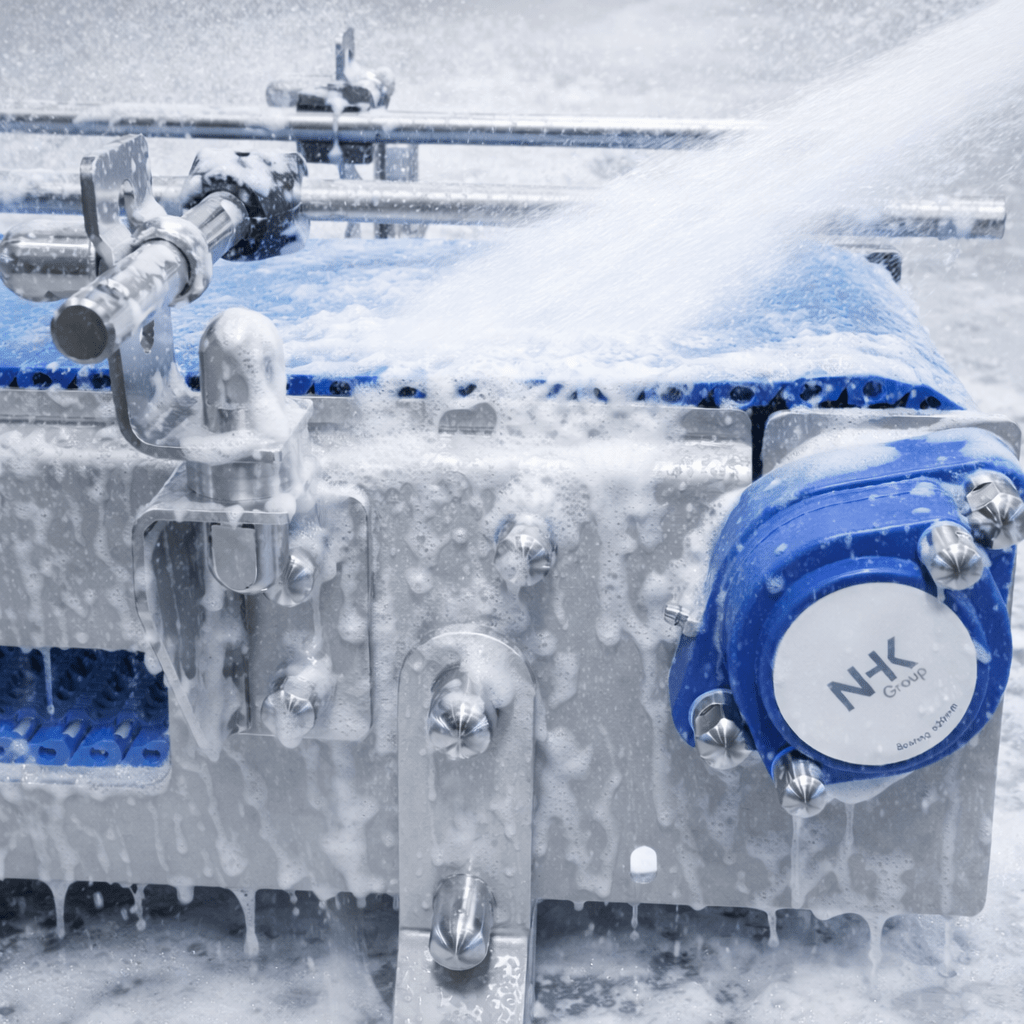
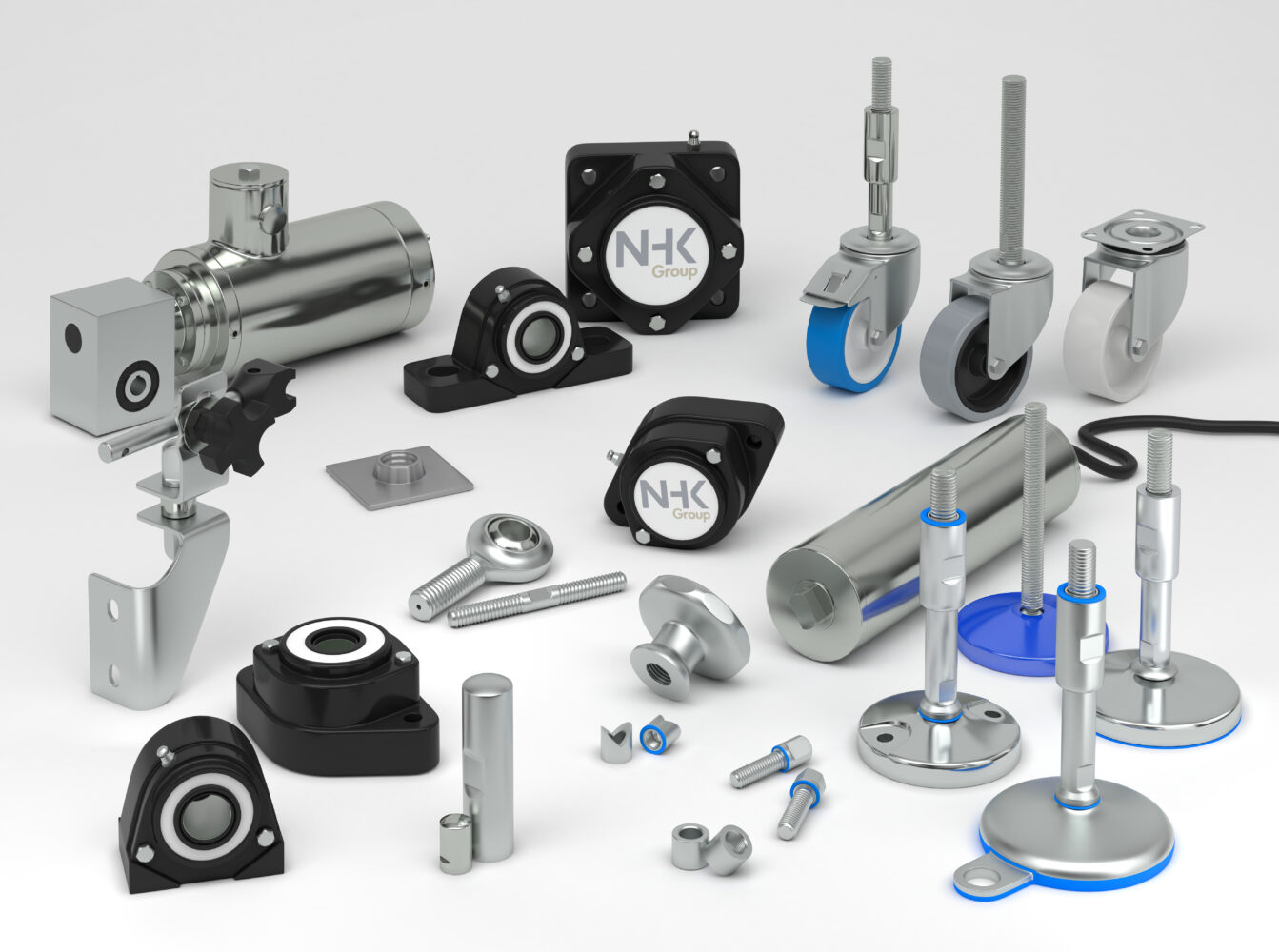
Hygienic machinery components are parts – bearing units, feet, castors, fasteners, guides and seals – designed so they can be cleaned quickly and completely, without crevices, exposed threads or surfaces that hold water. Besides food safety, they bring ecological benefits: less water, fewer chemicals, less energy and less waste. This guide explains where each benefit comes from, what limits it, and how to measure it in your own plant instead of relying on general claims.
Where the ecological benefits come from
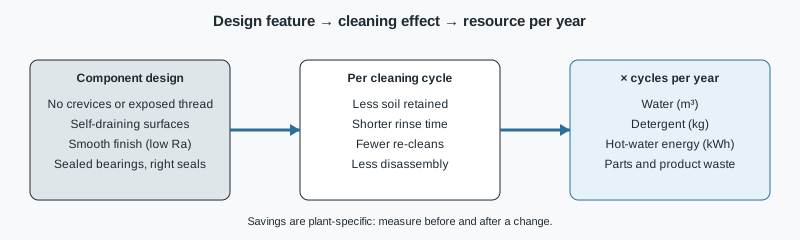
In a food or pharma plant, most of a component's environmental impact during use is not caused by the component itself but by cleaning it. A conveyor may be cleaned once or several times a day; every cycle uses water, detergent, disinfectant and energy to heat water. A component that retains less soil needs a shorter or gentler cleaning cycle, and the saving repeats every cycle of the year.
Key design features:
- No crevices (narrow gaps where soil collects) and no exposed threads.
- No dead spaces (areas cleaning fluid does not reach).
- Self-draining surfaces that do not hold water after rinsing.
- Smooth surface finish: EHEDG guidance is Ra ≤ 0.8 µm for product-contact surfaces (Ra = average surface roughness).
- Sealed bearings and compatible seals so grease is not washed out onto the machine.
Benefits of using hygienic machinery components: overview
| Benefit | Mechanism | What limits it | How to measure |
|---|---|---|---|
| Water | Shorter rinse, fewer re-cleans | Plant cleaning procedure, other non-hygienic parts on the line | m³ per clean (flow meter or flow × time) |
| Chemicals | Lower contact time or concentration needed | Must be validated; hygiene results come first | kg or litres detergent per week |
| Energy | Less hot water heated; shorter cleaning time | Water temperature set by procedure | kWh for hot water per clean |
| Parts waste | Longer service life, fewer replacements | Only if material and seals suit the regime | Replacements per year per position |
| Product loss | Lower contamination and foreign-body risk | A probability, not a guaranteed amount | Rejected batches, hygiene non-conformities |
| End of life | Recyclable stainless steel; dismantlable designs | Mixed materials need separating | Share of components recyclable as metal |
Water efficiency
Water per cleaning cycle is roughly flow rate × rinse time, plus water for re-cleans. Smooth, crevice-free and self-draining components release residues faster and reduce the number of areas a hygiene inspector rejects, which cuts both terms. The source article's point holds: shorter, less water-intensive cleaning cycles conserve water and lower operating costs. How much depends on how much of the cleaning time is spent on the components in question.
Chemical reduction
Soil trapped in crevices and dead spaces forces longer detergent contact times, higher concentrations or manual scrubbing. Hygienic components remove that need where they are installed, which can allow milder cleaning. Two cautions: any change to cleaning chemistry must be validated by the hygiene team, and some cleaning agents are still needed – "chemical-free" cleaning is not a realistic claim. Material choice also matters the other way round: elastomers must be compatible with the chosen chemicals (EPDM, FKM and VMQ react differently), so check the supplier's compatibility data for your cleaning agents.
Energy savings
The largest energy effect of hygienic components is usually indirect: less hot water heated and shorter cleaning time with pumps and foaming units running. Mechanical efficiency, such as lower friction in well-sealed bearings, plays a smaller role. Claims of "improved thermal management" should be backed by data for the specific component.
Waste reduction and durability
Durable components reduce parts waste only when they suit the environment: the right stainless grade (304 for general wet areas, 316 where chlorides cause chloride pitting), compatible seals and food-grade grease. A component that fails early because of washed-out grease creates more waste than a cheaper part chosen correctly. Hygienic design also reduces product loss, because contamination, flaking paint, rust and grease leakage are common causes of rejected product.
Materials and recyclability
Stainless steel is widely recycled and is the dominant material in hygienic components. Plastics and elastomers in housings, bases and seals are harder to recycle, especially when bonded to metal. Claims of "eco-friendly materials derived from renewable sources" should be checked for the specific product – for food contact, materials must above all comply with EC 1935/2004, and plastics with EU 10/2011. For dismantling and recycling, prefer designs where seals and plastic parts can be separated.
How to measure the benefits in your plant
- Choose one line or zone where components will be changed.
- Record a baseline for four weeks: cleaning time, water per clean, detergent use, hot-water energy, replacements and hygiene non-conformities.
- Change the components – for example, exposed-thread feet to sealed feet, open to sealed bearing units.
- Keep the cleaning procedure unchanged at first, then optimise it with the hygiene team.
- Record the same data for four weeks after the change and after the procedure is optimised.
- Calculate yearly effect = difference per clean × cleans per year.
Example – a calculation illustration with assumed figures, not measured data. A line is cleaned twice a day, 360 days a year, with a hose flow of 3 m³/h. If rinsing time per clean falls by 5 minutes after the change, yearly water saving = 3 m³/h × (5 ÷ 60) h × 720 cleans = 180 m³. The plant would then add the corresponding hot-water energy and detergent effect from its own figures.
Carbon footprint
Lower water heating, fewer chemicals, fewer replacements and less product loss all reduce emissions, but the size is plant-specific. Report measured reductions from the method above rather than general percentages. For how these benefits fit a wider sustainability framework, see sustainable development and growth; for cleaning cost in total cost of ownership, see the importance of hygienic optimization.
Conclusion
The benefits of using hygienic machinery components are real but indirect: they arise through cleaning, durability and lower contamination risk. NHK lists its certified hygienic components and sealed units such as IP67 waterproof bearing units with spherical inserts on NHK Machinery Parts. IP67 is an immersion test, not a hygiene certification.