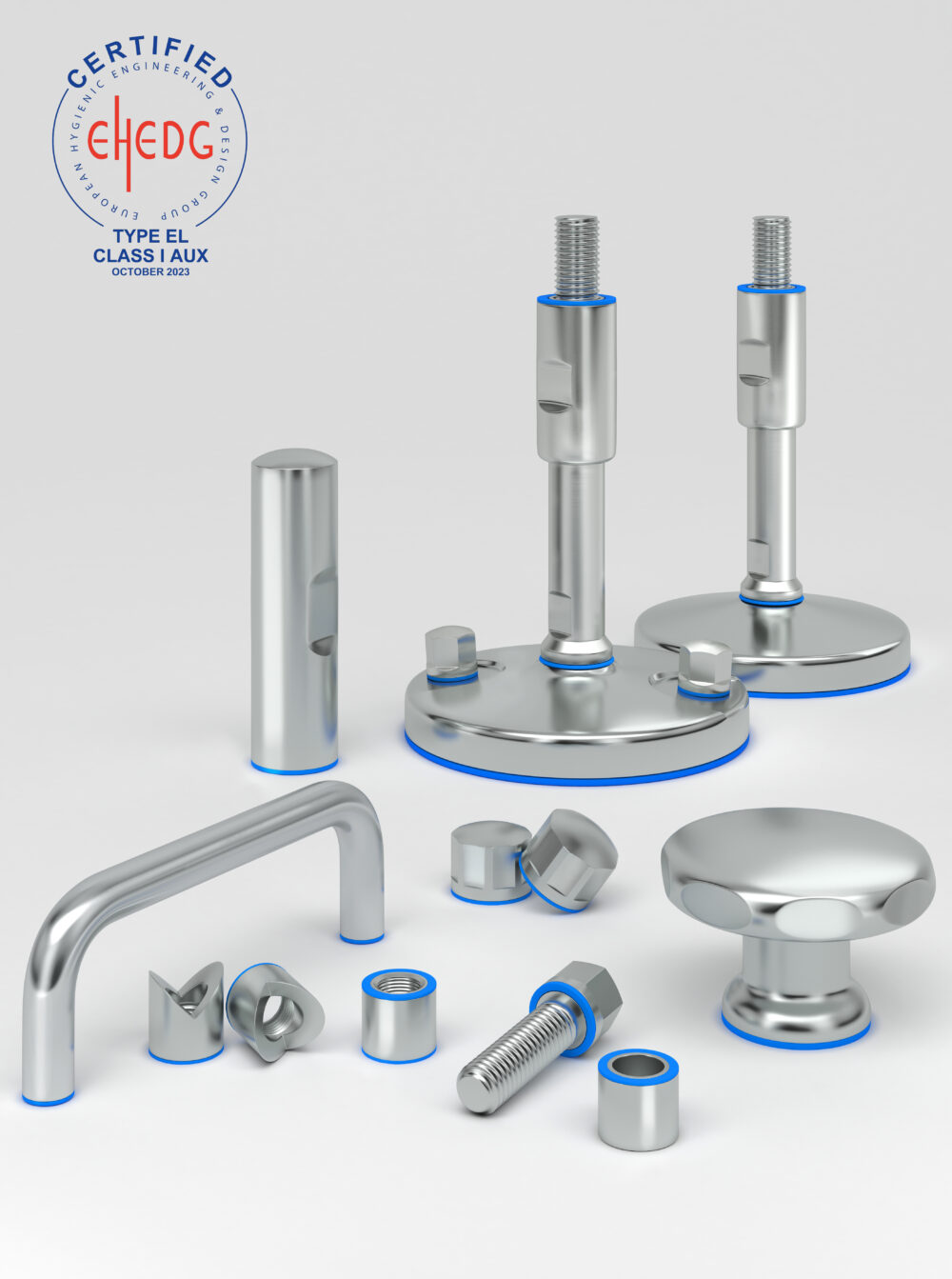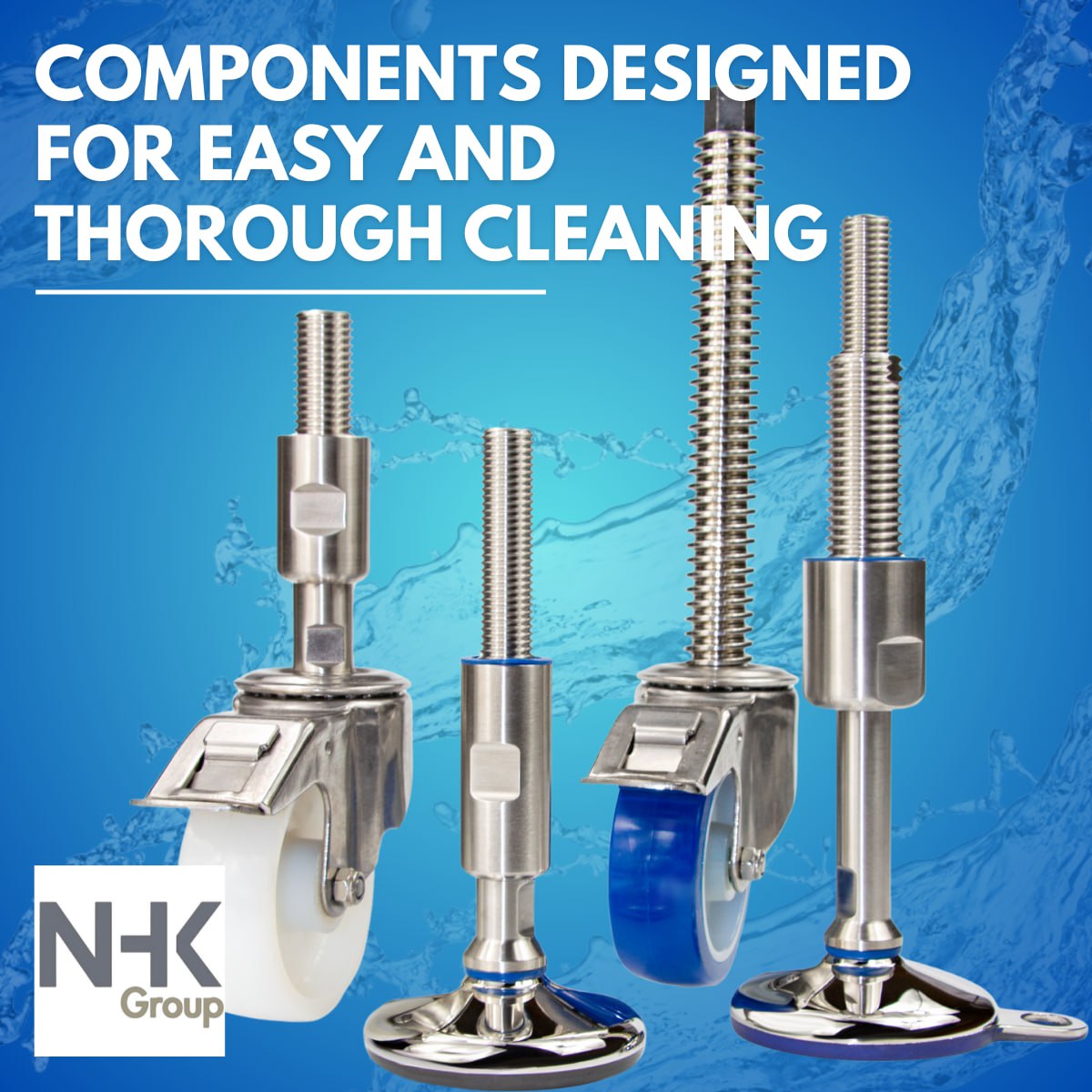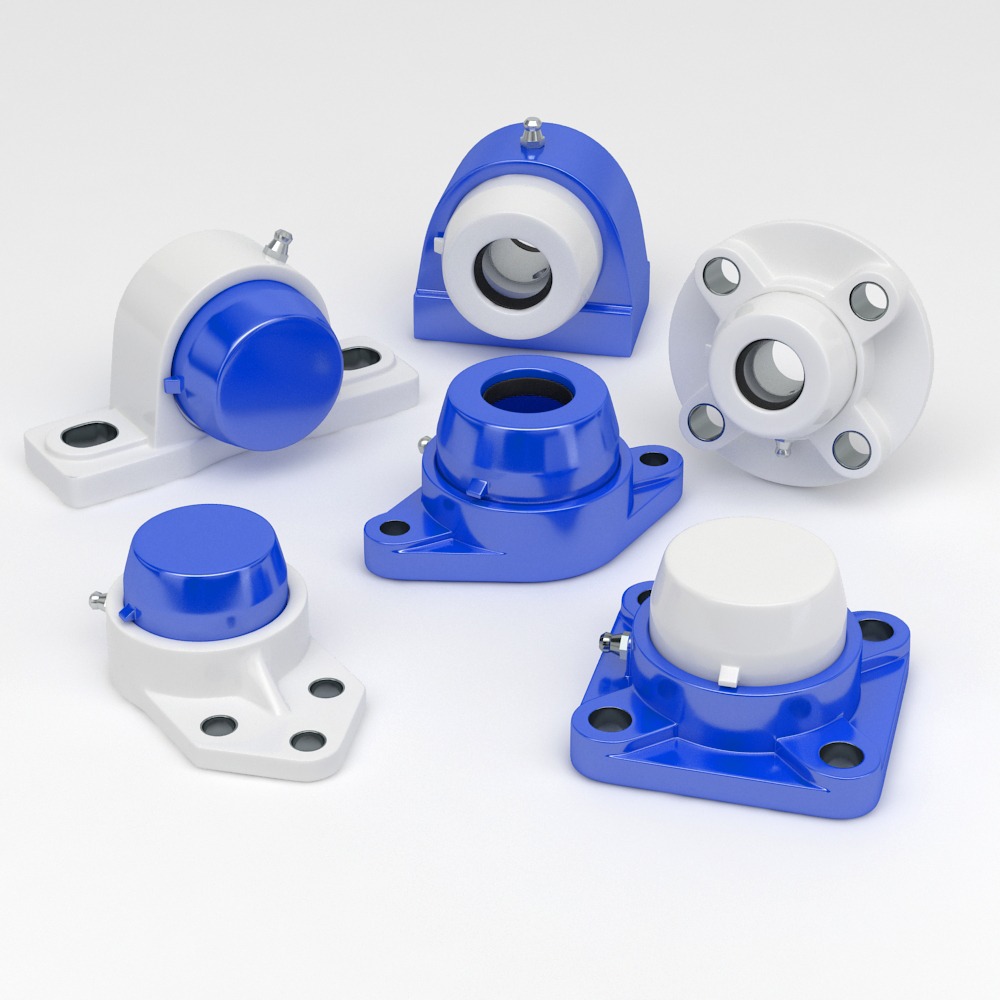
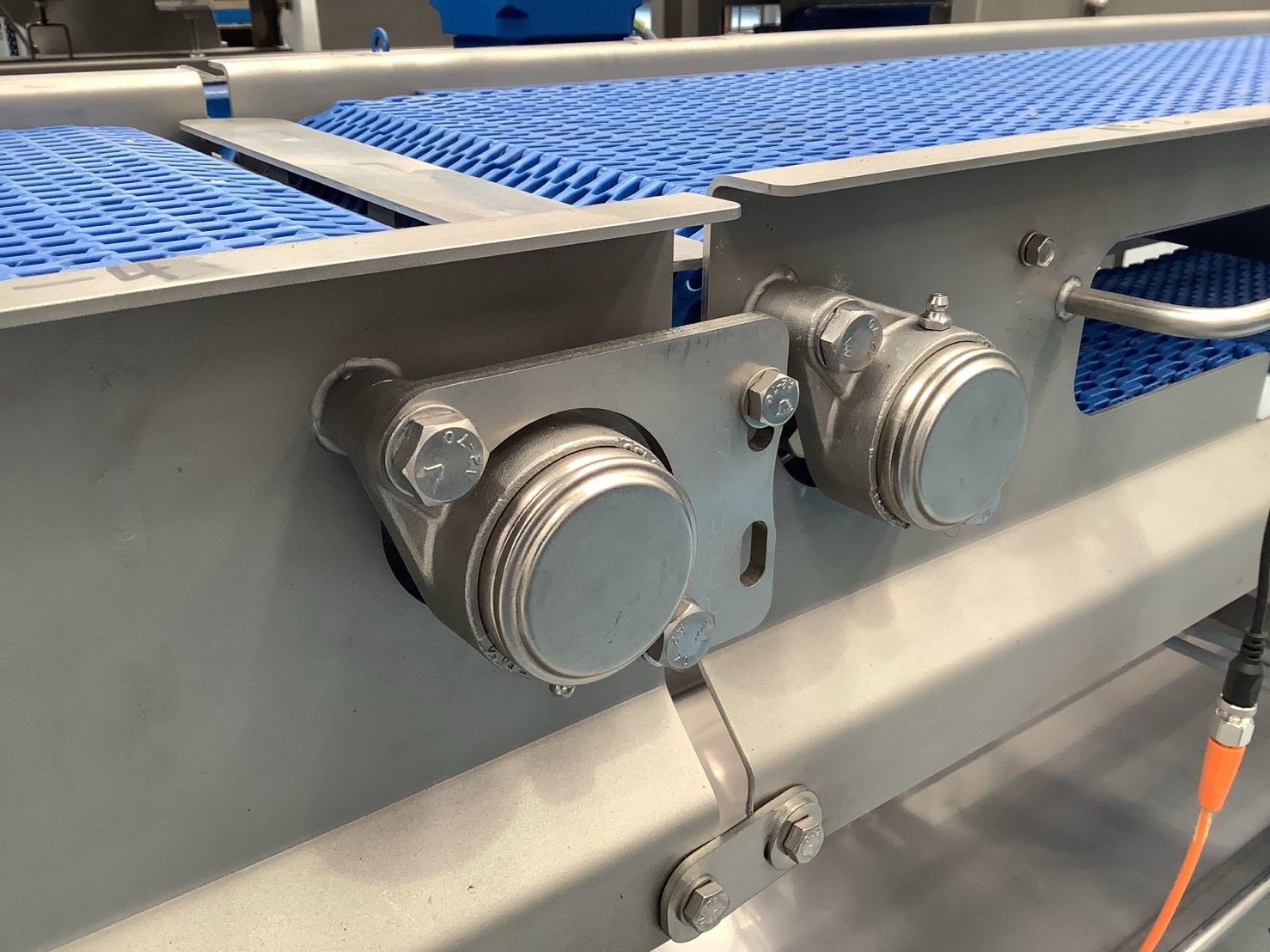
Standard parts in hygienic design are catalogue components – bolts, feet, bearing units, brackets – that were not designed for cleanability, and the rule of thumb is simple: they are acceptable where neither product nor cleaning splash reaches them, and they need replacing by hygienic standard components wherever residues can collect and contaminate product. This guide goes zone by zone and lists the typical substitutions. It builds on the core principles of hygienic design in food processing machinery.
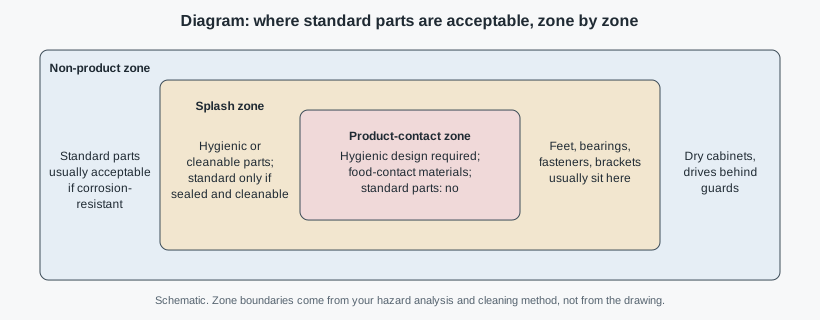 hygiene zones and where standard parts are acceptable. Schematic, not a product test report.
For how zones differ between enclosed and exposed lines, see open and closed processing compared.
The three zones
EN 1672-2 and EN ISO 14159 divide a machine by how close a surface is to the product. In practice three zones are used:
- Product-contact zone – surfaces that touch product, or from which product, liquid or residue can drain or drop back onto product. These must be designed for cleaning and made of food-contact materials under EC 1935/2004.
- Splash zone – surfaces that do not touch product but are reached by product splash, cleaning water or foam. Residues here can be carried back into the product zone by spray, hands or tools.
- Non-product zone – surfaces that neither product nor cleaning splash reaches in normal operation, such as closed electrical cabinets or drives behind sealed guards.
Where a part sits is decided by the machine's layout and cleaning method, not by the part. A bearing unit under a conveyor bed is in the splash zone if the bed is foamed and rinsed daily, even though it never touches product.
When standard components are acceptable – zone by zone
| Zone | Standard parts acceptable? | Conditions |
|---|---|---|
| Product contact | No | Hygienic design, food-contact materials and declaration of compliance; certification if the customer requires it |
| Splash zone, wet cleaning | Rarely | Only if the part has no exposed thread, crevice or dead space and withstands the chemicals; otherwise substitute |
| Splash zone, dry cleaning | Sometimes | Cleanable by dry methods, no ledges where dust or powder settles |
| Non-product zone | Usually | Corrosion-resistant material if in a humid room; nothing that sheds particles into adjacent zones |
Crevices are narrow gaps where cleaning agents cannot reach; dead spaces are pockets where liquid and residue stand; harbourage points is the collective term for places where microbes survive cleaning. Standard parts typically fail on exactly these features: exposed threads, hex socket heads, open bearing housings, washers that trap water, and brackets with unsealed joints.
Send your application data and get a recommendation on which parts to substitute
Typical substitutions
| Standard part | Problem in splash or contact zone | Hygienic substitute |
|---|---|---|
| Hex bolt, socket head, plain washer | Recesses in socket, gap under washer, exposed thread | Hygienic bolt with smooth domed head and sealing washer |
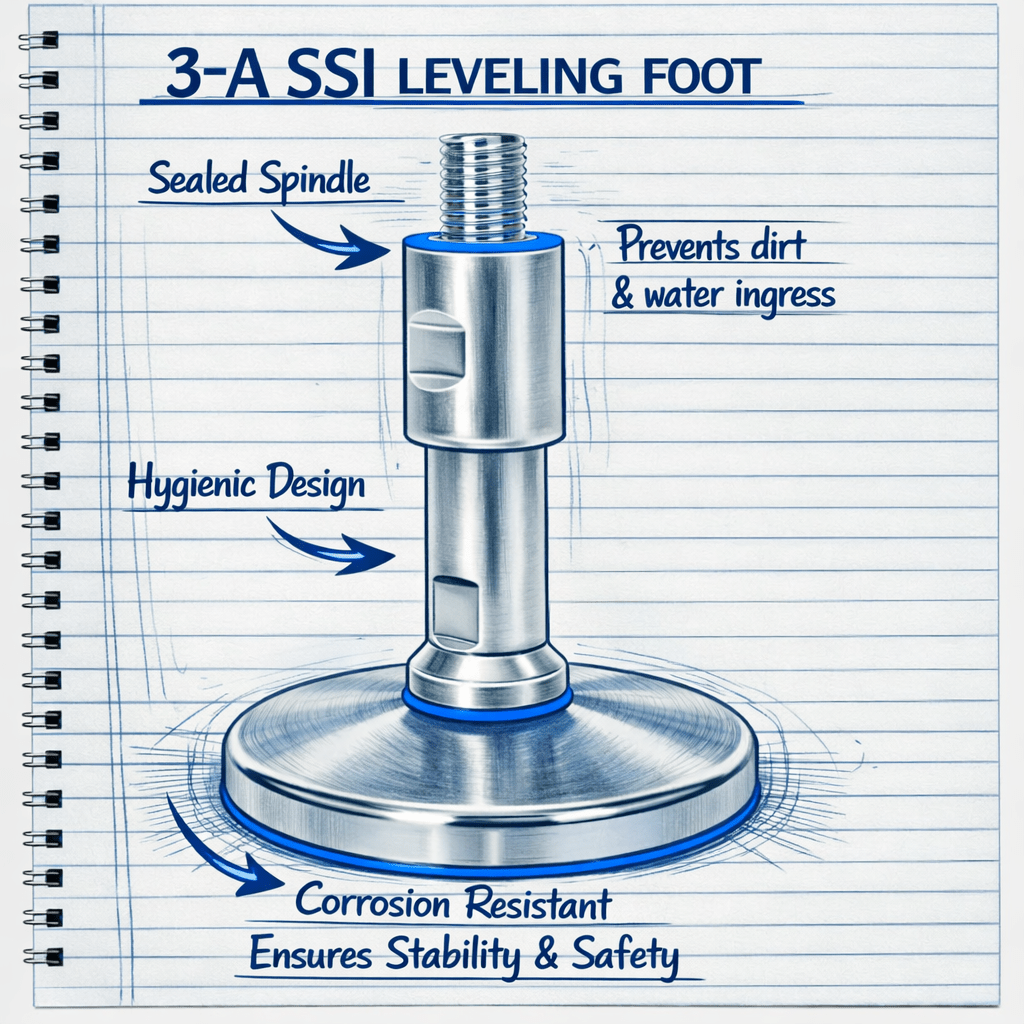
| Adjustable foot with exposed thread | Thread collects residue, joint to frame open | Hygienic levelling foot with enclosed thread and sealed base |
| Cast iron bearing unit, open end | Corrosion, grease and water trap at open end | Stainless or sealed hygienic bearing unit with closed cover |
| Welded or bolted bracket with gaps | Crevice between bracket and frame | Bracket with sealed or continuously welded joint, sloped surfaces |
| Tube end left open or capped loosely | Water and residue enter the tube | Welded or sealed tube insert |
| Plastic handle or knob | Unknown material, recesses | Handle with smooth profile in a declared food-contact material |
For fasteners, NHK's hygienic-bolt listing is an enquiry reference, not proof that every supplied variant has EHEDG certification or 3-A authorisation; request the exact design's evidence; for feet, see adjustable vs levelling feet for how to specify the design.
How to decide part by part
- Mark the zones on the general arrangement drawing using the cleaning method: which surfaces are foamed, rinsed or wiped.
- List every part in the splash and contact zones from the bill of materials.
- Check each part for exposed threads, crevices, dead spaces, horizontal ledges and non-self-draining surfaces (surfaces where water cannot run off).
- Check materials: stainless grade for the chemicals (AISI 304 or 316L where chlorides cause chloride pitting), elastomers compatible with cleaning agents and product fats (EPDM, FKM or VMQ), food-contact declarations where needed.
- Decide: keep, substitute with a hygienic part, or move the part out of the zone – often the cheapest fix is to relocate a bearing or sensor behind a guard.
- Document the decision and the supplier documents for each substituted part.
Example
Assumed situation, for method only: a dairy cheese-handling conveyor is cleaned daily by foam and low-pressure rinse. The general arrangement shows the belt and guides in the product-contact zone, the frame, legs, bearing units and side-guide brackets in the splash zone, and the motor in a closed housing in the non-product zone. Review result: 24 socket-head bolts on the frame below the belt are substituted with hygienic bolts; four exposed-thread feet become hygienic levelling feet; two cast iron bearing units at the drive shaft become stainless sealed units with closed covers; the motor's standard fasteners stay, because the housing is sealed and outside the splash path. The two bearings at the return roller are moved outboard behind a guard instead of being substituted.
When certified parts are needed
Hygienic design is a property of the part; certification is evidence for a specific design. EHEDG certifies equipment designs after testing and evaluation; 3-A authorisation follows a Third Party Verification. Both are voluntary. A certified part is needed when the customer's specification, a retailer standard or the machine's own certification requires it. Ask for the certificate covering the exact part and size, not a company or product-family claim. The guide to EHEDG certification explains what a certificate covers.
Common mistakes
- Treating the underside of a conveyor as non-product zone because product never touches it.
- Substituting the bolt but keeping a standard washer that traps water.
- Check the nut-side thread and seating interface when assessing a through-bolt substitution, not only its head.
- Choosing stainless parts and assuming they are hygienic – material and design are separate questions.
- Mixing stainless and zinc-plated parts, which invites galvanic corrosion (corrosion where two metals touch in a wet environment).
- Asking a supplier for "hygienic components" without stating the zone and cleaning method.
More examples of part-by-part upgrades are in advantages of using sanitary machinery components and sanitary requirements by industry.
What to send for a recommendation
Before asking for certification evidence, use the verification checklist for bought-in hygienic parts.
- Machine type and a drawing or photo marking the zones
- Cleaning method: dry, foam, low or high pressure, chemicals, temperature
- List of standard parts you are reviewing (bolts, feet, bearings, brackets) with sizes
- Material grade required (AISI 304 or 316L)
- Certificate needed, if any (EHEDG, 3-A)
- Quantities and delivery country
Use the hygienic design support preparation checklist to connect these details to one component question before sending them to NHK.
An NHK technician reviews the list, suggests hygienic substitutes where they are needed and sends a quote.