Food contact materials for machine components are the metals, plastics, elastomers and coatings in a food machine that touch food, or that can transfer substances to it – including surfaces from which liquid, condensate or debris can drain onto product. Choosing them is a two-part job: the material must survive the product, cleaning chemicals and temperature, and it must be legally suitable for food contact in the market where the machine will run. Most problems on site come from getting one part right and ignoring the other.
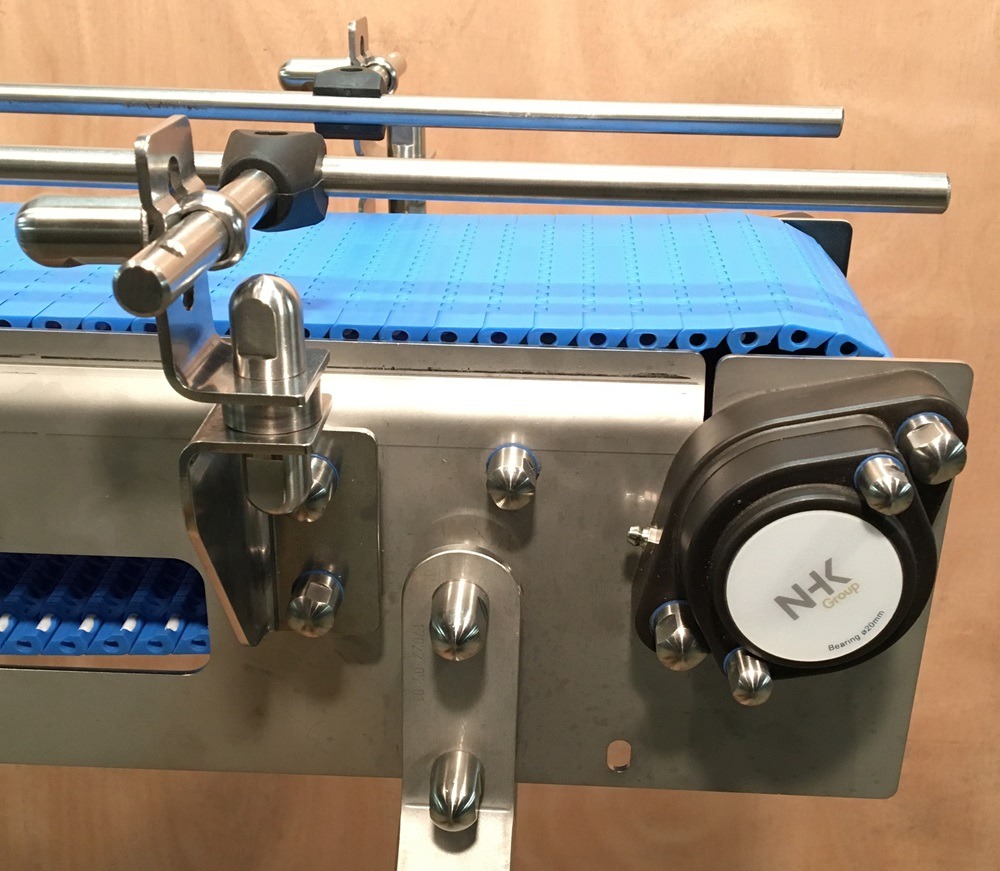
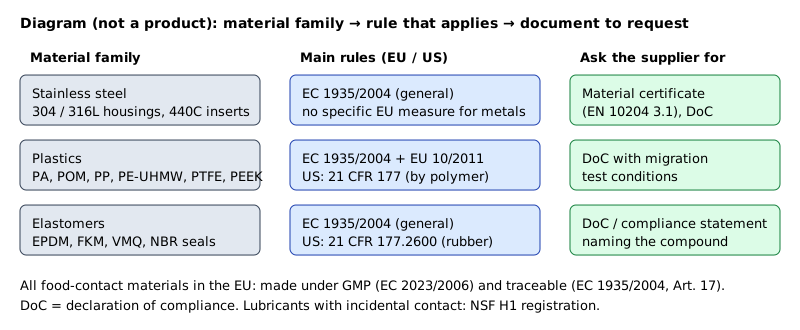 linking stainless steel, plastics and elastomers to EU and US food contact rules and supplier documents. Schematic, not a product test report.
This guide is the starting point for food-contact compliance in the hygienic design and standards hub. It covers the rules, the material families, how to choose, and which documents to ask for.
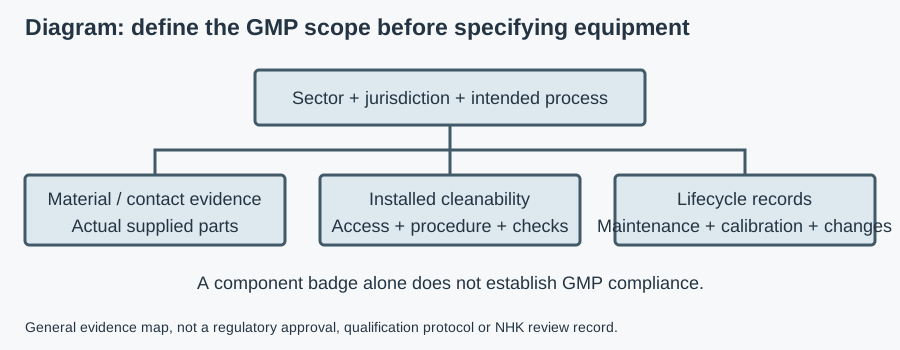
For installed machinery and operating records, separate these material rules from GMP equipment requirements in food and pharma.
Which components count as food contact?
Start with the zones. The product-contact zone includes every surface that touches product, and every surface from which product or liquid can return to it. The splash zone is reached by product or cleaning spray but is not intended to touch product. The non-contact zone is neither. EN 1672-2 and EHEDG guidance both treat a surface that can drain onto product as part of the food zone, whatever the drawing calls it.
| Zone | Typical components | Material requirement |
|---|---|---|
| Product contact | Conveyor belts, guides, wear strips, scrapers, hoppers, seals in the product path | Declared food contact material for the food types, temperatures and contact times in use |
| Splash zone that drains onto product | Guards above open product, bearing housings above conveyors, side frames, fixings | Treat as product contact; declared material |
| Splash zone that does not drain onto product | Frame legs, lower crossmembers, feet, castors | Cleanable, corrosion-resistant, chemical-resistant; declaration useful but not always required |
| Non-contact | Motor housings, control cabinets, floor anchors | Corrosion-resistant and cleanable |
Two errors are common. Engineers declare a guard "non-contact" although condensate drips from it onto the belt; and buyers demand food contact declarations for parts at floor level, adding cost without reducing risk.
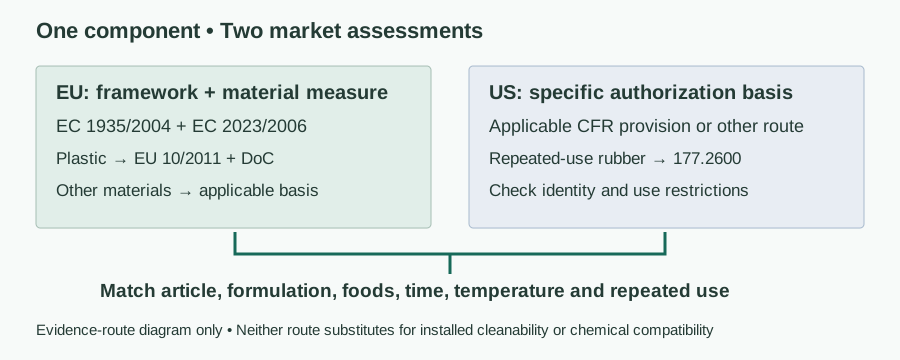
Use the EC 1935/2004 vs EU 10/2011 vs FDA 21 CFR document comparison when checking legal scope, declarations and supporting evidence for the supplied article.
The rules: EU and US
EC 1935/2004 – the EU framework for all materials
Regulation (EC) No 1935/2004 applies to every material intended to come into contact with food: metals, plastics, rubber, coatings, adhesives and lubricant residues on surfaces. Its core requirement (Article 3) is that materials must not release constituents in quantities that could endanger health, bring about an unacceptable change in the composition of the food, or deteriorate its taste and odor. Article 17 requires traceability at all stages. The text is available on EUR-Lex.
EC 2023/2006 – good manufacturing practice
Regulation (EC) No 2023/2006 requires food contact materials to be made under good manufacturing practice (GMP): a documented quality system, control of raw materials and records. It is the reason a supplier should be able to trace a seal or a plastic part to its batch.
EU 10/2011 – plastics only
Regulation (EU) No 10/2011 applies to plastic materials and articles. It lists permitted monomers and additives, sets an overall migration limit (10 mg/dm² of contact surface) and specific migration limits for individual substances, and requires a declaration of compliance – the supplier's written statement that the material meets the regulation, with the conditions it was tested for (food simulants, temperature, contact time). It does not apply to rubber, metals or coatings.
Metals and elastomers in the EU
There is no specific EU measure for metals or rubber. Metals are judged against the general requirements of EC 1935/2004, and many suppliers refer to the Council of Europe resolution on metals and alloys and its technical guide. For elastomers, suppliers often refer to national rules in addition to the framework regulation. Ask which reference a declaration is based on.
United States: FDA 21 CFR
In the US, food contact substances are regulated by the FDA. 21 CFR Part 177 lists permitted polymers section by section – for example 177.1520 for olefin polymers (PE, PP), 177.1500 for nylon resins, 177.1550 for perfluorocarbon resins (PTFE), 177.2470 for polyoxymethylene copolymer (POM) and 177.2600 for rubber articles intended for repeated use. Compliance with one section says nothing about another; check that the declaration names the right section for the actual polymer.
Neither EHEDG certification nor 3-A authorization replaces these rules. EHEDG certifies the cleanability of a specific design; 3-A sets material requirements within its own standards (see stainless steel for 3-A Sanitary Standards). Both are voluntary.
Ask NHK's technicians about food contact materials for your machine
Stainless steel for food processing components
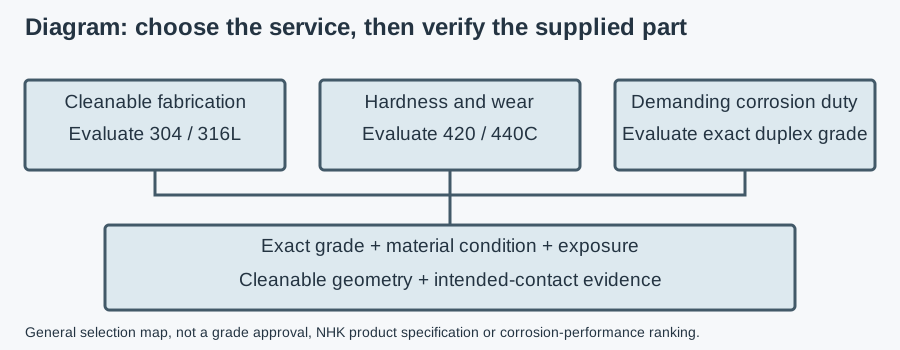
Austenitic stainless steel is the default for food processing components because it is corrosion-resistant, cleanable and well understood. Use the steel selection and supplier-document checklist to compare the finished-part evidence with the material requirement.
| Grade | Typical use | Watch out for |
|---|---|---|
| AISI 304 (1.4301) | Frames, guards, housings, fasteners in most food areas | Chloride pitting (local corrosion caused by chloride ions) with salt, brine or daily chlorinated cleaning |
| AISI 316L (1.4404) | Product-contact surfaces, meat, fish, dairy, brine, aggressive cleaning | Higher cost; still not immune to strong chlorides at high temperature |
| AISI 420 / 440C (martensitic) | Bearing inserts, blades, wear parts needing hardness | Lower corrosion resistance than 304/316L; keep cleaning chemicals in range |
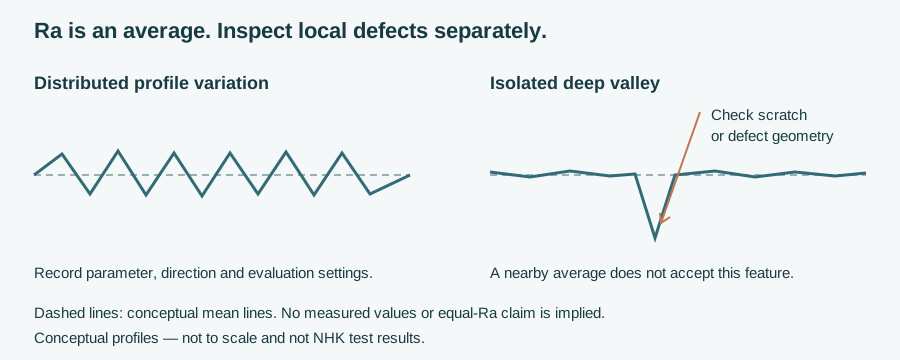
Stainless steel is only food safe while its passive layer is intact. Welds, machining and contact with carbon steel tools damage it; passivation – a chemical treatment that restores the protective oxide layer – should follow fabrication. Surface finish matters too: EHEDG guidance gives Ra ≤ 0.8 µm for product-contact surfaces. The choice between the two austenitic grades is covered in AISI 316L vs AISI 304 compared in practice.
Food grade plastics for machinery
Plastics are used where metal is too heavy, too noisy, too hard on product or too expensive: wear strips, guides, chain and belt components, scrapers, bushings, housings for light bearing units.
| Plastic | Typical components | Strengths | Limits |
|---|---|---|---|
| PE-UHMW | Wear strips, guides, chute liners | Low friction, abrasion resistant, impact tough | Low heat resistance, creeps under load |
| POM (acetal) | Gears, bushings, chain parts, rollers | Stiff, dimensionally stable, low friction | Attacked by strong acids and chlorine-based cleaners |
| PA (polyamide) | Rollers, castor wheels, housings | Tough, wear resistant | Absorbs water and swells |
| PP | Housings, tanks, covers | Chemical resistant, low cost | Brittle at low temperature |
| PTFE | Seals, low-friction liners | Wide chemical and temperature range | Soft, cold flows |
| PEEK | High-temperature bushings and parts | Heat and chemical resistant, strong | High cost |
Two practical points. First, color and detectability: blue and metal-detectable or X-ray-detectable grades are used near open product so that broken fragments can be found. Detectable additives must themselves be covered by the declaration. Second, the declaration lists test conditions. A plastic declared for aqueous foods at room temperature is not automatically covered for fatty foods at 70 °C. Check the simulants and temperatures against your product.
Food grade elastomers
Seals, gaskets, O-rings, belt covers and buffers are usually elastomers. They are the material most often chosen by habit and most often the first to fail. Elastomer compatibility means the compound resists the product, the cleaning chemicals and the temperature without swelling, hardening or cracking.
| Elastomer | Good with | Poor with |
|---|---|---|
| EPDM | Hot water, steam, alkaline cleaners, many acids | Fats and oils – swells |
| FKM | Fats, oils, many acids, higher temperatures | Steam and hot water over time in some grades; higher cost |
| VMQ (silicone) | Wide temperature range | Mechanically weak, cuts and tears; poor with steam over time |
| NBR | Oils and fats at moderate temperatures | Ozone, weathering, strong oxidizing cleaners |
The compound matters, not only the polymer type: two EPDM seals can have very different food contact status and resistance. Ask for the declaration of the actual compound, and in the US check that it references 21 CFR 177.2600. Seal material choice in more depth sits in the materials and surfaces hub.
For a seal-specific decision, use the EPDM, FKM and silicone exposure-screening method to combine food, cleaning, steam and joint requirements before requesting the compound documents.
How to choose: a method
- Define the zone of each component, including whether it can drain onto product.
- Define the product: aqueous, acidic, alcoholic, fatty or dry. Fat and alcohol are the most demanding for plastics and elastomers.
- Define the cleaning: CIP (cleaning in place, solution circulated without dismantling) or COP (cleaning out of place); chemicals, concentration, temperature and frequency.
- Define temperatures: process, cleaning and any sterilization or freezing.
- Shortlist materials that survive steps 2–4 mechanically and chemically.
- Check legal status for the market: EC 1935/2004 and EU 10/2011 in the EU; the right 21 CFR section in the US.
- Request documents and file them with the machine's technical documentation.
Example (assumptions, for method only): a conveyor for cheese portions in a dairy, cleaned daily with alkaline and acid cleaners at 60 °C. Wear strips touch product. Shortlist: PE-UHMW (abrasion resistant, fine at 60 °C cleaning). Product is fatty, so the declaration must cover fatty food simulants at the contact temperature. Belt-return seals see fat and hot cleaner: EPDM would swell with fat, so FKM is shortlisted and its compound declaration requested. Side frames above the belt drain onto product: 316L, passivated after welding. Floor-level feet: stainless, no food contact declaration needed. No result is claimed; the method is what matters.
Documents to request
| Document | For | What to check |
|---|---|---|
| Declaration of compliance (DoC) | Plastics (mandatory under EU 10/2011), elastomers, coatings | Regulations named, food types and simulants, temperature and time, date, batch or compound |
| Material certificate (EN 10204 3.1) | Stainless steel parts | Grade matches drawing, heat number traceable |
| FDA compliance statement | Parts for the US market | The correct 21 CFR section for the actual polymer |
| NSF H1 registration | Lubricants with possible incidental contact | Registration number and product name |
| EHEDG certificate | Components where certified design is required | Names the specific product, valid date |
A declaration that names only "FDA approved" or "food grade" without a regulation, section or conditions is not enough for a technical file.
Common mistakes
- Treating "food grade" as a specification.
- Using a plastic outside the temperatures or food types in its declaration.
- Choosing seals by polymer name without asking for the compound declaration.
- Ignoring drip paths and calling overhead parts "non-contact".
- Forgetting lubricants: an H1 registration is needed where incidental contact is possible.
- Not keeping documents: traceability under EC 1935/2004 needs records, not memory.
Contamination, recalls and where materials fit
Material failures are one route to contamination: fragments from cracked plastics, swollen seals, corroded fasteners and flaking coatings. GFSI-benchmarked schemes such as BRCGS, FSSC 22000 and IFS expect plants to control them through supplier approval, foreign-body controls and documentation. How materials fit into a wider prevention program is described in these guides:
Use GFSI schemes compared for equipment purchasing to separate site certification from component acceptance and supplier evidence.
| Topic | Guide |
|---|---|
| Contamination routes through components | Safeguarding against contamination and product recalls |
| A layered plant program against recalls | Avoiding contamination and product recall |
| What to do on the component side when a recall happens | Avoiding contamination and following product recall |
| Grade choice for stainless parts | AISI 316L vs AISI 304 |
Which one do you need? If you are choosing materials for a new machine, stay on this page and use the method above. If you are investigating a contamination event, start with the component contamination guide. If you are writing a plant-wide program, start with the layered program guide. For supplier documents in a purchasing process, see the buyer's guides.
What to send NHK
- Component(s) and zone, including drip paths
- Product type and temperatures
- Cleaning method, chemicals and frequency
- Market (EU, US or other) and documents required
An NHK technician answers the material question and, where components are needed, suggests suitable parts and sends a quote. To browse, see NHK's hygienic machinery components in stainless steel and NHK's reference article on elastomer selection for food equipment.