EHEDG – the European Hygienic Engineering & Design Group – is a non-profit consortium of equipment makers, food producers, research institutes and authorities that publishes guidelines on hygienic design and certifies specific equipment and component designs that meet them. This guide explains what EHEDG certification proves, what it does not, how to read a certificate and what to ask a supplier who claims it. (The name is sometimes misspelt "EHEDGE" in searches.) It is part of our hygienic design and standards section.
What EHEDG certification is
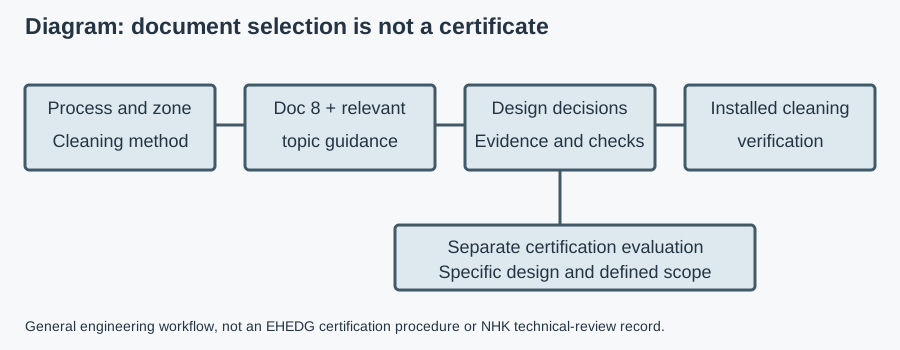
For the underlying documents rather than the certificate, use the EHEDG guidelines and Doc 8 guide to select scope and record design decisions.
An EHEDG certificate states that one equipment design – a pump, valve, sensor, bolt, levelling foot or bearing unit, for example – has been evaluated against the EHEDG guidelines and, where a test method applies, tested for cleanability. The certificate names the manufacturer, the model and the certification type and class.
Three points are often misunderstood:
- It certifies a design, not a company. A supplier is not "EHEDG certified"; individual products are. Other products from the same supplier may have no certificate.
- It is voluntary. No EU law requires EHEDG certification. The legal baseline is the Machinery Directive (replaced by Machinery Regulation (EU) 2023/1230 from 20 January 2027), with EN 1672-2 and EN ISO 14159 as hygiene standards, and EC 1935/2004 for food-contact materials.
- It does not test materials for food-contact compliance. EHEDG requires a signed declaration from the manufacturer but does not test materials or review legal compliance. You still need the material and food-contact declarations.
How EHEDG certification works
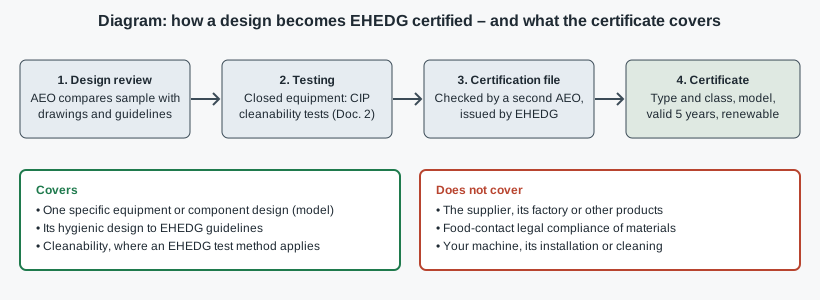 the EHEDG certification route and what the certificate covers. Schematic, not a product test report.
- Design review. An EHEDG Authorised Evaluation Officer (AEO) compares a new sample with the manufacturer's drawings and the relevant guidelines – always including Doc. 8, the hygienic design principles. Features such as surface roughness Ra and internal radii are measured. (EHEDG guidance gives Ra ≤ 0.8 µm for product-contact surfaces.)
- Testing where it applies. Most closed equipment must pass cleaning-in-place (CIP) tests to EHEDG Doc. 2 at an Authorised Test Laboratory. Open equipment can go to certification after the design review.
- Certification file. The AEO prepares the file; a second AEO reviews it before EHEDG issues the certificate.
- Validity. Certificates are valid for five years, because the guidelines are revised. Renewal requires a new application and may require new evaluation.
For the full route from a machine builder's side – preparation, test methods, documents and timeline drivers – see how to get EHEDG certified.
EHEDG certification types and classes
The class tells you how the equipment is meant to be cleaned. A certificate is only meaningful if its class matches the way your line is cleaned. The classes below follow EHEDG's published certification scheme; see the EHEDG overview of certification types and classes for the current version.
| Type and class | Cleaning method | Equipment | Typical examples |
|---|---|---|---|
| EL Class I | Wet, cleaned in place without dismantling | Closed or open | Pipeline equipment such as pumps, valves and sensors |
| EL Class II | Wet, dismantled for cleaning | Closed or open | Blenders, dosing pumps, conveyors, mincers, slicers |
| EL Aseptic Class I | Wet CIP, steam sterilisable, bacteria-tight | Closed | Pumps with double mechanical seals, bellow valves |
| EL Aseptic Class II | Dismantled for wet cleaning, sterilisable, bacteria-tight after reassembly | Closed | Pressure relief valves with double seals |
| ED Class I | Dry cleaned only, without dismantling | Closed | Equipment for dry products that is never wet cleaned |
| ED Class II | Dismantled for dry cleaning only | Closed or open | Dry-product equipment opened for cleaning |
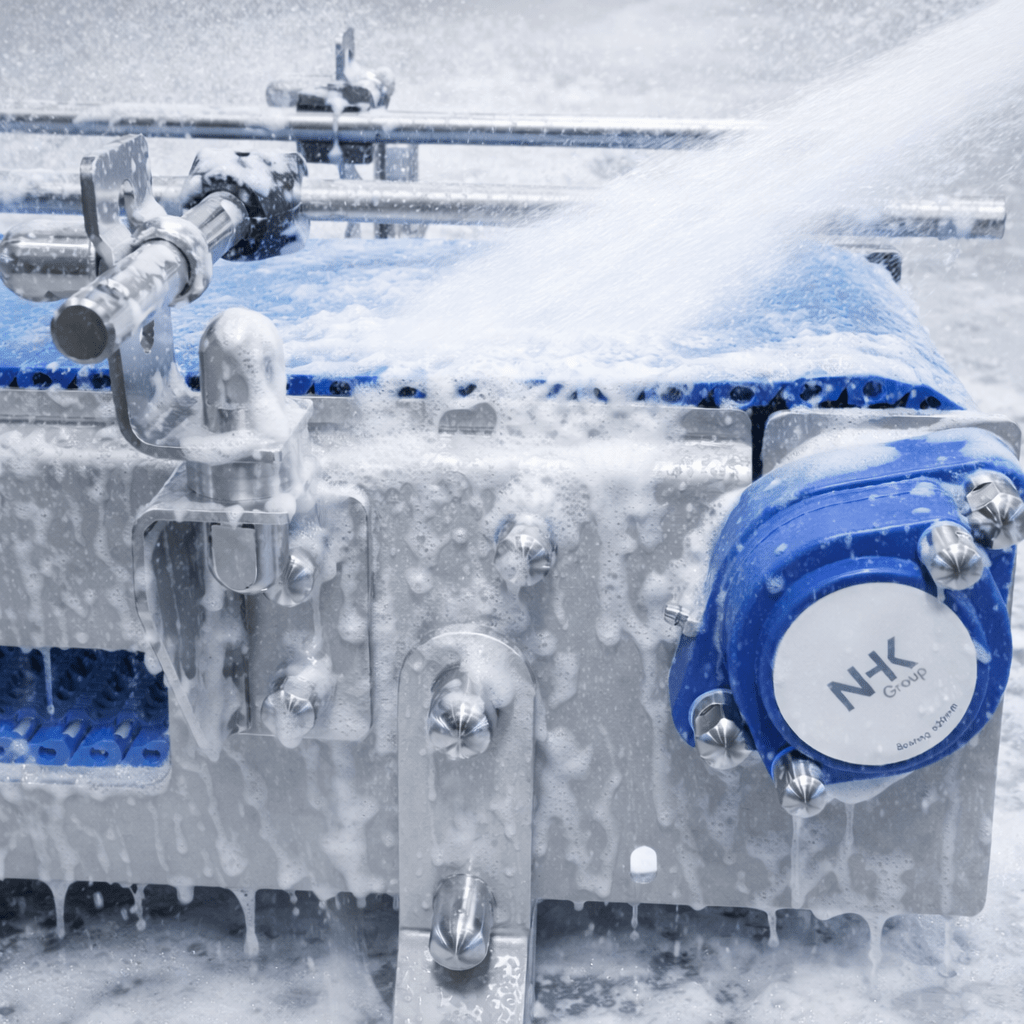
What this means in practice: a component certified for dry cleaning (ED) is not evidence for a line washed daily with foam and high pressure. A design certified for cleaning after dismantling (Class II) only performs as certified if your crew actually dismantles it.
Ask NHK's technicians which certified component fits your cleaning method
EHEDG certified, compliant or "designed to guidelines"
| Wording on a datasheet | What it proves | What to ask for |
|---|---|---|
| "EHEDG certified" + certificate number | That model was evaluated and certified in the stated class | The certificate; check it in EHEDG's public list |
| "EHEDG compliant" / "meets EHEDG" | A supplier's own claim | Design evidence, drawings, Ra values; no certificate exists |
| "Designed to EHEDG guidelines" | Intent; no third-party check | Same as above, plus the reasons for any deviation |
| "EHEDG member" | The company pays membership | Nothing about any product |
Our guide to finding equipment and checking the offered certificate scope turns the register listing into a component-by-component purchasing check. The difference between EHEDG and 3-A – 3-A Symbol authorisation follows a Third Party Verification against a 3-A Sanitary Standard – is covered in EHEDG and 3-A SSI certified components and parts.
How to verify an EHEDG certificate
- Ask for the certificate itself, not a logo on a brochure.
- Check that the manufacturer name and the exact model or article number on the certificate match the part you are buying. Variants – a different thread, base, seal material or housing – may not be covered.
- Check the type and class against your cleaning method.
- Check the issue date; certificates run for five years.
- Look the certificate up in the public list of certified equipment on the EHEDG website.
- For private-label parts, ask for the private-label certificate; EHEDG issues these based on the original certificate, with the same expiry date.
- Ask separately for material certificates and the food-contact declaration of compliance to EC 1935/2004 (and EU 10/2011 for plastics).
Where EHEDG certified components matter most
A certified machine part only helps if it sits where cleanability decides food safety. Prioritise:
- Product-contact zone – surfaces the food touches; certified pumps, valves and sensors carry the most weight here.
- Splash zone – surfaces reached by product or cleaning water; certified feet, bolts, bearing units and covers remove harbourage points (threads, gaps and crevices where residues survive cleaning).
- High-care areas after the kill step, where cooked or ready-to-eat product is open.
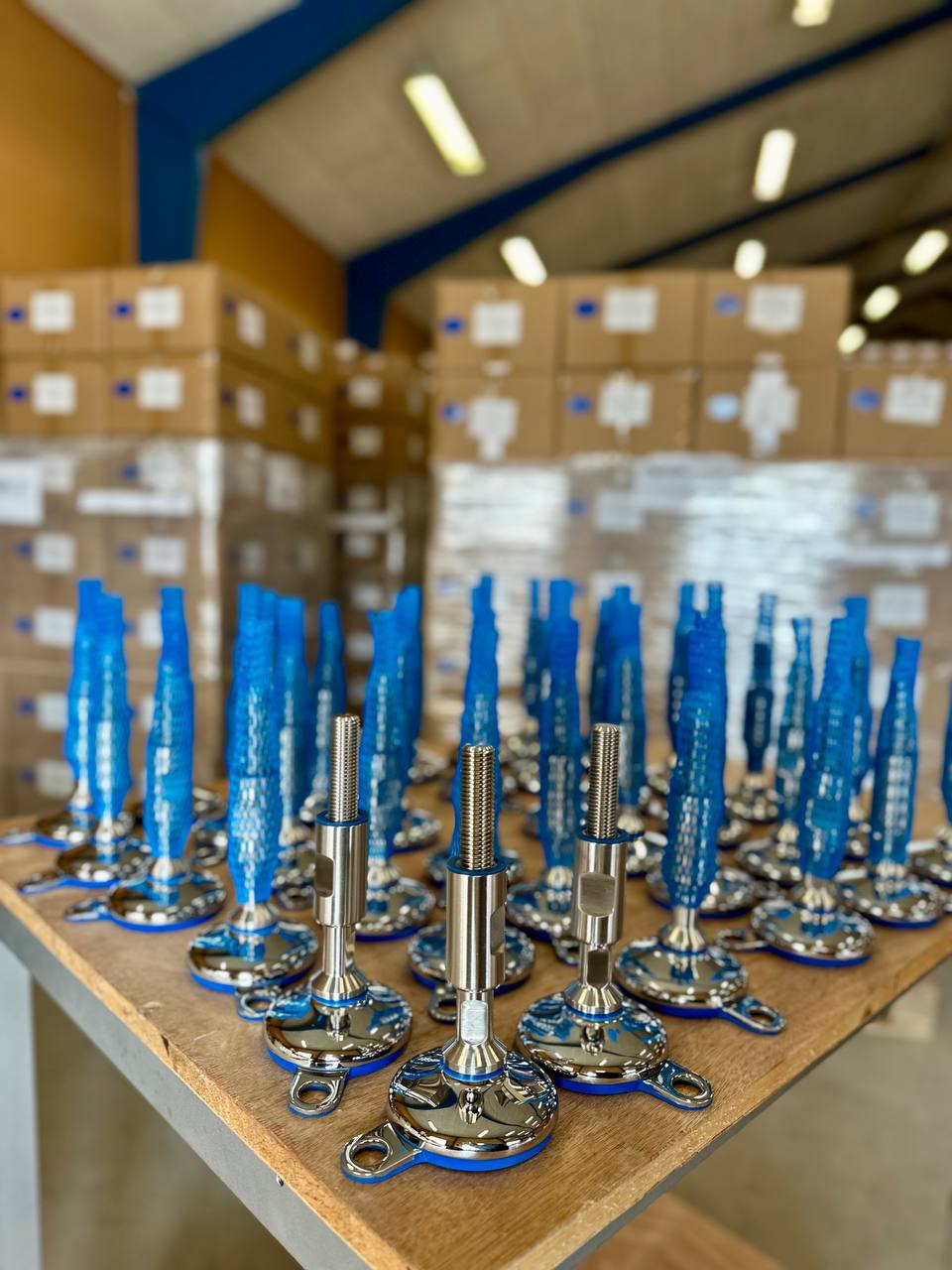
Less benefit comes from certifying parts in dry non-contact zones. For the design rules behind certification, see the core of hygienic design in food processing machinery. For certified small hardware, see safe food production with EHEDG components. Certified levelling feet are a frequent first step because floor-level threads are a classic harbourage point; NHK holds EHEDG certificate C2400039 for the levelling-foot designs listed in that certificate; match the exact supplied model and variant to its scope rather than assuming the SHAF adjustable-foot listing is covered. See NHK's certifications.
Common mistakes with EHEDG claims
- Treating a supplier's membership or a logo as a product certificate.
- Accepting a certificate for a related model with a different seal or thread.
- Ignoring the class: a dismantle-to-clean design cleaned in place.
- Assuming the certificate covers food-contact law – it does not.
- Installing a certified part in a way that creates new crevices: unsealed joints to the frame, wrong torque on seals, mixed metals causing galvanic corrosion.
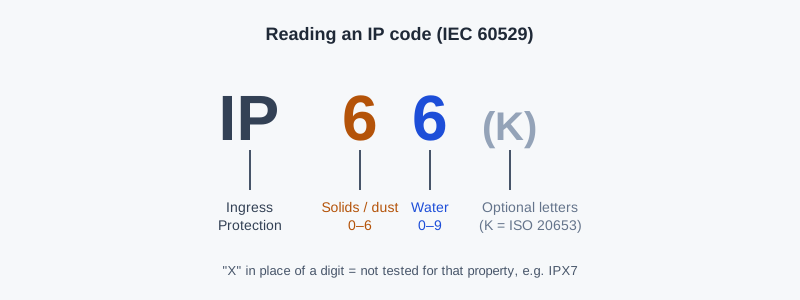
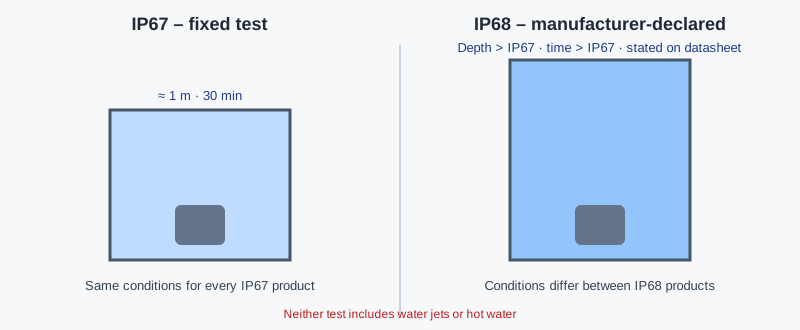
- Treating an IP rating as a hygiene certificate. IP67 is an immersion test, not a washdown or cleanability rating; see IP68 or IP69K in hygienic zones.
What to include in a specification or RFQ
Use the same fields the enquiry form asks for:
- Component and quantity
- Zone (product-contact, splash, non-contact) and cleaning method – CIP, COP, foam or high-pressure washdown
- Required certificate: EHEDG type and class, or 3-A authorisation
- Material grade (AISI 304 or 316L) and seal material
- Documents: certificate copy, material certificate, EC 1935/2004 declaration
- Delivery country
Send these details to NHK
After the enquiry, an NHK technician checks which certified design matches your class and cleaning method and sends a quote. For NHK's own background article, see everything you want to know about EHEDG certification.