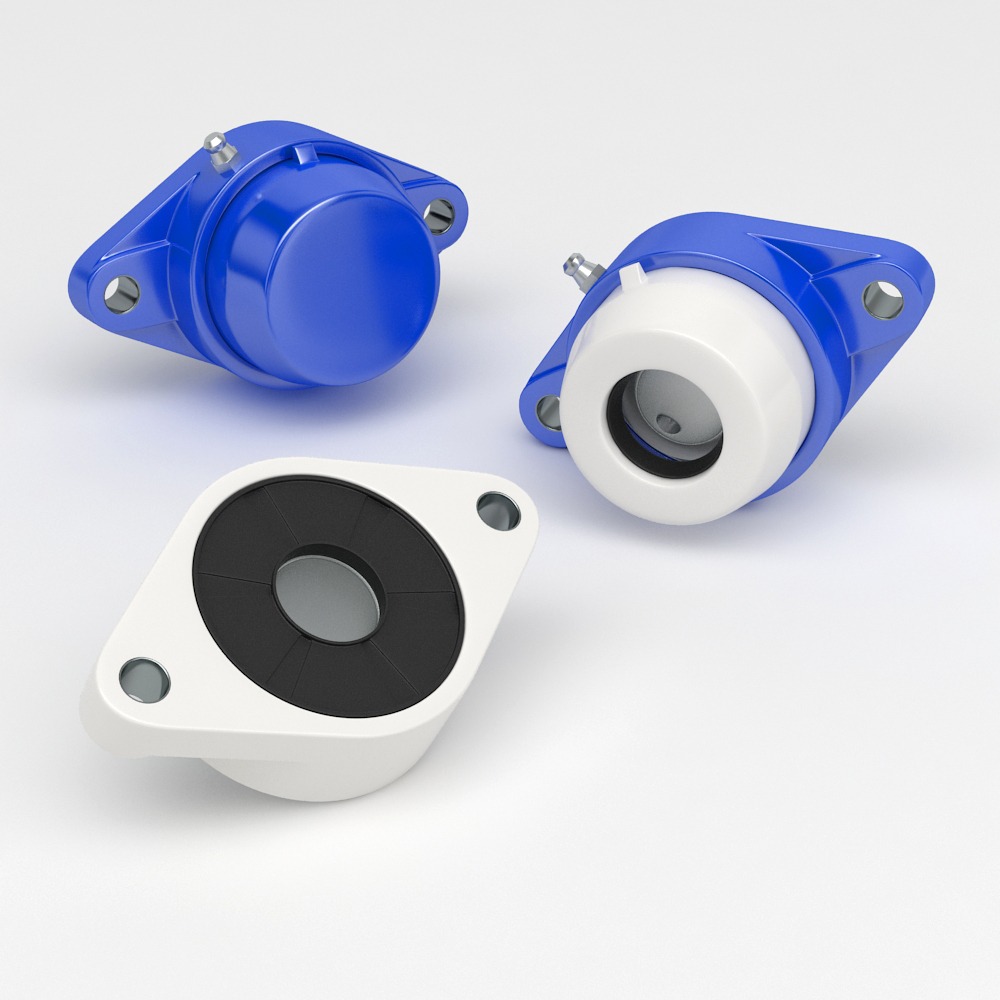
Bearing units are ready-to-mount assemblies of a bearing insert in a housing – also called a bearing block, mounted bearing or housed bearing – that support a rotating shaft and bolt directly to a machine frame. The main types are the pillow block (base bearing), tapped base pillow block, flange units with two, three or four bolts, cartridge flange and take-up units. In food and pharma machines the choice also depends on housing material, sealing and cleaning. This guide is the overview for the bearing-types cluster of the Bearing units hub.
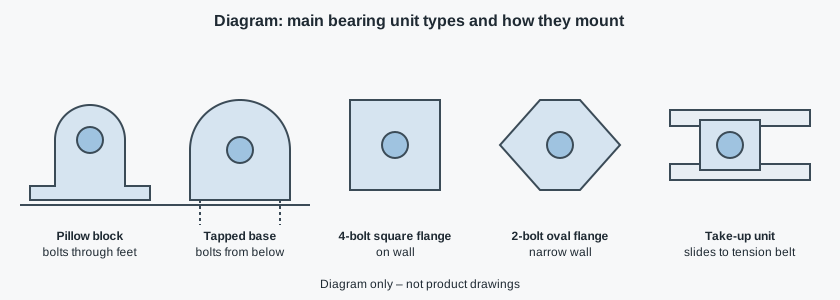 main bearing unit types and how they mount. Schematic, not a product test report.
Types of bearing block compared
| Type | How it mounts | Typical use | Hygiene notes |
|---|---|---|---|
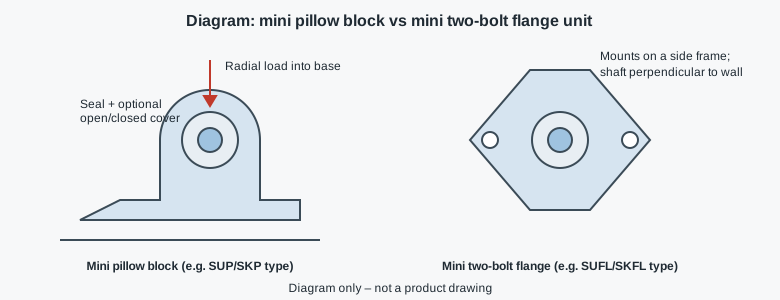
| Pillow block (base bearing) | Two bolts through the feet, onto a surface parallel to the shaft | Conveyor shafts on crossmembers, line shafts | Base sits flat on frame – gap and bolt heads to manage |
| Tapped base pillow block | Bolted from below into threaded holes in the base | Where bolt heads above the housing are not wanted or access is from below | Fewer exposed bolt heads on top; underside still needs sealing or stand-off |
| 4-bolt square flange | Four bolts to a wall perpendicular to the shaft | Higher loads through a side wall | More bolts, more crevices; strong and stable |
| 2-bolt oval (rhombic) flange | Two bolts to a narrow wall | Light to moderate loads, narrow conveyor frames | Fewer bolts; check load direction |
| 3-bolt flange | Three bolts on a triangular or one-sided pattern | Space-limited walls | Pattern-specific replacement |
| Cartridge (spigot) flange | Spigot locates in a bore in the wall | Accurate centring, through-wall mounting | Spigot fit must be sealed in wet zones |
| Take-up unit | Slides in a frame to set belt or chain tension | Conveyor tail shafts | Slides and screws collect residue – a known harbourage point |
A harbourage point is a place where residues and microbes collect and survive cleaning. The housing type sets how many such points you introduce: bolt heads, gaps between housing and frame, set-screw holes and slide rails. For small shafts and light-duty packaging frames, see compact stainless units for light conveyors.
For deeper comparisons see the pillow block bearings guide, the flange bearing guide, stainless steel pillow blocks for washdown and NHK's reference on pillow block vs flange housing differences.
Send your application data and get a bearing unit recommendation
Choosing the type: frame first, then load
- Frame geometry: a surface parallel to the shaft suggests a pillow block; a wall perpendicular to the shaft suggests a flange unit.
- Load direction and size: pillow blocks take radial load best into the base; flange units vary by bolt pattern – four-bolt for higher or changing loads, two-bolt for lighter loads in the direction of the bolt line.
- Adjustment: belt tension on tail shafts needs take-up units or a separate tensioning arrangement.
- Access and cleaning: tapped base units avoid bolt heads on top; flange units on side walls keep bearings out of the product path.
- Replacement: use standard interchange dimensions where possible – see the bearing unit designations decoder for how codes describe insert and housing.
Document the rating-life and static-load selection checks separately from housing format so geometry is not mistaken for assembly capacity.
Housing materials for hygienic areas
| Material | Where it fits | Watch out for |
|---|---|---|
| Cast iron, painted | Dry areas, no wet cleaning | Paint chipping and rust in washdown |
| Stainless steel (often AISI 304-type cast or machined) | Wet and washdown areas, splash zone | Chloride exposure: consider grade; galvanic contact with mild-steel frames |
| Thermoplastic / composite | Light loads in wet areas, low weight | Load and temperature limits; impact |
| Stainless with sealed or hygienic design | Close to product, frequent high-pressure cleaning | Check documents – EHEDG certificate only for specific certified designs |
The splash zone is the area reached by product splash or cleaning water. Most hygienic conveyor bearings sit in it. Material choice is covered in sealed stainless bearing units for hygienic industries and bearing units in composite housing.
Inserts, sealing and covers
- Insert: stainless inserts resist corrosion; set-screw locking is common, eccentric collars or adapter sleeves on some series.
- Seals: contact seals with an elastomer suited to cleaning chemicals and temperature.
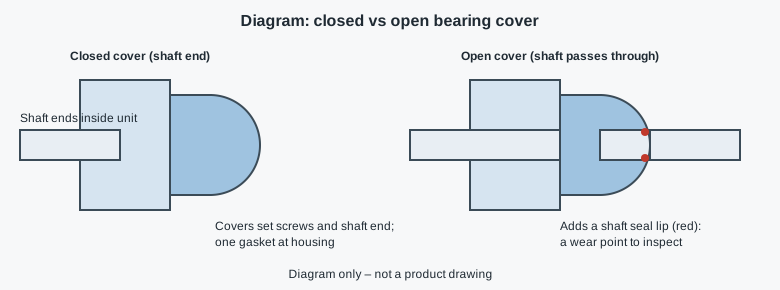
- Covers: closed covers at shaft ends, open covers where shafts pass through; see the bearing cover guide.
- Grease: food-grade (NSF H1 registered) where incidental product contact is possible.
- Ingress: IP ratings such as IP67 or IP69K in hygienic zones describe ingress tests – useful, but not hygiene certifications.
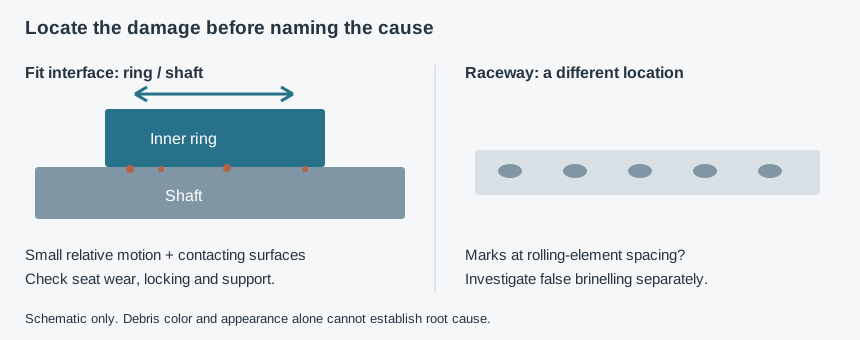
For movement or debris at a fit, check the ring-seat and locking investigation separately from housing material and sealing.
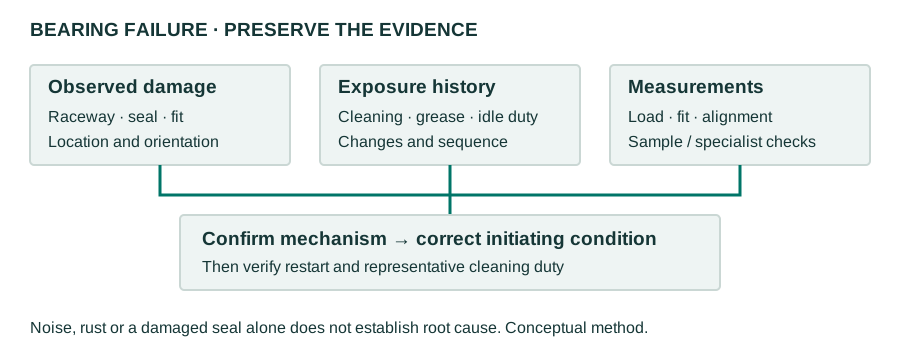
For recurring noise or damage, use the washdown, lubrication and mechanical failure workflow before choosing a replacement housing format.
Example
Assumed situation, for method only: a stainless belt conveyor in a bakery with daily foam cleaning. The drive shaft is supported on crossmembers – pillow blocks; one side passes through to a gearbox, so an open cover is used there. The tail shaft needs belt tensioning – take-up units were the first idea, but their slides collect flour and residues; the designer instead uses fixed flange units on side walls with a separate external tensioner, reducing crevices. Small guide rollers use mini units. All housings are stainless with food-grade grease and covers.
Common mistakes
- Choosing by catalogue load rating alone and ignoring frame layout and cleaning.
- Bolting housings flat on frames in wet zones without sealing or stand-off.
- Two-bolt flanges loaded across the bolt line.
- Take-up units in the product zone without a cleaning plan for the slides.
- Mixing painted cast-iron housings into stainless washdown lines.
What to send for a recommendation
For any claimed hygienic certification, use the documents to verify before buying a housed unit before relying on it in the specification.
- Unit type (pillow block, tapped base, flange 2/3/4-bolt, cartridge, take-up) and shaft diameter
- Load and speed, shaft layout (end or through)
- Zone and cleaning method, chemicals
- Housing material, covers, grease requirement
- Documents, quantities, delivery country
An NHK technician suggests the unit and sends a quote. NHK lists sealed stainless bearing units; confirm the available housing type, insert, material and mounting dimensions for the proposed unit.