Hygienic design is the engineering of food processing machinery so that it does not harbour product residue or microorganisms, and so that it can be cleaned and inspected quickly and reliably. Demand for safer food puts this at the centre of equipment design, because contamination often starts in places nobody looks at: under the machine, around the feet and inside bearing housings. This guide explains the core principles and shows how they apply to two components every machine has – feet and bearings.
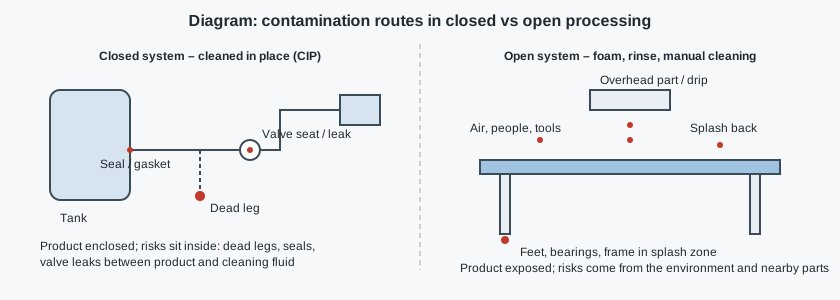
How these principles differ between enclosed and exposed lines is covered in open vs closed processing systems.
What hygienic design means in food processing equipment
Whether a catalogue part can stay or must be replaced depends on its zone; see when standard parts are acceptable in hygienic design.
Hygiene design is not one feature but a set of principles applied to every part of a machine. Its purpose is to remove harbourage points – places where residue and microorganisms survive cleaning – and to make cleaning results repeatable. It supports three goals: food safety, operational efficiency (shorter, more predictable cleaning) and compliance with health and machinery regulations.
Two zones are distinguished:
- Product-contact zone – surfaces that touch food or from which liquid can drip back into it.
- Non-contact and splash zone – the frame, drives, feet and bearings that do not touch product but are hit by spray, splashes and cleaning chemicals.
Both need hygienic equipment design. How these principles are spreading to other industries and markets is covered in hygienic design: a global trend. For a step-by-step programme for machine builders, see how to optimize your machines hygienically. The splash zone is often where residue builds up, because it receives less attention during design.
Core principles of hygienic design
| Principle | What it means | How it shows on feet and bearings |
|---|---|---|
| Suitable materials | Corrosion-resistant, non-toxic, food-safe | Stainless steel; plastics and elastomers with food-contact compliance |
| Smooth surfaces | Low roughness, no porosity | Polished or smooth stainless surfaces; EHEDG guidance of Ra ≤ 0.8 µm for product-contact surfaces |
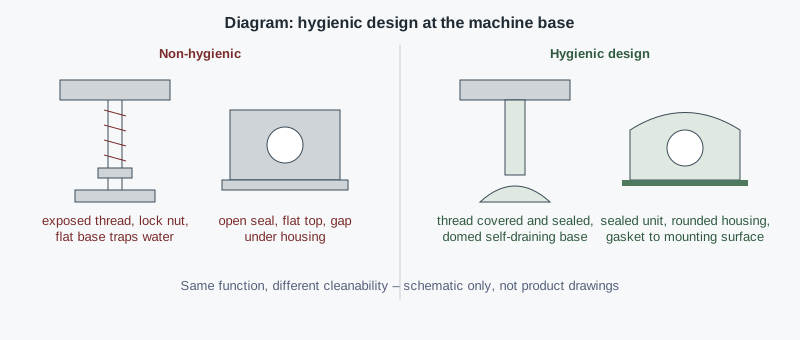
| No crevices or dead spaces | No gaps or pockets where residue collects | Sealed threads; no lock nuts or open housing gaps |
| Self-draining | Water and cleaning agents run off | Domed or sloped foot bases; rounded housing tops |
| Sealed joints | No ingress of water or product | Sealed bearing units; gaskets between housing and frame |
| Accessibility | All surfaces reachable for cleaning and inspection | Clearance under the machine; housings that can be inspected |
Surface roughness Ra is the average deviation of a surface profile from its mean line; lower values are easier to clean. Crevices are narrow gaps that cleaning fluids cannot flush; dead spaces are pockets where liquid stands.
For drawing and acceptance decisions, use the surface-profile, finish and verification checklist alongside inspection of joints and cleaning access.
Feet: hygienic design at floor level
Feet are a fundamental but often overlooked component. Adjustable feet provide stability, leveling and vibration absorption, which supports both efficient operation and hygiene.
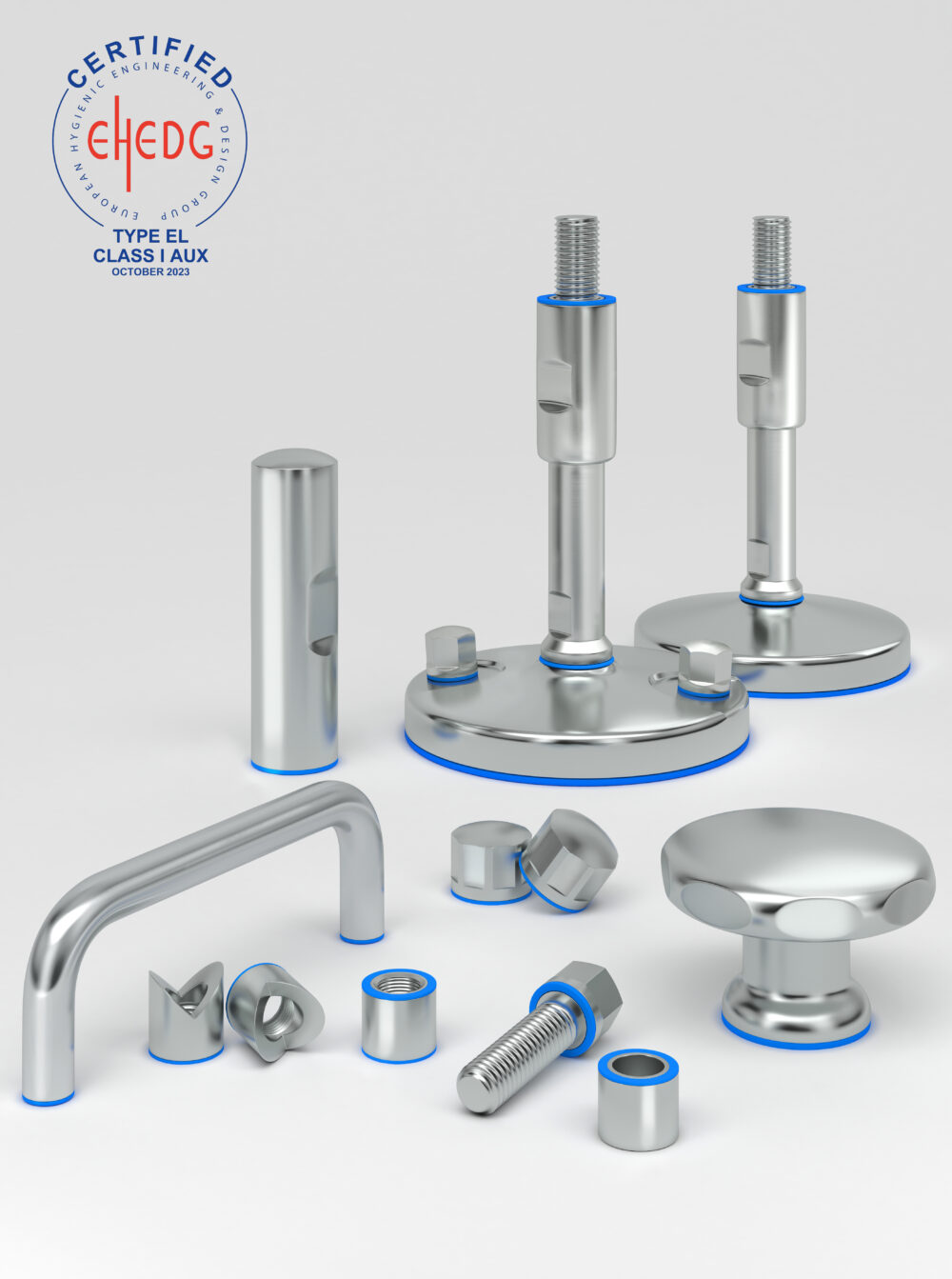
Key features of hygienic feet
- Smooth surfaces – smooth, non-porous surfaces prevent dirt, bacteria and food particles from accumulating.
- Adjustability – adjustable levelling feet keep the machine level on uneven floors, so liquids drain as designed instead of pooling on frames and trays.
- Corrosion resistance – stainless steel or other corrosion-resistant materials withstand aggressive cleaning agents.
- Self-draining design – shapes that prevent water and cleaning agents from standing.
- Sealed thread – the adjustment thread is covered or sealed, because an exposed thread is a crevice that cannot be cleaned reliably.
Where hygienic feet are used
- Conveyors – stability and correct height alignment along the line.
- Mixers and blenders – stability and reduced vibration during high-speed operation.
- Packaging machines – leveling for accurate alignment of forming, filling and sealing.
Steel grade depends on the environment: AISI 304 suits many dry or mildly wet areas, while AISI 316L resists chloride pitting (localised corrosion from chlorides in salt and cleaning agents) better where chlorinated cleaning or salty product is common. Fixing – free-standing or anchored – depends on vibration, seismic or tipping risk and on whether anchoring holes can be sealed. Stainless solid base feet are one option: stainless steel solid base feet.
Bearings: hygienic design in moving parts
Bearings make movement smooth and efficient, but in food processing they face high loads, frequent washing and food particles.
Characteristics of hygienic bearings
- Corrosion-resistant materials – stainless steel components or housings, or materials suitable for food environments, to prevent rust and degradation.
- Sealed design – sealed or enclosed units stop moisture, dust and food particles from entering and lubricant from escaping.
- Maintenance-free options – lubricated-for-life units remove relubrication and the risk of grease purging into the product area. Inspection is still needed.
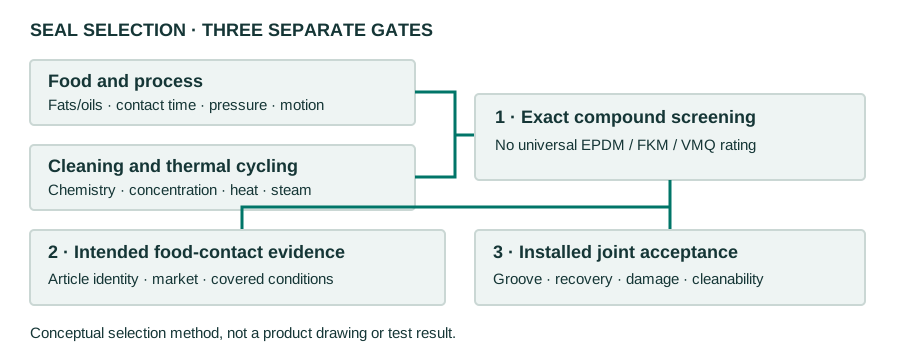
- Resistance to cleaning agents – housing, seals and lubricant must tolerate the caustic and acidic chemicals used. Check elastomer compatibility: EPDM, FKM and VMQ seals react differently to fats, oils, chemicals and heat.
Where hygienic bearings are used
- Conveyor belts – continuous motion with low friction and wear.
- Rotating equipment – mixers, grinders and slicers at high speed.
- Packaging lines – precise motion in filling, sealing and labelling.
The sealed option: sealed stainless bearing units. Housing types are compared in the pillow block bearing guide.
Cooking and heat processing equipment
Hygienic design in cooking equipment – ovens, fryers, kettles, cookers – follows the same principles with added heat. Baked-on residue is harder to remove, so smooth surfaces and access matter more. Seals, lubricants and plastic parts must tolerate operating and cleaning temperatures; check the temperature range of each component, including feet and bearings mounted near heat sources.
Standards and regulatory compliance
In Europe, EN 1672-2 sets hygiene requirements for food processing machinery, and EN ISO 14159 gives hygiene requirements for machinery design. EC 1935/2004 applies to all food-contact materials. In the US, FDA regulations cover food-contact materials, for example 21 CFR 177.2600 for rubber. EHEDG certifies specific equipment designs and 3-A authorises designs after Third Party Verification; both are voluntary.
Components support compliance; they do not deliver it alone. A machine is assessed as a whole, so "designed to EHEDG guidelines" is accurate for a component unless it holds its own certificate. For the full framework, see hygienic machine design standards in 2025.
Benefits of hygienic components
- Food safety – fewer places where bacteria can survive cleaning.
- Compliance – easier audits and documented material compliance.
- Durability – resistance to harsh cleaning, temperature and corrosion reduces replacement.
- Efficiency – correctly levelled machines and reliable bearings reduce misalignment and breakdowns.
High-pressure washdown is common; where it is, check ingress ratings against the actual test – IP69K in ISO 20653 (and the related IP69 in IEC 60529) covers high-pressure, high-temperature spray, while IP67 is a temporary immersion test. An IP rating is not a hygiene certificate.
Design review checklist for feet and bearings
- Identify the zone: product-contact, splash or non-contact.
- Confirm the cleaning method (dry, foam, high-pressure washdown, CIP/COP) and chemicals.
- Select steel grade (304 or 316L) and seal materials compatible with chemicals, product and temperature.
- Check for exposed threads, lock nuts, open gaps and flat horizontal surfaces.
- Confirm self-draining shapes and clearance for cleaning under the machine.
- Choose sealed bearing units and gasketed mounting where washdown occurs.
- Request documents: material certificates, declarations of compliance, any design certificates.
- Verify after cleaning trials with visual inspection, ATP or swabs.
Example
Assumptions (illustrative only): a packaging machine in a splash zone stands on threaded feet with lock nuts, and its drive shaft runs in open-housing bearings. Cleaning is daily foam and rinse with chlorinated agents.
- Feet: residue collects in exposed threads and under flat bases. Replace with sealed-thread levelling feet with self-draining bases in AISI 316L because of the chlorinated cleaning; re-level so frame trays drain.
- Bearings: grease and water mix at the housing gap. Replace with sealed stainless units with a gasket to the frame.
- Verification: compare swab results and cleaning time before and after – measured on site, not assumed.
Future trends
- Smart components – bearings with integrated sensors for condition monitoring.
- Antimicrobial coatings – being developed for components, but they do not replace cleaning and their effectiveness depends on the application.
- Recyclable materials – stainless steel is widely recycled; designs that can be repaired extend life.
For a feature-by-feature checklist to judge whether a component is easy to clean, see easy to clean components and parts.