An IP rating – Ingress Protection code – is a classification defined in IEC 60529 that states how well an electrical or mechanical enclosure resists the entry of solid objects, dust and water, each verified by a defined test. Most explanations online are written for phones and watches. This guide is written for machine builders and food-plant engineers: what each digit actually tests, which waterproof IP rating fits which washdown zone, and the questions an IP code cannot answer.
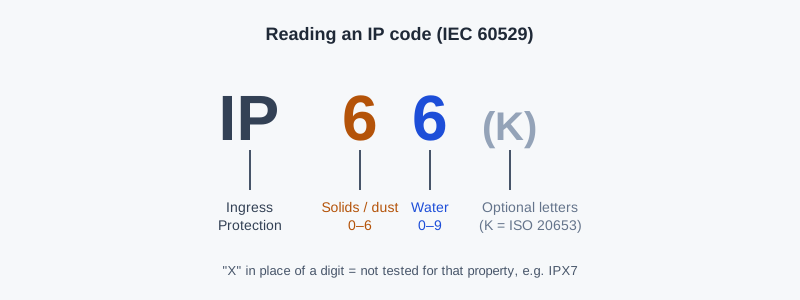 showing how to read an IP code: letters IP, first digit for solids, second digit for water and optional letters. Schematic, not a product test report.
IP ratings belong to the hygienic design and standards hub, because they decide whether bearings, motors, sensors and housings survive cleaning – even though they say nothing about whether a part can be cleaned.
Ingress meaning: what an IP rating describes
"Ingress" simply means entry. An IP rating describes how much entry of solids and water the tested enclosure prevented, under the standard's test conditions. Four points follow from that definition:
- It describes one sample in one configuration, usually new. Cable glands, covers and mounting can change the result.
- It describes ingress only, not corrosion, chemical attack, wear or aging.
- Each digit is tied to a specific test. Two ratings are only comparable if you know which tests they stand for.
- X in place of a digit means "not tested" – IPX7 claims immersion protection but no dust rating.
The IP code table
First digit: solids and dust
| Digit | Protection against | Test idea |
|---|---|---|
| 0 | No protection | – |
| 1 | Objects larger than 50 mm (back of a hand) | Sphere probe |
| 2 | Objects larger than 12.5 mm (fingers) | Sphere and finger probe |
| 3 | Objects larger than 2.5 mm (tools, thick wires) | Probe |
| 4 | Objects larger than 1.0 mm (thin wires, screws) | Probe |
| 5 | Dust-protected – some ingress allowed, not enough to interfere | Dust chamber |
| 6 | Dust-tight – no dust ingress | Dust chamber, with vacuum where applicable |
Second digit: water
| Digit | Protection against | Type of test |
|---|---|---|
| 0 | No protection | – |
| 1 | Vertically dripping water | Drip |
| 2 | Dripping water, enclosure tilted up to 15° | Drip |
| 3 | Spraying water up to 60° from vertical | Spray |
| 4 | Splashing water from any direction | Spray/splash |
| 5 | Water jets (nozzle about 6.3 mm) | Jet |
| 6 | Powerful water jets (nozzle about 12.5 mm) | Jet |
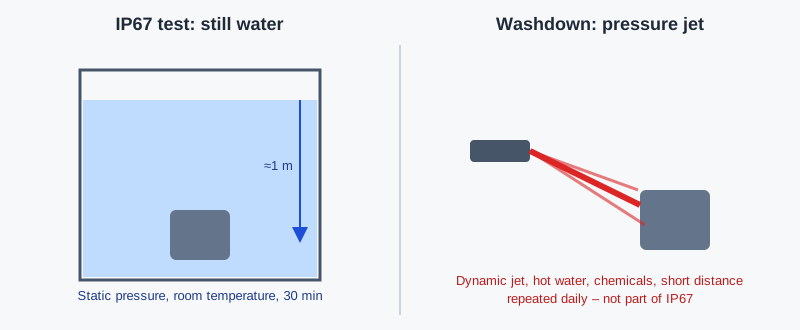
| 7 | Temporary immersion, about 1 m for 30 minutes | Immersion |
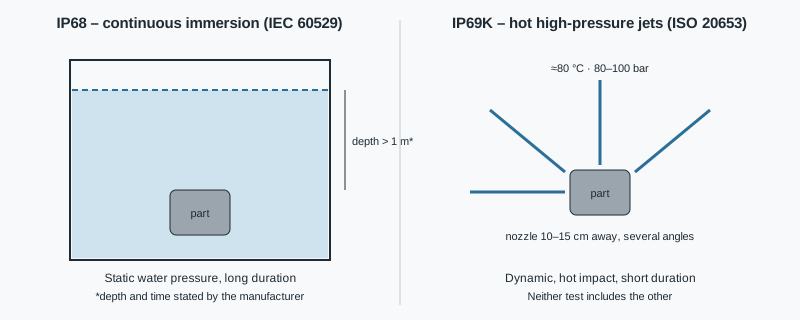
| 8 | Continuous immersion, manufacturer-declared, more severe than 7 | Immersion |
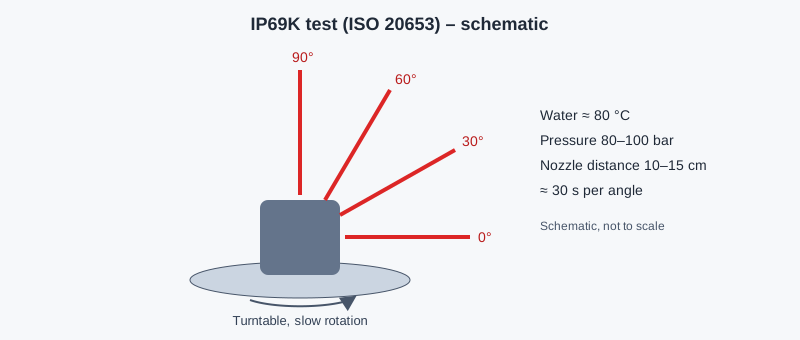
| 9 | High-pressure, high-temperature jets (IEC 60529 IPX9; IP69K in ISO 20653) | Hot high-pressure jet |
The water scale is not a single ladder. Digits 1–6 and 9 are spray and jet tests; 7 and 8 are immersion tests. A product rated IP67 has not necessarily passed the IP66 jet test. When both were tested, both codes appear: IP66/IP67, IP68/IP69K.
Ask NHK's technicians which IP rating your application needs
Optional letters and the K in IP69K
IEC 60529 allows additional letters after the digits. A–D describe protection of persons against access to hazardous parts; H, M, S and W are supplementary letters (for example, M and S for whether moving parts were in motion or stationary during the water test). On food-machinery datasheets these are rarely used – which is one reason to ask whether a shaft seal was tested rotating.
The K in IP69K is different: it comes from ISO 20653, a road-vehicle standard. Its jet test – water at about 80 °C, 80–100 bar, from 10–15 cm, at several angles – resembles high-pressure washdown, so the food industry adopted it. IEC 60529 later added its own IPX9 with very similar conditions.
The ratings that matter for machinery – and where they are explained
| Rating | What it means in practice | Typical machinery use | Detailed guide |
|---|---|---|---|
| IP54 | Dust-protected, splashing water | Dry areas, light splash, thermoplastic bearing housings in non-wet zones | – |
| IP65 / IP66 | Dust-tight, water jets / powerful jets | Splash zones with low- to medium-pressure rinse | – |
| IP67 | Dust-tight, temporary immersion | Parts that may be submerged briefly | IP67 rating explained |
| IP68 | Dust-tight, continuous immersion (declared conditions) | Pits, tanks, flumes, flooded areas | IP68 rating explained |
| IP69K / IP69 | Dust-tight, hot high-pressure jets | Daily hot high-pressure washdown near the part | IP69K rating explained |
| IP67 vs IP68 | Choosing between the two immersion ratings | Submersion depth and duration | IP67 vs IP68 compared |
| IP67 vs IP69K | Immersion vs hot jets – which component needs which | Washdown components that may also be flooded | IP67 vs IP69K compared |
| IP68 vs IP69K | Immersion vs hot jets | Parts that are flooded and lanced | IP68 vs IP69K in hygienic zones |
Which one do I need? Choosing a waterproof IP rating per zone
Food plants use zone terms that map onto cleaning loads. The product-contact zone is surfaces that touch product or drain onto it; the splash zone is surfaces reached by product splash or cleaning spray; the non-contact zone is everything else.
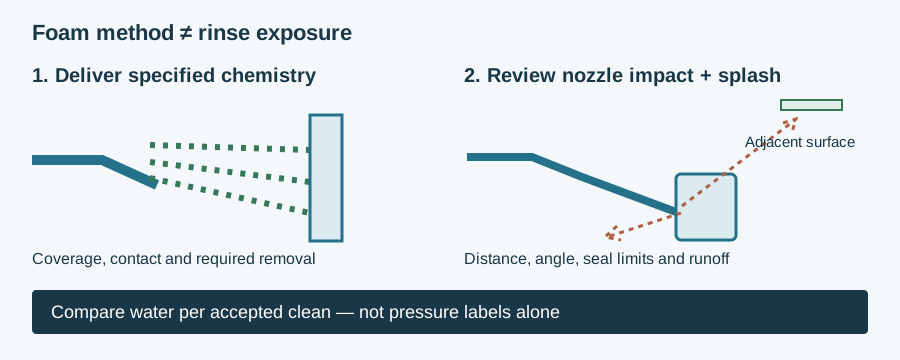
- List the cleaning method per zone – dry cleaning, foam and low-pressure rinse, high-pressure lance, CIP (cleaning in place, for closed systems) or COP (cleaning out of place, parts removed and washed).
- Note pressure, water temperature and nozzle distance for wet cleaning.
- Check for submersion or flooding, with depth and duration.
- Pick the jet digit and, if needed, the immersion digit from the table below.
- Then check what the IP code cannot tell you – seal material, tested configuration, hygienic design, documents.
| Zone and cleaning | Typical IP rating to look for | Also check |
|---|---|---|
| Non-contact zone, dry area, wipe-down | IP54 often adequate | Dust, oil mist |
| Splash zone, foam and low-pressure rinse | IP65 / IP66 | Drainage, seal material |
| Splash zone, daily hot high-pressure lance | IP69K (or IP69) | Seal design, chemical resistance, tested rotating |
| Flooded pits, flumes, tanks | IP67 or IP68 with declared depth/time | Add IP69K if also lanced |
| Product-contact zone | IP rating is secondary | Hygienic design, Ra, food-contact materials, certificate |
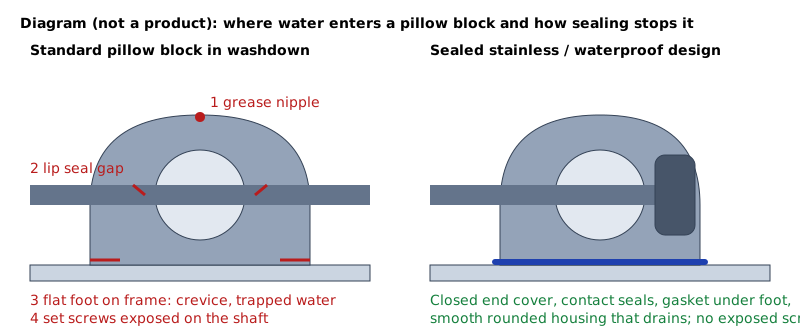
For bearings, waterproof bearing house units explains when a sealed housing is needed and how it is cleaned.
Example (assumptions, for method only): a ready-meal plant has three zones on one conveyor. Above the belt, a sensor sits in the splash zone cleaned daily with foam and a hot lance at close range; below the frame, a drive sits in a drained tray that floods during cleaning; in the control cabinet area, components are cleaned dry. The specification asks for IP69K on the sensor, IP68 with stated depth and duration plus IP69K on the drive, and IP54 in the dry area. Seal materials are checked against the alkaline foam and sanitizer. The ratings follow the plant's own cleaning parameters; no product performance is implied.
What an IP rating does not tell you
| Question | Answered by the IP code? | Where to look |
|---|---|---|
| Will seals resist my detergents and sanitizers? | No | Elastomer compatibility – EPDM, FKM or VMQ (silicone) against your chemicals |
| Will it last years of daily cleaning? | No | Seal design, field experience, maintenance interval |
| Can it be cleaned? | No | Hygienic design: no crevices (narrow gaps liquid enters but cleaning cannot reach), self-draining surfaces, smooth finish |
| Is it suitable for food contact? | No | Declaration of compliance with EC 1935/2004 |
| Is it hygienically certified? | No | EHEDG certificate or 3-A authorization for the specific design |
| Does it hold while hot parts are rinsed cold? | No | Seal design that tolerates internal pressure changes |
That last row is a common field failure: a warm bearing housing or motor is rinsed with cold water, the air inside contracts, and the pressure difference draws water past a seal that passed its IP test when new. For how hygiene certification differs from ingress ratings, see the EHEDG guide; for parts designed so cleaning is fast and thorough, see easy-to-clean components and parts.
Common mistakes with IP ratings
- Reading the water digit as a ladder. IP67 is not "better than IP66"; they test different things.
- Specifying only "IP68". Without depth and duration, it accepts almost any immersion test above IP67.
- Ignoring the installed configuration. An IP69K housing with an unrated cable gland is not an IP69K assembly.
- Cleaning harder than the test. Holding a lance closer or longer than the IP69K test conditions exceeds what was tested.
- Using an IP rating as a hygiene argument. Auditors and EHEDG assess cleanability; the IP code does not include harborage points (places where residues survive cleaning).
What to ask a supplier about IP ratings
For any claimed hygienic certification, use the checking hygienic-design evidence separately from the IP code before relying on it in the specification.
- Which IP code(s), to which standard (IEC 60529, ISO 20653), and on which configuration?
- For IP68: which depth, duration and water temperature?
- Was the shaft or moving part stationary or rotating during the water test?
- Which seal material, and is it compatible with your cleaning chemicals and temperatures?
- Is there an EHEDG certificate or 3-A authorization for the specific design, if required?
- For food-contact parts: a declaration of compliance with EC 1935/2004.
An NHK technician answers your question and, if needed, suggests a component and sends a quote. NHK holds EHEDG certificate C2400043 for a bearing design and lists 11 representative-office locations. To browse, see NHK's sealed stainless bearing units and bearing units in IP54 thermoplastic housing, or NHK's article on IP67 vs IP69K applications. See NHK's certifications.