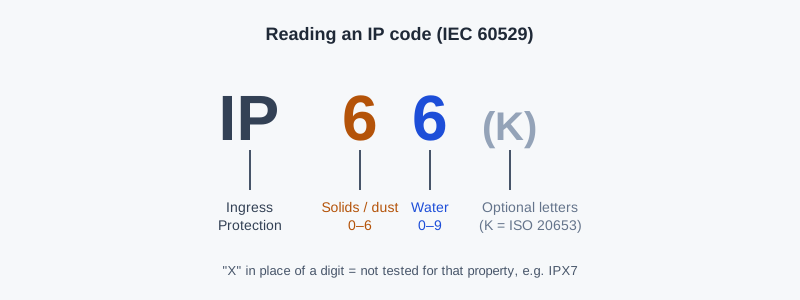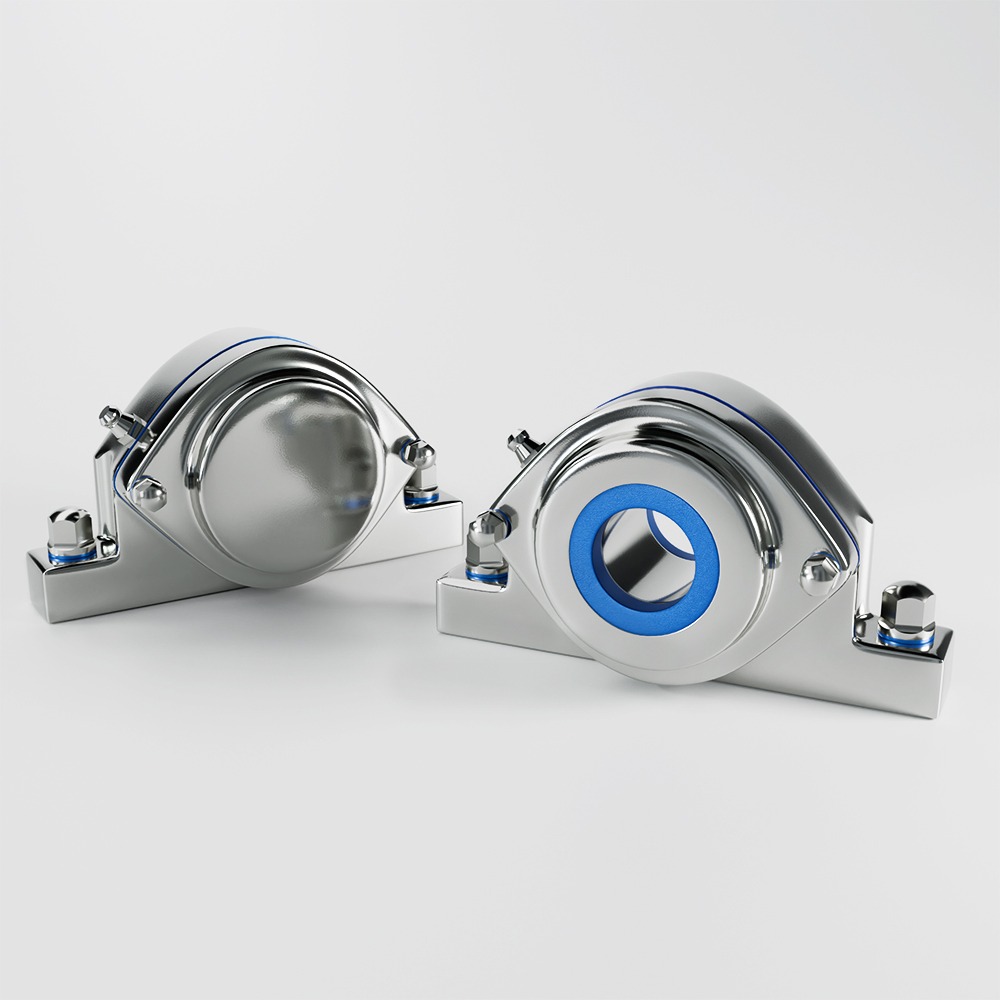
IP68 is an ingress protection rating defined in IEC 60529 that classifies an enclosure as dust-tight (first digit 6) and protected against continuous immersion in water (second digit 8) under conditions the manufacturer declares. On industrial equipment – sensors, motors, junction boxes, bearing housings – IP68 is often read as "the highest waterproof rating". For a food plant, that reading is misleading: IP68 answers whether a part survives being submerged, not whether it survives being pressure-washed every day.
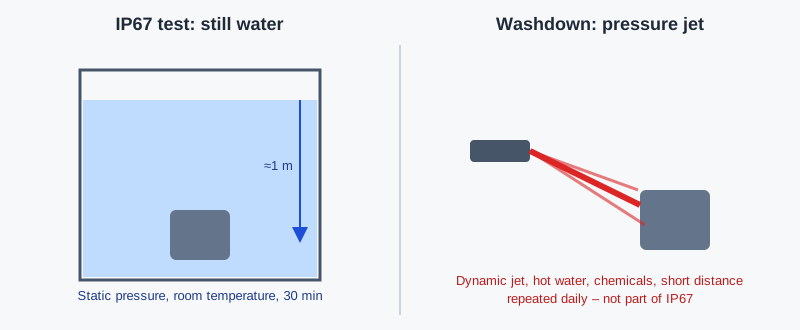
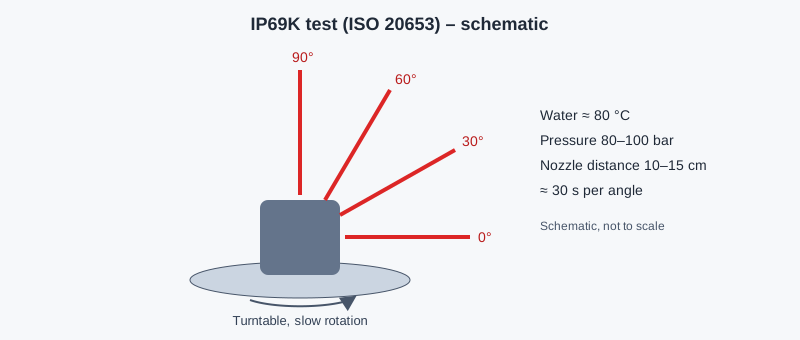
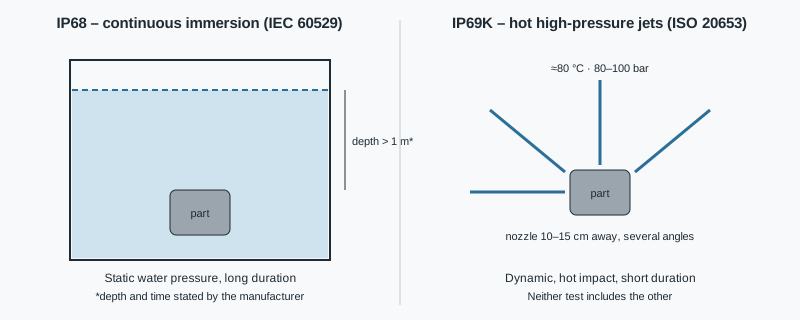 the IP68 still-water immersion test with hot high-pressure IP69K jets. Schematic, not a product test report.
This page is part of the IP rating guide in the hygienic design and standards hub.
What IP68 means: the code and the test
| Element | Meaning | IP68 |
|---|---|---|
| IP | Ingress Protection, IEC 60529 | – |
| First digit | Solids and dust | 6 = dust-tight |
| Second digit | Water | 8 = continuous immersion |
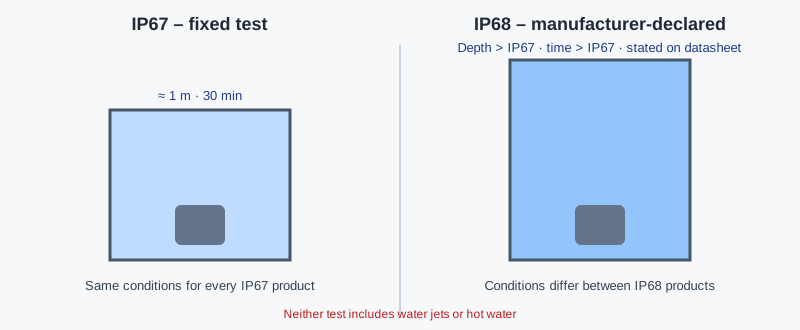
| Test depth and duration | – | Declared by the manufacturer |
| Requirement | – | More severe than IP67 (about 1 m for 30 minutes) |
| Pass criterion | – | No harmful water ingress, as defined for the product |
The key sentence is "declared by the manufacturer". IEC 60529 does not fix one IP68 test. A sensor tested at 1.5 m for one hour and a pump housing tested at 10 m for days can both be labeled IP68. The rating is only meaningful together with its stated conditions.
Ask NHK's technicians which rating your application needs
IP68 vs IP67 vs IP69K
For a decision guide between the two immersion ratings, see IP67 vs IP68 compared.
| Rating | Standard | Water load | Typical use on food machinery |
|---|---|---|---|
| IP67 | IEC 60529 | Temporary immersion, about 1 m, 30 min | Parts that may be submerged briefly |
| IP68 | IEC 60529 | Continuous immersion, manufacturer-stated depth and time | Parts in pits, tanks, flumes or flooded areas |
| IP69K | ISO 20653 | Hot (about 80 °C), high-pressure (80–100 bar), close-range jets | Parts near hot high-pressure cleaning |
The immersion digits (7, 8) and the jet digits (5, 6, 9) are separate tests. IP68 does not include IP66 or IP69K. A part tested for both carries both codes, for example IP66/IP68 or IP68/IP69K. For the detail of each, see the IP67 rating explained, the IP69K rating explained and the direct comparison of IP68 and IP69K in hygienic zones.
Why IP68 is not a washdown rating
Washdown in food plants loads a seal in ways an immersion test does not:
- Jet impact. A lance concentrates pressure on one spot of a seal; still water presses evenly and gently.
- Temperature. Hot rinse water softens elastomers and heats trapped air; when the part cools, the air contracts and draws water in past the seal ("breathing").
- Chemicals. Alkaline foam, acids and chlorinated sanitizers attack seal materials over time. Elastomer compatibility – whether EPDM, FKM or VMQ (silicone) seals resist the chemicals – is not part of any IP test.
- Repetition. IP68 is tested once on a new sample; cleaning happens daily for years.
- Motion. Many IP tests are static. Rotating shaft seals behave differently.
None of this makes IP68 useless – it means the rating answers a narrower question than "is it waterproof?"
Where IP68 makes sense on industrial equipment
| Situation | IP68 useful? | Also check |
|---|---|---|
| Sensors or drives in flumes, tanks or water baths | Yes | Depth and duration stated ≥ actual |
| Equipment in pits or drained trays that flood during cleaning | Yes | Whether jets also reach it (add IP69K) |
| Conveyor bearings above floor, daily high-pressure washdown | Not the right test | IP69K, seal design, hygienic housing |
| Splash zone with low-pressure rinse | Not needed | IP65/IP66 often adequate |
| Dry areas | No | Dust protection |
The splash zone – surfaces reached by spray or product splash – is where most food-machinery components sit; there, jet resistance and cleanability matter more than immersion. For bearings, see waterproof bearing house units, which explains when a sealed housing is needed.
Example (assumptions, for method only): a vegetable washing line has a level sensor and a drive in a flume that runs full during production, and the area is pressure-washed after each shift. The sensor sits under water continuously, so the specification asks for IP68 with a stated depth and duration at least equal to the flume depth and production run, plus a jet rating (IP69K) because it is also cleaned with a lance. Seal material is checked against the sanitizer in use. No performance is claimed – the requirement follows the plant's own depth, time and cleaning parameters.
Common mistakes with IP68
- Not reading the stated conditions. "IP68" without depth and duration is incomplete.
- Assuming IP68 covers jets. It does not; dual marking is needed.
- Testing assumptions on the wrong configuration. Cable glands, connectors, covers and shaft seals must be part of the tested assembly.
- Ignoring water temperature. Immersion tests use water near room temperature; hot process water is a different load.
- Using IP68 as a hygiene argument. Crevices (narrow gaps liquid enters but cleaning cannot reach) and harborage points (places where residues survive cleaning) are not assessed by any IP test.
What to ask a supplier
For any claimed hygienic certification, use the matching hygiene documents to the immersed component before relying on it in the specification.
- Which IP code(s), and what depth, duration and water temperature were used for the IP68 test?
- Was the test performed on the configuration you will install, including glands, covers and seals?
- Was the moving part stationary or rotating?
- Is there also a jet rating (IP66 or IP69K) for washdown?
- Which seal material, and is it compatible with your cleaning chemicals?
- Is there an EHEDG certificate or 3-A authorization for the specific design, where required, and a declaration of compliance with EC 1935/2004 for food-contact parts?
An NHK technician answers your question and, if needed, suggests a component and sends a quote. NHK holds EHEDG certificate C2400043 for a bearing design. To browse, see NHK's IP67 bearing house units, or read NHK's article on how IP67 and IP69K differ in practice. See NHK's certifications.