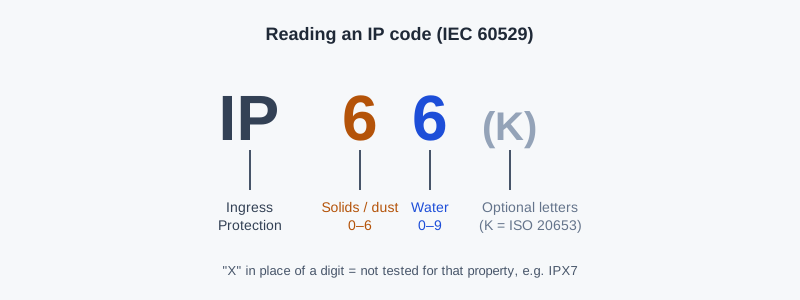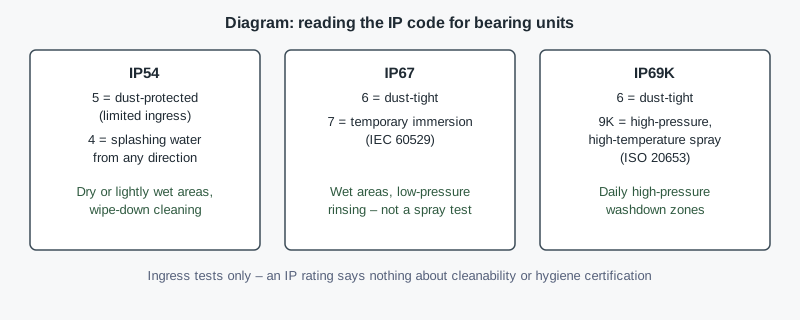
IP67 is an ingress protection (IP) code defined in IEC 60529 that classifies how well an enclosure keeps out solid particles and water: the first digit, 6, means dust-tight; the second digit, 7, means protected against the effects of temporary immersion. On machine components – bearing units, motors, sensors, junction boxes – IP67 is often read as "waterproof, so fine for washdown". That reading is where most problems start. This page explains what the IP67 standard requires, what the test proves, and what it does not prove for food-plant cleaning.
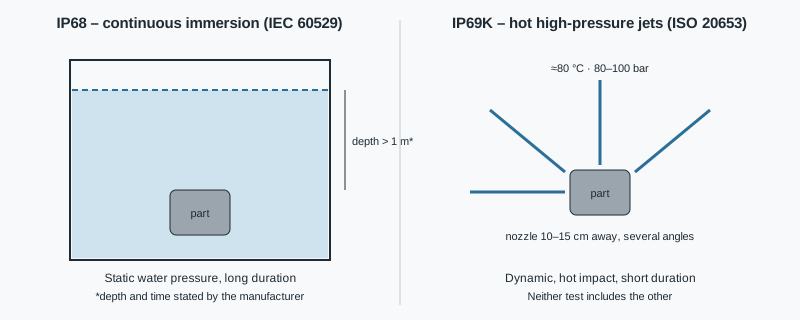
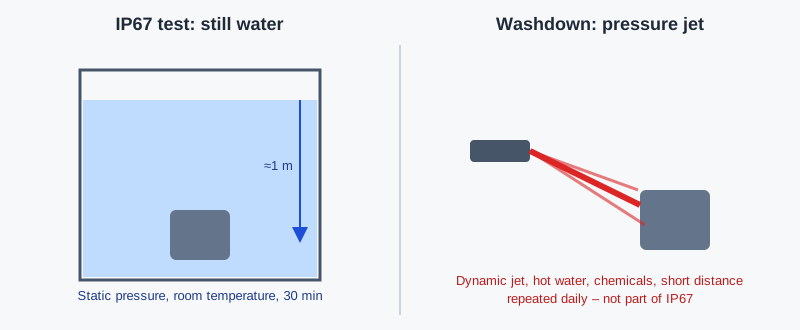 the still-water IP67 immersion test with a high-pressure washdown jet. Schematic, not a product test report.
This page is part of the IP rating guide in the hygienic design and standards hub.
IP67 meaning: how to read the code
| Part | Meaning | IP67 value |
|---|---|---|
| IP | Ingress Protection, IEC 60529 | – |
| First digit (0–6) | Protection against solid objects and dust | 6 = dust-tight |
| Second digit (0–8) | Protection against water | 7 = temporary immersion |
| Letter X | Not tested for that digit | e.g. IPX7 = water only |
The two digits are independent tests. IP67 does not include the lower water digits automatically in the way many readers assume: digits 1–6 describe dripping, spraying and jets; 7 and 8 describe immersion. A product tested for both jets and immersion carries both codes, such as IP66/IP67.
Ask NHK's technicians which rating your application needs
IP67 requirements: what the test involves
IEC 60529 sets the general test; the product standard or the manufacturer can specify details. In outline:
- Dust test (6). The sample is exposed to fine dust in a test chamber; for enclosures where pressure differences can draw dust in, a vacuum is applied. Dust-tight means no dust ingress.
- Immersion test (7). The sample is immersed so that its lowest point is about 1 m below the surface (and its highest point at least 0.15 m below for taller enclosures) for 30 minutes.
- Assessment. The sample passes if water has not entered in a harmful quantity, as defined for that product.
Note what the test conditions are: still fresh water, near room temperature, a new sample, once.
What IP67 does not prove
| Condition in a food plant | Covered by IP67? | Why it matters |
|---|---|---|
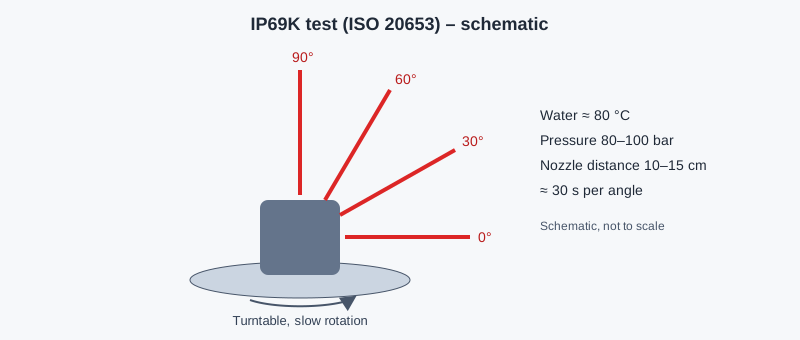
| High-pressure water jets | No | Jets load seals dynamically; covered by IPX5/IPX6 and IP69K (ISO 20653) |
| Hot water and steam | No | Temperature changes seal hardness and creates pressure differences |
| Thermal cycling (warm part, cold rinse) | No | Air inside contracts and draws water past seals – "breathing" |
| Detergents and sanitizers | No | Elastomer compatibility (whether EPDM, FKM or VMQ seals resist the chemicals) is a separate question |
| Repeated daily cleaning over years | No | Seals wear and age; IP67 is tested once on a new part |
| Rotating shafts | Only if tested rotating | Many tests are static; shaft seals behave differently in motion |
| Cleanability, hygiene | No | IP is not a hygiene rating; crevices and harborage points (places where residues survive cleaning) are not assessed |
For a component-by-component choice, see IP67 vs IP69K. For high-pressure cleaning, compare IP68 and IP69K in hygienic zones. For the difference between ingress ratings and hygiene certification, see EHEDG.
IP67 for bearing units and other components
The question an engineer should ask is not "is it IP67?" but "what does the part see during cleaning?":
| Zone and cleaning | Typical rating to look for | Also check |
|---|---|---|
| Dry area, occasional wipe-down | IP54–IP65 often adequate | Dust, oil |
| Splash zone (reached by spray), low-pressure rinse | IP65/IP66 | Drainage, seal material |
| Occasional submersion, flooding, soaking | IP67 or IP68 | Duration and depth stated |
| Daily high-pressure, hot-water washdown | IP69K or tested to your conditions | Seal design, chemical resistance, hygienic design |
| Product-contact zone (touches product or drains onto it) | Rating is secondary | Hygienic design, Ra, food-contact materials, certificate |
For bearings specifically, see waterproof bearing house units, which explains when a sealed housing is needed and how it is cleaned.
Example (assumptions, for method only): a conveyor bearing unit marked IP67 sits at knee height on a meat line. The line is cleaned daily with foam and then rinsed with hot water from a hand lance at close range. After some months the bearing runs rough and grease shows signs of water. The IP67 rating was correct for immersion but did not address the pressure jet, hot rinse and thermal cycling. Options: a unit rated or tested for pressure cleaning, a cleaning instruction with defined nozzle distance and angle, and seal materials matched to the chemicals. No result is claimed here – the right option depends on the plant's own cleaning parameters.
Common mistakes with IP67
- Reading IP67 as "better than IP66". (For immersion versus continuous immersion, see IP67 vs IP68.) They test different things; neither includes the other.
- Assuming the rating applies to the installed assembly. Cable glands, covers, mounting holes and shaft seals all change the result. A rating applies to the tested configuration.
- Ignoring aging. A seal that passed when new can leak after months of chemicals and heat.
- Using IP67 as a hygiene argument. Auditors and EHEDG assess cleanability, not ingress.
- Not reading the test conditions. For IP67 they are standardized; for IP68 they are manufacturer-defined and vary.
What to ask a supplier
For any claimed hygienic certification, use the checking hygiene certificates separately from immersion evidence before relying on it in the specification.
- Which IP code(s), to which standard (IEC 60529, ISO 20653), and was the test done on the configuration you will install?
- Were jets (IPX5/IPX6 or IP69K) tested as well as immersion?
- Was the shaft or moving part stationary or in motion during the test?
- Which seal material is used, and is it compatible with your cleaning chemicals and temperatures?
- Is there a hygienic design certificate (EHEDG, 3-A) for the specific design, if one is required?
- For food-contact parts: a declaration of compliance with EC 1935/2004.
An NHK technician answers your question and, if needed, suggests a component and sends a quote. NHK holds EHEDG certificate C2400043 for a bearing design. To browse, see NHK's IP67 bearing house units, or read NHK's article on IP67 vs IP69K differences and applications. See NHK's certifications.