IP69K is an ingress protection rating defined in ISO 20653 showing that the tested sample is dust-tight and resists close-range water jets at high pressure and high temperature. It was written for road vehicles – parts cleaned with steam jets – and the food industry adopted it because the test resembles high-pressure washdown. On food machinery, IP69K is the rating people look for on bearing units, motors, sensors and enclosures near hot cleaning lances. This page explains the IP69K meaning, the test conditions, IP69 vs IP69K, and when a component really needs it.
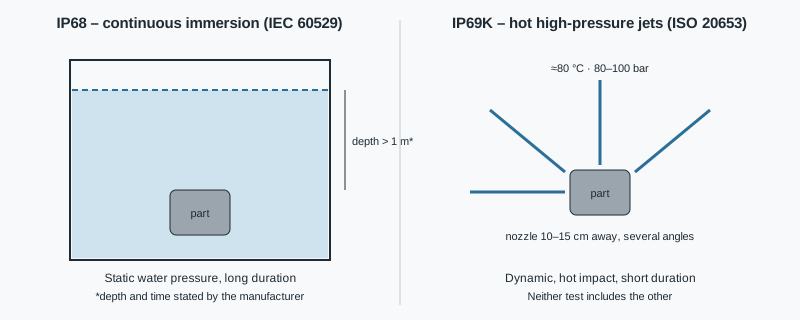
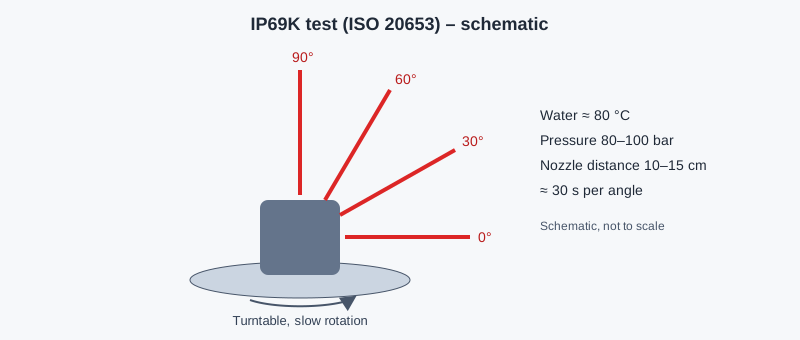 Schematic of the IP69K test with hot high-pressure spray from four angles onto a rotating sample. Schematic, not a product test report.
This page is part of the IP rating guide in the hygienic design and standards hub.
IP69K meaning and test conditions
| Parameter | IP69K (ISO 20653), typical values |
|---|---|
| First digit 6 | Dust-tight |
| Water temperature | About 80 °C |
| Pressure | 80–100 bar |
| Nozzle distance | 10–15 cm |
| Flow rate | About 14–16 liters per minute |
| Angles | 0°, 30°, 60° and 90° |
| Duration | About 30 seconds per angle, sample on a slowly rotating turntable (small parts) |
| Pass criterion | No harmful water ingress, as defined for the product |
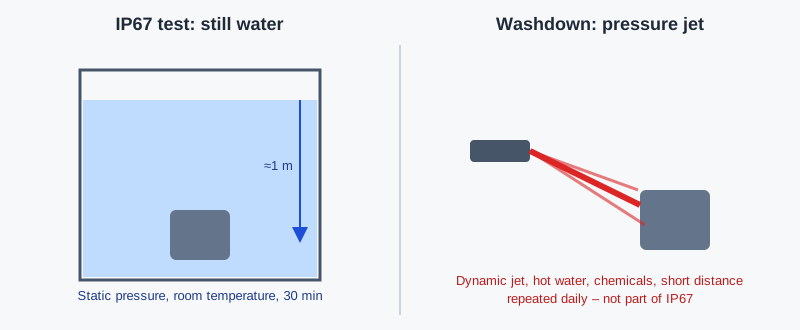
The test is short and intense: a few minutes of jet exposure on a new sample. Its value is that it loads seals the way a hand lance does – hot water, high impact, close range, changing angles – which immersion tests do not.
Ask NHK's technicians whether your application needs IP69K
IP69 vs IP69K
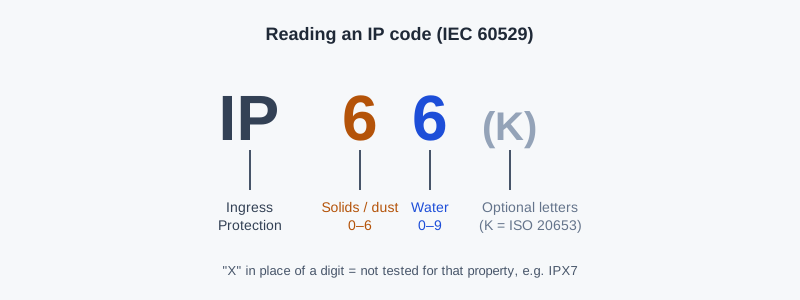
IEC 60529, the general enclosure standard, later added its own second digit 9 with hot high-pressure jet conditions very close to ISO 20653. That is why datasheets show "IP69", "IPX9" or "IP69K". For a buyer, the practical rules are:
- Check which standard is cited – ISO 20653 (IP69K) or IEC 60529 (IP69).
- Check that the test was done on the configuration you install: with cable glands, covers, shaft seals and mounting.
- Do not treat IP69 and IP69K as automatically interchangeable in a specification; if the plant or customer specifies one, ask for that one.
What IP69K does not cover
| Question | Answered by IP69K? | What to check instead |
|---|---|---|
| Can the part be submerged? | No – there is no IP69K depth | IP67 (temporary) or IP68 (manufacturer-stated depth and time) |
| Will seals resist my detergents and sanitizers? | No | Elastomer compatibility – whether EPDM, FKM or VMQ seals resist the chemicals |
| Will it survive daily cleaning for years? | No – tested once, new | Seal design, materials, field experience |
| Is it easy to clean? | No | Hygienic design: no crevices (narrow gaps liquid enters but cleaning cannot reach), self-draining surfaces, smooth finish |
| Does it work while turning? | Only if tested rotating | Ask whether shaft seals were tested in motion |
| Is it suitable for food contact? | No | Declaration of compliance with EC 1935/2004 |
For immersion, see the IP67 rating explained, and for which components need which rating, IP67 vs IP69K compared. For a side-by-side comparison of immersion and jet tests, see IP68 vs IP69K in hygienic zones.
When food machinery needs IP69K
Use the open-equipment washdown and nozzle-exposure comparison to connect the jet-test evidence with the actual application and rinse method.
Decide from the cleaning plan, not from the product brochure:
- List the cleaning method per zone. Foam and low-pressure rinse, high-pressure lance, CIP (cleaning in place, for closed systems) or dry cleaning.
- Note pressure, water temperature and distance. Hot lances at close range near the component point to IP69K.
- Check for submersion or flooding. If yes, add an IP67 or IP68 requirement.
- Check chemicals and frequency. Daily chlorinated or caustic cleaning points to seal material questions, not only the IP code.
- Check the zone. In the splash zone (reached by spray or product splash) and product-contact zone, hygienic design matters more than the rating.
| Typical situation | IP69K? |
|---|---|
| Dry bakery area, dry cleaning | Usually not needed |
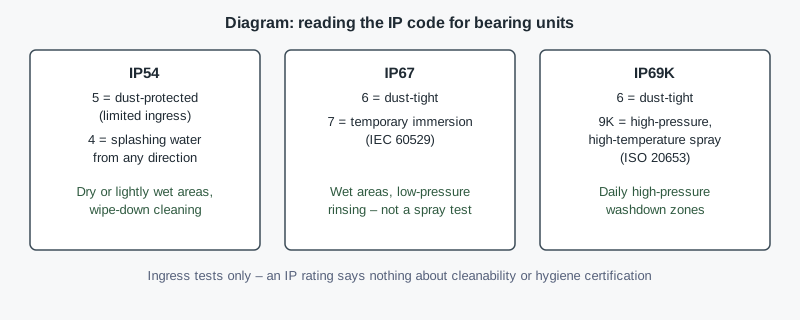
| Beverage filling hall, low-pressure rinse | Often IP65/IP66 is adequate |
| Meat, poultry or fish line, daily hot high-pressure washdown near conveyors | Typically yes |
| Dairy floor-level drives, intensive washdown | Typically yes |
| Components in flooded pits or tanks | IP68 as well, possibly IP69K too |
For bearings in washdown, see waterproof bearing house units; for components designed so cleaning is quick, see easy-to-clean components and parts.
Example (assumptions, for method only): a poultry plant cleans its evisceration line daily with alkaline foam, then rinses with water at around 60 °C from a lance at roughly 20–30 cm. Conveyor drive bearings sit at knee height. The cleaning parameters are close to the IP69K load, so the specification asks for IP69K on the tested configuration, seal material compatible with the alkaline foam and the sanitizer, and a hygienic housing design. The right choice still depends on the plant's own pressure, temperature and distance – no performance claim is made here.
Common mistakes
- Treating IP69K as "the highest waterproof rating". It is a jet test; immersion is separate.
- Assuming IP69K includes IP67 or IP68. Only dual marking (e.g. IP67/IP69K) shows both were tested.
- Ignoring what is attached. A cable gland or cover without its own rating defeats an IP69K housing.
- Cleaning harder than the test. Lances held closer than the test distance, or longer on one seal, exceed IP69K conditions.
- Using IP69K as a hygiene argument. EHEDG and 3-A assess cleanability; IP codes do not.
What to ask a supplier
For any claimed hygienic certification, use the supplier certificate checks alongside the jet-test report before relying on it in the specification.
- Which code and standard (ISO 20653 IP69K or IEC 60529 IP69), and on which configuration was it tested?
- Was the shaft or moving part stationary or rotating?
- Is there also an immersion rating (IP67/IP68), if submersion is possible?
- Which seal material, and is it compatible with your chemicals and temperatures?
- Is there an EHEDG certificate or 3-A authorization for the specific design, if required?
- For food contact: a declaration of compliance with EC 1935/2004.
An NHK technician answers your question and, if needed, suggests a component and sends a quote. NHK holds EHEDG certificate C2400043 for a bearing design. To browse, see NHK's sealed stainless bearing units, or read NHK's comparison of IP67 and IP69K for applications. See NHK's certifications.