To find EHEDG certified equipment, start with the official equipment register, then match the offered model and configuration to the certificate and its conditions. Do not start with a supplier logo or a list copied into a catalogue. The EHEDG certification scope guide explains what the scheme establishes; this page turns that background into a purchasing check.
Find the official EHEDG certified components list
Use the official EHEDG Certified Equipment register, not a manufacturer’s selection of badges. EHEDG describes its database as sortable by product name, type and company. Entries can provide a certificate and Appendix 3; document availability and interface controls may vary. The register is a source of certification evidence, not a ranked recommendation or a complete market directory.
Start with the certificate holder or manufacturer name, then the equipment name and exact model. If the supplier uses a commercial label, request the designation appearing in the register. A broad term such as “fitting” can describe very different designs; narrow it to the actual coupling, valve, fastener or connection. Try the product-family designation when an exact code produces no obvious match, but do not treat a nearby result as approval.
| Buyer’s starting point | Search or sort by | Match before accepting | What a result does not prove |
|---|---|---|---|
| Named supplier or private-label offer | Company/holder and stated product designation | Offered identity, certificate holder and any private-label documentation | Every product from that company is certified |
| EHEDG certified fittings | Connection or component name, model and type | Listed sizes, seals, connections and installation conditions | Every coupling, clamp or gasket in the assembly is covered |
| EHEDG certified load cell | Sensor, weighing module or support designation and manufacturer | Whether the certificate covers the sensor alone or the assembled support | Weighing accuracy, capacity or approval of an added sensor |
| Instrument or pump | Exact model, process connection and equipment description | Wetted configuration, seals, type/class and any aseptic scope | The entire line is sterile or its process is validated |
| Certificate number supplied | Number and associated holder/model in the documents | Current listing, certificate revision, dates and offered configuration | An old PDF remains current indefinitely |
Ask NHK's technicians about certificate scope
No result is not conclusive proof that the design is uncertified: naming, private labelling or incomplete offer information may be the problem. It is, however, insufficient evidence for accepting a certification requirement. Ask for the exact listing and documents, and leave the purchase approval unresolved until the identity and scope are clear. Do not substitute a screenshot of a logo.
Certified versus compliant: separate the claims
“EHEDG certified” means a specific design holds the relevant certificate. “EHEDG compliant” and “designed to EHEDG guidelines” do not establish certification by themselves. Those phrases can describe a supplier’s design claim even when a certificate also exists; ask for the evidence instead of assuming either presence or absence from wording alone. Membership is not product certification.
EHEDG certifies equipment designs, not companies, factories or generic materials. Food-contact documentation answers a different question. Regulation (EC) No 1935/2004 provides the food-contact framework, and Regulation (EU) No 10/2011 adds requirements for plastics within scope. A hygiene certificate does not replace the material/use evidence. Likewise, calibration and weighing performance are not hygiene certification.
For a US specification, 3-A Symbol authorisation follows Third Party Verification against the applicable 3-A Sanitary Standard. EHEDG and 3-A are voluntary and neither automatically substitutes for the other. The migrated EHEDG and 3-A claim comparison helps separate these document requests without assuming one certificate covers both schemes.
Which EHEDG certificate type and class applies?
Type distinguishes liquid cleaning, EL, from dry-only cleaning, ED. Class identifies the intended dismantling/cleaning arrangement. Aseptic designations add specific sterilizability and bacteria-tightness scope; they are not synonyms for a polished surface. Copy the full designation from the certificate rather than translating it into “washdown approved.”
| Designation | Published cleaning/design scope | Buyer’s checkpoint |
|---|---|---|
| EL Class I | Open or closed equipment, wet cleaned in place without dismantling | Can the installed procedure preserve the certified arrangement? |
| EL Class II | Open or closed equipment dismantled for wet cleaning | Are required removal and reassembly steps actually provided? |
| EL Aseptic Class I | Closed equipment, wet CIP without dismantling, steam sterilisable and bacteria tight | Match the exact aseptic configuration and operating instructions |
| EL Aseptic Class II | Closed equipment dismantled for wet cleaning, steam sterilisable and bacteria tight after reassembly | Confirm reassembly and sterilisation requirements |
| ED Class I | Closed equipment, dry cleaned only without dismantling | Do not infer suitability for a wet-cleaned application |
| ED Class II | Open or closed equipment dismantled for dry cleaning only | Provide dry-cleaning access and defined restoration steps |
These meanings follow EHEDG’s published certification-classes information. Cleaning in place (CIP) means cleaning the intended installed paths without routine dismantling; cleaning out of place (COP) involves removed parts. A class label is not a general detergent, pressure or temperature rating. Obtain the selected design’s limits and instructions separately.
Some register designations include AUX, for example EL Class I AUX. Keep the suffix exactly as shown and read the specific certificate and supporting scope. The accessible official classes summary did not define that suffix during this source check; no broader meaning or application approval is inferred here. Ask for clarification if it affects acceptance.
Verify the supplier’s claim in six steps
- Identify the purchased item. Record manufacturer, offered part number, model, sizes, material/seal options and drawing revision. Include process connection or mounting components supplied separately.
- Find independent scheme evidence. Open the register entry and its certificate, plus Appendix 3 where available. Compare the holder and equipment description with the offer; retain the reference and check date.
- Read scope and validity. Match type, class, suffixes, covered variants, restrictions and stated dates. EHEDG describes certificates as time-limited; use the current entry and certificate, not a calculated expiry based only on a brochure date.
- Compare the installation. Check mounting, orientation, seals, connection and required dismantling against the instructions. A certified component does not certify the machine around it.
- Resolve discrepancies before approval. Ask the supplier to identify the exact coverage or clarify substitutions. An unlisted seal or added sensor cannot be assumed covered by a related design’s certificate.
- Retain the purchasing record. Save the offer, certificate revision, scope confirmation, installation/cleaning instructions and separate material evidence with the approved drawing. Recheck after substitutions or design changes.
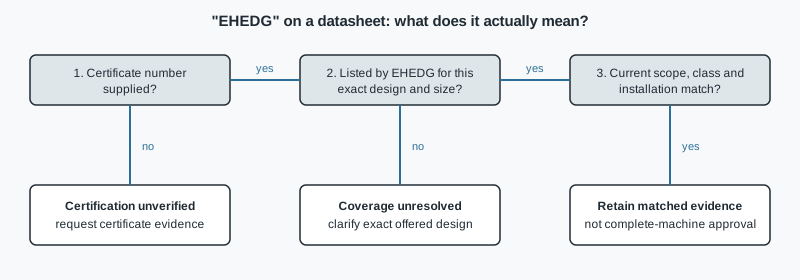
Diagram: trace the claim to the listed design and evidence before accepting the wording; schematic, not a certificate or NHK product approval.
If you are applying for certification rather than buying an existing design, use the machine-builder application and evaluation workflow. Do not confuse that process with verifying a supplier’s current certificate.
Fittings, load cells and installed interfaces
For EHEDG certified fittings, inspect the complete connection definition: seal, mating part, size and assembly method. A crevice is a narrow gap that retains soil beyond effective cleaning; the installed joint can create one even if its isolated component is listed. A harborage point is a place where residue survives the procedure. Follow the installed hygienic-design and interface rules when comparing the offered drawing with the actual machine.
For an EHEDG certified load cell request, establish whether the claim concerns a standalone sensor, weighing module or full foot assembly. Covers, cable glands, mounting seats and any height adjustment can change the cleaning interface. Use the weighing-support force-path and cable checks for mechanical and measurement selection; an ordinary certified foot does not automatically cover a sensor added to it. This guide confirms no NHK load-cell range, capacity or weighing accuracy.
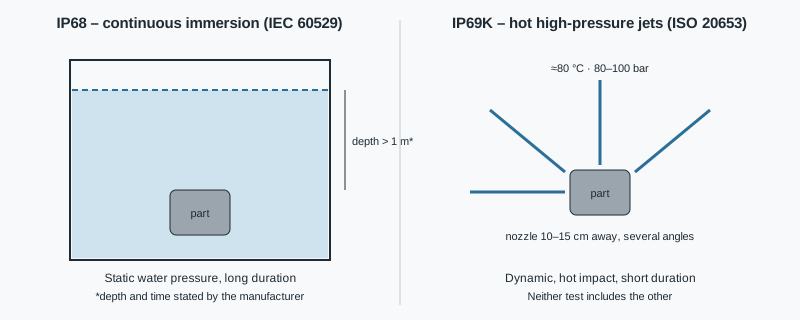
For instrumentation or aseptic pumps, match the process connection, seals and configuration rather than accepting a certificate for a different connection. Aseptic equipment scope does not validate the plant’s sterilisation cycle or prove an entire process sterile. IP67 is an immersion test, not a washdown rating; IP69K under ISO 20653 addresses specified ingress testing, not hygiene certification or unlimited chemical resistance.
Example: a certificate and offer do not match
Example — hypothetical assumptions, not NHK field data. An OEM receives an offer for a measuring support described as “EHEDG compliant.” A supplied certificate identifies an ordinary support design, while the offer adds a sensor body and cable entry. Assume the certificate does not explicitly identify that configuration.
The buyer records the mismatch and asks for exact-design coverage, installation restrictions and separate weighing documentation. The purchasing decision remains open: obtain a covered configuration, obtain authoritative clarification, or agree a documented non-certified design route with the customer. Do not describe the offered assembly as certified simply because one part or the supplier’s other product is listed.
RFQ and receiving checklist
Copy and complete: “Offered component and manufacturer: __. Model, sizes, connections, seal options and drawing revision: __. Required EHEDG type/class and suffix: __. Certificate number, holder, revision, current listing and covered configuration: __. Product-contact/splash zone and cleaning method, chemicals and exposure: __. Installation/dismantling instructions and unresolved scope question: __. Separate material/contact or measurement documents: __. Quantity and delivery country: __.”
At receipt, compare supplied identification, seal/connection options and drawings with the approved record. Resolve substitutions before installation; repeat scope checks after maintenance changes that affect the certified configuration. Self-draining surfaces release liquid instead of retaining pools, but that benefit depends on installed orientation and access. A certificate cannot compensate for a concealed mounting shelf.
Use the component buying and document-request guides to organise these details before sending the question through the form below.
Use the migrated risk-based component-prioritization method to decide where certification is required before applying the same requirement to every bought-in part.
For NHK evidence, consult NHK’s certifications, which lists bearing, component and levelling-foot certificate documents. Their publication does not establish blanket coverage for every product. The NHK certified and 3-A standard-component category is a secondary browsing path; use NHK’s product catalogues for full product data and request exact supplied-item confirmation.
NHK can clarify its component documents, confirm available options and prepare a recommendation or quote. The buyer still compares the offered configuration with the certificate and installation conditions; this guide does not provide independent technical approval of a particular purchase.