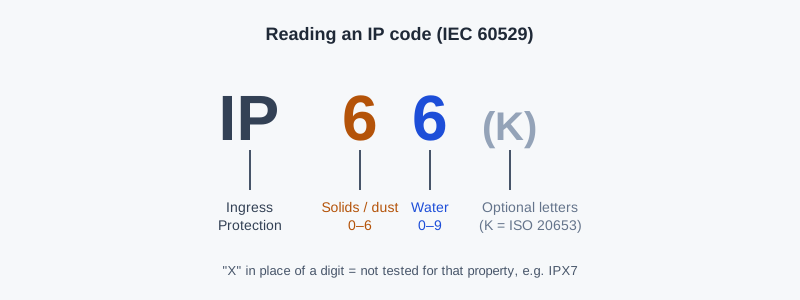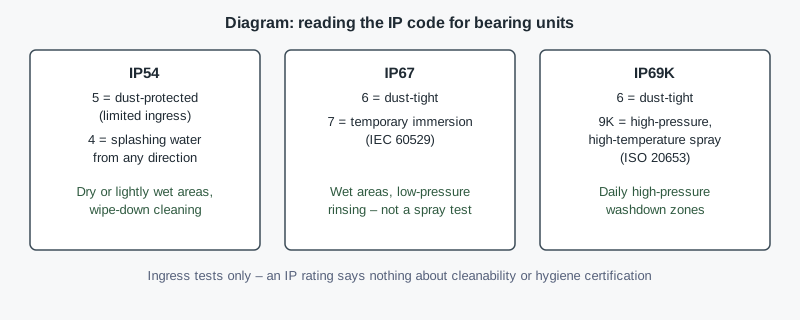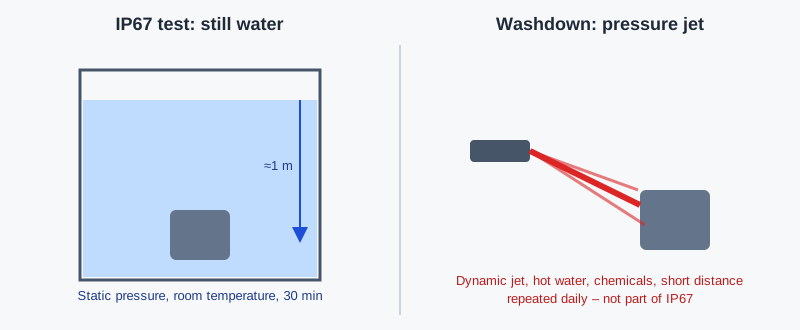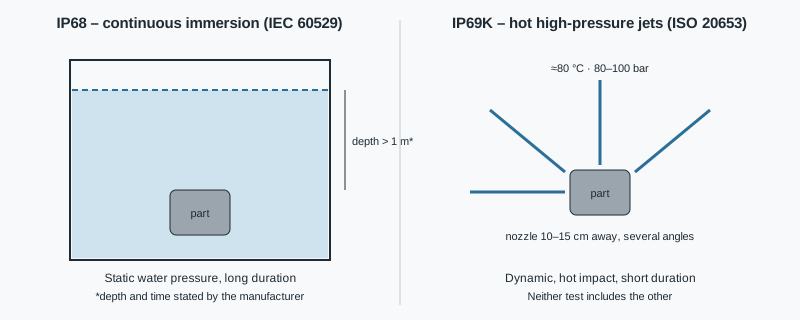
IP67 vs IP68 is a comparison of two ingress protection ratings in IEC 60529 that differ in only one respect: how severe the water immersion test is. Both start with 6 – dust-tight. The second digit, 7 or 8, describes temporary versus continuous immersion. For machinery in food plants the more important point is what both ratings leave out: neither tests the water jets, hot water and chemicals of daily washdown.
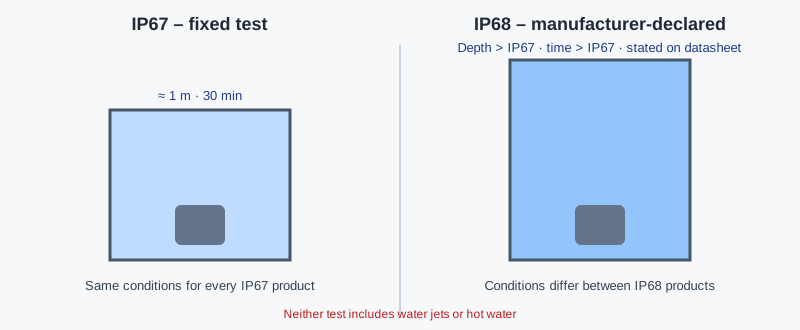 the fixed IP67 immersion test with manufacturer-declared IP68 immersion. Schematic, not a product test report.
This page is part of the IP rating guide in the hygienic design and standards hub.
IP67 vs IP68 at a glance
| IP67 | IP68 | |
|---|---|---|
| Dust (first digit 6) | Dust-tight | Dust-tight |
| Water (second digit) | 7 – temporary immersion | 8 – continuous immersion |
| Depth | About 1 m (lowest point) | Declared by the manufacturer, more severe than IP67 |
| Duration | 30 minutes | Declared by the manufacturer, more severe than IP67 |
| Same test for every product? | Yes | No – read the stated conditions |
| Water jets tested? | No | No |
| Hot water, chemicals, aging tested? | No | No |
| Hygiene assessment? | No | No |
Send your application data and get a component recommendation
The detail of each rating is covered in the IP67 rating explained and the IP68 rating explained. This page is about choosing between them.
The real difference: fixed vs declared conditions
An IP67 rating always means roughly the same test. An IP68 rating means "more than IP67", with the actual depth and duration chosen by the manufacturer. Two consequences for buyers:
- IP68 alone is incomplete. A specification line "IP68" accepts a product tested at slightly more than 1 m for slightly more than 30 minutes. If your part sits 2 m deep for a full shift, write the depth and duration into the specification.
- IP67/IP68 dual marking is common. Because the IP68 test is manufacturer-defined, some products carry both codes so the buyer knows the standard IP67 test was also passed.
What neither IP67 nor IP68 proves for washdown
| Washdown load | Covered by IP67 or IP68? | Look for |
|---|---|---|
| High-pressure jets | No | IP69K (ISO 20653) or IPX5/IPX6 |
| Hot water (around 60–80 °C) | No | IP69K; seal temperature range |
| Thermal cycling – warm part, cold rinse | No | Seal design that tolerates pressure changes |
| Detergents and sanitizers | No | Elastomer compatibility of EPDM, FKM or VMQ seals with your chemicals |
| Daily repetition over years | No | Field experience, maintenance interval |
| Cleanability | No | Hygienic design: no crevices, self-draining surfaces |
Thermal cycling is the failure mode most often missed: a warm bearing housing or motor is rinsed with cold water, the air inside contracts, and the pressure difference pulls water past a seal that passed immersion when new. For jet resistance, see the IP69K rating explained; for a direct comparison with jets, see IP68 vs IP69K in hygienic zones.
IP67 or IP68: how to choose
- Is the part ever submerged? If not, the 7-vs-8 question is secondary; go to step 4.
- How deep and how long? Brief submersion up to about 1 m: IP67. Deeper or longer: IP68 with stated conditions at least equal to the real ones.
- What is the water? Hot process water or brine is a different load from the test's fresh water near room temperature.
- How is it cleaned? Pressure lance near the part: add a jet rating (IP69K). Foam and low-pressure rinse: IP65/IP66 may be enough.
- Which zone? In the splash zone (reached by spray) and product-contact zone, hygienic design and materials decide more than the IP digit.
| Situation in a food plant | IP67 | IP68 | Also needed |
|---|---|---|---|
| Conveyor bearing, daily high-pressure washdown | Not the deciding test | Not the deciding test | IP69K, hygienic housing |
| Sensor in a flume or water bath | Only if brief and shallow | Yes, with stated depth/time | Jet rating if lanced |
| Drive in a pit that floods during cleaning | Possibly | Often | Jet rating if lanced |
| Splash-zone part, low-pressure rinse | Adequate, not required | Not needed | IP65/IP66 |
For bearing units, see waterproof bearing house units, which explains when a sealed housing is needed.
Example (assumptions, for method only): a buyer compares two motor-mounted sensors for a cooked-meat line: one IP67, one IP68 (stated as 2 m for 24 hours). The sensors are mounted above a conveyor, never submerged, and cleaned daily with foam and a hot rinse from a lance. The IP68 rating adds nothing for this installation; the decision should rest on a jet rating (IP69K or test evidence for the plant's pressure and temperature), seal material and housing design. No performance claim is made for either product.
Common mistakes
- Treating IP68 as "IP67 plus everything".
- Specifying "IP68" without depth and duration.
- Assuming the rating applies to the installed assembly, including cable glands, covers and shaft seals.
- Choosing by IP digit when the real load is a pressure jet.
- Using an IP rating as evidence of hygienic design – IP tests do not assess harborage points (places where residues survive cleaning).
What to ask a supplier
For any claimed hygienic certification, use the certificate verification after choosing the immersion conditions before relying on it in the specification.
- IP67, IP68 or both – and for IP68, which depth, duration and water temperature?
- Was the test done on the configuration you will install?
- Is there a jet rating (IP66, IP69K) as well?
- Which seal material, and is it compatible with your cleaning chemicals?
- Is there an EHEDG certificate or 3-A authorization for the specific design, if required, and an EC 1935/2004 declaration for food-contact parts?
An NHK technician reviews the installation and cleaning plan, suggests a component and sends a quote. NHK holds EHEDG certificate C2400043 for a bearing design. To browse, see NHK's IP67 bearing house units, or NHK's guide to IP67 and IP69K applications. See NHK's certifications.