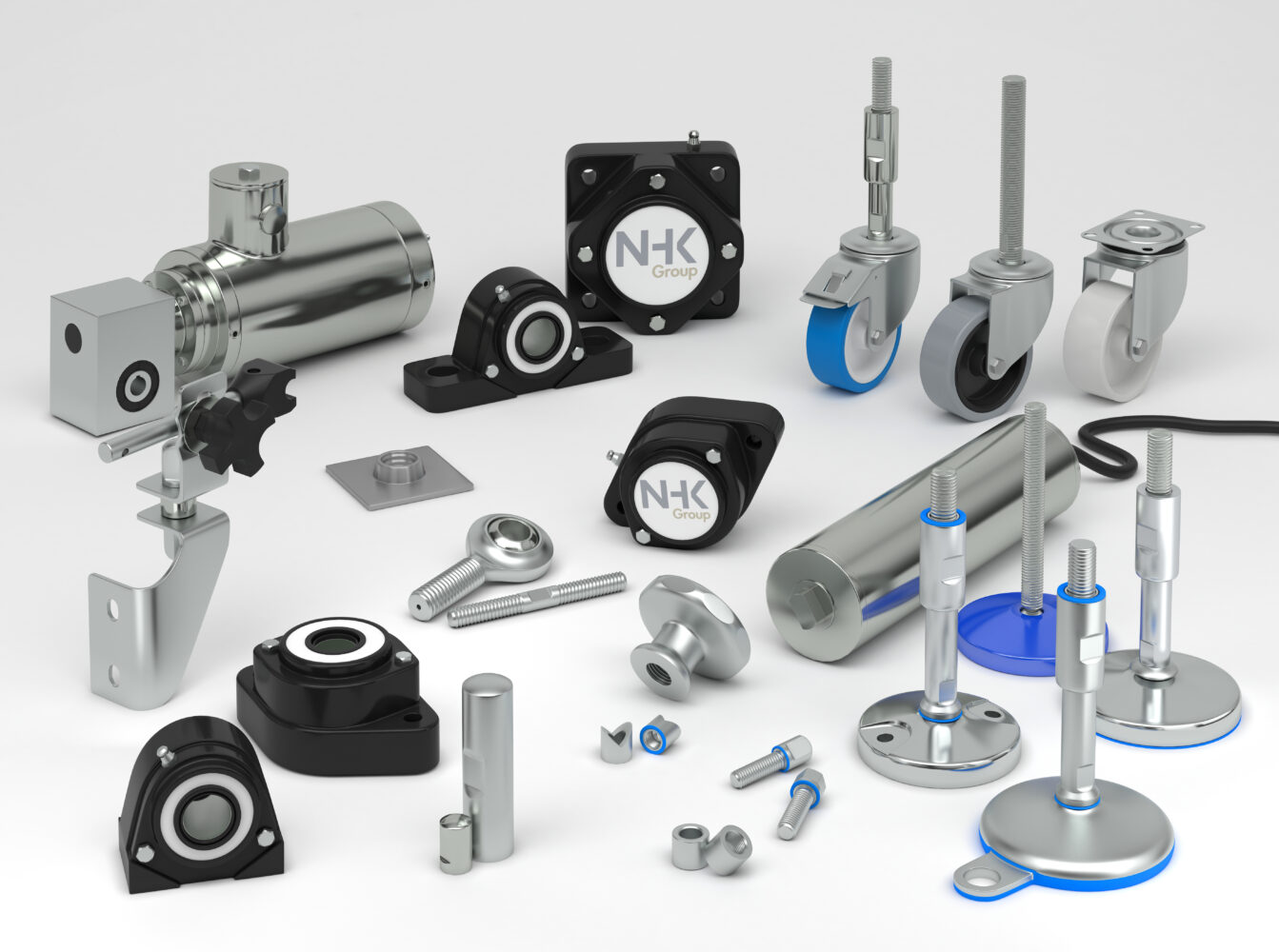
Sustainable development at machine level means building equipment that lasts, cleans efficiently and avoids unnecessary replacement – and the simplest way to secure it is to choose the right component family for each position on the machine. Food processing, pharmaceutical and other hygiene-sensitive plants use a wide range of parts: feet, castors, bearing units, conveyor components and motors. This guide maps those families to their applications so each part suits its load, environment and cleaning regime.
For the lifecycle resource view – water, energy and materials over a machine's life – see the companion article ensure sustainable development and growth.
Why the right component family matters for sustainability
Parts that do not suit their environment fail early. A plated steel castor in a washdown area corrodes; a standard bearing unit in a wet zone takes in water; a foot with an exposed thread in a splash zone collects soil and corrodes. Each failure means a replacement part, disposal, labour, downtime and often extra cleaning.
The opposite mistake is also waste: specifying sealed stainless components with certificates in a dry packaging hall where a simpler part would last as long.
The selection logic is therefore:
- Environment – dry, splash, wet, washdown, product zone.
- Hygiene zone – product-contact (touches product), splash zone (wetted by spray but not product) or non-contact.
- Load and function – static or moving loads, adjustment, noise, speed.
- Evidence – datasheet ratings, declarations of compliance, certificates where needed.
Component families and where they fit
| Family | Typical use | Choose when | Watch out for |
|---|---|---|---|
| Stainless steel and composite solid base feet | Fixed support of frames and machines | Floor is level or frame is levelled otherwise; moisture and chemicals present | No height adjustment |
| Stainless steel machine leveling feet | Adjustable support on uneven floors | Machine must be levelled precisely | Exposed threads in wet zones – use sealed hygienic designs |
| Stainless noise-reducing castors | Mobile equipment, trolleys | Equipment is moved and washed; noise matters | Wheel material and bearing sealing; load rating |
| IP54 composite housing bearing units | Light-duty conveyors, splash areas | Dust and water splashes only; corrosion-resistant housing wanted | Not for immersion or jet washdown |
| IP67 waterproof bearing house units | Wet areas | Temporary immersion or heavy wetting | Immersion test, not a washdown rating |
| Sealed stainless bearing units | Wet, chemical cleaning | Daily washdown and cleaning agents | Check rating against jets, elastomer compatibility |
| Mounted ball bearing house units | General machinery | Dry or protected positions | Housing material vs environment |
| Mini stainless bearing units | Compact equipment | Limited space, light loads | Load capacity on datasheet |
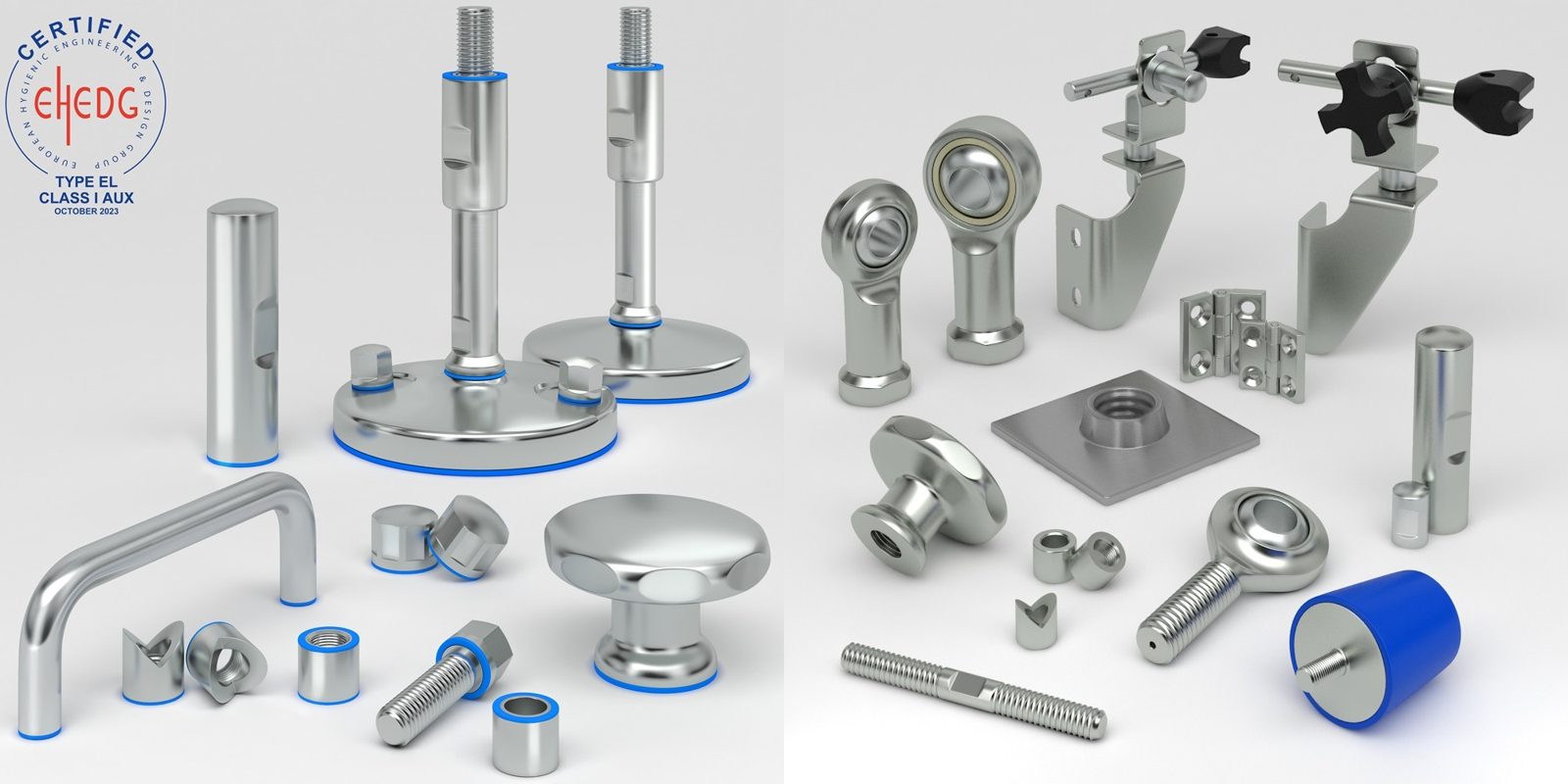
| Hygienic stainless machinery components | Knobs, handles, hinges, fixings | Parts in splash and product zones | Crevice-free design, grade |
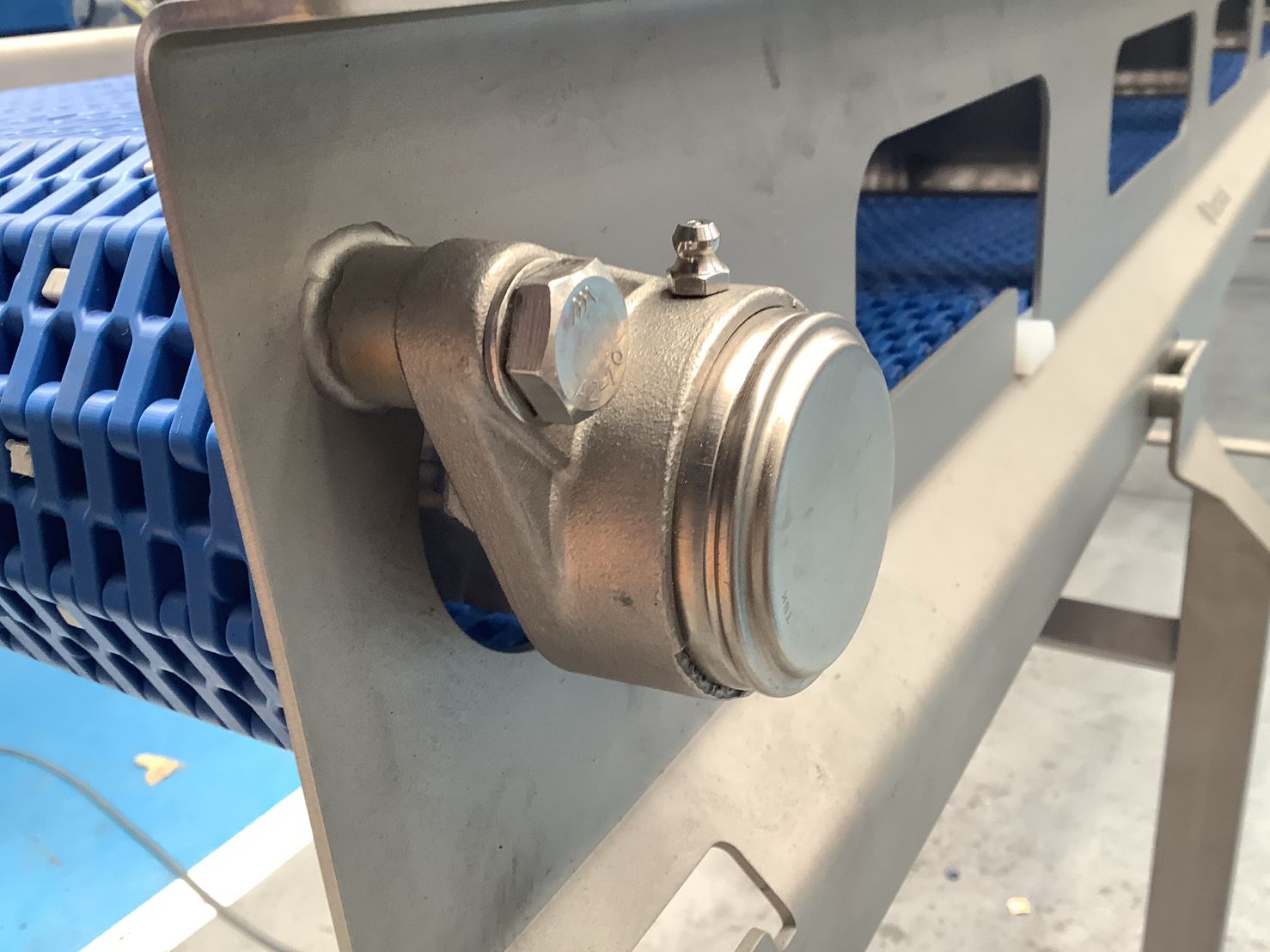
| Conveyor components and side guides | Material handling | Products are guided and transported | Cleanability of guide fixings, wear |
| Stainless drum and gear motors | Conveyor drives | Drives are washed down | Seal design, IP rating, heat |
Feet and castors
Solid base feet carry load at a fixed height. In stainless steel or composite they resist moisture and chemicals and are easy to clean, as long as the base sits flush or has clearance for cleaning.
Stainless steel machine leveling feet have an adjustable threaded stem for precise levelling on uneven floors, which keeps sensitive equipment accurate. Stainless steel gives long life and corrosion resistance. In splash and product zones, choose hygienic designs that enclose the thread – an exposed thread is a harbourage point (a place where residue and bacteria survive cleaning). Use AISI 316L where chlorides are present, because it resists chloride pitting better than 304. See NHK's stainless steel machine levelling feet and the dedicated site for industrial machine leveling feet.
Stainless noise-reducing castors reduce the noise of moving equipment, which improves the working environment. Durability in washdown depends on wheel material and how the wheel bearings are sealed. See NHK's stainless noise-reducing castors.
Bearing units
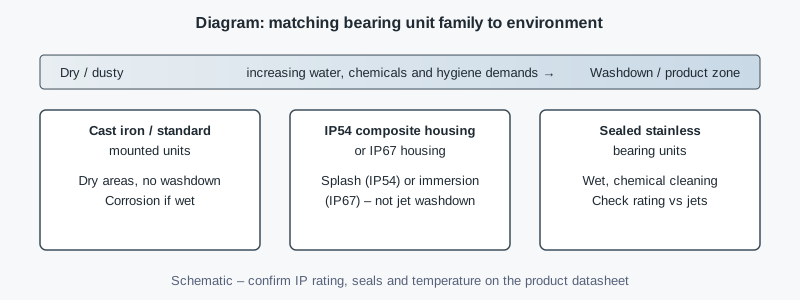
- IP67 waterproof bearing house units are sealed against dust and protected against temporary immersion (IEC 60529). They keep contaminants out in wet areas, but IP67 is not a high-pressure washdown rating – that is IP69K (ISO 20653).
- Sealed stainless bearing units protect against contamination and corrosion and are designed for cleaning agents and wet processes. Their sealing protects the bearing from dust and water and extends service life. See NHK's sealed stainless bearing units.
- Bearing units in IP54 composite housing combine low weight with corrosion resistance and protection against dust and splashes – suitable for many light-duty applications, not for immersion or jets.
- Mounted ball bearing house units provide support and smooth rotation in general machinery and are designed for easy installation and maintenance; check housing material against moisture.
- Mini bearing units in stainless steel suit compact equipment where space is limited; check the load capacity on the datasheet.
Conveyor parts, components and drives
Hygienic stainless machinery components – handles, hinges, fixings – resist corrosion and are easy to clean when designed without crevices. Conveyor components and side guides guide products and must withstand wear and cleaning; look at how guides are fixed, since clamps and brackets are common soil traps. Stainless drum and gear motors drive conveyors in wet areas; they resist corrosion and are easy to clean, but check seal design and ingress rating against the cleaning method.
Certification and documents
EHEDG certifies specific equipment designs as cleanable; 3-A SSI standards are widely used for dairy and food equipment, and conforming designs may carry the 3-A Symbol after a Third Party Verification. Both are voluntary, apply to named models and verify cleanability – not sustainability or durability. For any family, request:
- Datasheet ratings: load, temperature, IP rating.
- Material grade and certificates.
- Declaration of compliance for food-contact materials (EC 1935/2004; EU 10/2011 for plastics).
- EHEDG certificate or 3-A authorisation naming the model, where claimed.
Example
Assumptions (illustrative only): a bakery line has a dry dough-handling section and a wet tray-washing section.
- Dry section: mounted ball bearing units or IP54 composite units; solid base or standard stainless leveling feet.
- Wet tray-washing section: sealed stainless bearing units, sealed-thread hygienic levelling feet in 316L if chlorinated cleaners are used, stainless castors on mobile racks.
- Result: higher-specification parts only where the environment demands them, and fewer early failures in the wet section.
For sorting which parts belong where on a whole machine, see industrial machinery parts and components.