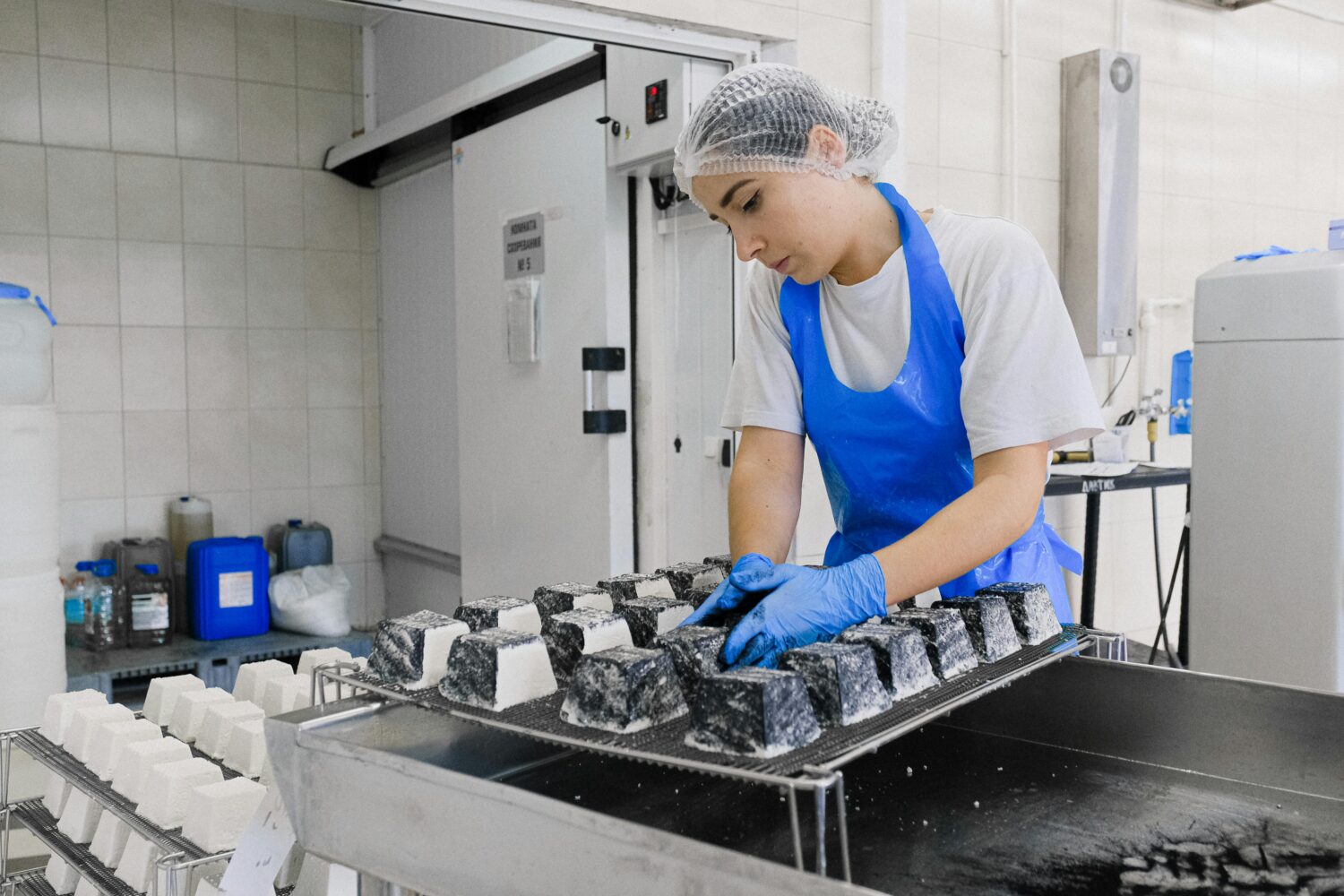
Sustainable development in food, pharmaceutical and related manufacturing means producing safely while using less water, energy, chemicals and material over the life of the equipment. Hygienic components – especially those with EHEDG certification or 3-A authorisation – contribute because they make cleaning shorter and more effective and last longer. This guide explains where those effects come from, how to quantify them and how to choose components with the lifecycle in mind.
Industries that depend on hygienic equipment include food, dairy, beverage, bakery, confectionery, meat, fish and seafood, cosmetics, veterinary, chemical, medical and pharmaceutical processing.
Understanding EHEDG and 3-A SSI certification
- EHEDG (European Hygienic Engineering & Design Group) publishes hygienic design guidelines and certifies specific equipment designs. A certificate indicates that the design prevents microbial contamination and is easy to clean, based on evaluation and, where required, testing.
- 3-A SSI (3-A Sanitary Standards, Inc.) is a US organisation that develops sanitary design standards, originally for dairy and now for food equipment more widely. A design conforming to a 3-A Sanitary Standard may carry the 3-A Symbol after Third Party Verification.
Both are voluntary and apply to the certified or authorised design only. Neither certifies sustainability – they certify hygienic design. For the differences, see what is the difference between 3-A and EHEDG.
Why hygienic design matters for sustainable growth
- Product safety – reducing contamination and spoilage avoids product loss and recalls, which are among the largest sources of waste.
- Regulatory compliance – meeting local and international requirements avoids fines, recalls and disposal of non-compliant product.
- Operational efficiency – equipment that is easy to clean and maintain reduces downtime, so the same equipment produces more.
- Resource efficiency – efficient cleaning uses less water, chemicals and energy.
Where hygienic components affect resource use
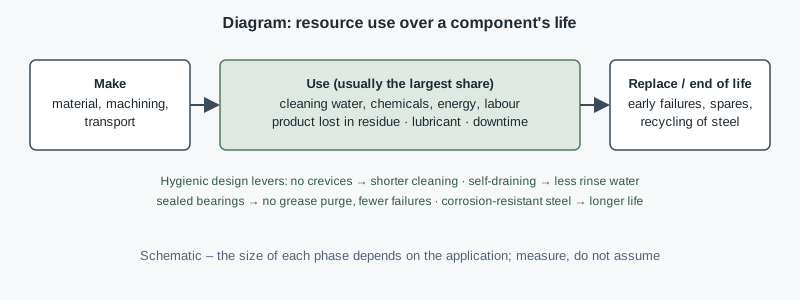
For most machine components in wet food production, the use phase dominates. A levelling foot or bearing unit is cleaned hundreds of times a year, and each clean uses water, chemicals, heat and labour. The design details decide how much:
| Design feature | Effect during use | Sustainability lever |
|---|---|---|
| No crevices or exposed threads | Residue does not lodge; shorter cleaning | Less water, chemicals and time per clean |
| Self-draining surfaces | Water and product run off | Less rinse water; shorter drying |
| Sealed bearing units | No water ingress or grease purge | Fewer failures; less lubricant in wastewater |
| Corrosion-resistant steel (304 / 316L) | Resists cleaning chemicals and chlorides | Longer life; fewer replacements |
| Smooth surfaces (EHEDG guidance Ra ≤ 0.8 µm for product contact) | Residue releases easily | Less mechanical and chemical cleaning effort |
| Durable, standard components | Predictable life, available spares | Less waste from early failure and obsolete parts |
Crevices are narrow gaps that cleaning fluids cannot flush; self-draining surfaces slope so liquids run off; surface roughness Ra is the average height of surface irregularities. Chloride pitting – localised corrosion from chlorides in salt and chlorinated cleaners – is the main reason to choose AISI 316L over 304 in wet, chlorinated environments.
Component examples
Sealed bearing units
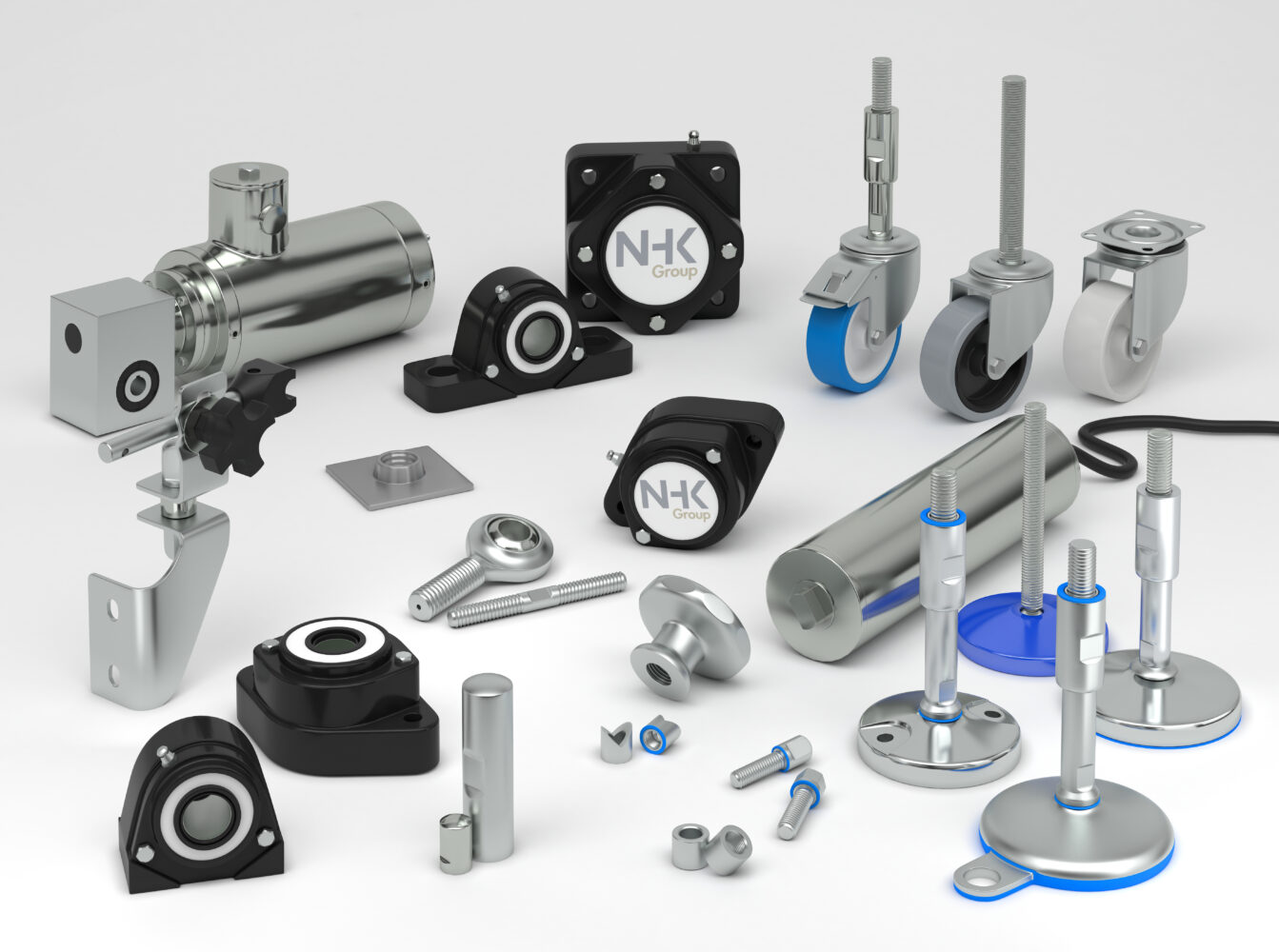
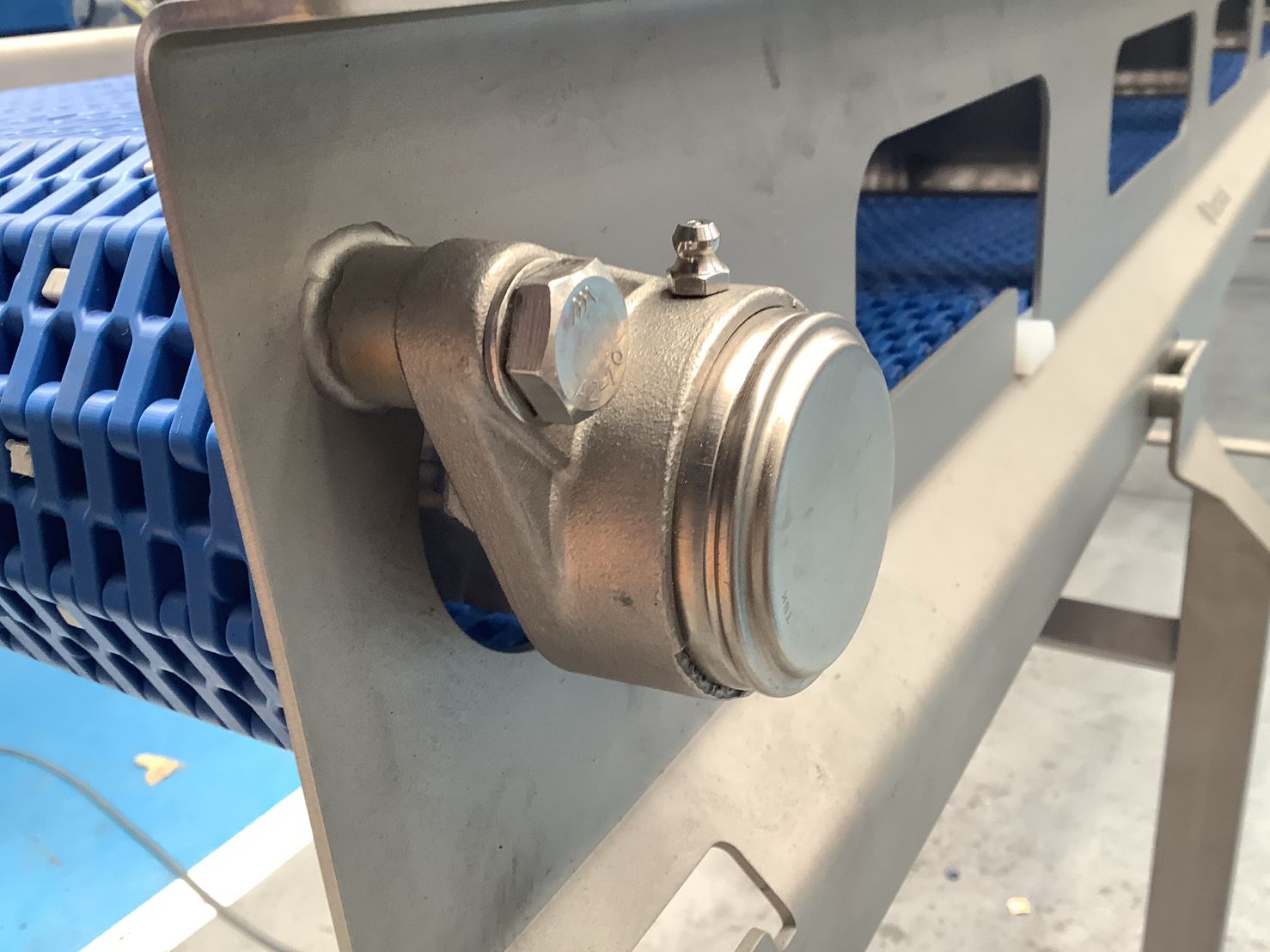
Sealed stainless bearing units prevent the ingress of water and contaminants and resist corrosion. IP67 means dust-tight and resistant to temporary immersion; it is not a high-pressure washdown test (that is IP69K under ISO 20653). Fewer bearing failures mean fewer replacement parts and less unplanned downtime. Whether a bearing unit is certified must be checked per model.
Sanitary enclosure parts
Enclosures in hygienic design protect sensitive equipment while remaining easy to clean: smooth surfaces limit residue, durable materials last, and easy disassembly allows thorough cleaning. A 3-A claim should be backed by the authorisation for the specific part.
Adjustable leveling feet
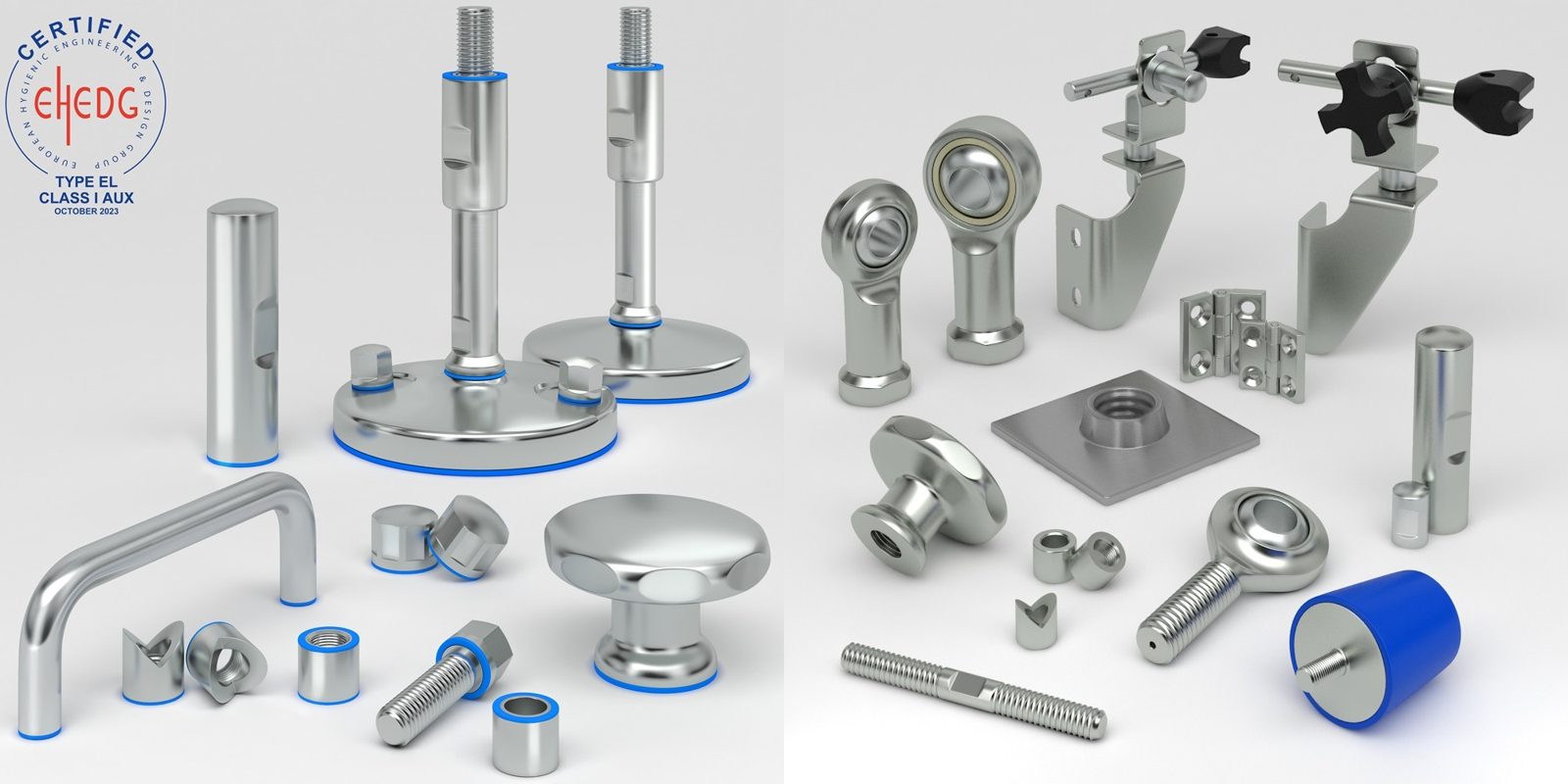
Hygienic adjustable leveling feet keep machines stable on uneven floors, and a correctly levelled frame drains as designed. Corrosion-resistant stainless steel, a sealed thread and a sloped body make them easier to clean. NHK's range of EHEDG-certified and 3-A SSI standard components shows which designs hold certificates.
How to quantify the sustainability benefit
A per-clean model makes the effect visible:
Annual resource use = cleans per year × (water + chemicals + energy + product lost per clean)
Add replacement parts per year for components with limited life. Compare the existing design with the hygienic one using measured values.
Example
Assumptions (illustrative only, placeholder values to replace with measurements): a conveyor section is cleaned daily, 300 times per year. Before a retrofit, a cleaning trial records 400 litres of water per clean; after replacing threaded feet and open bearings with sealed-thread levelling feet and sealed stainless bearing units, a repeat trial records 340 litres.
- Before: 300 × 400 = 120,000 litres per year.
- After: 300 × 340 = 102,000 litres per year.
- Difference: 18,000 litres per year for this section, before counting chemicals, heated water energy and labour.
The numbers are placeholders; the method is the point. Only report figures measured on your own line. For an energy-focused version of the model, see EHEDG-certified design and energy savings.
Selecting components with the lifecycle in mind
- Define the zone and cleaning method – dry, splash, wet cleaning, foam or high-pressure washdown, CIP (clean-in-place) or COP (clean-out-of-place).
- Choose material grade – AISI 304 for drier, less aggressive areas; 316L where chlorides or salty product are present.
- Prefer sealed, crevice-free designs – sealed threads on feet, sealed bearing units, hygienic fasteners.
- Check seals and elastomers – EPDM, FKM and VMQ resist different chemicals, fats and temperatures; an incompatible seal fails early.
- Ask for evidence – EHEDG certificates or 3-A authorisation for the specific model, declarations of compliance for food-contact materials.
- Plan spares and standardisation – fewer component types reduce stock and obsolete parts.
- Measure before and after – water, chemicals, energy and cleaning time.
Working with suppliers
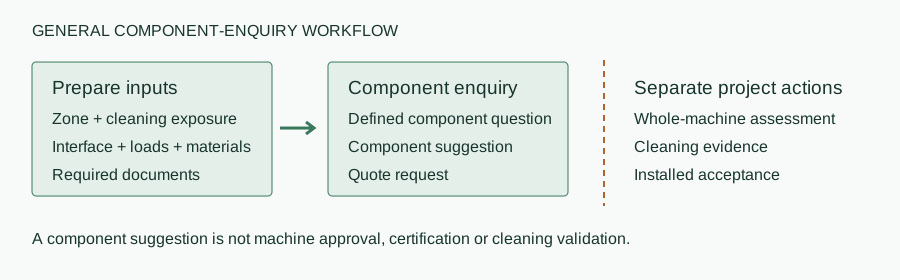
Each industry has its own requirements, so components often need to be matched to the application – a pharmaceutical line with dry cleaning has different needs from a fish plant with daily chlorinated washdown. Useful suppliers help with application questions and provide documentation, rather than general claims. Treat "environmentally friendly" without data as marketing; ask for material information, expected service conditions and certificates instead. NHK's own article on this topic: ensuring sustainable development and growth.
For the three pillars of sustainability applied to machinery decisions, see sustainable development and growth.
Benefits for long-term growth
- Lower operating cost – less water, chemicals, energy and labour per clean.
- Less waste – fewer product losses, recalls and early component failures.
- Easier compliance – documented hygienic design simplifies audits and customer approvals.
- Longer equipment life – durable materials and sealed components extend service life.
For a step-by-step method to measure and cut water and detergent per clean, see reducing water and cleaning detergent usage.
For a guide to choosing each component family to suit its environment, see secure sustainable development and growth.