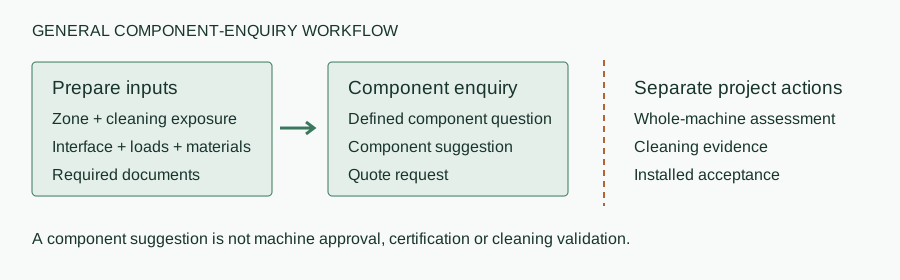
Hygienic design support for a machine builder is most useful when a broad concern becomes a specific component decision. “Can this bearing mounting be cleaned after the stated washdown?” is actionable; “make our conveyor hygienic” leaves the boundary, evidence and acceptance criteria undefined. Use the buyer's guides for the purchasing context, then prepare the focused request below.
This page is a preparation guide, not a claim that NHK offers independent design consultancy. NHK's technicians suggest components and send a quote. Keep machine design decisions, safety assessment, cleaning validation and release responsibilities with the appropriate project team. Additional services must be confirmed before they become part of a project plan.
What to prepare for a component recommendation
Start with the component in its installed position, including neighbouring surfaces and the route by which product or cleaning liquid reaches it. A catalogue outline alone cannot show whether a bracket hides a seal seat, whether a foot traps liquid against the frame or whether a guard blocks inspection. Record what is known and label what remains uncertain.
| Input | Prepare this information | Why it changes the component question |
|---|---|---|
| Zones and product | Mark product-contact, splash and non-contact surfaces; describe the product and transfer routes | A nominally non-contact part can still drip or shed residue onto exposed food |
| Cleaning method | Dry cleaning, external foam/rinse, CIP or COP; include dismantling and access | The proposed interface must be reachable by the actual procedure |
| Exposure | Chemicals, concentration, temperature, contact time and rinse conditions; pressure and distance where relevant | Material compatibility and ingress evidence need defined conditions |
| Drawings | General arrangement plus one installed detail, dimensions, tolerances and revision | A cleanable component can acquire an inaccessible gap at its mounting face |
| Mechanical duty | Static and dynamic loads, direction, speed, starts, vibration and adjustment | Hygiene geometry cannot compensate for an unsuitable load path or fit |
| Materials | Metal grade, contact materials, seal compound, finish and evidence required | “Stainless” and “food grade” do not identify an application-specific limit |
| Certificates and documents | Exact requirement, design identity and scope; material/contact evidence | A badge or product-family statement cannot substitute for item-specific evidence |
| Purchase details | Part numbers if known, quantity and delivery country | Distinguishes a technical uncertainty from an identifiable quotation request |
Send your application data for a component recommendation and quote
If a dimension, load or chemical concentration is unavailable, say so. Do not turn an estimate into a confirmed requirement just to complete the table. A useful request separates the supplied facts, design assumptions and questions that need an answer before ordering.
Hygienic design review for machine builders: prepare the interface
Use this six-step method within your own engineering review. It organizes an enquiry without promising that a supplier will perform each step for you.
- Define one decision. Name the component function and the concern: exposed adjustment thread, inaccessible mounting seat, cleaning-fluid ingress or missing contact-material evidence. Explain whether this is a new design or a replacement in an installed machine.
- Map exposure. Product-contact means food touches the surface or contamination can return to it. Splash surfaces receive product or cleaning liquid without intended direct food contact. Show foreseeable transfer from nearby non-contact areas rather than assuming distance alone provides protection.
- Show both operating and cleaning positions. Record guards, removal paths, tool clearance and where dismantled parts are stored. CIP means cleaning in place without dismantling; COP means removing parts for cleaning elsewhere. External foam cleaning is not automatically a validated CIP process.
- Define the load path. Show which surface carries the force, the direction and duty cycle. Include adjustment range, mounting tolerances and unsupported spans where relevant. Keep component loads separate from total machine mass; unequal support and dynamic duty may matter.
- List evidence separately. Geometry, metal grade, seal compatibility, food-contact use and certificate scope answer different questions. Identify who must supply each document and who will check applicability. Do not replace a missing material record with a design certificate.
- Record the decision and open actions. Use an interface reference, question, evidence requested and action owner. Reopen the record when the part, seal, mounting position or cleaning procedure changes. A previous component choice is not automatically valid after a machine conversion.
For a broader OEM improvement programme, use the migrated machine-builder hygienic optimization guide. It explains team learning and prototype checks; this page concentrates on the information needed for one supplier enquiry.
Questions to put to a supplier's technician
Ask questions tied to the proposed component rather than requesting a generic hygiene assurance. Useful questions include: Which available design fits the stated duty and interface? Which installed dimensions and limits must we confirm? What cleaning and maintenance instructions apply? Which exact materials and replacement seals are supplied? Which documents identify that configuration?
Ask for missing evidence explicitly, but do not assume every supplier can provide the same analysis. “Please identify the documented cleaning restrictions for the proposed part” is different from “please validate our sanitation procedure.” A technician's product suggestion can inform the choice; validation requires an agreed method and evidence for the installed process.
If you search for ask a hygienic design engineer, focus the actual request on the component and application data. This site identifies NHK's technicians, not a named responder's qualification or an independently verified consultancy role. Do not put a formal assessment, site visit, CAD redesign or machine sign-off into the enquiry as an assumed included service.
Typical review findings: general engineering guidance
These are general issues to look for, not NHK field findings, customer cases or evidence that a particular component fails. A crevice is a narrow gap that can retain soil; a harborage point is a location where residue can persist beyond effective cleaning. Check the installed connection as well as the exposed surface.
| Finding | Check on the actual machine | Question or action before selecting parts |
|---|---|---|
| Exposed thread or recessed fastener | Can residue reach it, and can the cleaning procedure remove it? | Compare closure/sealing options and the full joint, not only the bolt head |
| Liquid retained at a mounting seat | Inspect the underside and installed drainage orientation | Resolve the interface or access route; a polished cover does not close the hidden gap |
| Seal edge swollen, cracked or displaced | Record the exact compound, cleaning exposure and assembly condition | Request compatible material evidence and installation limits; do not substitute by colour alone |
| Bearing behind an obstructing guard | Check rinse access, removal path and lubricant escape routes | Establish protection and inspection requirements without treating an IP test as hygiene approval |
| Certified part with a different installed configuration | Compare designation, seal, mounting and scope restrictions | Resolve the mismatch before accepting the claim |
| Replacement alters load or adjustment | Compare the original load path, engagement and usable range | Confirm mechanical suitability before considering the hygiene improvement complete |
The migrated zone-by-zone standard-parts guide helps frame substitution choices. Do not assume every problem needs a more elaborate component: relocation, improved access or a changed mounting detail may address the contamination route more directly.
Certificates, materials and acceptance are different checks
Use the equipment certificate verification workflow to check the exact supplied design. EHEDG certification is voluntary and concerns specific equipment designs, not companies, factories or alloys. A 3-A Symbol authorisation follows Third Party Verification; neither scheme automatically approves the surrounding machine.
Food-contact suitability is a separate question. EC 1935/2004 is the EU framework for food-contact materials and articles; EU 10/2011 has plastics-specific scope, while FDA 21 CFR 177.2600 addresses repeated-use rubber articles. The food-contact document comparison helps formulate item-specific evidence requests rather than a universal “FDA certificate” demand.
Ingress evidence also has a boundary: IP67 is an immersion test, not a washdown rating, and IP69K is not a hygiene certification. Specify real cleaning exposure and ask what evidence supports the proposed configuration. Keep acceptance conditions visible: geometry checked, instructions available, material evidence applicable and representative cleaning/inspection agreed by the responsible team.
Example: turn a bracket concern into a request
Example — hypothetical assumptions, not NHK project data. Assume a machine builder is reviewing a removable guide bracket beside exposed product, cleaned externally with foam and rinse. The bracket underside is inaccessible in its operating position. No component, dimensions, material or certificate has yet been approved.
The request should identify the bracket's function, show its seat and safe removal route, and record whether residue can return to product. Cleaning conditions and the required adjustment must accompany the drawing. Ask for a component suggestion and the corresponding installation/material evidence, not a statement that the conveyor is hygienic. The project team retains the access demonstration and cleaning acceptance actions.
If the proposed alternative requires a different mounting face, repeat the interface check before purchase. Replacing the visible bracket while leaving the concealed seat unchanged could preserve the original cleaning problem. An unresolved dimension remains an open item, not permission to assume interchangeability.
Copyable component enquiry and handover checklist
Copy and complete this request: “Component/function and question: __. Machine/process and zone: __. Drawing reference/revision and installed dimensions: __. Product and cleaning exposure: __. Loads, speed, duty and adjustment: __. Metal, finish and seal requirements: __. Certificate scope and material/contact documents needed: __. Confirmed inputs and unresolved assumptions: __. Part numbers if known, quantities and delivery country: __.”
Before sending, check that the detail shows both mating parts and the cleaning position. Identify who can supply missing data. The site's form accepts the written request; reference drawings in the message and ask how to share them rather than assuming an attachment upload or confidentiality arrangement. Do not include confidential customer drawings until the sharing method and authorisation are agreed.
NHK's technicians suggest components and send a quote. Verify the proposed item against your requirements before ordering and retain the supplied documents with the approved configuration. NHK's product catalogues are a secondary path for full product data; the existing form below remains the enquiry path on this site.