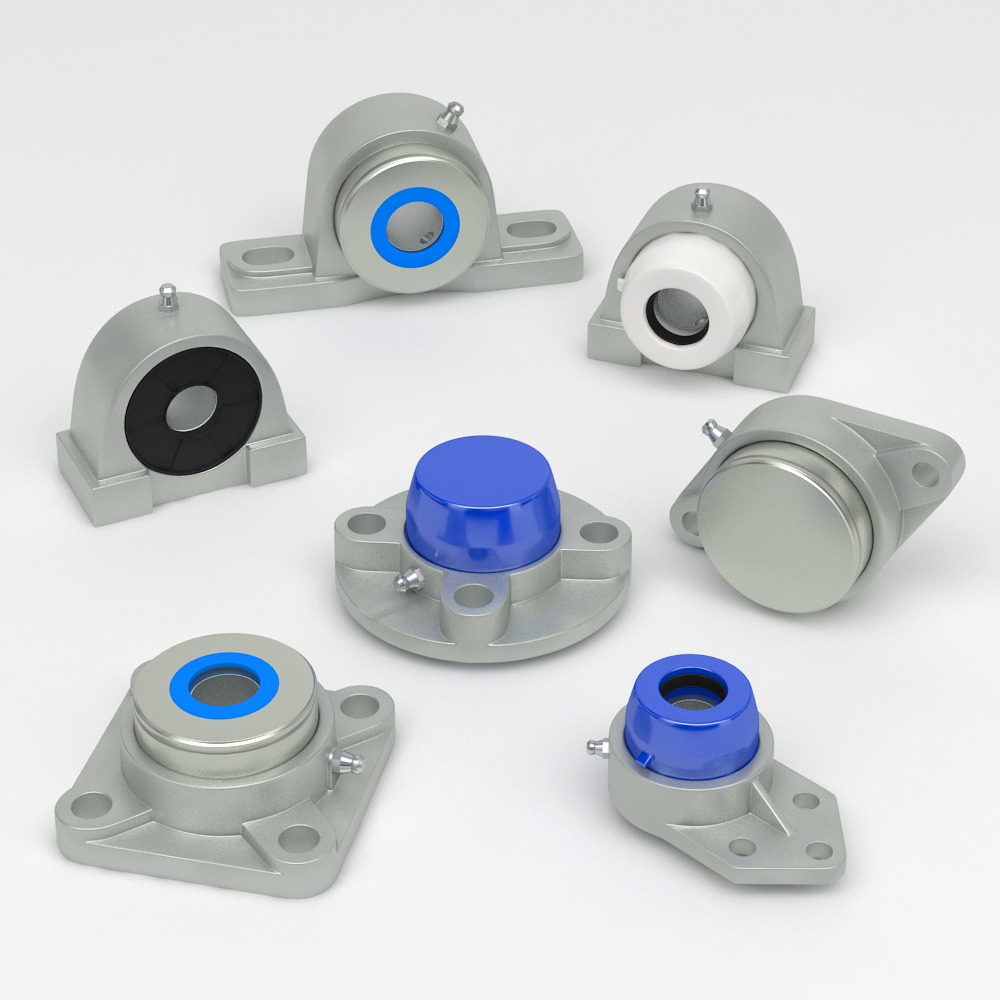
440 stainless steel – AISI 440, also called "440 steel" or "stainless steel 440" – is a high-carbon martensitic stainless steel: it contains enough chromium to resist corrosion in moderate conditions and enough carbon to be hardened to bearing-steel levels. That combination is why nearly every stainless rolling bearing on food machinery runs on 440C rings and balls. It is also why 440 should be handled differently from the 304 and 316L used in frames and product-contact surfaces.
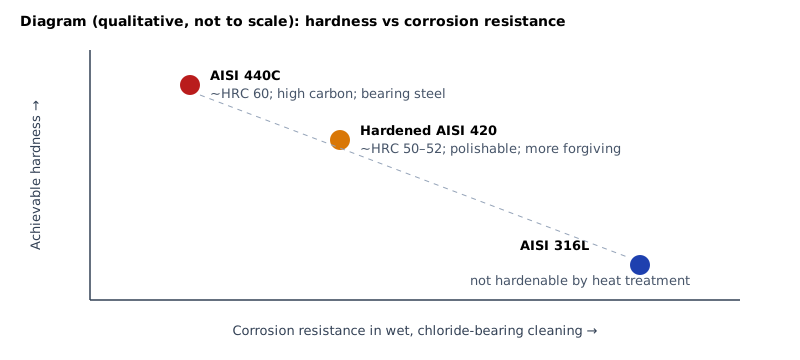 the trade-off between hardness and corrosion resistance for 420, 440C and 316L. Schematic, not a product test report.
This guide belongs to the materials and surfaces hub. It explains how 440 behaves in hygienic machinery. Exact composition limits and design values come from the steel or bearing supplier's datasheet.
440 stainless steel compared with other grades
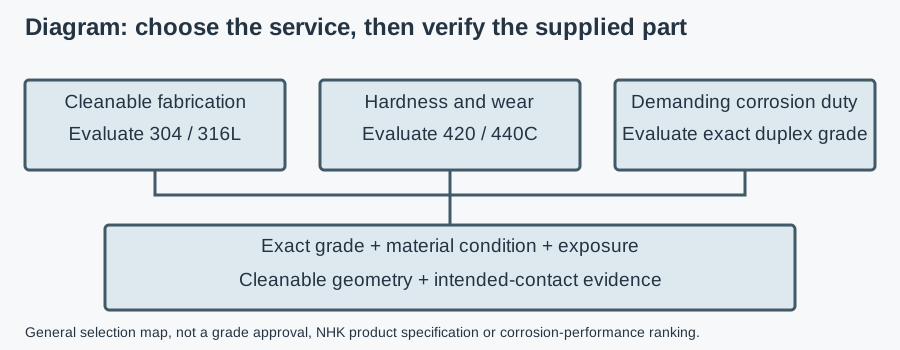
For assembly-wide material choices, see the fabrication, wear and washdown grade overview rather than applying a bearing grade to every component.
| Property | 440C (typical) | 420 (hardened) | 304 / 316L |
|---|---|---|---|
| Structure | Martensitic | Martensitic | Austenitic |
| Chromium | about 16–18 % | about 12–14 % | about 17–20 % |
| Carbon | about 0.95–1.2 % | about 0.15–0.4 % | ≤ 0.08 % / ≤ 0.03 % |
| Typical hardened hardness | about 58–60 HRC | lower, depending on carbon | Not hardenable by heat treatment |
| Corrosion resistance | Moderate; depends on supplied condition | Moderate; do not assume a universal ranking against 440C | Good / very good |
| Weldability | Very poor | Poor | Good |
| Typical use on food machinery | Bearing rings and balls, seats, wear parts | Shafts, blades, pump parts | Frames, housings, product-contact surfaces |
"440" is a family: 440A, 440B and 440C differ in carbon and therefore in hardness and toughness. In engineering use, and in nearly all stainless bearings, "440" means 440C. In Europe the closest grade is usually given as 1.4125 (X105CrMo17); bearing steel to ISO 683-17 is also made in a similar composition. Confirm the exact designation with the supplier.
For a head-to-head choice between the two martensitic grades, see 440C vs hardened 420 stainless steel. For 420 on its own, see the AISI 420 guide.
Send your application data and get a bearing recommendation
Why 440 is the stainless bearing steel
A rolling bearing carries its load on very small contact areas between balls and raceways. The contact stress is high, and the surface must resist rolling-contact fatigue and wear. That needs hardness in the region of 58 HRC or more – the range of conventional chrome bearing steel. Of the common stainless grades, only 440C reliably reaches it after hardening and tempering.
The trade-off comes from the carbon. Part of the chromium forms hard carbides instead of protecting the surface, so 440C is less corrosion-resistant than its chromium content suggests. Large carbides also limit toughness and the finest achievable polish compared with lower-carbon steels.
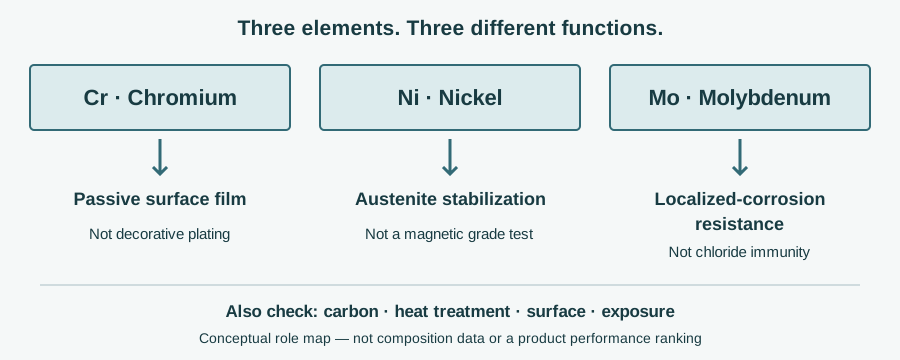
The alloy chemistry and verification guide explains why chromium content alone cannot rank a hardened wear part against an austenitic fabrication grade.
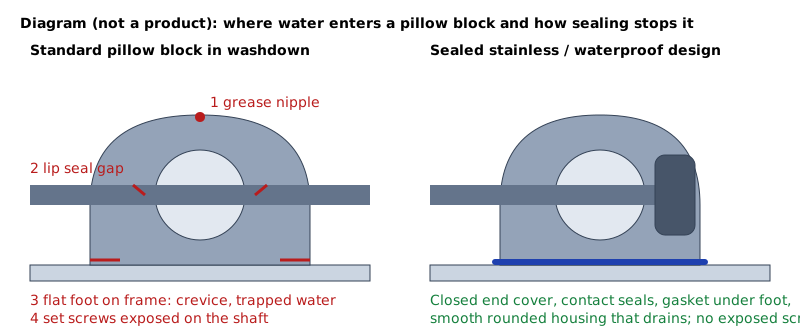
In practice, a stainless bearing is a system: 440C rings and balls, a housing in stainless steel or plastic, seals, and a food-grade lubricant. The steel only resists what the seal lets through.
Corrosion resistance in washdown
| Condition | 440C behaviour | What protects the part |
|---|---|---|
| Dry or splash-free area | Good | Normal lubrication |
| Water spray, neutral detergents | Generally acceptable | Seals, drainage, drying |
| Alkaline foam, then rinse | Acceptable if fully rinsed | Rinse sequence, seal design |
| Chlorinated sanitisers left on parts | Pitting and staining over time | Rinsing; consider coatings or other bearing materials |
| Brine, salted products | Poor – chloride pitting (local attack by chloride ions) | Keep out of contact; 316L housings, sealed design |
| Water trapped behind seals | Crevice corrosion and lubricant washout | Fully sealed, relubricable or sealed-for-life units |
| High-pressure jet aimed at seals | Water forced into the bearing | Seal type and cleaning procedure |
The splash zone – surfaces reached by spray but not by product – is where most 440 bearings sit. The usual failure sequence on site:
- High-pressure water and foam push past a contact seal.
- Cleaning solution dilutes or emulsifies the grease.
- Water stays in the bearing after cleaning; chlorides concentrate as it evaporates.
- Raceways show staining, then pitting; the bearing gets noisy and runs rough.
The steel is the last line of defence here. Seal design, lubricant and the cleaning procedure decide most of the service life. The effect of individual cleaning agents is covered in how chlorides and cleaning chemicals affect stainless steel machinery parts.
Galvanic corrosion is rarely the main issue inside a stainless bearing, but a 440 part in wet contact with a more noble metal can corrode preferentially; avoid mixed metals in wet joints.
Where 440 fits on food machinery
| Application | Why 440 | Watch out for |
|---|---|---|
| Ball bearing rings and balls in stainless bearing units | Hardness for rolling contact | Seal and lubricant decide washdown life |
| Valve seats, balls, needles | Wear and erosion resistance | Product and CIP (cleaning in place) chemistry |
| Cutting edges, knife parts | Edge retention | Chlorinated cleaning; regrinding removes passive layer |
| Wear pins and bushings | Hard surface | Lubrication, mating material |
| Frames, guards, hoppers, welded parts | Not suitable | Use 304 or 316L |
For housed bearings, see stainless steel pillow block bearings and mounted ball bearing units in stainless steel. For the structural parts around them, compare AISI 316L vs AISI 304.
How to decide whether 440 is right
- Does the part need hardness above what 420 achieves? Rolling bearings and high-wear surfaces usually do; otherwise consider 420 or an austenitic grade.
- Which zone is it in? In the product-contact zone (touches product or drains onto it), check food-contact documentation and cleaning chemicals first.
- Can chlorides reach it daily? If yes, plan for seals, rinsing and drying – or a different material.
- Is the part welded? 440 is not weldable in practice; use a mechanical joint.
- Specify the system, not only the steel – seal, lubricant and housing material.
Example (assumptions, for method only): a conveyor in a ready-meal plant has stainless pillow block bearings (440C inserts) in the splash zone. Daily alkaline foam, rinse and high-pressure cleaning; bearings fail with rough running after a few months. Inspection finds stained raceways and washed-out grease. Changing the steel would not address the cause; the options are a sealed unit with better protection against jets, adjusted nozzle distance and angle, a food-grade grease with better water resistance, and relubrication after cleaning where the design allows it. No outcome is claimed here – service life depends on the plant's own conditions.
What to write in the specification
- Grade and designation (for example 440C / 1.4125), and hardness range (HRC)
- For bearings: seal type, lubricant (food-grade, e.g. NSF H1 registered where required) and housing material
- Surface finish on exposed surfaces; EHEDG guidance of Ra ≤ 0.8 µm applies to product-contact surfaces
- Passivation suited to martensitic steel, where the part is exposed
- Material certificate (EN 10204 3.1) where traceability is needed
- Declaration of compliance with EC 1935/2004 if the finished part contacts food
What to send NHK
- Component (bearing unit, insert, wear part) and shaft size
- Zone and cleaning method (foam, high-pressure, CIP) and chemicals
- Load, speed and temperature
- Current problem (rust, noise, wear) and how long parts last now
- Certificates and documents needed; quantities; delivery country
NHK's technicians suggest components and send a quote. To browse, see NHK's sealed stainless bearing units, or read NHK's comparison of 420 and 440 steels.