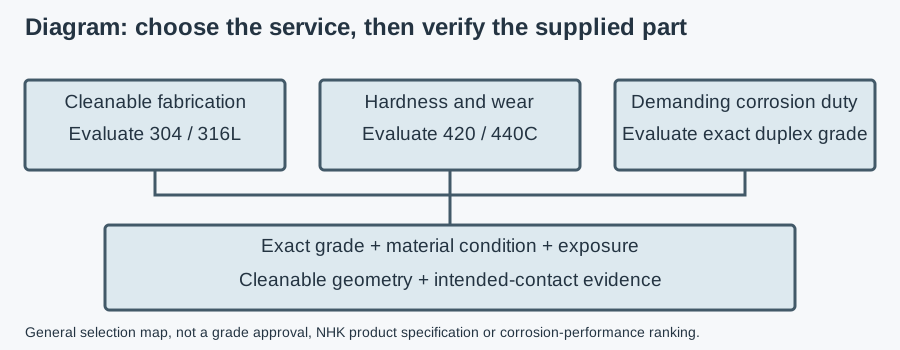
Food grade stainless steel describes stainless material selected and documented for an intended food-contact use, not one universally approved alloy. The engineering decision joins grade, material condition, surface integrity, geometry and exposure. This overview routes readers to specific grade guides in the Materials and surfaces hub; it does not replace a component datasheet or an application-specific compliance assessment.
Stainless steel grades: choose the job before the alloy
Start with what the part must do. A cleanable frame, a welded vessel fitting and a hardened bearing race have different mechanical and corrosion requirements. The product-contact zone directly touches food; a splash zone receives product or cleaning liquid without intended direct contact. A non-contact part still needs assessment where corrosion debris, lubricant or cleaning runoff could reach the food path.
Record both process exposure and cleaning. Include the food, contact duration, cleaning chemicals and concentrations, temperature, rinsing, drainage and any retained deposits. The nominal alloy designation does not describe all these conditions. Specify the metal's supplied condition and fabrication treatment as well as its name; hardened, welded and machined parts need different checks.
| Grade or family | Why evaluate it | What limits the choice | Confirm before specifying |
|---|---|---|---|
| AISI 304 / 304L | Austenitic fabrication and cleanable structural parts in compatible service | Chloride exposure, crevices and fabrication condition | Exact grade, weld procedure, finish and cleaning compatibility |
| AISI 316L | Austenitic fabrication where greater chloride-pitting resistance is needed | Not immune to chloride attack or unsuitable chemicals | Exposure assessment and finished-part condition |
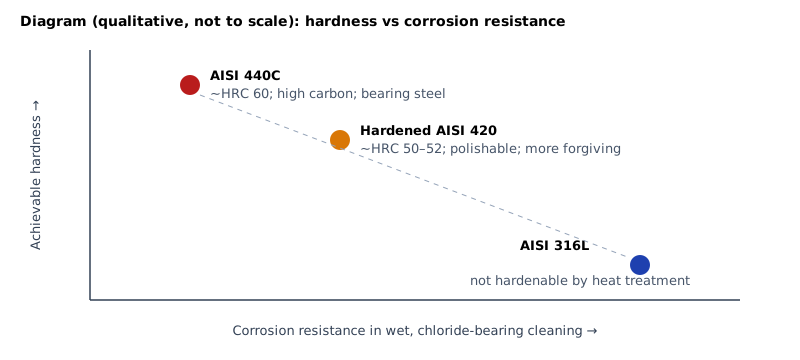
| AISI 420 | Martensitic parts where heat-treated hardness is important | Corrosion behavior depends on grade and heat treatment | Exact designation, hardness requirement and corrosion limits |
| AISI 440C | Hardened rolling-contact or wear applications | Not a substitute for a fabricated corrosion-resistant frame alloy | Supplied condition, wear duty and protection from exposure |
| Duplex stainless steel | Combined strength and corrosion requirements beyond some conventional choices | Properties vary by grade; fabrication needs specific control | Exact duplex grade, compatibility and qualified processing |
Send material and cleaning requirements for a component recommendation
These rows are selection directions, not product approvals or a universal ranking. A corrosion-resistant alloy cannot correct an inaccessible gap, and a hardened alloy cannot be substituted simply because another grade has better washdown resistance. Resolve the mechanical requirement and exposure together.
Which grade guide do I need?
The stainless-steel cluster separates broad selection from specific material questions. Use the guide matching the decision you face; do not create a specification by combining unrelated headline properties from several grades.
| Decision | Guide | What it adds |
|---|---|---|
| 304 or 316L for fabricated parts? | Austenitic grade selection for cleaning and welding | Grade comparison, fabrication and application criteria |
| Hardened 420 or 440C? | Hardness and service trade-offs between hardened grades | Wear-part choice rather than frame selection |
| What does 420 mean? | 420 material condition and washdown limits | Martensitic grade identity and treatment considerations |
| What does the 440 family mean? | 440-family selection for bearings and wear parts | Exact designation and component-use questions |
| What does a 3-A requirement mean for material? | Stainless material evidence for 3-A sanitary requirements | Applicable standard, surface and documentation context |
There is no standalone duplex page in this cluster. The duplex section below provides the overview without creating a second page or inventing a product range.
Advantages of stainless steel—and what they do not prove
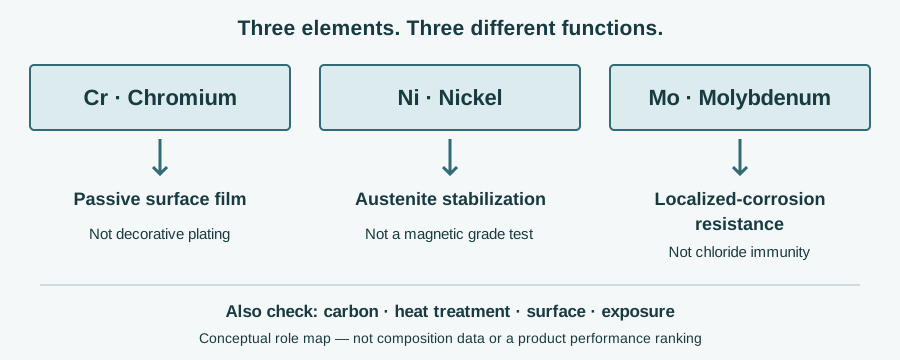
Stainless steels rely on a chromium-rich passive surface film for corrosion resistance. This can support durable, cleanable surfaces in compatible service, but the film is not an impermeable coating. Mechanical damage, contamination, deposits and aggressive exposure can change the surface condition. Corrosion resistance is an application property, not a promise that stainless never stains or pits.
The chromium, nickel and molybdenum role guide explains how passive-film formation, crystal structure and localized-corrosion resistance contribute differently to that selection.
Austenitic grades can suit forming and welding, while martensitic grades can provide heat-treated hardness for particular wear duties. Duplex grades combine austenitic and ferritic structures and can offer useful strength and corrosion properties for selected applications. These are different advantages: a frame needs stiffness and fabrication quality, whereas a raceway needs a specified contact and heat-treatment condition.
Stainless material can tolerate appropriate cleaning procedures without absorbing liquid into the bulk metal. That does not mean a rough joint, damaged weld or trapped residue is cleanable. Nor does it establish compatibility of the seals, lubricant, plastic inserts or cable glands fitted beside the metal. Specify the complete component and installed assembly, not only the visible body.
304 and 316L: fabricated parts, chloride exposure and welding
304 is a common starting point for austenitic stainless fabrication where the environment is compatible. The molybdenum-bearing 316L grade generally offers greater chloride-pitting resistance than 304, but neither is immune. Chloride pitting is localized attack that may progress beneath a small surface opening. Warm, concentrated or stagnant exposure can be more demanding than a brief well-rinsed contact; identify the real conditions rather than writing “wet area.”
The L designation denotes a low-carbon variant. For welded equipment, assess the exact grade and welding procedure rather than treating 304, 304L and 316L as interchangeable labels. Welding, heat tint, embedded iron contamination and subsequent surface treatment influence finished-part performance. Request the fabricator's applicable procedure and inspection evidence, not a claim that low carbon removes every welding risk.
Do not prescribe 316L solely because the machine is washed daily, or 304 solely because it is outside direct food contact. A draining 304 component in compatible service and a creviced 316L component in unsuitable chemistry present different risks. The decision needs exposure data, fabrication condition and the actual joint design.
420 and 440C: hardness is a separate requirement
420 and 440C are martensitic stainless designations associated with heat-treated hardness. They may be relevant to blades, rolling contact or wear parts, but their supplied condition matters as much as the family name. Require the exact grade designation and applicable treatment evidence; do not use an unsourced hardness value as a design input.
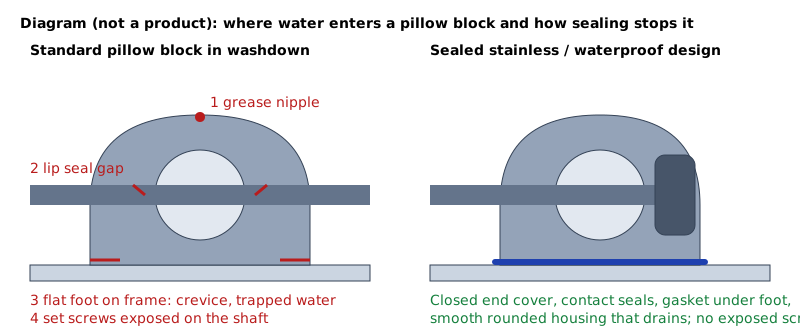
A bearing unit can contain different grades in its housing, shaft interfaces and rolling elements. A stainless housing does not identify its raceway material, and a raceway grade does not prove the external enclosure withstands the cleaning cycle. NHK's 420 and 440 reference comparison provides additional context; it is not evidence of the grade in every NHK bearing model.
If exposed hardened parts face washdown, assess corrosion protection and the surrounding sealing arrangement without assuming that harder means more corrosion-resistant. Confirm whether the part's wear function can coexist with the intended exposure. A grade substitution needs review of fit, contact stress, heat treatment and life requirements, not just an alloy name changed on an order.
Duplex: specify a grade, not a family promise
Duplex stainless steels have a mixed austenitic/ferritic structure. Particular grades can offer a useful combination of strength and corrosion resistance, but “duplex” alone does not establish composition, weld behavior or resistance to every cleaning chemical. Specify the exact designation and obtain application evidence for the relevant exposure.
Evaluate fabrication capability, joining to other parts and the delivered material condition. Welding and processing require control appropriate to the grade; a stock material property cannot validate a finished welded assembly. Higher strength also does not automatically justify a thinner hygienic component: stiffness, distortion, fatigue, cleanability and attachment design still need assessment.
Consider an exact duplex grade when conventional choices do not meet the documented service requirements, not as an automatic upgrade for every food line. No NHK duplex component offering, strength value or corrosion threshold is established by this guide.
Washdown limits: inspect geometry and surface condition
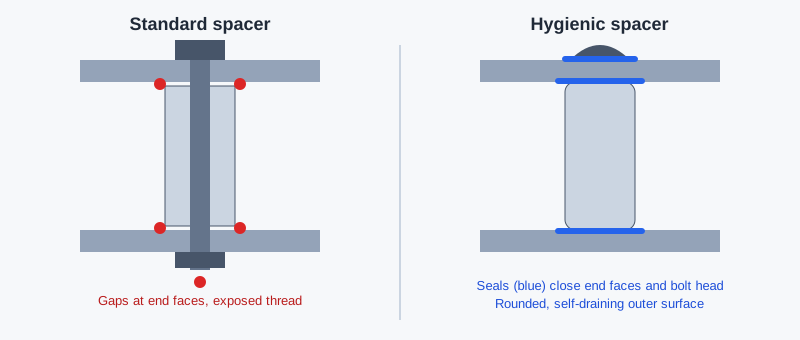
A crevice is a narrow gap that can retain liquid and soil beyond effective cleaning. A harborage point is a location where residue survives the cleaning procedure. Washer seats, poorly closed tubes, overlapping plates and damaged seals can create both hygiene and corrosion problems. Self-draining surfaces release liquid instead of retaining pools; check drainage in the installed position.
Deposits can retain and concentrate aggressive substances. Chloride pitting and crevice corrosion are not corrected merely by polishing the visible exterior. The field guide to identifying pits, crevices and cracking adds the exposure and fault-investigation detail. Define the cleaning process before declaring a grade acceptable, including foam, rinse, cleaning-in-place (CIP: cleaning without dismantling) or cleaning-out-of-place (COP: removed parts cleaned separately).
Passivation treats a suitably prepared stainless surface to support its passive condition; it does not fill pits or close an uncleanable gap. Removal of heat tint or contamination may require other preparatory treatment. Specify the required fabrication and treatment outcome through an appropriate procedure. Avoid an undefined instruction to “passivate everything” as a substitute for inspection.
Use the finishing-process selection and acceptance checklist to distinguish contamination removal from smoothing and specify evidence for the finished component.
For stainless connected to aluminum or plated steel, use the mixed-metal compatibility and wetted-area checks before treating an alloy upgrade as the complete remedy.
Surface roughness Ra describes averaged profile variation. It does not capture every scratch, pit, weld discontinuity or joint. Set the acceptance basis for the relevant surfaces and how they will be checked; no universal finish value is imposed here. A low reported Ra is not a food-contact declaration or hygiene certificate.
The finish measurement and drawing-acceptance guide explains how to define the parameter, measurement locations and separate defect checks.
Food-contact evidence is not a grade certificate
Regulation (EC) No 1935/2004 concerns materials and articles intended to contact food and their suitability under intended use. Grade identification alone does not establish that a finished article meets its applicable requirements. Consult the official food-contact framework regulation for the legal text. The food-contact material selection and document guide explains how metal, plastic and elastomer evidence differs.
Regulation (EU) No 10/2011 is plastics-specific; do not request it as a blanket stainless-steel approval. For metals, identify applicable requirements in the destination market and request relevant supplier evidence for the actual article and use. A formal declaration requirement depends on the applicable measures and jurisdiction; do not imply that every stainless item has the same mandatory declaration format. Material traceability and intended-contact evidence are related but different documents.
EHEDG certifies specific equipment designs, not alloy grades or a supplier's entire catalog. Similarly, a 3-A Symbol authorization concerns the identified equipment and applicable requirements, not every stainless part nearby. An IP ingress test does not establish hygiene or food-contact suitability. Keep these claims separate when checking the supplier's documents.
The supplier evidence route for different contact materials distinguishes metal identity from plastics migration and US material-specific compliance.
Example: compare two component functions on one food line
Example — hypothetical assumptions, not NHK field data. Assume a wet food line needs a fabricated guide bracket near product splash and a hardened rotating wear part inside a protected assembly. The plant has a defined cleaning procedure but no grade has yet been approved.
- Identify each function and zone. Record whether direct food contact or foreseeable transfer occurs, the mechanical duty and the route by which residue reaches the part.
- For the bracket, evaluate appropriate austenitic grades using actual cleaning exposure and the fabrication detail. Inspect the seat and drainage; do not assume an upgraded alloy resolves a trapped-liquid joint.
- For the wear part, obtain the exact hardened grade, supplied condition and required performance from its designer. Check the assembly's protection and maintenance limits instead of substituting a frame alloy.
- Ask for separate material identity, intended-contact evidence where applicable and certificate scope if required. Match each document to the actual item, configuration and use conditions.
- Agree inspection and cleaning acceptance before purchase. If either part retains liquid or exposes an incompatible interface, revise the design or process and reassess the grade.
The outcome is a documented selection route, not a claim that either component or alloy passes a specific food-contact or corrosion test.
Inspection and RFQ: make the selection auditable
At installation and planned maintenance, safely inspect the exposed part and its interfaces. Look for retained residue, staining, pitting, scratches, damaged seals and weld discontinuities. Record location and exposure before deciding on repair or replacement. Do not grind out damage without checking remaining geometry and the approved repair procedure.
| Observation | What to investigate | Action to specify |
|---|---|---|
| Staining near a connection | Contamination, retained liquid and cleaning changes | Diagnose cause and confirm suitable surface treatment |
| Local pits beneath deposits | Chemistry, drainage and actual alloy condition | Assess damage, exposure and repair/replacement requirements |
| Residue after cleaning | Access, joints, seals and procedure | Correct retention pathway and validate cleaning |
| Unexpected wear or cracking | Grade, treatment, loads and assembly fit | Engineering review before alloy substitution |
| Document mismatch | Item designation, condition and intended use | Obtain item-specific evidence before approval |
Copy and complete: “Component, drawing and quantities: __. Mechanical function and supplied material condition: __. Product/contact or splash zone: __. Cleaning chemicals, concentration, temperature, duration and drainage: __. Proposed grade, surface and fabrication requirements: __. Required material identity, intended-contact evidence and exact certificate scope: __. Delivery country: __.”
Use the buyer's material-document checklist to organize the drawing and intended-use evidence before sending the request.
NHK's stainless machinery fittings category is the secondary browsing path; it does not establish that every listed part uses one grade or offers every alloy described here. Send the completed application through the site's enquiry form so NHK can confirm available components and supporting documents, then propose an appropriate component and quotation. No stock, response-time or universal material-approval claim is made.