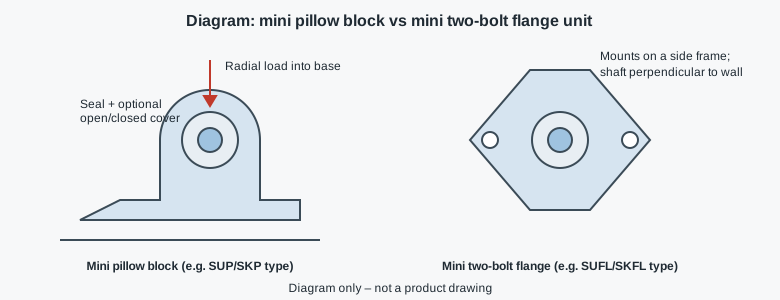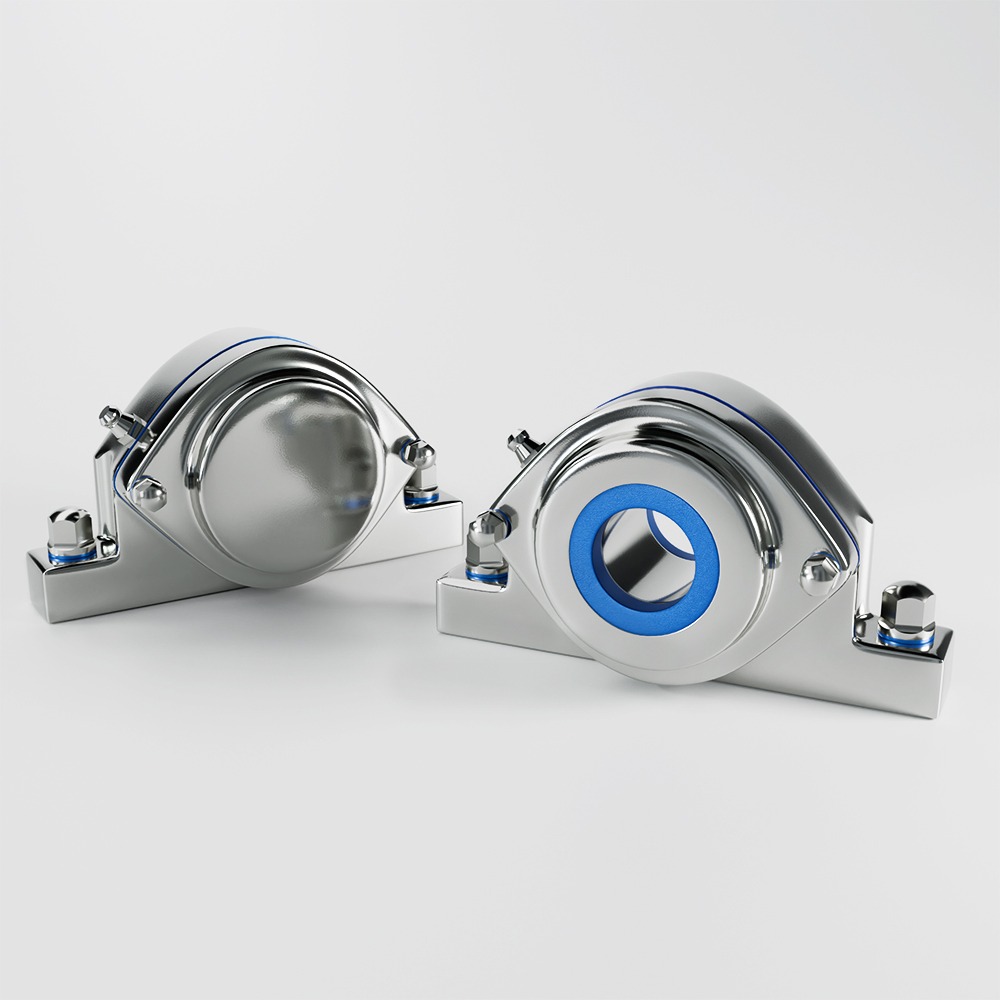
Stainless steel pillow block bearings are housed bearing units – a bearing insert in a housing whose base bolts to a surface parallel to the shaft – with both housing and insert made of corrosion-resistant steel. Waterproof pillow block bearings go a step further: contact seals, closed end covers and a sealed housing keep water and detergent out of the bearing. Both exist for one reason – a standard cast-iron unit with a chrome-steel insert does not survive daily wet cleaning.
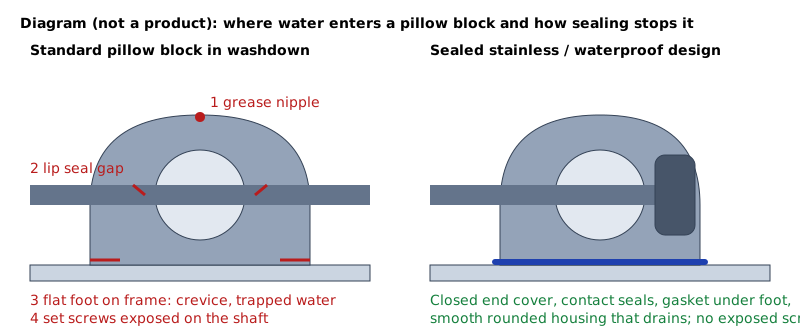 water entry points on a standard pillow block vs a sealed stainless design. Schematic, not a product test report.
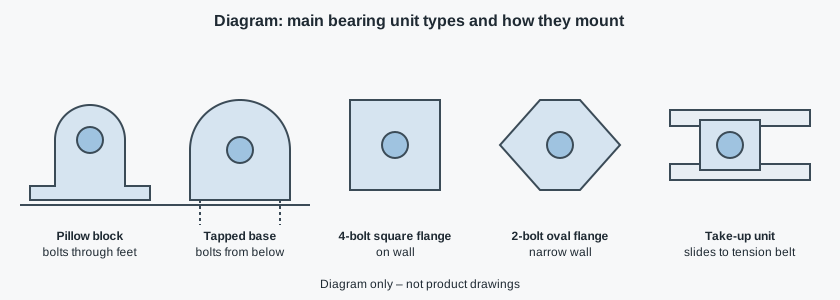
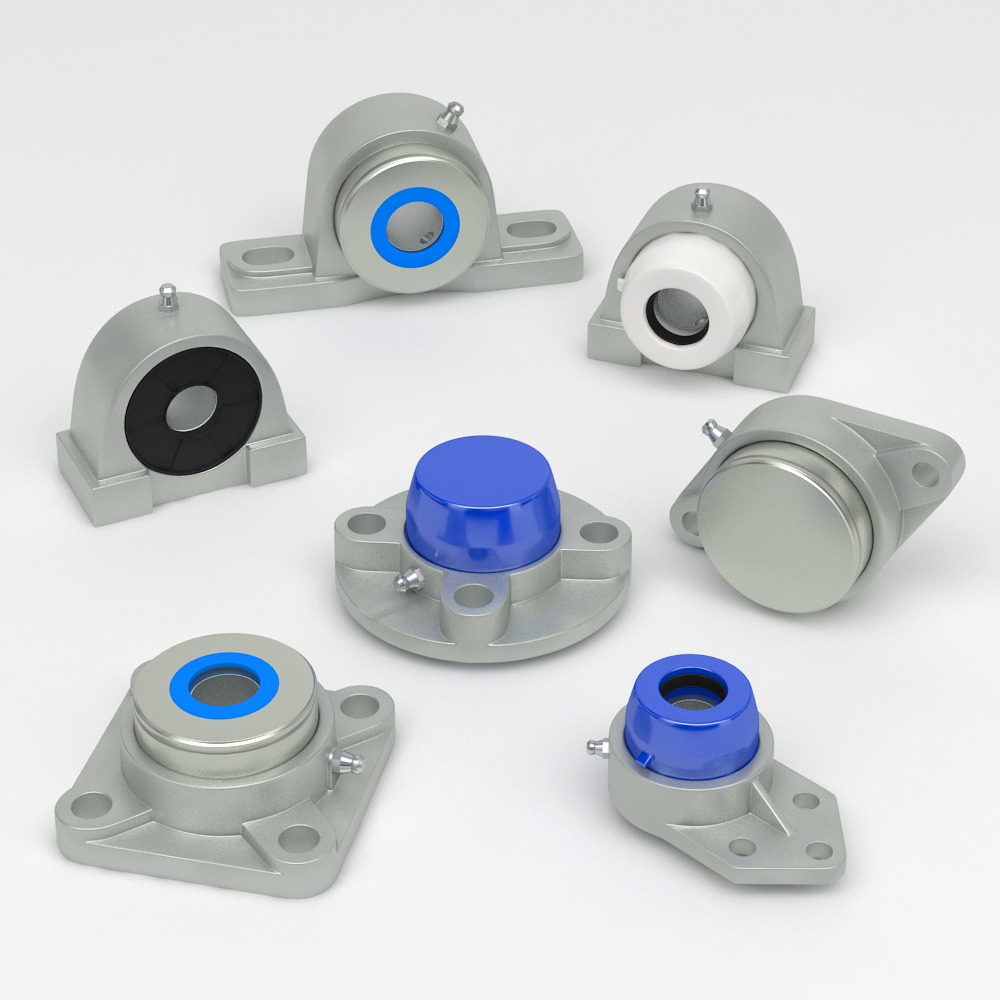
For the other housing shapes – flange, take-up, tapped base – see the overview of bearing unit types for hygienic areas. The general geometry, insert types and shaft locking of pillow blocks are covered in the complete pillow block bearing guide; this page concentrates on stainless and waterproof versions for washdown.
Standard vs stainless vs waterproof pillow blocks
| Feature | Standard (cast iron + chrome steel) | Stainless steel pillow block | Waterproof / sealed pillow block |
|---|---|---|---|
| Housing | Painted cast iron | AISI 304 (sometimes 316) | Stainless or thermoplastic, smooth and rounded |
| Insert | Chrome bearing steel | Hardened stainless, usually 440C (how 440 stainless steel behaves in washdown) | Usually 440C stainless |
| Seals | Single lip or flinger | Contact lip seals | Multiple contact seals, often with covers |
| Covers | Rarely | Optional open or closed | Typically closed on shaft ends |
| Foot to frame | Flat, unsealed | Flat, unsealed unless specified | Sealed or designed to drain |
| Load rating | Reference | Lower than chrome steel, same size | Lower; housing may also limit |
| Typical zone | Dry, non-food | Wet, splash zone | Daily washdown, splash zone near open product |
The splash zone is the area that product or cleaning spray reaches but where the part does not touch product. Most conveyor and machine-frame bearings sit there.
Send your application data and get a pillow block recommendation
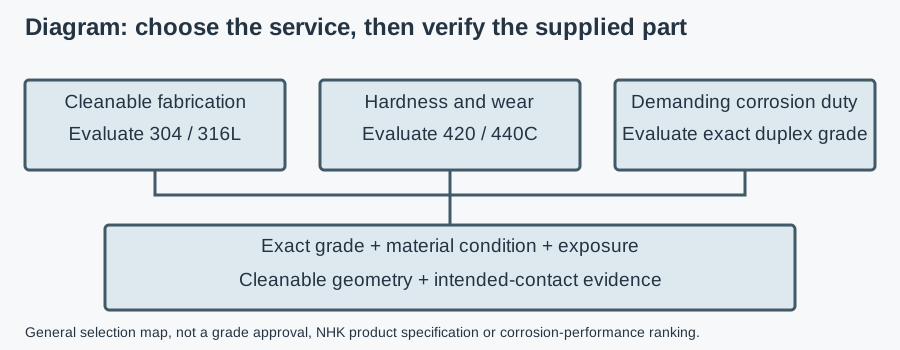
Materials: housing and insert
Housing. AISI 304 is the common grade and handles most food and beverage cleaning. AISI 316 adds molybdenum, which improves resistance to chloride pitting – local corrosion caused by chloride ions from salt, brine or chlorinated cleaners. Thermoplastic housings are light and corrosion-free, but check the load limit, impact resistance in cold rooms and chemical resistance.
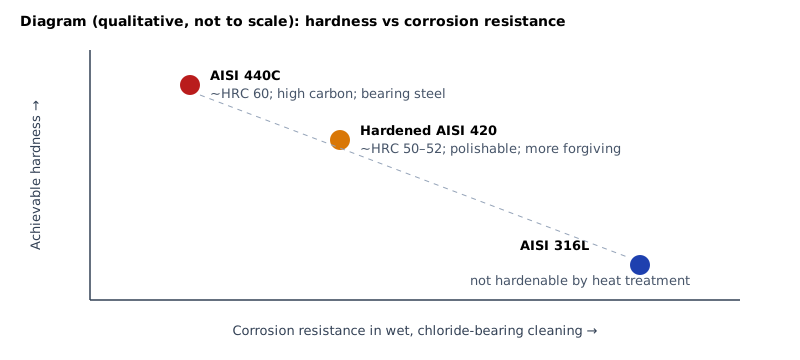
Insert. Stainless inserts are hardened martensitic steel, usually 440C, because the austenitic grades used for housings are too soft for rolling contact. 440C resists water and mild cleaners well but is less corrosion-resistant than 304 or 316; in strongly chlorinated environments even a 440C insert can show surface rust. The trade-off between hardness and corrosion resistance is explained in 440C vs hardened 420 stainless steel.
Fasteners and shims. Use stainless bolts in the same grade family as the housing. A zinc-plated bolt in a stainless foot rusts and stains the housing, and mixing metals in a wet joint invites galvanic corrosion.
Seals, covers and lubrication
Seals decide service life in washdown far more than the housing material does. Contact lip seals keep water out better than labyrinths or flingers but add friction and heat at higher speeds. Elastomer compatibility matters: NBR is common, EPDM tolerates hot water and alkaline cleaners but not oils, and FKM resists oils and many chemicals at a higher price.
End covers turn the shaft end, set screws and the outer seal into one cleanable surface. Use a closed cover where the shaft ends at the bearing and an open cover with its own seal where the shaft passes through; bearing covers explains the choice and the expansion clearance needed inside a closed cover.
Lubrication follows the zone. In food areas the grease should be registered NSF H1 (incidental food contact). Units are either sealed for life or relubricatable through a grease nipple. Relubricatable units can be purged after cleaning to push out water, but over-greasing forces seals out and leaves grease on the housing where product sticks.
Waterproof pillow block bearings and IP ratings
Many waterproof units are described with an IP rating. IP67 (IEC 60529) is a temporary immersion test; IP69K (ISO 20653) is a high-pressure, high-temperature jet test. Neither is a hygiene certification, and neither means the seal can take a jet aimed at it every day. The difference is set out in IP68 or IP69K in hygienic zones, and sealing principles in sealed waterproof stainless steel bearing units.
Selection method
- Define the zone and cleaning method: dry, wet, daily foam and rinse, or high-pressure washdown; note chemicals and temperatures.
- Choose housing material: 304 by default; 316 for high chlorides; thermoplastic for light loads where weight or cost matters.
- Size the insert with stainless ratings: calculate life with the 440C dynamic rating, not the chrome-steel figure.
- Choose sealing and covers: contact seals for washdown; closed covers on shaft ends; open covers with seals on through shafts.
- Decide lubrication: sealed for life or relubricatable, with NSF H1 grease in food areas.
- Detail the mounting: housing type (standard or tapped base), bolt grade, and how the foot is sealed to the frame or kept clear of it so water drains.
- Request documents: material certificates, grease registration, and the certificate of the specific design if a certified unit is required.
Example (assumptions, for method only): a stainless belt conveyor in a meat plant, foamed and rinsed daily with chlorinated alkaline detergent. Tail shaft 30 mm, radial load per bearing 1.2 kN at 100 rpm, required life 20,000 h. The engineer checks basic rating life L10h = (10⁶ / (60·n)) · (C/P)³ using the supplier's 440C dynamic rating C for a 30 mm unit and P = 1.2 kN, confirms the result exceeds 20,000 h with margin, and selects a 304 housing, contact seals, a closed cover on the tail shaft and an open cover on the drive side. Units are relubricatable with H1 grease after each cleaning. No figure here is an NHK rating.
Installation checklist
- Mount on a flat, clean surface; a twisted foot distorts the housing and preloads the bearing.
- Use stainless bolts and washers; tighten to the specified torque.
- Tighten set screws or the eccentric collar after aligning the shaft, then recheck after run-in.
- Leave clearance for shaft growth on long shafts – lock one bearing, let the other float or use a unit that allows axial movement.
- Fit covers last and confirm gaskets seat evenly.
Failure modes after washdown
| Symptom | Likely cause | Prevention |
|---|---|---|
| Rough running, brown grease | Water past the seals | Contact seals, covers, no jets at seals, purge after cleaning |
| Rust on insert or shaft | 440C in chlorides, or carbon-steel shaft | Rinse chemicals off, stainless shaft, check cleaner concentration |
| Black residue at the foot | Crevice between foot and frame | Seal the foot or space it to drain |
| Seal lip pushed out | Over-greasing | Small, measured amounts of H1 grease |
| Shaft fretting at the bore | Loose set screws | Recheck after run-in, correct shaft tolerance |
Use the bearing-seat damage checks to separate mechanical movement from corrosion and decide which measurements to take before replacing the unit.
For housed stainless units in general, including sizing with stainless ratings, see mounted ball bearing units in stainless steel.
What to send for a recommendation
For any claimed hygienic certification, use the verification evidence for the quoted pillow-block assembly before relying on it in the specification.
- Shaft diameter and housing type (standard or tapped base)
- Radial load, speed and required life
- Zone, cleaning method, chemicals and temperature
- Preferred housing material and covers (open/closed)
- Relubricatable or sealed for life; documents needed; quantities; delivery country
An NHK technician suggests a matching unit and sends a quote. To browse, NHK lists sealed stainless bearing units and IP67 bearing house units. Confirm pillow-block availability, materials, covers and ingress-test evidence for the exact proposed configuration; category names are not selected-unit specifications.