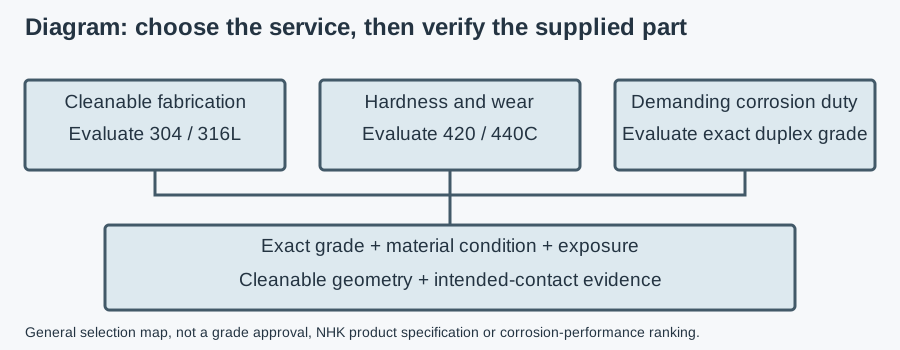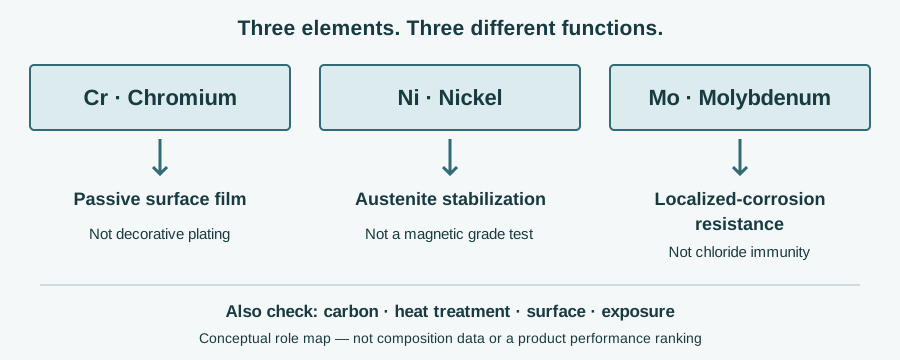
Chromium, nickel and molybdenum in stainless steel perform different jobs: supporting passivity, influencing crystal structure and improving resistance to certain localised corrosion mechanisms. They are not interchangeable measures of quality. Use the stainless grade and application-evidence overview for the wider selection; this guide explains why a composition label cannot decide the complete component specification.
Chromium, nickel and molybdenum: what each element does
| Element | Main role relevant to machinery | Practical implication | What the element name does not prove |
|---|---|---|---|
| Chromium | Enables a chromium-rich passive surface film | Surface contamination, welding and exposure influence corrosion performance | Permanent immunity, a sound weld or a cleanable joint |
| Nickel | Stabilises austenite in common chromium-nickel stainless grades | Helps explain the structure and fabrication behaviour of 304 and 316L | A universal chloride limit or magnetic identification of a grade |
| Molybdenum | Improves resistance to localised corrosion in suitable stainless compositions | Helps explain why 316L generally offers more chloride-pitting resistance than 304 | Compatibility with every cleaner or a guaranteed service life |
Read the table as a mechanism map, not a ranking of percentages. Carbon, nitrogen, processing and material condition also matter. The same nominal alloy can behave differently after fabrication or unsuitable heat treatment. Match composition to the exact grade designation and the supplied condition rather than buying “chromium-nickel steel” without a specification.
Chromium content stainless steel: passive film, not plating
Chromium allows stainless steel to form a thin protective passive film in a suitable environment. Passivity describes reduced metal dissolution because of that surface condition. It is not a thick coating, and stainless steel is not ordinary carbon steel made corrosion-resistant by decorative chromium plating.
Bulk chromium content alone cannot describe local surface resistance. Weld heat tint, embedded iron, deposits and crevices can undermine performance. Chromium tied up in carbides is not equivalent to chromium remaining in the surrounding metallic matrix. Grade chemistry and thermal history therefore belong together in the material record.
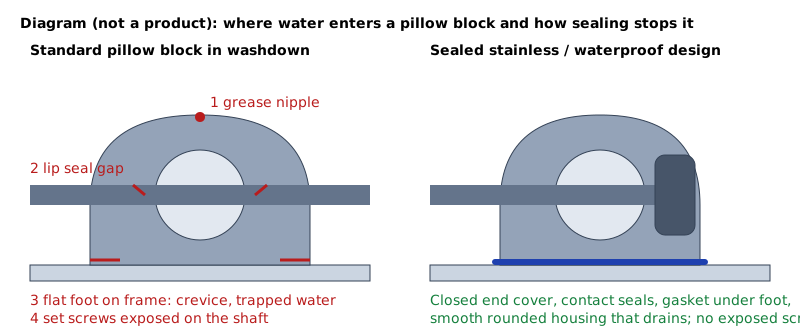
Inspect staining before assuming the alloy contains too little chromium. Determine whether the mark is transferred contamination, a pit or damage at a joint. Use the corrosion location and confirmation sequence instead of diagnosing composition from colour. More chromium on a datasheet does not repair an existing cavity or close a liquid-trapping gap.
Nickel in stainless steel: austenitic structure and fabrication
Austenite is a crystal structure. Nickel helps stabilise it in common austenitic stainless steels such as 304 and 316L, contributing to the combination of ductility and fabrication behaviour useful for formed or welded equipment. Austenitic stainless is not the only stainless family: ferritic and martensitic grades can be stainless without the same nickel addition.
Do not identify 304 or 316L using a magnet alone. Annealed austenitic material generally has low magnetic response, but cold work can introduce magnetic phases and weld metal may contain ferrite. Magnetic response does not establish nickel content, exact grade, food-contact suitability or corrosion performance.
Nickel is not a substitute for molybdenum when assessing chloride pitting. Nor does the word “austenitic” confirm a finished part's welding quality or chemical compatibility. Require the material designation, fabrication condition and exposure record. A grade family is a starting point, not a component approval.
What does molybdenum do in stainless steel?
Molybdenum improves resistance to pitting and crevice corrosion in appropriate stainless alloys. Pitting is localised attack after passive-film breakdown; crevice corrosion develops in a sheltered gap with altered local chemistry. Its contribution helps explain the greater chloride-pitting resistance generally associated with 316L compared with 304.
For that practical choice, use the 304 and 316L fabrication and exposure comparison. Molybdenum does not make 316L immune to chlorides. Cleaner concentration, temperature, contact time, retained deposits and drainage still determine the exposure; unsuitable conditions may require a different material or design after specialist assessment.
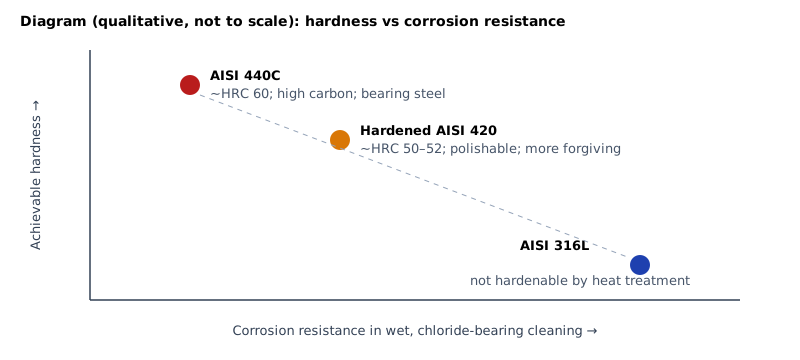
Pitting-resistance equivalents are composition-based screening tools. They do not calculate component life or establish resistance to every corrosion mechanism. Do not apply a simple bulk-composition ranking across hardened martensitic and austenitic parts without considering carbides, heat treatment and actual service.
Why 420 and 440 need carbon and heat-treatment checks
Martensitic stainless steels can be hardened through an appropriate thermal cycle. Carbon and heat treatment help provide wear resistance, while carbide formation and the surrounding matrix condition influence corrosion behaviour. A higher chromium number is therefore not sufficient to rank a hardened wear part against a fabricated austenitic bracket.
The 420 designation and delivered-condition guide explains why the exact variant matters. The 440-family wear-part specification guide separates family names from an identified grade such as 440C. Do not treat “440” as a complete order description or substitute a softer fabrication alloy where the designer requires hardened rolling-contact performance.
NHK's martensitic-grade reference comparison is the secondary background path, not evidence that every NHK bearing uses either grade. In a complete component, housings, rolling elements, fasteners and shafts may require separate material identities and verification.
Verify composition, surface condition and intended use
- Identify each material. Match the drawing, exact designation and material record to the delivered component. Separate housing, insert and fastening materials instead of assuming one grade throughout.
- Check supplied condition. Request relevant heat-treatment or hardness evidence for wear parts and fabrication records where needed. Composition alone does not establish those properties.
- Choose identification methods deliberately. Positive material identification (PMI) can screen alloy chemistry. Handheld X-ray fluorescence commonly measures chromium, nickel and molybdenum but does not establish the low-carbon L designation; use appropriate carbon-capable analysis and traceable records where that distinction matters.
- Inspect finished surfaces. Check weld condition, contamination, damage and retained-liquid interfaces. Agree inspection methods rather than accepting brightness as proof of passivity or cleanability.
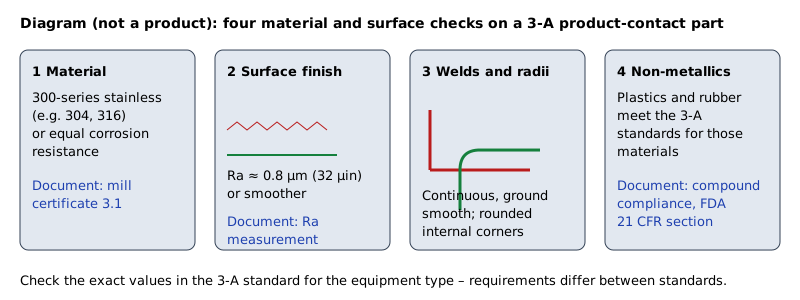
- Separate compliance documents. Regulation (EC) No 1935/2004 addresses intended food-contact use, not a chromium or nickel percentage. Use the finished-article contact-document checklist to distinguish alloy identity from relevant compliance evidence.
For claimed equipment certification, use the design-certificate scope and configuration checks. EHEDG certification and 3-A Symbol authorization are not conferred by an alloy composition or an analysis report.
Example and enquiry: translate chemistry into a component question
Example — hypothetical assumptions, not NHK field data. A machine needs a welded splash-zone bracket and a hardened internal wear part. The bracket sees a documented cleaning cycle; the wear part has a designer-defined hardness requirement. No grade or component has yet been approved.
For the bracket, compare fabrication grades against the actual exposure and weld preparation. For the wear part, request the exact hardened grade and condition before considering substitutions. Do not select both by the highest chromium figure or assume molybdenum resolves a damaged seal. The outcome remains conditional on application evidence.
Copy and complete: “Component/drawing and quantity: __. Function and mechanical duty: __. Exact material for each part and supplied condition: __. Product-contact/splash zone: __. Cleaner, concentration, temperature, dwell and rinse: __. Weld, finish and inspection requirements: __. Material, treatment, intended-contact and certificate documents needed: __. Delivery country: __.”
Send these fields through the existing enquiry form. NHK can clarify component options and documents, suggest a component and quote; material availability needs confirmation for the actual item. NHK's stainless machinery component browsing category is the secondary product path, not a claim that every listed part contains all three elements.