420 stainless steel – AISI 420, often written "420 steel" or "stainless steel 420" – is a martensitic stainless steel: a chromium steel with enough carbon to be hardened by heat treatment, like a tool steel, while keeping some of the corrosion resistance of stainless. That combination makes it popular for blades, shafts, pump parts and wear components. It also defines its limit: 420 is the least corrosion-resistant of the stainless grades commonly found on food machinery, and in daily washdown that matters.
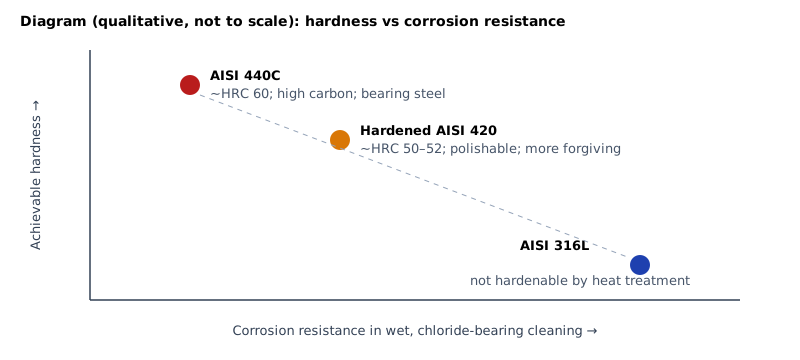 the trade-off between hardness and corrosion resistance for 420, 440C and 316L. Schematic, not a product test report.
This page is part of the materials and surfaces hub. It covers what 420 is, how hardening affects it, how it behaves in hygienic environments and where it fits. Composition limits and mechanical values vary with the exact grade and supplier; use the supplier's datasheet for design values.
What 420 stainless steel is
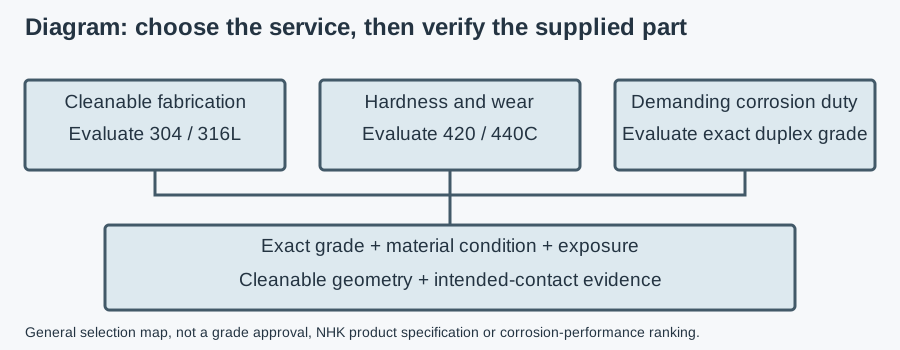
Use the stainless material selection and evidence checklist for the broader decision before specifying a hardened part.
Stainless steels are grouped by their crystal structure. Austenitic grades (304, 316L) are tough, weldable and the most corrosion-resistant of the common grades, but cannot be hardened by heat treatment. Martensitic grades (410, 420, 440C) contain more carbon and can be hardened, but have lower corrosion resistance. 420 sits in the middle of the martensitic family.
| Property | 420 (typical) | 304 / 316L | 440C |
|---|---|---|---|
| Structure | Martensitic | Austenitic | Martensitic |
| Chromium | about 12–14 % | about 17–20 % | about 16–18 % |
| Carbon | about 0.15–0.4 % | ≤ 0.08 % / ≤ 0.03 % | about 0.95–1.2 % |
| Molybdenum | none or trace | none / about 2–2.5 % | up to about 0.75 % |
| Hardenable | Yes | No | Yes, higher |
| Magnetic | Yes | Largely no (annealed) | Yes |
| Weldability | Poor | Good | Very poor |
| Corrosion resistance | Moderate | Good / very good | Moderate; NHK describes hardened 440C and 420 as broadly similar |
"420" is not one steel. European standards split it into several grades with different carbon levels:
| Common name | EN number | Designation | Notes |
|---|---|---|---|
| 420 (low carbon) | 1.4021 | X20Cr13 | Tougher, lower hardness |
| 420B | 1.4028 | X30Cr13 | Higher hardness; common for shafts and tools |
| 420C / 420 high carbon | 1.4034 | X46Cr13 | Highest hardness of the 420 family; blades |
When a drawing says "AISI 420" without an EN number or hardness, two suppliers can deliver noticeably different parts.
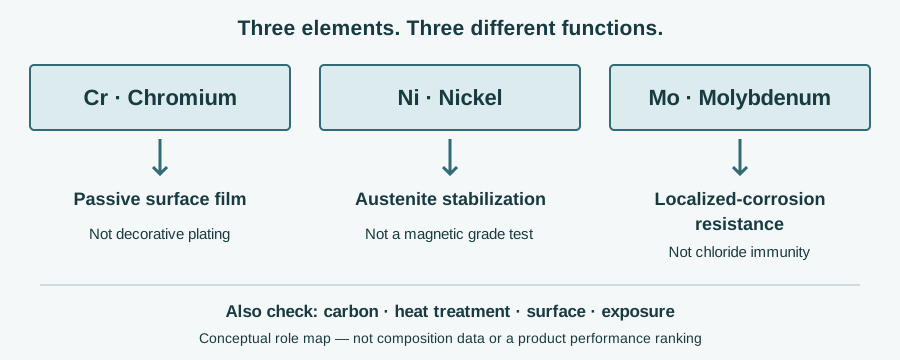
Use the element-function and material-condition checks to separate bulk composition from the delivered structure and surface behaviour.
Send your application data and get a material recommendation
Hardening: what it does to 420
420 is supplied annealed (soft and machinable) and hardened after machining. The usual route:
- Austenitise – heat to the hardening temperature given by the steel supplier, so carbon dissolves.
- Quench – cool quickly (oil, gas or air depending on section) to form hard martensite.
- Temper – reheat to a lower temperature to reduce brittleness and set the final hardness.
Two practical consequences:
- Corrosion resistance is better hardened than annealed. In the hardened state, carbon is held in solution instead of tying up chromium as carbides. Annealed 420 parts in a wet zone often rust where an identical hardened part does not.
- Tempering temperature matters. Suppliers generally advise against tempering in an intermediate range (often given as roughly 425–550 °C), where toughness and corrosion resistance fall. Low-temperature tempering keeps both hardness and corrosion resistance; higher tempering gives toughness at lower hardness.
Achievable hardness depends on carbon content: the higher-carbon versions (1.4028, 1.4034) reach higher hardness than 1.4021. Ask the supplier for the hardness range the part will be delivered at, not the maximum the grade can reach.
Corrosion limits in washdown
On food machinery, the question is rarely whether 420 resists water – it does – but whether it resists the cleaning regime.
| Condition | 420 behaviour | Better choice if this is daily |
|---|---|---|
| Dry or occasional wipe-down | Good | – |
| Fresh water, rinse, neutral detergents | Generally acceptable if hardened and polished | – |
| Alkaline foam cleaning | Acceptable with rinse and drying | 304 for structure |
| Chlorinated cleaners and sanitisers | Pitting and staining likely over time | 316L for structure; supplier-verified alternatives for wear, not an automatic switch to 440C |
| Brine, salted products, seawater | Poor – chloride pitting (local corrosion caused by chloride ions) | 316L |
| Acidic products or acid cleaners | Limited | 316L |
| Stagnant water in crevices | Crevice corrosion likely | Redesign to drain; austenitic grade |
Three things improve 420's chances in a wet zone:
- Surface finish. A ground or polished surface corrodes less than a turned or rough one, because there are fewer sites for chlorides to collect. EHEDG guidance of Ra ≤ 0.8 µm for product-contact surfaces is a sensible target where 420 meets product or spray.
- Passivation. An acid treatment after machining removes embedded free iron and helps restore the passive layer. It must suit martensitic steel – treatments designed for 304 can attack hardened 420.
- Cleaning discipline. Rinse chlorinated chemicals off thoroughly, keep concentrations within the cleaner supplier's limits and let parts dry. Most 420 corrosion seen in plants comes from residues left overnight.
Galvanic corrosion is also worth checking: when 420 is in electrical contact with a more noble metal such as 316L in a wet joint, the 420 part corrodes faster. The way chlorides and cleaning agents attack each grade is covered in more detail in how chlorides and cleaning chemicals affect stainless steel machinery parts.
Where 420 fits on hygienic machinery
| Application | Why 420 | Watch out for |
|---|---|---|
| Cutting blades, knives, slicer parts | Hardness and edge retention | Pitting at the edge in chlorinated cleaning; regrinding removes passive layer |
| Shafts and pins needing wear resistance | Hard surface, stainless | Not for brine; check fatigue strength at hardness |
| Pump and valve parts (seats, stems) | Wear resistance | Chemical compatibility with product and CIP (cleaning in place) solutions |
| Bushings and wear plates | Hard, low wear | Mating material, lubrication |
| Bearing components | Hardened 420 is used for some bearing parts | 440 stainless steel is more common for stainless bearing rings and balls |
| Frames, guards, hoppers | Not recommended | Use 304 or 316L – weldable and more corrosion-resistant |
For bearings, the choice between hardened 420 and 440C is a separate decision, compared in detail in 440C vs hardened 420 stainless steel. For structural parts, the decision is usually between the austenitic grades, covered in AISI 316L vs AISI 304. Where 3-A Sanitary Standards apply, product-contact surfaces are normally 300-series; see stainless steel for 3-A Sanitary Standards before using 420 there.
How to decide: is 420 right for this part?
- Does the part need hardness or wear resistance? If not, use 304 or 316L.
- What zone is it in? In the product-contact zone (touches product or drains onto it) and the splash zone (reached by spray), check the cleaning chemicals next. In dry, non-contact areas, 420 is usually fine.
- What are the chemicals? Chlorides, brine or acids daily point away from 420.
- Can it drain and dry? Parts that stay wet in crevices corrode first.
- Is welding needed? If yes, choose an austenitic grade or design for a bolted or pressed joint.
- If 420 remains the choice, specify grade, hardness, finish and passivation (below).
Example (assumptions, for method only): a slicer in a cooked-meat plant uses pins in 420 that guide a blade carrier. Cleaning is daily alkaline foam, rinse and a chlorinated sanitiser. After months in service the pins show pitting. Options: keep 420 but specify a polished finish, correct passivation and a full rinse after sanitising; or switch the pins to a harder, more corrosion-resistant martensitic grade or a coated 316L pin if wear allows. The chosen fix depends on wear rate, which the plant measures – no outcome is claimed here.
What to write in the specification
- EN number and designation (for example 1.4028 / X30Cr13), not only "AISI 420"
- Heat treatment condition and hardness range (HRC)
- Surface finish (Ra) on functional and exposed surfaces
- Passivation method suitable for martensitic steel
- Material certificate (EN 10204 3.1) with heat number
- Food contact: declaration of compliance with EC 1935/2004 where the part touches food
What to send NHK
- Component and its function (wear, cutting, shaft, bearing)
- Zone, cleaning method, chemicals and temperature
- Required hardness or load
- Current material and the problem seen (rust, wear, breakage)
- Documents needed; quantities; delivery country
NHK's technicians suggest components and send a quote. To browse, see NHK's hygienic machinery components in stainless steel; NHK's reference article on 420 vs 440 stainless steel compares the two martensitic grades.