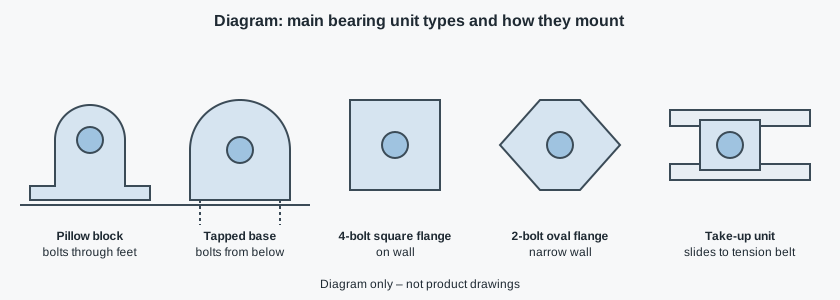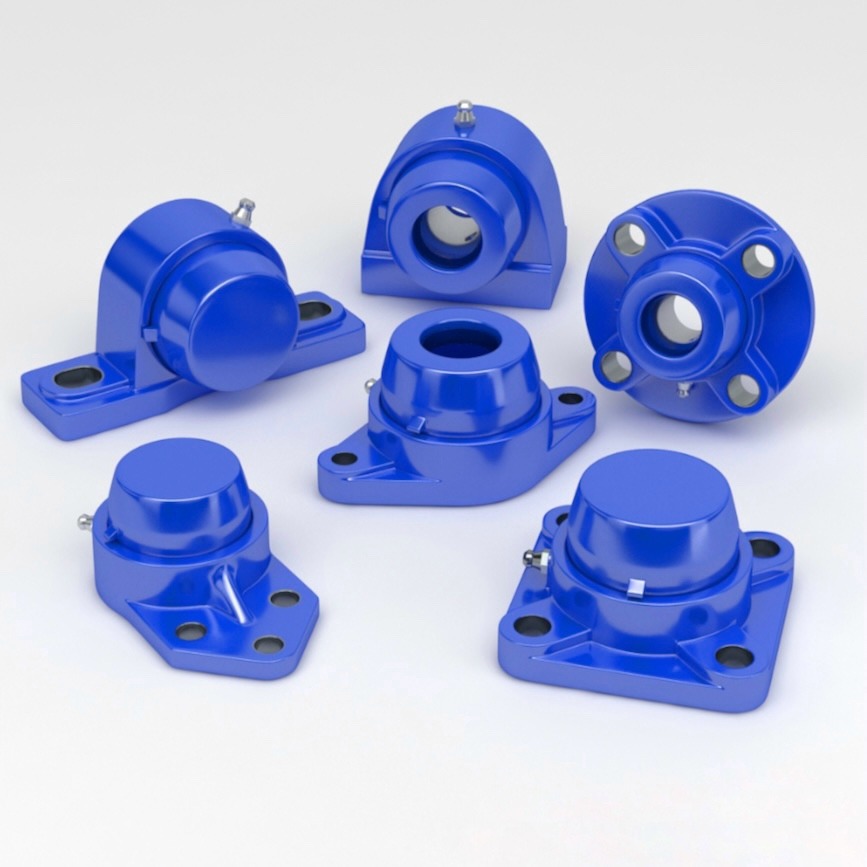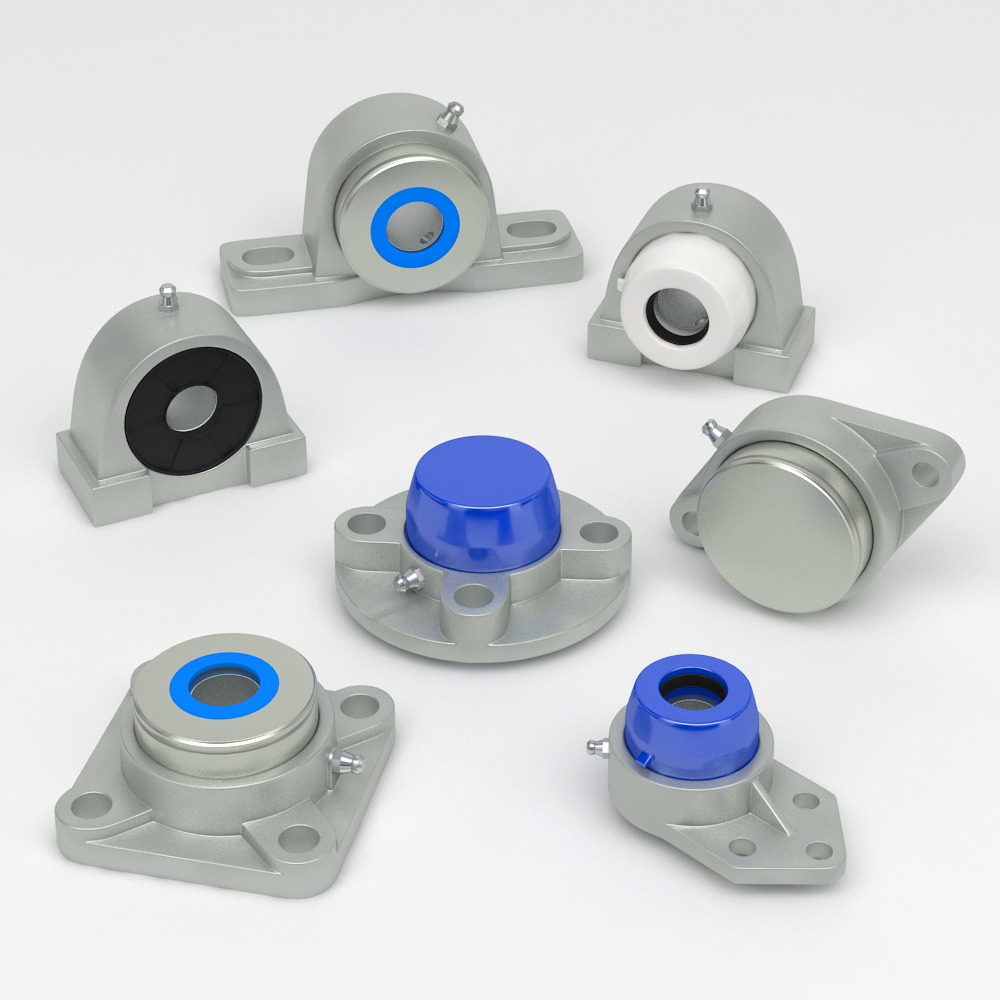
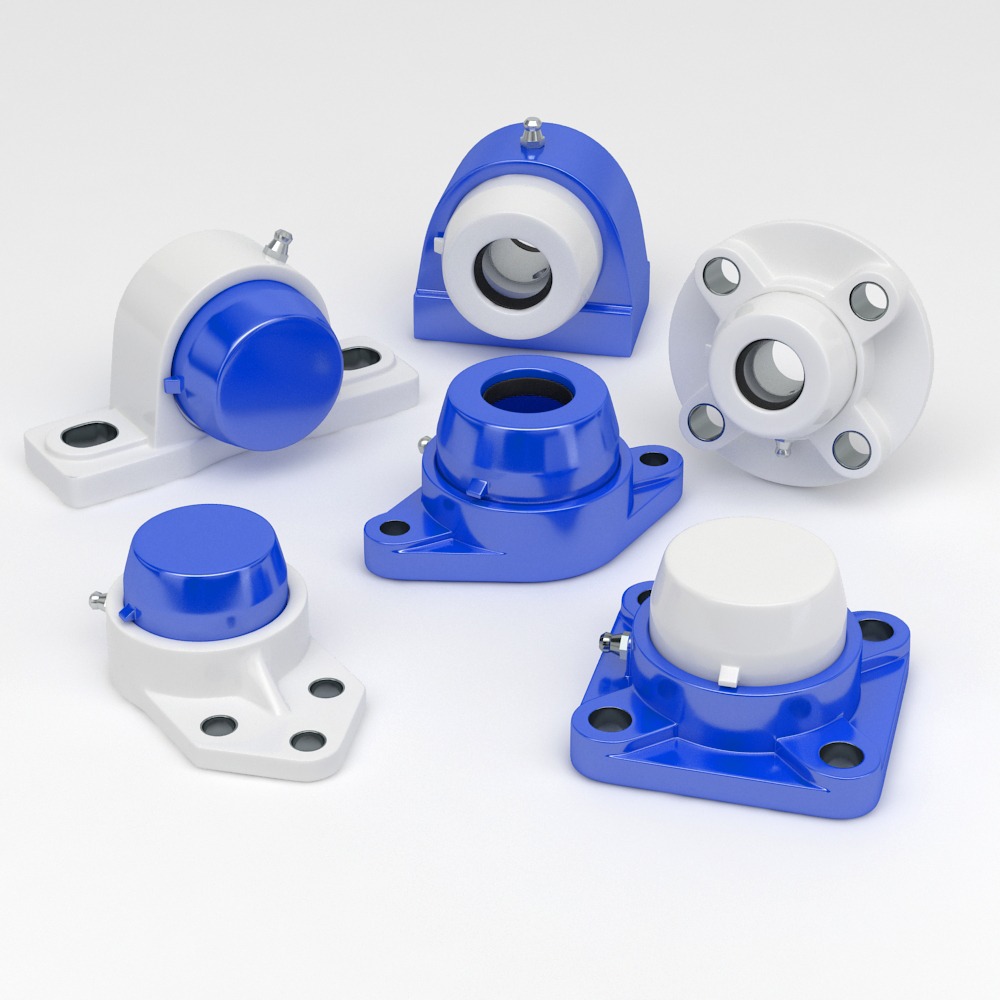
Plastic bearing units are mounted bearing units whose housing is moulded from a thermoplastic or fibre-reinforced composite instead of cast iron or steel; bearing units in waterproof composite housing combine such a housing with a corrosion-resistant insert and seals for wet environments. They are used where moisture, chemicals and cleaning would corrode metal housings – food processing, pharmaceuticals, marine and agricultural machinery. This guide explains what the composite housing does well, where it reaches its limits, and how to select and install it.
For a detailed look at one specific design, see the square ball bearing unit in IP54 composite housing.
What are plastic bearing units?
A plastic bearing unit consists of:
- a plastic bearing housing – pillow block, flange or take-up – usually in a glass-fibre-reinforced engineering polymer;
- a bearing insert, typically a deep-groove ball bearing with a spherical outer ring, in stainless or chrome steel;
- seals on the insert and, on some designs, end covers.
The housing positions the bearing, carries the load into the frame and protects the bearing. Because the housing cannot rust, it suits applications where traditional metal housings corrode.
Why choose a composite housing?
- Corrosion resistance: no rust, no flaking coatings that could become foreign bodies.
- Chemical resistance: many polymers tolerate common alkaline and acid cleaners; check compatibility for the specific chemicals.
- Light weight: easier handling and lower inertia on moving assemblies.
- Easier cleaning: smooth moulded surfaces without paint.
- Electrical insulation: the plastic housing does not conduct, which can help where galvanic corrosion (corrosion when dissimilar metals touch in water) is a concern.
Limits of plastic bearing housings
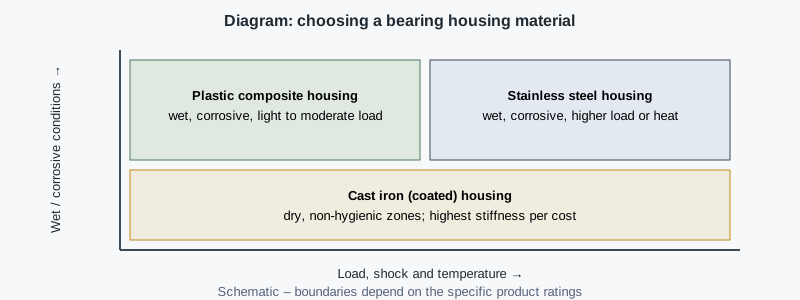
| Property | Plastic composite | Stainless steel | Cast iron (coated) |
|---|---|---|---|
| Corrosion | Does not rust | Highly resistant; chlorides can attack | Rusts if coating is damaged |
| Load and stiffness | Lower; may limit the unit rating | High | High |
| Shock loads | Can crack | Good | Good, but brittle |
| Temperature | Lower limit set by the polymer | High | High |
| Weight | Lowest | Highest | High |
| Cleanability | Smooth, unpainted | Smooth, polishable | Paint can chip |
| Typical zones | Wet areas, moderate loads | Heavy washdown, higher loads | Dry, non-hygienic areas |
The rating of the housing – not just the insert – must cover the load. Under heat, plastic loses stiffness, and under sustained bolt clamping force it can creep (slowly deform), so mounting matters more than with metal.
Is a composite housing waterproof? IP ratings explained
The word "waterproof" only means something with a stated IP rating:
| Rating | Standard | Protection | Typical use |
|---|---|---|---|
| IP54 | IEC 60529 | Dust-protected, splashing water | Occasional splashes, light wet cleaning |
| IP67 | IEC 60529 | Dust-tight, temporary immersion | Flooding; not a washdown rating |
| IP69 | IEC 60529 | High-pressure, high-temperature jets | Pressure-washer cleaning |
| IP69K | ISO 20653 | High-pressure, high-temperature jets | Pressure-washer cleaning |
Many plastic bearing units are IP54: the plastic housing is water resistant, but the unit as a whole is protected only against splashes. For high-pressure washdown, choose a unit with a higher stated rating or a sealed stainless design – see waterproof bearing house units.
Where to use plastic bearing units
- Food processing: conveyors and packaging lines in wet areas, where housings must withstand frequent cleaning and resist detergents. Check food-compatible polymer, colour policy and H1 grease.
- Pharmaceuticals: chemical resistance to disinfectants and smooth cleanable surfaces.
- Marine: salt water and humidity – the housing does not corrode; the insert must also be corrosion resistant.
- Agriculture: dust, mud and moisture on lightly loaded shafts; heavy, shock-loaded drives usually need metal housings.
How to select plastic bearing units
- Define the environment: wet or dry, chemicals and concentrations, temperature range, salt.
- Define the cleaning method: wipe, low-pressure rinse, foam or high-pressure washdown – and match the IP rating.
- Check load, speed and shock against the housing rating as well as the insert rating.
- Check temperature including hot cleaning water.
- Choose the insert: stainless (for example a hardened martensitic grade) for wet areas; chrome steel only where dry.
- Choose seals and grease: compatible elastomer and NSF H1 grease where incidental food contact is possible.
- Request documents: housing polymer, IP test evidence, declarations of compliance for food-contact materials (EC 1935/2004; EU 10/2011 for plastics) where relevant.
Example
Assumptions (illustrative only): a lightly loaded tray conveyor in a vegetable packing area is rinsed daily with low-pressure water and a mild alkaline detergent; coated cast-iron pillow blocks show rust and paint flakes.
- Environment: wet, mild chemicals, room temperature.
- Load: light, no shock – within composite housing ratings after checking the supplier's data.
- Cleaning: low-pressure rinse – IP54 acceptable, provided units are not aimed at with pressure washers.
- Choice: plastic pillow block units with stainless inserts and H1 grease.
- If the plant later moves to high-pressure washdown, the rating must be reassessed.
Installation checklist for plastic bearing housings
- Mount on a flat, clean surface; plastic will not bridge an uneven base.
- Use washers and tighten bolts to the supplier's torque – overtightening causes creep and cracks.
- Use stainless fasteners; consider hygienic or capped fasteners in the splash zone (area wetted by spray but not product).
- Align the shaft; lock the insert to the shaft as specified.
- Fit end covers where available.
- Check bolt tension after the first period of operation, as plastic settles.
- Inspect for cracks, discolouration from chemicals and seal wear.
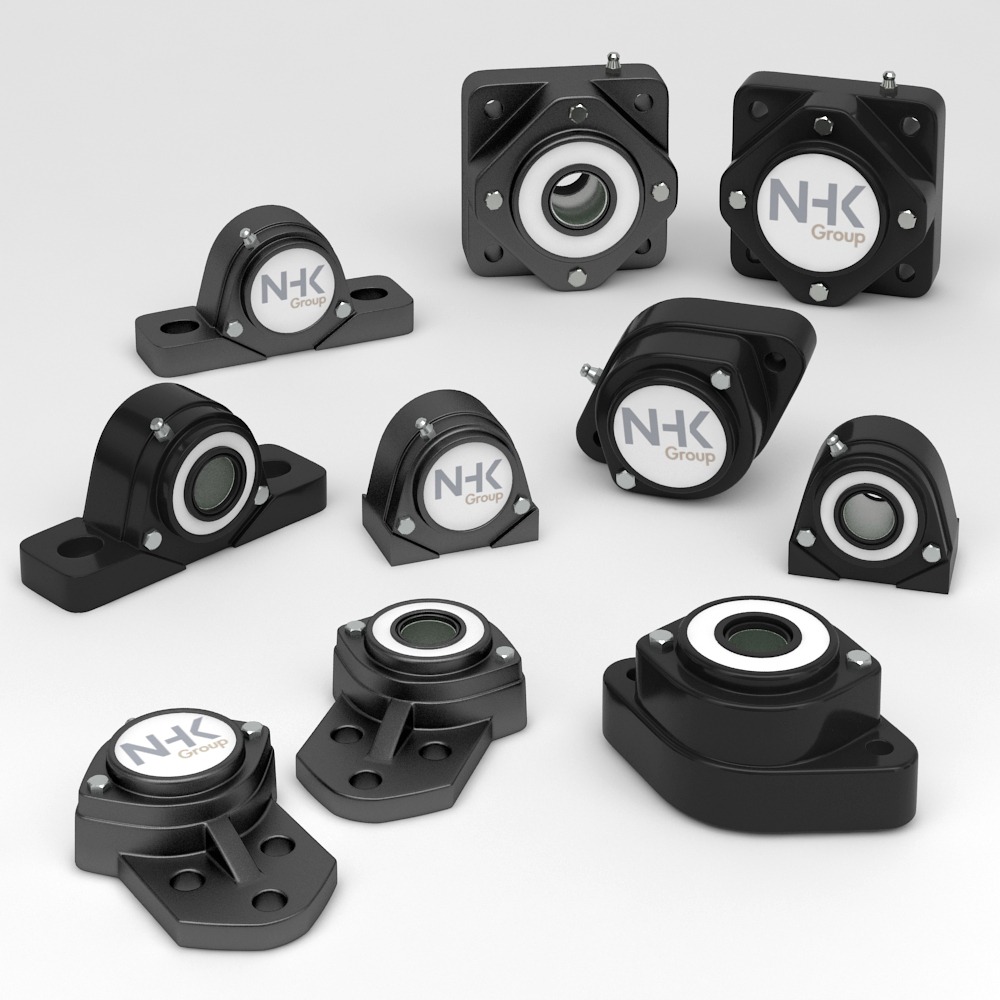
NHK's bearing units in IP54 thermoplastic housing are an example of this design; check the product page for ratings.