Bearing failure causes are the initiating conditions that damage a bearing or make its installed arrangement unable to perform its function. In food plants, environmental and mechanical mechanisms often interact: ingress can damage lubrication, while poor support can damage a seal. This pillar belongs to the Bearing units engineering hub and organizes the bearing-reliability cluster around diagnosis before replacement.
Bearing damage types: choose the investigation route
Use this table to locate the damage before choosing a material, seal or grease. ISO 15243 provides terminology for rolling-bearing damage; a visible mark is evidence for an investigation, not an automatic root-cause verdict. Preserve parts before cleaning away deposits that could explain the sequence.
| Finding and location | Possible mechanism | What to check | Prevention direction |
|---|---|---|---|
| Rust or pits on rolling surfaces, seal side or under a cover | Moisture or chemical corrosion | Ingress path, water/cleaner exposure, deposits and lubricant condition | Correct the demonstrated entry path and compatible sealing/cleaning conditions |
| Milky, displaced or depleted grease; scoring or rough rolling tracks | Water contamination, lubricant loss or inadequate film | Sample condition, quantity, grease identity, relubrication history and seal damage | Restore the approved lubrication strategy after fixing exposure |
| Flaking raceway material | Rolling-contact fatigue or secondary damage | Load path, operating history, earlier pits/indentations and lubrication | Resolve the initiating condition; review bearing and arrangement capacity |
| Uneven contact track, edge loading or mounting distortion | Misalignment, deflection or unsuitable support | Alignment under load, housing seating, shaft and frame geometry | Correct support, alignment and permitted axial movement |
| Indentations at rolling-element spacing | Plastic deformation or false brinelling, depending on evidence | Shock/mounting loads versus idle oscillation; inspect morphology | Correct load handling or idle vibration after confirmation |
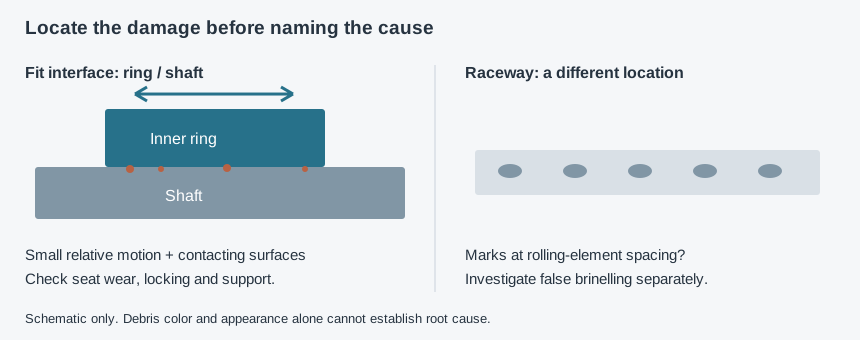
| Wear and oxidised debris beneath a ring | Fretting, creep or coexisting corrosion | Fit, locking, seat dimensions and vibration | Use the fit-interface movement investigation |
Send your application data and get a component recommendation
Do not assume the last visible damage was the first mechanism. A pit can become a fatigue initiation site; debris from a damaged raceway can create further indentations. A seized bearing can erase the earlier lubrication evidence. Record both the observations and the uncertainty before recommending a remedy.
Why bearings fail after washdown
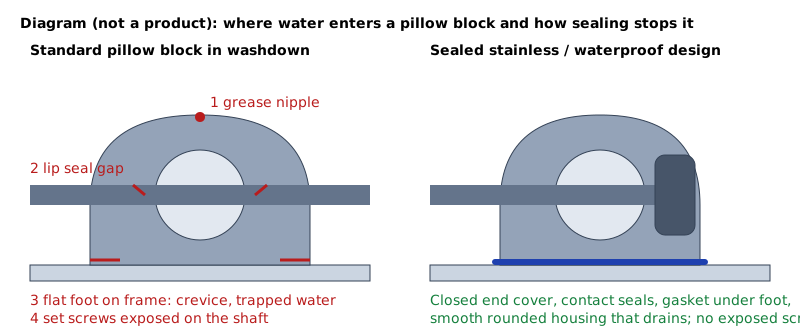
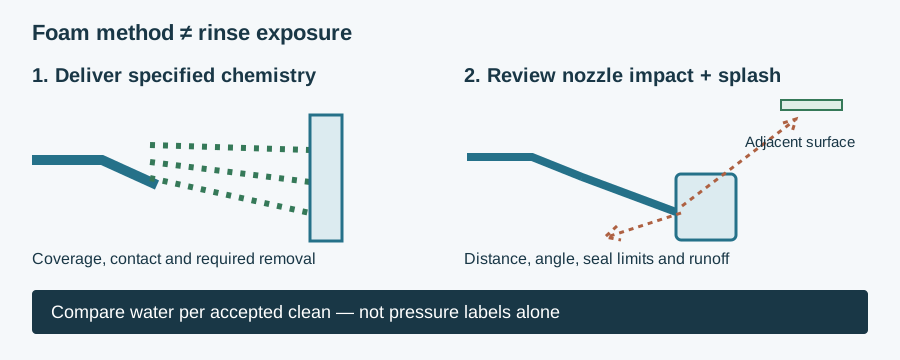
Water can enter through damaged shaft seals, incorrectly seated covers, worn contact surfaces or an unsuitable assembled sealing path. Direct jet exposure may exceed the conditions covered by the supplier’s evidence. Detergent, sanitiser and food residues can also affect the seal and lubricant; water alone is not the only exposure to record.
Grease contamination and grease washout are different findings. Water may remain in grease without visibly removing it, while displacement or leakage can reduce the available lubricant. Check the quantity, consistency and distribution as well as water content. Milky appearance is a clue, not a quantitative moisture test or proof of the route of entry.
Thermal cycling after hot cleaning can change pressure and encourage moisture entry where a sealing path permits it. Record cleaning and cooling conditions, machine orientation and whether a unit is running or stopped. Do not infer ingress merely because noise first appears after washing; cleaning can expose an earlier defect or coincide with a maintenance change.
A splash zone receives food or cleaning spray without intended direct product contact. Inspect possible transfer from grease, corroded parts or fragments toward food. A harborage point retains residue through cleaning; a crevice behind the housing may create both a hygiene concern and prolonged wet exposure. Correcting internal lubrication does not correct that exterior joint.
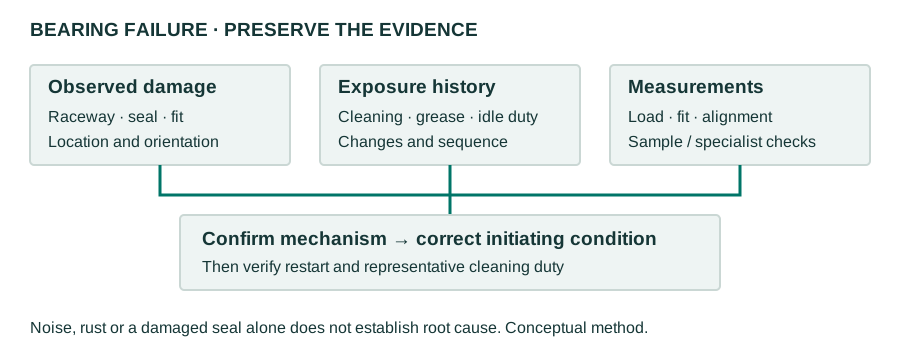
Bearing failure analysis: preserve evidence and test hypotheses
- Make the machine safe. Isolate energy, secure supported shafts and belts, and release stored loads through approved procedures. Involve QA where fragments, lubricant or corrosion could reach product; follow the plant’s hold and investigation procedure.
- Record the timeline. Identify the unit, position, hours or cycles where known, symptoms, cleaning events and recent changes. Capture load, speed, direction reversals, idle vibration and maintenance without inventing missing records.
- Photograph before disturbance. Mark orientation and loaded side. Record seals, covers, mounting faces, grease leakage and retained liquid. Keep removed components labelled so raceway marks can be related to the machine.
- Separate inspection locations. Examine raceways, rolling elements, cage, inner-ring bore, shaft seat, outer-ring seat, cover and seals separately. Do not describe bore fretting as raceway corrosion merely because both look brown.
- Preserve useful samples. Where relevant, collect lubricant and deposits using clean tools and suitable containers before adding grease or washing parts. Record sampling location; laboratory analysis may be needed to identify contamination or wear debris.
- Measure the arrangement. Check shaft fit, ovality, wear, locking and housing support against the actual drawing and unit instructions. Assess alignment and deflection under representative load, not just with an unloaded belt.
- Compare competing explanations. Link each proposed cause to observations and confirmatory checks. If evidence cannot distinguish shock indentation from idle vibration, retain both hypotheses rather than approving a repair from one photograph.
- Define disposition and follow-up. Agree component replacement, shaft repair, cleaning or mounting changes and restart criteria. Record a baseline after correction and inspect through representative production and cleaning before closing the investigation.
Do not spin a removed bearing with compressed air to “test” it or reuse a damaged unit because hand rotation feels smoother after rinsing. Specialist examination may be needed where fractures, extensive seizure or secondary damage obscure the initiating mechanism.
Water ingress, corrosion and lubricant washout
Map the contamination route across the whole assembly: exterior cover, shaft-side seal, insert sealing, lubricant supply point and mounting interfaces. A closed end cover protects a terminated shaft; a through-shaft arrangement needs the appropriate opening and sealing design. Replacing only the visible cover can leave the actual path unchanged.
Assess cleaner concentration, temperature, dwell, rinse and seal chemistry. Do not reduce required sanitation unilaterally to protect a bearing. The hygiene team and supplier should agree a compatible cleaning procedure and verify it at the installed joint. For the related corrosion cluster, use the metal-attack and exposure identification guide.
IP67 under IEC 60529 concerns dust and temporary immersion under defined conditions, not high-pressure washdown. IP69K is a jet-test designation from ISO 20653; require evidence for the actual assembly and conditions. Neither rating certifies chemical resistance, fatigue life or cleanability. The immersion-versus-jet evidence comparison supports the sealing-document decision without replacing installed checks.
Misalignment, overload and mounting damage
Misalignment and shaft deflection can concentrate load or alter seal contact. A spherical insert may accommodate specified mounting alignment; it is not permission for uncontrolled shaft movement or a distorted frame. Check the manufacturer’s limits and confirm how alignment, floating movement and axial location are intended to work together.
Review belt or chain tension, product loads, drive reactions, shock and startup events. Shaft diameter alone does not determine bearing capacity. Use the actual insert’s dynamic and static ratings, plus housing, locking and mounting limits. ISO 281 rating life concerns rolling-contact fatigue; it does not predict an installed washdown interval or repair contaminated grease.
Compare static vs dynamic load rating to document fatigue life and peak-load deformation as separate checks before specifying a replacement.
For the mechanical sizing method, use the migrated mounted-unit load and installation checklist. Do not import another material’s rating because the replacement shares a bore size. Likewise, a higher-rated insert will not stiffen a flexible mounting plate or correct an unsuitable locking arrangement.
Mount with the specified tools and force path; do not transmit installation force through rolling elements. Check burrs, shaft condition, housing contact, tightening sequence and locking procedure. Excessive torque, forced alignment and an unsuitable fit can introduce damage before the first washdown. More preload is not a universal cure for noise.
Use the shaft tolerance for insert bearings guide to document locking-system selection and seat acceptance before fitting a replacement.
Fretting, false brinelling and idle vibration
Fretting involves small repeated movement at contacting interfaces, often with oxidised wear debris. Ring creep is relative movement of a ring on its seat. Locate the damage beneath a ring or at the mounting contact and investigate fit, locking, support and running vibration. Neither stainless construction nor grease repairs a worn shaft seat.
False brinelling concerns damage at rolling-element contacts under small oscillatory motion, often during idle vibration or transport. Marks at element spacing also require consideration of plastic indentation from static or mounting loads. Location, shape and history distinguish the investigation; colour alone cannot.
This pillar’s linked fretting spoke gives the detailed fit-measurement route. For idle duty, record vibration from neighbouring equipment, transport and shutdown periods. Ask the bearing supplier about protective measures for the actual arrangement; do not prescribe a universal periodic shaft rotation or paste without considering safety, locking and hygiene.
Prevention by unit type, sealing and cleaning access
| Arrangement decision | Failure path to address | Selection/inspection question |
|---|---|---|
| Pillow block on a base | Distorted support, retained liquid beneath the housing | Is the base rigid, aligned and cleanable in its installed orientation? |
| Flange unit on a side wall | Shaft alignment, wall flex and rear mounting gap | Are the fixing pattern, support and through-shaft sealing suitable? |
| Take-up arrangement | Tension changes, sliding support and exposed adjustment features | Can the required motion remain aligned, supported and cleanable? |
| Shaft-end versus through-shaft cover | Different exposed entry paths | Is the cover/seal configuration documented for this exact assembly? |
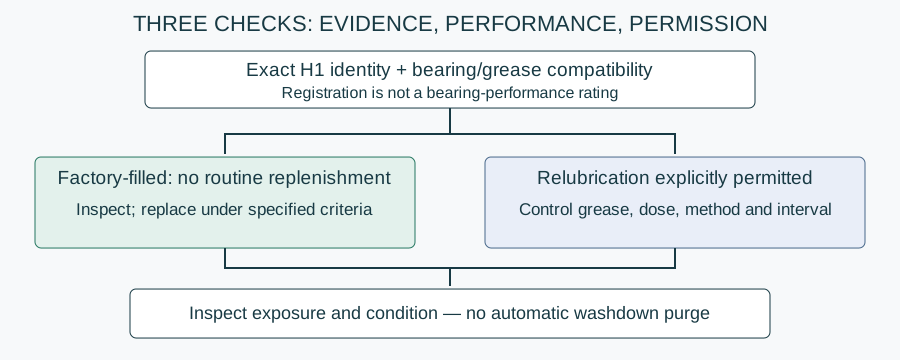
| Relubricatable versus factory-filled unit | Supply contamination, excess grease or inaccessible maintenance | What intervention is permitted and what condition checks remain necessary? |
Compare the housing-format and installation choices before changing footprint, shaft height or tensioning method. Geometry is not a load rating, and a flange is not automatically more washdown resistant than a pillow block. The proposed insert, covers, mounting joint and maintenance access must work together.
The migrated waterproof-unit cleaning and seal inspection guide provides the cleaning-specific route; apply the actual unit’s instructions rather than adopting a universal regreasing step. For the related cleaning cluster, use the installed access and residue-removal checks. CIP cleans equipment in place; COP cleans removed parts separately. Neither label validates a hidden bearing joint.
Relubrication: identify the permitted maintenance strategy
Identify whether the exact unit is relubricatable or intended to retain its factory fill. Do not add a grease nipple, open seals or inject lubricant into a unit without supplier approval. “Lifetime lubrication” describes intended service conditions, not immunity to water ingress or permission to ignore running condition.
For relubricatable units, use the specified lubricant, amount, interval and method. Confirm compatibility before mixing greases; shared colour or an H1 label does not establish equivalent thickener, base oil or bearing performance. Clean delivery points and control tools so servicing does not introduce dirt or water.
Uncontrolled purging can displace seals or release grease toward food. Do not prescribe “pump until fresh grease appears” for every unit, and do not assume new grease repairs pitted raceways. Investigate contamination first, then follow the permitted corrective and lubrication procedure with approved disposal of displaced material.
NSF H1 registration concerns incidental food contact, not deliberate contact or a bearing-life rating. ISO 21469 addresses lubricant hygiene requirements and is a separate reference. Request evidence for the exact grease; do not repeat generic “FDA-certified grease” wording. Check running condition and external seals even where regreasing is not required.
Use the NSF H1 lubricant and servicing guide to document registration, grease compatibility and the permitted maintenance strategy separately.
Use the scheduled-versus-condition-based maintenance decision to turn accepted repair findings into an inspection plan.
Example: noise after cleaning on a conveyor
Example — hypothetical assumptions, not NHK field data. A conveyor becomes noisy after a cleaning change. One unit has grease leakage and a wet cover rim; belt tension was also adjusted recently. The grease specification, load measurements and damaged raceways have not yet been examined. No initiating cause is assumed.
Preserve the cover and lubricant observations, record the cleaner and nozzle exposure, then inspect the seal path. Measure alignment, support and tension before treating the timing as proof of washout. Corrosion with identified moisture could support an ingress hypothesis; uneven tracks and excessive measured load would require a mechanical explanation as well.
Agree replacement and corrective actions from those findings. A sealing change without correcting excessive tension can repeat the failure; a larger bearing without closing the entry path can also fail. Record baseline condition and follow-up after representative cleaning. No successful outcome, service-life gain or test limit is invented.
Specification and enquiry: send the failure record
Copy and complete: “Unit designation, shaft drawing and quantity: __. Damage location, symptoms and inspection record: __. Load cases, belt tension, speed and running/idle duty: __. Shaft fit, locking, alignment and support: __. Zone and contamination paths: __. Washdown, nozzle exposure, chemicals, concentration, temperature, dwell and rinse: __. Seal/cover condition and required ingress evidence: __. Lubricant identity, permitted servicing and history: __. Material, lubricant, food-contact and exact-design certificate documents: __. Delivery country: __.”
Send these details to NHK
Use the buyer’s evidence-request guides to organise documents. No dedicated bearing-failure calculator or selector is published; observations and measurements cannot be replaced by a generic lifespan estimate. Ask for exact unit identification, mounting instructions, sealing/cleaning limits and lubricant evidence, plus any claimed design certificate.
NHK publishes an IP67 bearing category for configuration checks; the sealed-stainless category beside the enquiry form is the secondary browsing route. Confirm materials, lubrication and test coverage for the proposed item. EHEDG certification concerns specific designs; 3-A Symbol authorization follows Third Party Verification. Both are voluntary, and neither establishes freedom from overload, ingress or failure.
Send the record through this site’s existing form so NHK can suggest a component and prepare a quote. Recurring shaft, frame or drive problems may also need the machine builder and bearing manufacturer. No diagnosis from photographs alone, response time or failure-free service is promised.