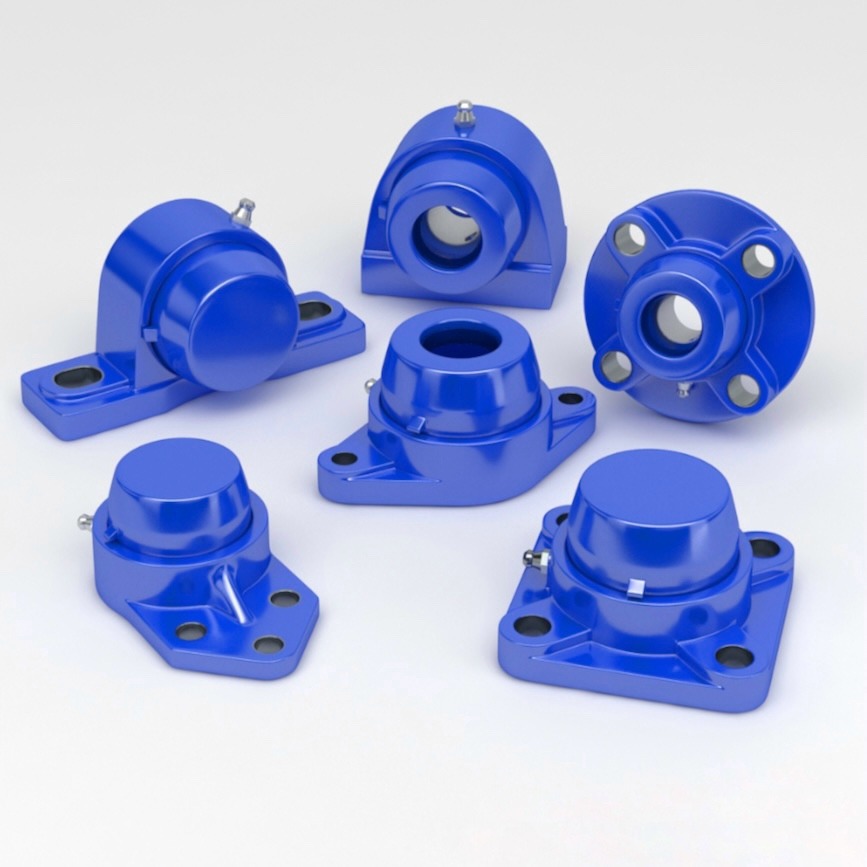
A square ball bearing unit in IP54 composite housing is a flange-mounted bearing assembly: a ball bearing insert held in a square, four-bolt thermoplastic housing that protects it against dust and splashing water. Units like this are used on conveyors in food processing, packaging lines, mixers and agricultural machinery. This guide explains what each part of the name means, where the unit fits, where it does not, and how to select and install it.
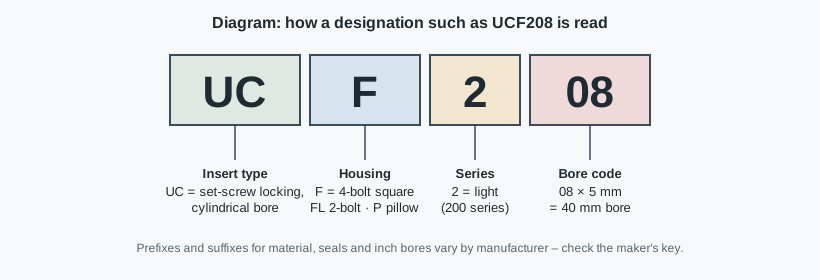
What the name tells you
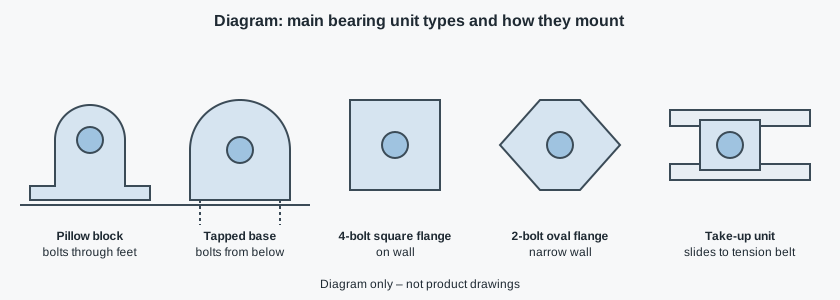
- Square 4-bolt flange – the housing bolts to a surface perpendicular to the shaft, usually a side frame, with four bolts in a square pattern. Compared with two- or three-bolt flanges, it spreads load over more fixings and resists tilting.
- Ball bearing – a deep-groove ball bearing insert, typically with a set-screw or eccentric locking to the shaft. It carries radial load and moderate axial (thrust) load in both directions.
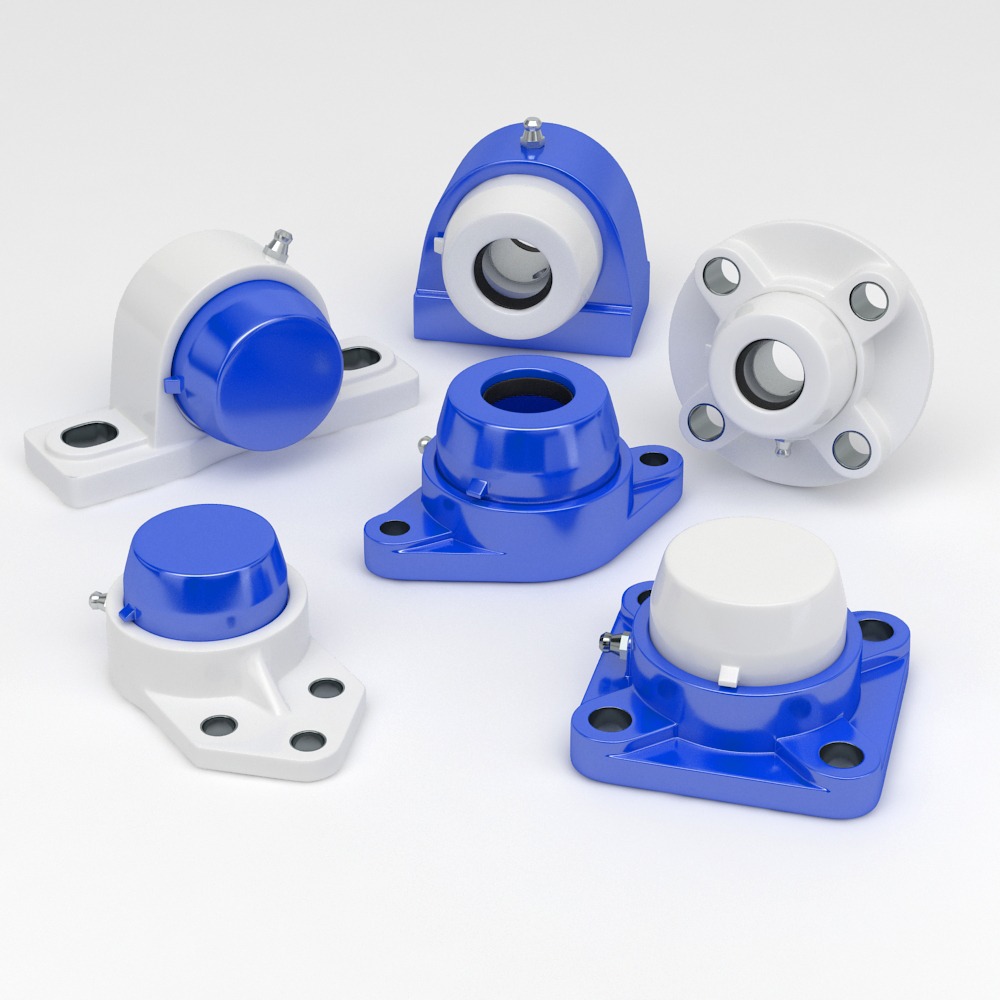
- Composite or thermoplastic housing – a moulded plastic housing instead of cast iron or stainless steel. On NHK's square 4-bolt flange unit FPL the housing is polypropylene, available in black, white or blue, with a clip-on safety cap.
- IP54 – the ingress protection code under IEC 60529: 5 for dust protection, 4 for splashing water.
What IP54 means in practice
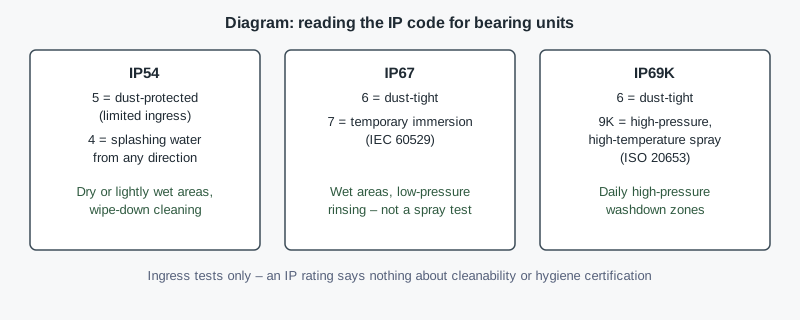
The first digit, 5, means dust-protected: some dust may enter but not enough to interfere with operation. The second digit, 4, means protection against water splashed from any direction. IP54 is not a jet, immersion or high-pressure test. A bearing unit rated IP54 therefore suits dry areas, light splash and wipe-down or low-pressure cleaning. Where the unit sits in a splash zone – an area hit by spray and cleaning water but not in product contact – with daily high-pressure washdown, choose a unit tested to that condition. For the higher ratings, see ingress protection in hygienic zones: IP68 or IP69K.
Advantages of the thermoplastic housing
The same housing material is used across other flange shapes, for example the one-side 3-bolt flange unit FBPL.
- Light weight – plastic housings weigh much less than cast iron or stainless steel, reducing mass on frames and making handling easier.
- No rust – the housing does not corrode, so there is no rust staining on the frame or product.
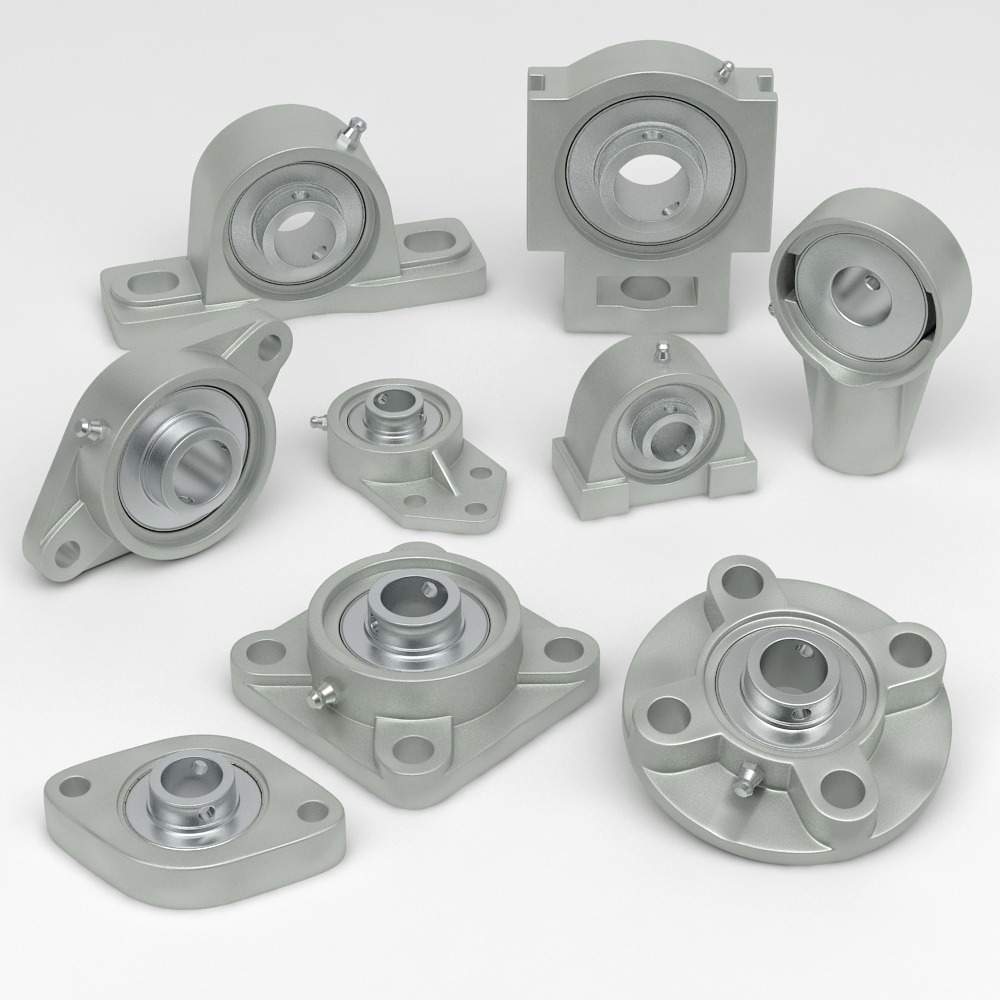
- Non-magnetic housing – the plastic housing itself is non-magnetic. The bearing insert is steel – chrome steel or stainless AISI 440C on the NHK unit – and 440C is magnetic, so the unit as a whole is not non-magnetic.
- Chemical resistance – polypropylene resists many common cleaning agents, but resistance depends on the chemical, concentration and temperature. Check compatibility with the chemicals actually used.
- Cleaning – smooth moulded surfaces are easy to wipe clean. Where a unit has a grease nipple, check that it does not create a crevice and that relubrication does not purge grease into the product area.
The original article described thermoplastic units as self-lubricating. That applies to some polymer plain bearings, not to a ball bearing unit: here the insert is pre-lubricated with grease, and relubrication may be possible via the grease nipple.
Ball bearings in flange units
Ball bearings reduce friction between rotating and static parts, keep heat generation low and are efficient in continuous operation, which suits conveyors and packaging machines. They carry both radial and some axial load, useful where shafts see thrust in addition to rotation. Service life depends on load, speed, lubrication and contamination; ISO 281 rating life gives the calculation basis. For housing type selection – flange versus pillow block – see the pillow block bearing guide.
Why blue matters
Blue is chosen in food and pharmaceutical plants because it rarely occurs in natural food. If part of a housing breaks off, a blue fragment is easier to see during visual inspection. Colour also helps maintenance staff recognise components intended for food areas. Two limits apply: blue helps visual detection only – it does not make plastic detectable by metal detectors or X-ray unless the material is specified as detectable – and colour does not mean a component is certified.
Comparing housing options
| Property | Thermoplastic IP54 | Thermoplastic or composite IP67 | Sealed stainless steel |
|---|---|---|---|
| Ingress protection | Dust-protected, splashing water | Dust-tight, temporary immersion | Depends on design; check rating and test |
| Typical cleaning | Wipe-down, low-pressure rinse | Wet cleaning, low-pressure rinse | High-pressure washdown, foam (if rated) |
| Corrosion | Housing does not rust | Housing does not rust | Corrosion-resistant steel |
| Weight | Low | Low | High |
| Mechanical robustness | Moderate; check load and impact | Moderate | High |
| Temperature | Limited by polymer (−20 to +100 °C on the NHK FPL page) | Limited by polymer | Wider; check seals and grease |
Applications by industry
Food processing and beverages
In dry or lightly wet areas – dry-goods conveyors, packing halls, outside the main washdown zone – the IP54 housing keeps dust and splashes out and the blue colour supports inspection. In daily wet cleaning or high-pressure zones, use units rated for that duty.
Pharmaceuticals
The non-corroding, easy-to-wipe housing suits dry production areas such as tablet handling and packaging. The non-magnetic housing helps near sensitive equipment, but remember the steel insert.
Chemical processing
Plastic housings avoid the corrosion that affects cast iron, provided the polymer is compatible with the chemicals present. Check resistance data for each agent.
Agriculture
Dust, dirt and moisture are common; the dust protection and corrosion-free housing help, and the four-bolt flange gives stable mounting. Heavy impact or shock loads may require a metal housing.
Packaging
Smooth rotation and low heat generation suit continuous packaging operation, and the housing tolerates regular light cleaning.
How to select a square IP54 bearing unit
- Define the zone and cleaning method – dry, splash, wet cleaning or high-pressure washdown. If high-pressure, choose a different unit.
- Check chemicals and temperature against the housing polymer and grease.
- Determine load and speed – calculate radial and axial load and check rating life to ISO 281.
- Choose the insert material – chrome steel for dry areas, stainless where moisture is present.
- Check shaft diameter, locking type and misalignment – the NHK FPL page lists maximum misalignment of 3° between shaft and housing.
- Decide on caps and relubrication – closed safety cap at shaft ends; grease nipple only if relubrication is planned.
- Specify colour – blue for visual detection in food areas; detectable material if required.
Example
Assumptions (illustrative only): a horizontal shaft on a dry-goods packaging conveyor, mounted to side frames, cleaned weekly by wiping and vacuuming, ambient temperature, light load.
- Zone: dry, no washdown – IP54 is adequate.
- Housing: blue thermoplastic square 4-bolt flange for frame mounting and visual detection.
- Insert: stainless steel, since occasional damp wiping is used.
- Shaft ends: safety caps fitted for operator protection.
- Not chosen: the same unit for the wet meat line next door, where daily high-pressure washdown calls for sealed stainless or IP69K-tested units.
Installation checklist
- Mount on a flat, rigid surface; avoid distorting the housing by over-tightening bolts.
- Align the shaft within the stated misalignment limit.
- Lock the insert to the shaft as specified and fit the safety cap.
- Do not over-grease; excess grease escapes and collects dirt.
- Inspect for cracks, discolouration and noise at each maintenance interval.
Where units are washed down at high pressure, see waterproof bearing house units for sealed bearing house options.
For a general comparison of plastic and metal housings, see plastic bearing units in waterproof composite housing.
When to choose another bearing unit
For decision criteria on when an IP54 thermoplastic unit is enough, see an economical and reliable solution.
Choose a different unit if the zone has high-pressure or hot-water washdown, aggressive chemicals the polymer does not resist, temperatures outside the polymer's range, heavy shock loads, or a requirement for a design certified to EHEDG or 3-A. NHK's other bearing families are listed on the IP54 thermoplastic bearing units line and its related ranges.