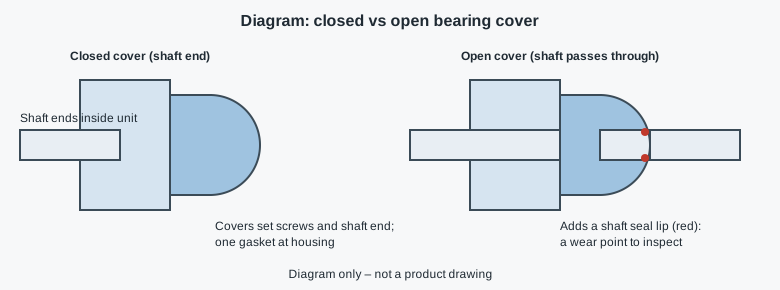
Fretting corrosion is a small-motion contact problem, not simply another name for a rusty bearing. On food machinery, look at the shaft beneath the inner ring, the outer-ring seat and housing mounting joints separately from the rolling surfaces. This guide provides a diagnostic sequence and prevention checks for those interfaces. It belongs to the Bearing units engineering hub; use the bearing failure causes field guide to place fit damage alongside ingress, lubrication and load investigations.
What is fretting corrosion, and where does it occur?
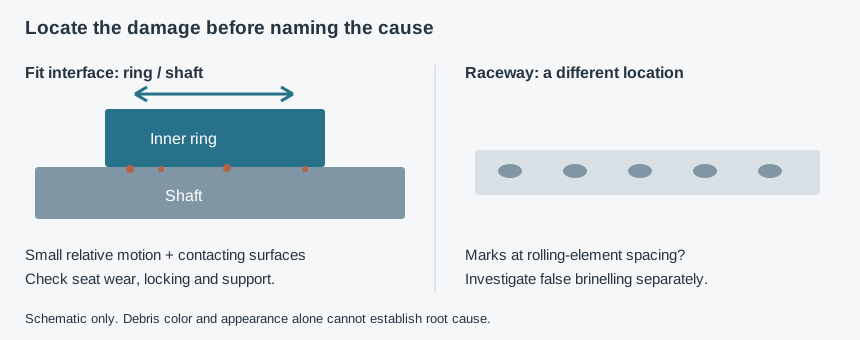
Two loaded surfaces can appear stationary while moving slightly against each other during vibration, bending or changes in load. Repeated rubbing damages the contact surface and generates debris; oxidation can contribute to further damage. At a bearing fit, the result may include worn seats, local polishing and reddish-brown or dark debris. Color alone cannot establish the mechanism.
Bearing fretting can occur at the inner-ring bore against the shaft, the outer ring against its housing seat, or a housing-to-frame contact that moves under load. Identify the actual interface. A spherical insert's ability to accommodate alignment during installation is not permission for uncontrolled movement in service. Confirm the arrangement's intended alignment and axial movement with the manufacturer.
Recognize fretting, creep, false brinelling and moisture corrosion
ISO 15243 classifies rolling-bearing damage and its possible causes. Its terminology supports an investigation, not a diagnosis made from a single photograph. SKF and NSK damage guidance similarly distinguishes seat movement, raceway damage and environmental corrosion.
| Finding | Possible mechanism | How to check | Action to investigate |
|---|---|---|---|
| Debris and local wear under a ring or at a mounting face | Fretting at a contact interface | Photograph before cleaning; compare worn contact areas and measure the seat | Check fit, locking, support and sources of micro-movement |
| Circumferential polishing or evidence a ring moved around its seat | Ring creep | Look for relative movement and seat wear; review fit and load direction | Confirm the specified fit and locking arrangement |
| Raceway marks at rolling-element spacing after idle vibration or oscillation | False brinelling | Inspect raceway pattern and shutdown or transport history | Investigate oscillation and lubrication at rolling contacts |
| Rust or pits where water or cleaning solution entered | Moisture or chemical corrosion | Check seal paths, deposits, cleaner changes and affected locations | Address ingress and chemistry alongside mechanical damage |
Send bearing and fit details for a diagnostic recommendation
Creep describes relative ring movement on its seat; it can contribute to fretting and wear, but is not synonymous with either false brinelling or every fretting mark. Multiple mechanisms may coexist. For example, water can corrode a damaged seat while looseness permits further movement. Keep those observations separate in the investigation record.
Causes: vibration, fit, locking, support and washdown
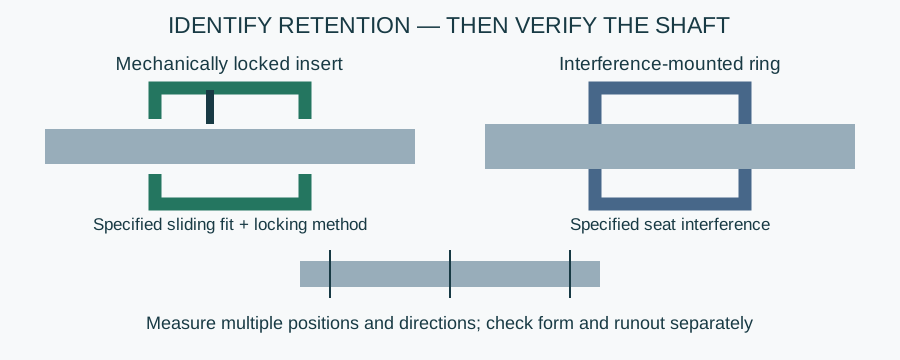
A loose or unsuitable fit can allow movement when the ring is loaded. Selection depends on the unit construction and duty: rotating or changing load, shaft condition, speed and temperature all matter. Conventional press-fit bearing advice cannot be copied directly to an insert unit that uses set screws, a collar or a sleeve. Use the relevant mounting instructions.
Check support stiffness and contact condition. A housing on a distorted or flexible plate may move even when its fasteners seem tight. Inspect flatness, contact marks, damaged holes, shims and the load path. More bolts do not automatically solve a poorly supported joint. The oval flange mounting guide provides context for compact housings and rigid mounting.
Vibration may come from imbalance, loose drives, changing belt tension, frame motion or adjacent equipment while a machine is stopped. Record running and idle conditions rather than assuming every mark developed during rotation. Washdown can add moisture and remove lubricant, but it is an environmental contributor—not proof of micro-movement. Compare the environmental attack identification table when rust or pitting appears beyond the loaded fit.
Diagnostic procedure before choosing replacement parts
- Make the inspection safe. Isolate energy and secure the shaft, belt tension and supported loads using the plant's safe-work procedure. EN ISO 12100 supplies risk-assessment principles; it does not specify one universal disassembly method.
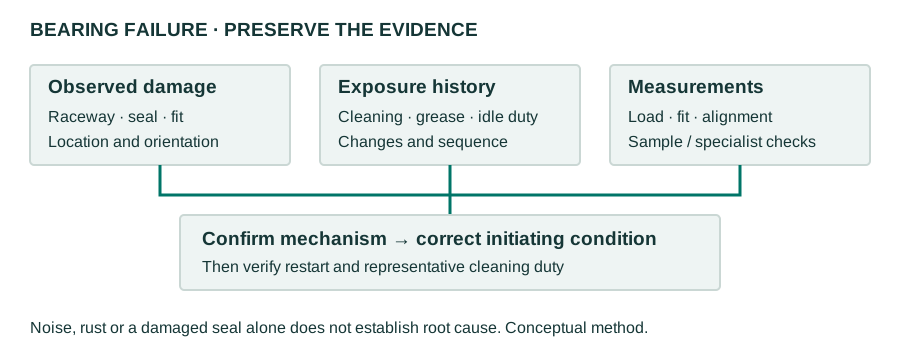
- Preserve evidence. Record unit position, ring orientation, locking arrangement, cleaning history and symptoms. Photograph deposits before wiping or abrasive cleaning. Label removed parts so damage can be related to the machine position.
- Separate damage locations. Inspect inner-ring bore, shaft, outer-ring seat, mounting face, seals and raceways independently. Note polishing, pits, scoring, debris and spaced contact marks without assigning an unsupported cause.
- Measure the fit and support. Measure shaft diameter at several positions and directions with appropriate instruments; assess taper, ovality and seat wear against the actual drawing. Check housing contact and alignment. Compare with supplier limits rather than using a generic tolerance from another bearing series.
- Review locking and duty. Identify the correct screw, collar or sleeve procedure, tightening sequence and torque. Check direction of rotation, loads and vibration. Review cleaning changes and lubricant application as separate possible contributors.
- Choose and verify the remedy. Agree repair or replacement criteria for the shaft, housing and insert. Retain enough evidence to check whether movement was corrected after restart; record a baseline and a follow-up inspection under the plant's maintenance plan.
Do not fit a new insert onto a worn seat merely because the nominal shaft size matches. The complete pillow-block installation guide covers the surrounding arrangement, but the actual dimensions and acceptance criteria must come from the drawing and manufacturer.
Fretting corrosion prevention: fits, locking and lubrication
Prevention starts with controlling unintended relative movement. Specify the correct shaft seat, appropriate locking system and sufficiently rigid housing support. Follow the unit's tightening sequence; excessive torque or interference can damage components rather than improve retention. Confirm that any intended floating or alignment function remains available.
Follow the insert-seat selection and measurement checks to separate shaft size, geometry and locking requirements in the inspection record.
Review alignment and shaft deflection under operating load, not only when the machine is empty. Correct imbalance, loose attachments and frame movement where they are demonstrated. If shutdown vibration is relevant, ask the bearing supplier about protection for the idle duty rather than changing grease without a diagnosis.
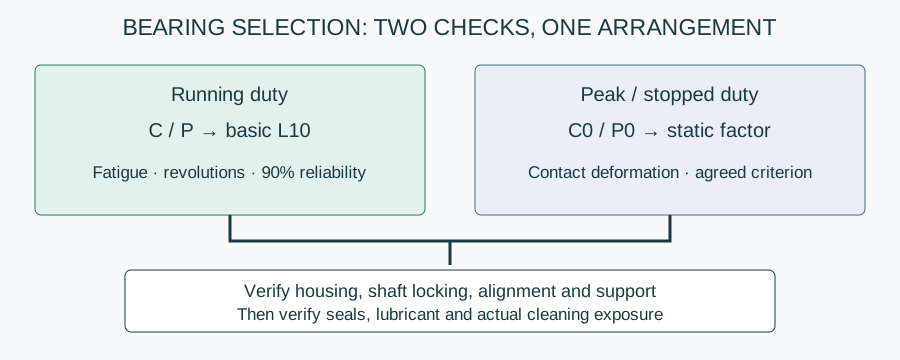
Use the separate running-life and peak-load assessment when documenting duty; neither calculation replaces investigation of fit movement.
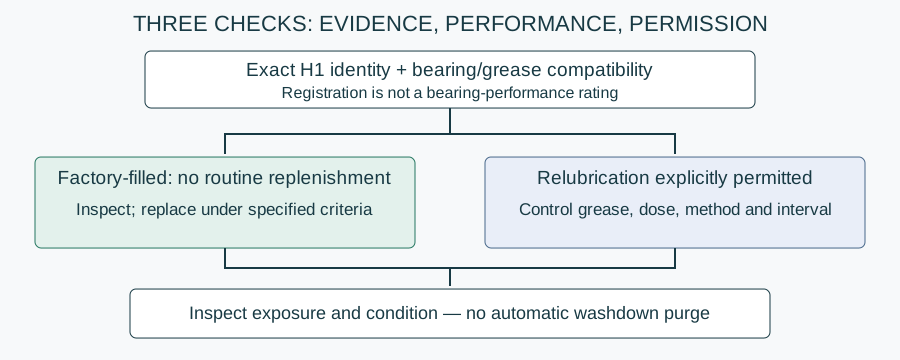
Lubrication of rolling contacts and treatment of a fit interface are different tasks. Do not put anti-fretting paste, retaining compound or grease on a locking interface unless the manufacturer permits it: changing friction may alter retention or assembly behavior. Such compounds do not restore a worn seat or stiffen a flexible frame.
In food areas, assess potential product contact and contamination from any treatment. ISO 21469 addresses hygiene requirements for lubricants with incidental product contact; it does not approve every paste for every installation. Follow product documentation and the plant's hygiene approval. Avoid surplus compound that can collect soil or escape toward product.
Compare the H1 registration and bearing-grease checks for rolling-contact lubrication without treating an H1 label as approval of a fit-interface compound.
Housing design and cleaning: separate requirements
A sealed stainless housing can help address environmental exposure, but it does not secure a poorly locked inner ring or prevent a mounting plate flexing. Consider drainage, access and seals together with mechanical support. Harborage points are joints where residues survive cleaning; do not conceal a moving, dirty joint with an improvised sealant bead.
For the separate sanitation assessment, compare the cleaning-access and inspection guidance.
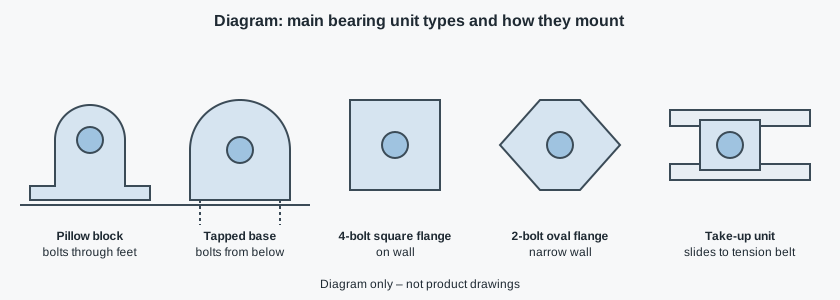
For choosing replacement geometry, consult the bearing block type comparison. Check that changes to housing footprint, shaft position or locking do not introduce new alignment or cleaning problems. An ingress rating documents a defined ingress test, not fit retention, fatigue life or hygienic cleanability.
Example: debris beneath a conveyor insert
Assumptions: a washed conveyor has debris beneath an insert's inner ring and vibration during operation. The shaft size, load and measured wear have not been supplied. This is a diagnostic example, not an NHK case or a confirmed failure cause.
The maintenance team photographs the bore and shaft, checks the locking instructions and measures the seat. It also examines frame support and seals. Local interface wear would support investigating fretting; broader pits and water traces would require environmental-corrosion checks too. The remedy depends on the findings: an out-of-limit seat needs an approved repair or replacement, while a sound seat with incorrect locking requires correcting the procedure. No diagnosis or successful outcome is assumed.
Specification and enquiry checklist
Send the unit designation, shaft drawing and measured seat condition; damage photographs with locations; load, speed, running and idle vibration history; locking method and maintenance record; housing support and alignment; cleaning chemicals, temperatures and application method; lubricant or interface compounds; and quantity and delivery country.
Use the buyer's evidence-request guides to organize those measurements and supplier questions before selecting replacements.
Copyable request: “Assess the bearing arrangement against the supplied seat measurements and operating conditions. Confirm shaft-fit requirements, locking method and torque, mounting support, seal and lubricant compatibility, and limits for repaired seats. Identify any permitted interface treatment and its hygiene requirements. Do not treat corrosion-resistant housing material as evidence that seat movement is controlled.”
NHK lists sealed stainless bearing units for product selection; that category is not an anti-fretting performance claim. An NHK technician can use the application details to suggest a component and quote. Investigation of damaged shafts or recurring vibration may also require the machine builder and bearing manufacturer's review.