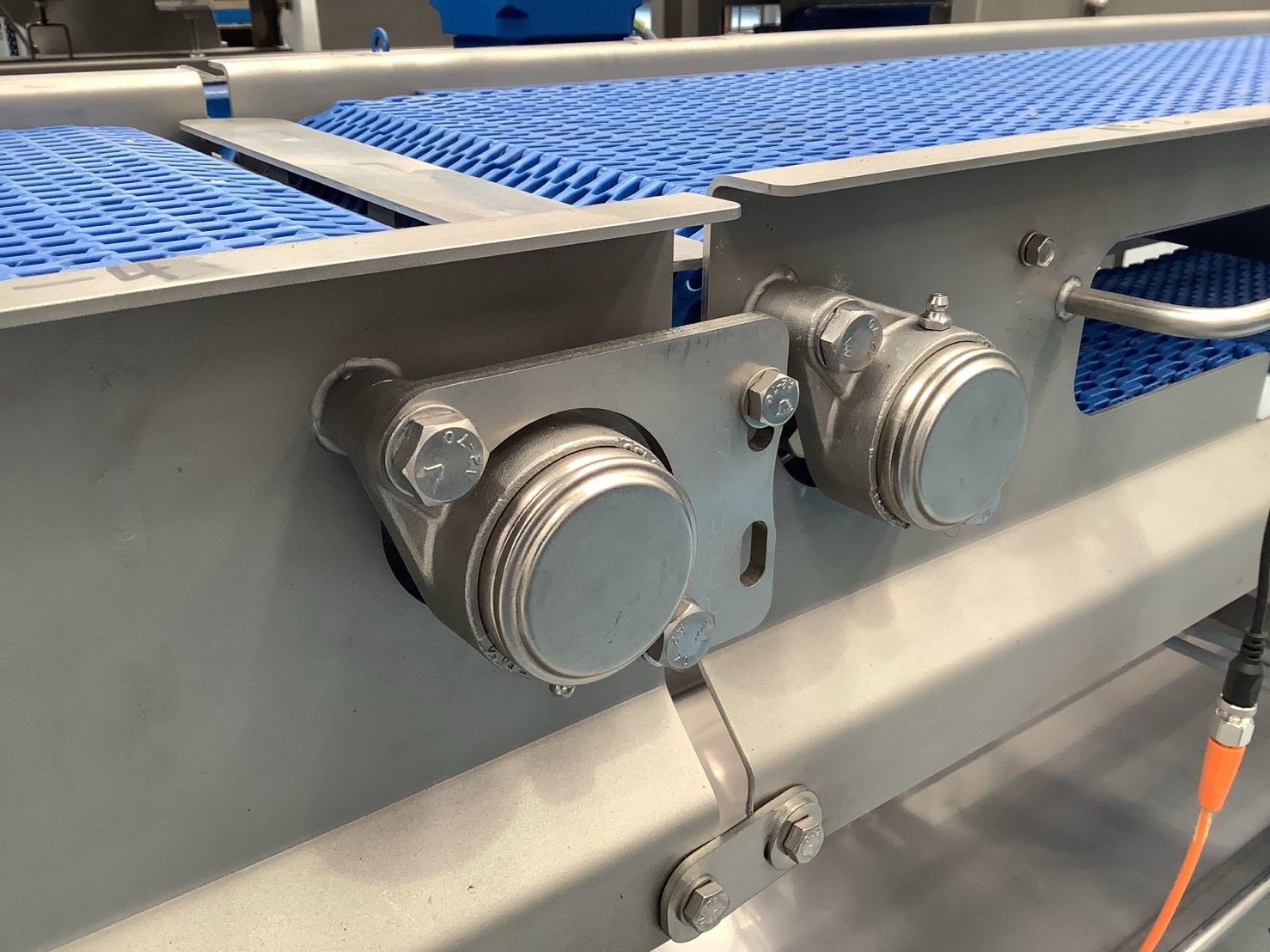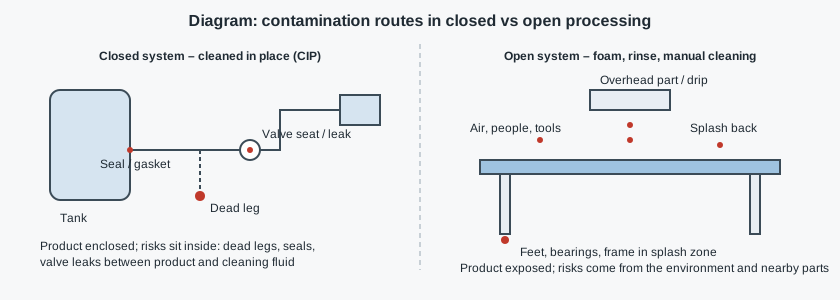
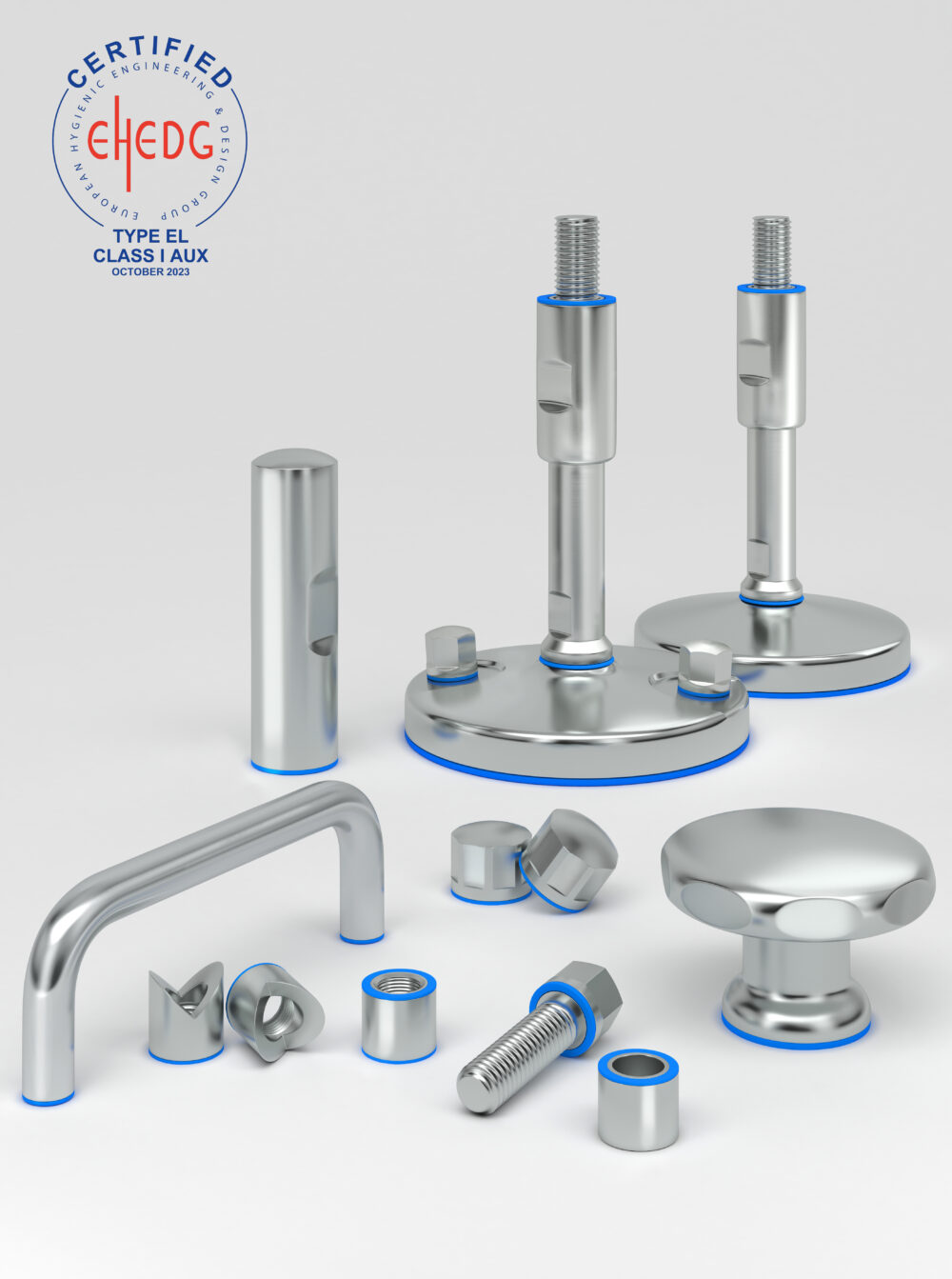
A bespoke machine is one designed for a specific customer's product, process or floor space rather than built from a standard series. Food, pharmaceutical and biotechnology producers increasingly ask for them – to handle sensitive products, fit existing lines or cope with harsh cleaning – and hygienic components such as EHEDG nuts, hygienic feet and easy-to-clean parts are central to making them work.
The engineering question behind the trend is practical: in a one-off machine, which parts should be custom, and which should be standard hygienic components? This guide answers that. For the standards themselves, see hygienic machine design standards.
What is changing in bespoke machine building
- More customisation of layout and process, driven by product variety, allergen changeovers (cleaning between products to remove allergen residues) and limited floor space.
- Higher hygiene expectations from customers who audit machines against EN 1672-2, EHEDG guidelines or 3-A.
- More sensors and data, which add parts – and potential crevices – to the machine.
- Sustainability questions about materials, cleaning water and energy.
Each of these makes the choice of components more important, not less.
Customise the machine, standardise the hygienic hardware
Hygienic small parts – nuts, bolts, feet, bearing units, seals – are hard to design well. A crevice-free seal geometry, a self-draining shape (surfaces that shed water instead of holding it) and the right surface finish take development and, for certified parts, testing. Standard hygienic components bring that work with them, along with drawings and documents.
| Aspect | Standard hygienic component | Bespoke component |
|---|---|---|
| Hygienic design evidence | Existing; EHEDG certificate or 3-A authorisation if the specific design holds one | Must be created for the part |
| Documents | Available: drawings, material certificates, declarations of compliance | Must be produced and maintained |
| Lead time and spares | Replaceable from stock range | Depends on drawing and maker |
| Fit to the machine | Machine must adapt to the part | Part fits the machine exactly |
| Risk | Known | Unknown until reviewed |
EHEDG nuts: what they are and when to use them
EHEDG nuts are hygienic fasteners – usually domed nuts with an integrated seal – designed to EHEDG guidelines so that no thread or crevice is exposed. A crevice is a narrow gap where product and moisture collect and cleaning fluid cannot flush; it becomes a harbourage point for bacteria.
Use them in the product-contact zone (surfaces the product touches) and the splash zone (surfaces from which product can return to the product). In the non-contact zone, standard stainless fasteners may be acceptable if the risk assessment supports it.
What matters when specifying:
- Certificate: call a nut EHEDG-certified only when its specific design has a certificate – ask for the number. See the EHEDG nuts and certified components.
- Seal material: EPDM, FKM or VMQ chosen by cleaning chemicals, fats and temperature (elastomer compatibility). EPDM swells in fats and oils; FKM resists oils; VMQ (silicone) covers a wide temperature range but is mechanically weaker.
- Material: AISI 304 for general use; 316/316L where chlorides are present, because it resists chloride pitting (local corrosion caused by chloride ions) better.
- Torque: over-tightening extrudes the seal and creates a gap; follow the supplier's instructions.
Hygienic feet: the base of a custom machine
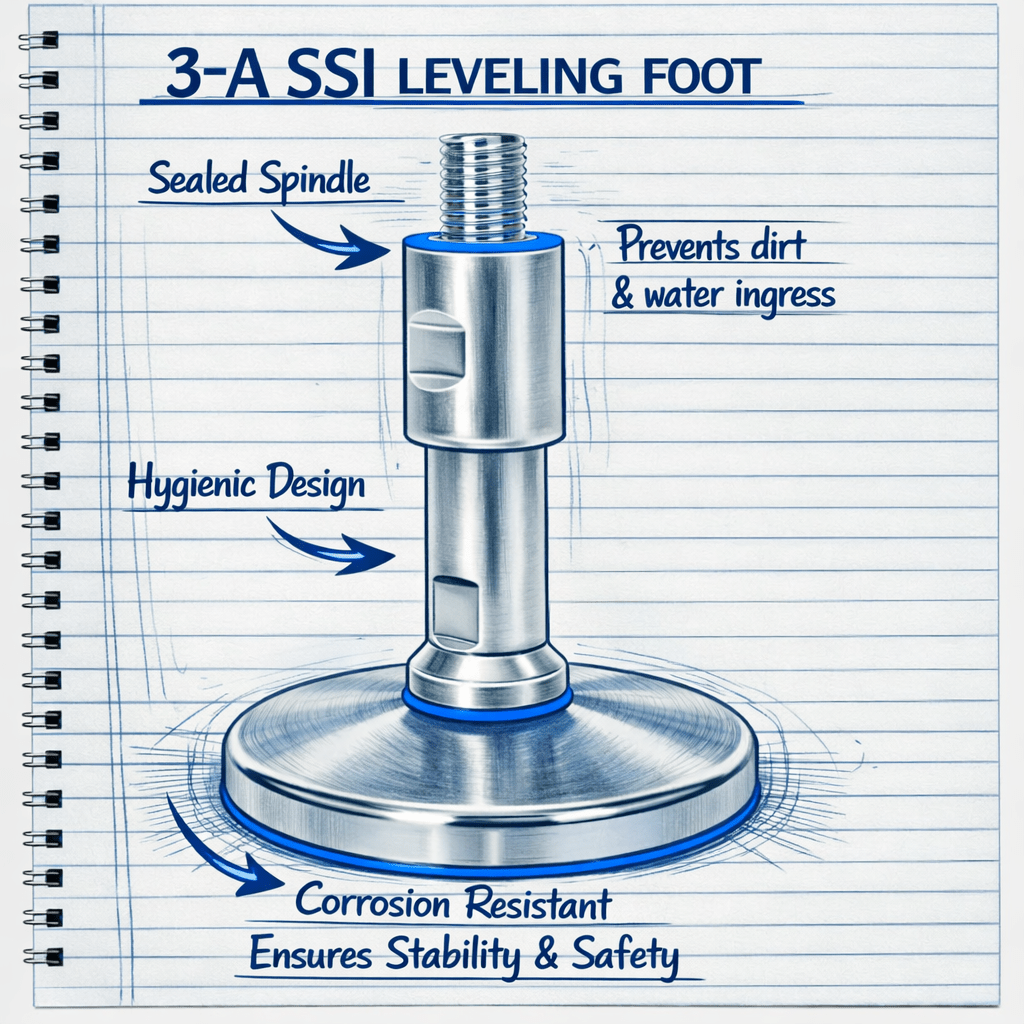
Bespoke machines often have unusual weight distributions and floor conditions, which makes hygienic feet a design item rather than a catalogue afterthought. Key attributes:
- Smooth, sealed design with no exposed thread at floor level, where water and residue collect.
- Corrosion resistance against cleaning agents – stainless steel, grade chosen by chemicals.
- Adjustability for precise leveling on uneven floors.
- Load per foot: total load ÷ number of feet that actually carry it × safety factor. On uneven floors, assume fewer feet carry the load until the machine is levelled.
- Fixing: free-standing, or anchored where vibration or seismic loads require it.
In pharmaceuticals, easy-to-clean feet support Good Manufacturing Practice (GMP) requirements for cleanable equipment. Detail: hygienic levelling feet.
Easy-to-clean components and tool-free disassembly
Easy-to-clean components share a set of attributes:
- Tool-free disassembly – parts that must be cleaned out of place (COP, cleaning out of place) can be removed quickly, which supports allergen changeovers.
- Minimal crevices and dead spaces – no pockets where liquid stagnates.
- Smooth, non-porous materials – EHEDG guidance gives surface roughness Ra ≤ 0.8 µm for product-contact surfaces.
- Chemical resistance for harsh cleaning agents, important in food, cosmetics and chemical processing.
Tool-free does not mean loose: quick-release parts must stay secure in operation and be impossible to fit wrongly.
How to choose standard or bespoke components
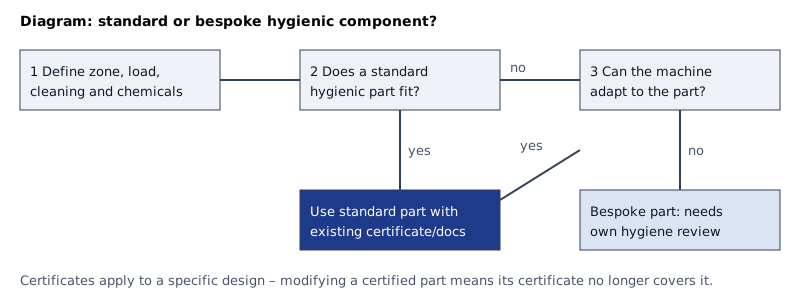
- Define the conditions for each part: zone, load, cleaning method (CIP – cleaning in place, foam, high-pressure washdown), chemicals and temperature.
- Search standard hygienic ranges for a part that meets them.
- Check whether the machine can adapt – a hole pattern, bracket or frame height – to fit a standard part.
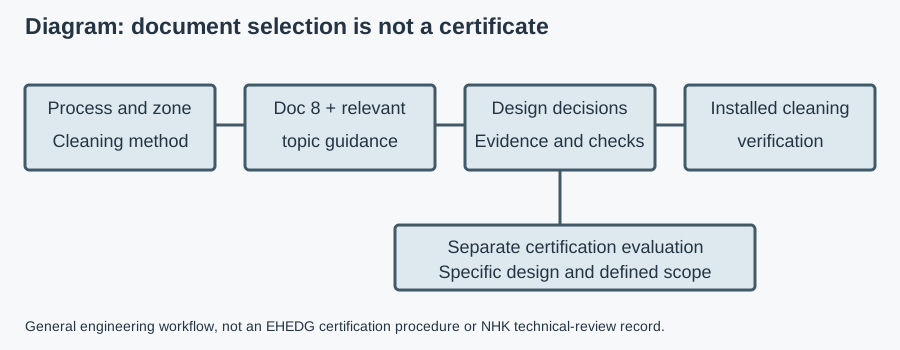
- Only then design a bespoke part, and give it a hygienic design review against EN 1672-2 or EHEDG guidelines.
- Avoid modifying certified parts: a changed part is outside the certificate.
- Document materials, declarations of compliance and drawings for every part.
Example: a custom tray-handling machine
Assumptions (illustrative): a one-off machine for a ready-meal plant, washed daily with foam and low-pressure rinse, chlorinated cleaner used weekly.
- Frame, guides and tray handling: bespoke – the plant's trays and layout are unique.
- Fasteners in the splash zone: standard hygienic domed nuts with EPDM seals (low fat exposure), AISI 316 because of chlorinated cleaner.
- Feet: standard sealed hygienic feet; load per foot calculated assuming three of four feet carry the load before levelling.
- Sensor mounting bracket: no standard part fits, so bespoke – designed with sloped surfaces and continuous welds, reviewed separately.
Sensors, sustainability and modular design
- Sensors: monitoring can detect wear or support cleaning verification, but each sensor adds a mounting, a cable and seals. Use hygienic sensor housings and mountings. See automated hygienic components.
- Data analysis: data-driven tools can suggest process adjustments; they do not replace hygienic design.
- Sustainability: stainless steel is recyclable; easy-to-clean design reduces water and detergent use. Check that any alternative material has food-contact documentation before using it.
- Modular design: standard component interfaces let parts be replaced or upgraded later.
Cost of bespoke builds
Bespoke machines usually cost more up front. Using standard hygienic components where possible limits that cost, shortens engineering time and keeps spare parts available over the machine's life.
RFQ checklist for components in a custom machine
- Zone (product-contact, splash, non-contact) and installation drawing.
- Load, cleaning method, chemicals and temperature range.
- Material grade and surface finish (Ra).
- Seal material and declaration of compliance (EC 1935/2004; EU 10/2011 for plastics; FDA 21 CFR 177.2600 for rubber where relevant).
- EHEDG certificate or 3-A authorisation number, if certification is required.
- Drawings (CAD) and cleaning and installation instructions.