EHEDG guidelines are technical guidance documents used to inform hygienic equipment and facility design. They address design principles and particular equipment, fabrication or assessment topics; they are not certificates for the reader's machine. Begin with the EHEDG certificate-scope and supplier-check guide for the wider scheme, then use this page to select documents and turn their guidance into a traceable design review.
EHEDG guideline documents: choose by scope, not number alone
A guideline number identifies a document, not its applicability to every food machine. Read the official summary, obtain the relevant edition and compare its scope with the product, equipment and cleaning method. Record the title and revision in the project specification. A supplier's statement that it “follows EHEDG” is too broad to establish which guidance informed the supplied detail.
The table below is a navigation aid, not a reproduction of the documents or a list of mandatory clauses. It uses verified catalog titles. Obtain the official document before using detailed criteria in a drawing, inspection plan or contractual acceptance requirement.
| Document | Verified title | Why consult it | Scope check before use |
|---|---|---|---|
| GL 8 / Doc 8 | Hygienic Design Principles | General design basis and risk-based assessment | Identify applicable principles for the equipment and installation |
| Doc 2 | A method for assessing the in-place cleanability of food processing equipment | Understand the named cleanability assessment method | Confirm applicability with the evaluation/test body; not a generic plant cleaning recipe |
| Doc 9 | Welding stainless steel to meet hygienic requirements | Fabrication and welded-interface questions | Use the applicable document and qualified fabrication procedure |
| Doc 10 | Hygienic design of closed equipment for the processing of liquid food | Closed liquid-processing equipment | Do not automatically apply closed-system details to an open conveyor |
Ask NHK's technicians about your guideline and component question
This is not a complete EHEDG document index. Use the official EHEDG guideline catalog to find equipment-specific topics and current access information. No edition is asserted here for Docs 2, 9 or 10 because their latest editions were not verified in this source check.
EHEDG Doc 8: Hygienic Design Principles
The current official catalog identifies GL 8 as Hygienic Design Principles, fourth edition, December 2025. The catalog describes risk-based considerations for equipment and facilities used in food manufacturing, including design, construction and installation. “Hygienic equipment design criteria” appears in searches and informal descriptions; use the verified document title and edition in the actual specification instead of treating that phrase as the current title.
Doc 8 provides the general design basis; it does not remove the need to select guidance specific to the equipment or process. A principle must be translated into a particular interface and a way of checking it. For example, “cleanable connection” needs a drawing, access arrangement, intended cleaning procedure and acceptance evidence. Writing “Doc 8 compliant” beside an unspecified bracket leaves those decisions unresolved.
This guide does not reproduce the paid document, interpret unreviewed clauses or prescribe dimensions from its public summary. Surface roughness, radii, seal geometry and other reference values need the relevant source, application and acceptance basis. No universal Ra or radius value is imposed here, and the edition named above is not proof that an existing supplier certificate has already been evaluated against that edition.
How designers use a guideline: a six-step review
- Define the task and boundaries. Identify food, equipment function, product flow, contact zones and contamination routes. A product-contact zone directly touches food; a splash zone receives product or cleaning liquid without intended direct contact. Include foreseeable transfer from nearby non-contact parts.
- Define cleaning and inspection. Record chemicals, concentration, temperature, access and dismantling. Cleaning-in-place (CIP) cleans without dismantling; cleaning-out-of-place (COP) removes parts for cleaning elsewhere. External foam cleaning of an open machine is not automatically a validated CIP process.
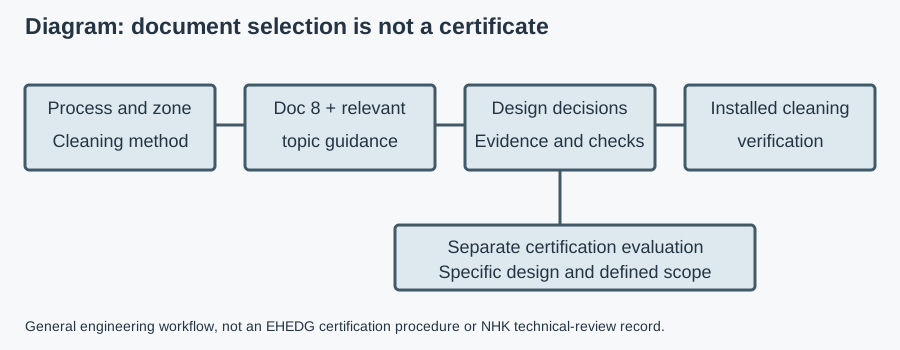
- Select and record documents. Begin with the general design principles and identify topic guidance from the official scopes. Record the exact edition obtained and why each document is relevant. Keep uncertain applicability as an open question rather than silently choosing the most familiar number.
- Map decisions to interfaces. List product-contact surfaces, welds, seal seats, fasteners, shafts, hollow sections and supports. Record the drawing/detail that addresses each risk, plus the supplier evidence or inspection needed. Do not substitute a catalog badge for the installed interface drawing.
- Agree verification. Define how accessible surfaces, drainage, dismantling, reassembly and cleaning will be demonstrated under representative conditions. Assign actions within the project team; this is suggested engineering practice, not a claim about an existing NHK review procedure.
- Close and maintain the record. Resolve exceptions with a documented assessment and update the review when materials, seals, geometry, cleaning or installation change. Preserve the approved configuration and questions requiring specialist evaluation.
The result should be a design record someone can inspect, not a collection of copied guideline phrases. The core hygienic-design principles guide connects these decisions to practical machinery interfaces.
Installation details that need evidence
A crevice is a narrow gap that can retain liquid or soil beyond effective cleaning. A harborage point is a location where residue survives the procedure. Inspect bracket seats, cover joints, adjustment threads and seal interfaces rather than judging only the visible polished surface. Self-draining surfaces release liquid instead of retaining a pool; check them in their installed orientation.
A component can have a suitable design yet be installed with an inaccessible gap, obstructed cleaning route or incompatible replacement seal. The guideline review therefore needs the connection to the frame, nearby utilities and the cleaning position, not only the component's drawing. The component design and certificate distinctions provide a migrated reference for these supplier claims. For supports, the foot selection and installed-load guide provides application context; leveling feet (levelling feet in British English) must still be selected for mechanical duty as well as hygiene.
Keep material suitability separate from geometry. An alloy name, seal family or ingress rating does not establish food-contact suitability or detergent resistance. Ask for evidence identifying the actual supplied materials and intended conditions. A design review can identify missing evidence but cannot invent it.
Guidelines versus certification, standards and law
EHEDG guideline use does not award a certificate. Certification is voluntary and concerns an identified equipment design within a stated scope. The machine-builder certification process guide covers the separate evaluation route. Do not describe a company, factory or alloy as EHEDG certified, or infer that a machine is certified because it contains a certified component.
EN 1672-2 and EN ISO 14159 address machinery hygiene requirements; food-contact legislation addresses material/article use. These are not interchangeable with an EHEDG guideline. The existing machinery standards overview provides the wider framework without turning this document-selection page into another standards index.
A contractual requirement to use particular guidance needs a clear document reference and acceptance basis. It does not make every guideline legally mandatory. Likewise, an IP test addresses ingress under stated conditions, not cleanability: IP67 is an immersion test, not a washdown rating. Separate these requirements in the purchase specification so each is supported by the appropriate evidence.
Example: review a removable guide bracket
Example — hypothetical assumptions, not NHK field data. Assume an OEM is reviewing a removable guide bracket beside an open food conveyor, with external foam cleaning and access required during product changeover. No bracket configuration or certificate has been selected.
- Mark the bracket's contact/splash exposure and the route by which residue reaches its seat. Record the cleaning position and safe removal method.
- Use Doc 8 as the general review basis, then check the catalog for applicable equipment and fabrication guidance. Do not assume Doc 10 is appropriate merely because the line has liquid cleaning.
- Ask for the mounting detail, materials, seals, permitted adjustment and reassembly procedure. Identify inaccessible seats or retained liquid that the installed design must resolve.
- Agree inspection and representative cleaning evidence, including the bracket removed and refitted. If certification is requested, verify the exact design and restrictions separately.
- Record remaining supplier questions and reopen the review if the seal, mounting geometry or cleaning method changes.
The outcome is a component-interface decision and evidence request. It is not a certificate, a field-tested cleaning result or a claim that a specific NHK bracket meets every requirement.
Review checklist and supplier questions to send
Use this compact record in a design review or enquiry. It connects document selection to a decision and its evidence without claiming an internal NHK approval workflow.
For a component suggestion and quote, separate supplier questions from machine approval and send only the relevant interface details.
| Record | Question to resolve | Evidence or action |
|---|---|---|
| Document and edition | Does its scope fit the task? | Official document and applicability note |
| Interface drawing | Where can liquid or residue remain? | Installed detail and access review |
| Cleaning procedure | Can the chosen interfaces be reached and inspected? | Safe cleaning/removal demonstration |
| Material and seal | Are actual use conditions supported? | Item-specific supplier documentation |
| Certificate if required | Does it cover the supplied design? | Exact designation, scope and restrictions |
| Change record | What would invalidate the assessed configuration? | Re-review trigger for replacements or modifications |
Copy and complete: “Guideline number/title and edition obtained: __. Equipment and contact/splash zone: __. Component and interface drawing: __. Product and cleaning conditions: __. Design question or unresolved access/geometry issue: __. Material evidence and certificate scope needed: __. Quantities and delivery country if requesting parts: __.”
Use the buyer's supplier-evidence guides to turn unresolved guideline questions into specific document requests.
NHK's equipment hygienic-design reference provides background, not the official guideline text. Its hygienic standard-component category is a secondary browsing path; confirm each proposed component's exact scope and documents. Send the specific question through the site's form so NHK's technicians can assess available components and the evidence needed. That enquiry does not replace an authorized certification evaluation.