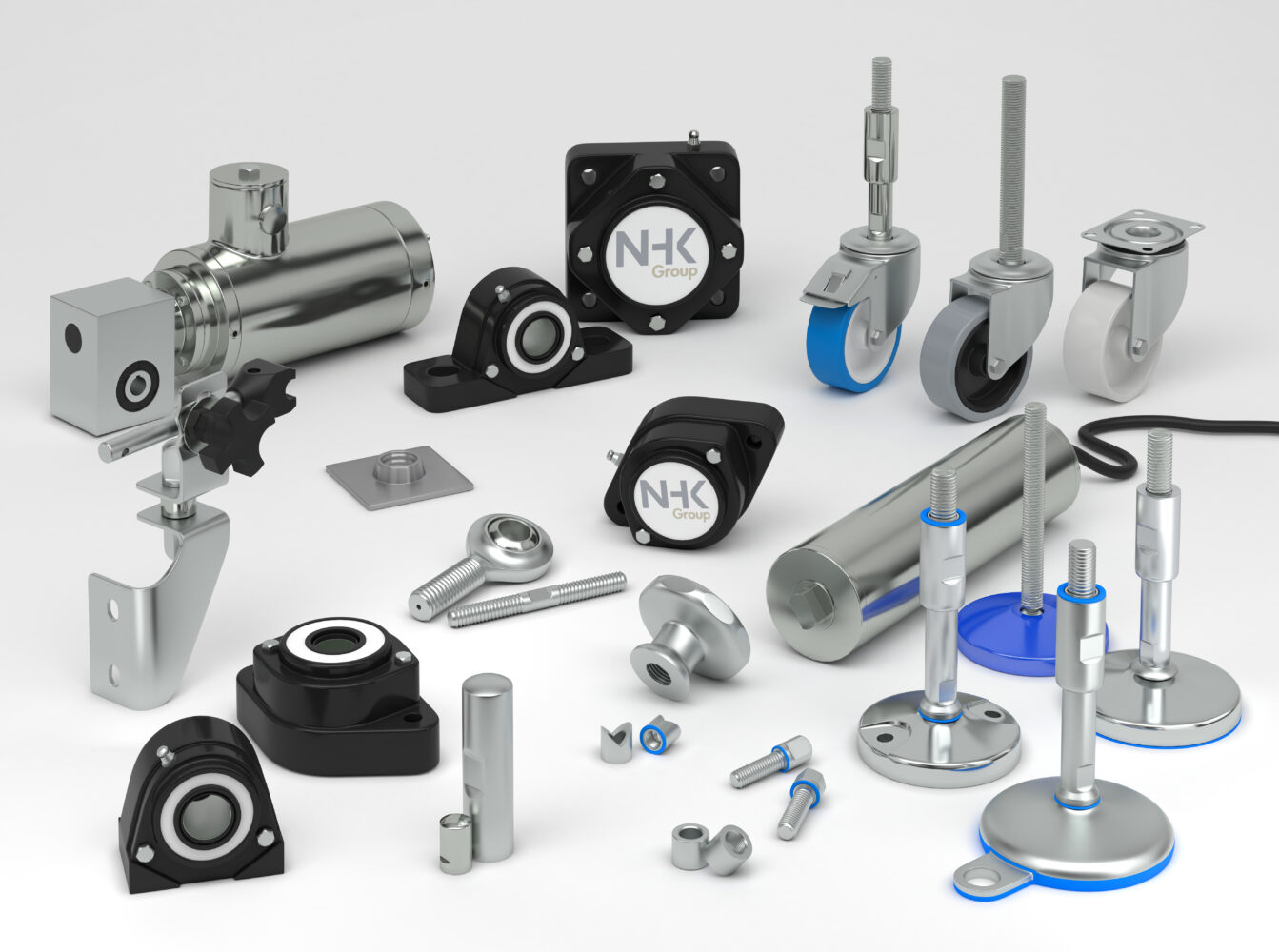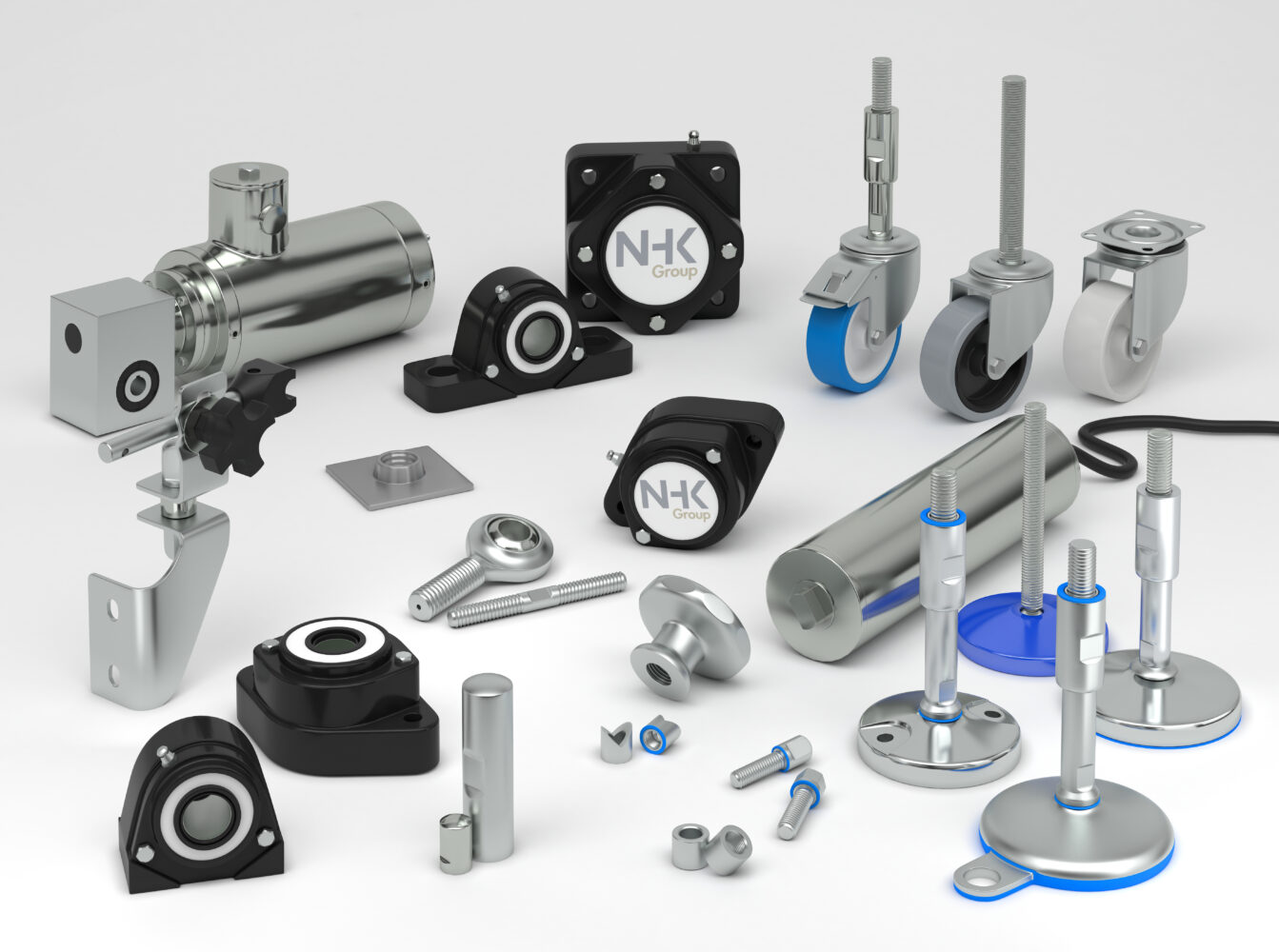
Optimized hygienic design is the practice of choosing and arranging sanitary conveyor components and machinery parts so that every zone of a machine can be cleaned reliably with the plant's actual cleaning method. In food processing, pharmaceuticals and biotechnology, that is where a competitive advantage is won or lost: in which component sits where. This guide goes through the main component families – certified parts, levelling feet, castors, bearing units, conveyor parts and drives – and shows where each one fits.
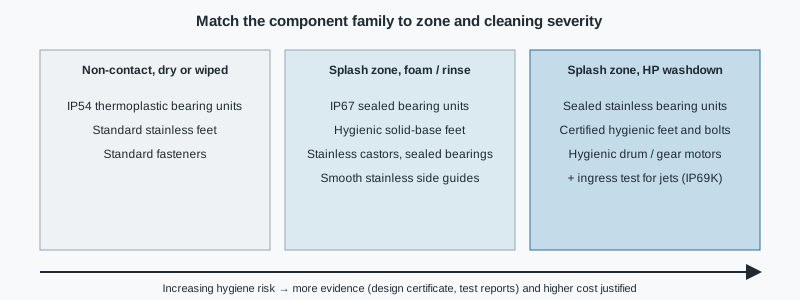
Where the advantage actually comes from
The business case for hygienic design is covered in hygienic design principles drive competitiveness. In engineering terms, the advantage has three sources:
- Cleanability: fewer harbourage points – crevices (narrow gaps), dead spaces (areas cleaning flow cannot reach) and exposed threads where soil and microorganisms survive cleaning.
- Lower contamination risk: fewer places for residue to build up and later return to the product.
- Evidence: certificates, declarations and test reports that customers and auditors can check.
Component choice decides all three. It also decides cost, so the aim is not "the best part everywhere" but the right part per zone.
Start with zones and cleaning method
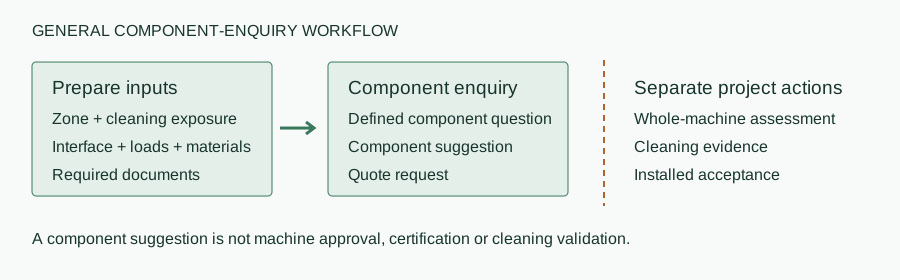
Before choosing a part, define:
- Zone: product-contact (surfaces the product touches or drains back from), splash zone (wetted by product or cleaning spray) or non-contact.
- Cleaning method: dry cleaning, wiping, foam and low-pressure rinse, high-pressure washdown, or CIP/COP (cleaning in place, or out of place after dismantling).
- Chemicals and temperatures, including chlorinated cleaners that cause chloride pitting on stainless steel.
- Customer requirements: some tenders ask for certified components in named zones.
Certified components: EHEDG and 3-A
EHEDG (European Hygienic Engineering & Design Group) certifies specific equipment designs that meet its hygienic design criteria. A certified design has been assessed as easy to clean, which reduces contamination risk and supports compliance with hygiene requirements such as EN 1672-2 and EN ISO 14159. EHEDG certification is voluntary and widely recognised; it does not replace legal requirements.
3-A Sanitary Standards are particularly established in the US dairy and food industries. The 3-A Symbol is authorised after a Third Party Verification that the design meets a specific 3-A standard, which includes requirements on materials, surfaces and resistance to cleaning. Like EHEDG, it is voluntary and applies to designs, not companies.
Certified parts make most sense where hygiene risk is highest and where customers ask for independent evidence. Feet and fasteners in the splash zone are typical examples, because they are notorious for exposed threads and gaps.
Component families compared
| Component | Typical zone | Hygienic features to look for | Trade-off |
|---|---|---|---|
| Certified hygienic levelling feet | Splash zone, washdown | No exposed thread, sealed base, self-draining shape | Higher cost; check load class and thread size |
| Stainless solid-base levelling feet | Splash or dry zone | Smooth solid base without cavities, corrosion-resistant | Not all have sealed threads |
| Hygienic castors | Mobile equipment in wet areas | Stainless or plastic body, sealed wheel bearings, open shapes | Load and floor conditions limit wheel choice |
| IP54 thermoplastic bearing units | Non-contact, light splash | Corrosion-resistant, light housing | IP54 = splash protection, not washdown |
| IP67 waterproof bearing houses | Wet areas, foam/rinse | Dust-tight, tested for temporary immersion | IP67 is not a jet test |
| Sealed stainless bearing units | Splash zone, washdown | Sealed design, stainless housing, food-grade grease | Higher cost; check seal elastomer vs chemicals |
| Mini stainless bearing units | Compact drives, small shafts | Stainless construction in limited space | Lower load capacity |
| Stainless side guides and conveyor parts | Product contact, splash | Smooth surfaces, few joints, tool-free adjustment | Removable parts must be controlled |
| Hygienic gear and drum motors | Conveyor drives | Stainless, sealed, smooth body without fan | Ingress rating must match washdown |
The sections below add what the table cannot.
Levelling feet
Machine levelling feet keep machines stable and aligned. In hygienic design they are a frequent weak point: an exposed thread or a hollow base collects soil right at floor level, where cleaning water runs. A solid stainless base prevents dirt accumulating under the foot; a sealed design also covers the thread. Choose AISI 304 for most wet areas and 316L where salt or chlorinated cleaners are present. Size the foot for the load actually carried: on an uneven floor, fewer feet carry the load until the machine is levelled.
Castors
Hygienic castors for mobile equipment use stainless steel or suitable plastics and sealed wheel bearings that keep cleaning water and soil out. Open shapes without cavities make them easier to clean.
Bearing units
Bearing units cover a wide range:
- IP54 thermoplastic housings offer limited dust and splash protection at lower cost than stainless steel. They resist corrosion but are not intended for high-pressure washdown – see bearing units in waterproof composite housing.
- IP67 waterproof bearing houses are dust-tight and tested for temporary immersion. IP67 is not a washdown test.
- Sealed stainless bearing units combine a sealed design with corrosion-resistant stainless steel, suited to wet, intensively cleaned areas.
- Mounted ball bearing units in stainless steel come in pillow block, flange and take-up housings for a range of loads.
- Mini stainless bearing units fit where space is limited.
For all of them, check the seal elastomer – EPDM, FKM or VMQ (silicone) – against product and cleaning chemicals, and use food-grade grease.
Conveyor parts, side guides and drives
Stainless conveyor parts with smooth surfaces prevent debris from accumulating. Side guides keep product aligned; in hygienic design they have few joints, smooth surfaces and simple adjustment. Hygienic gear and drum motors in stainless steel, with a sealed design, drive the conveyor without an external fan or gaps that collect soil.
Example: specifying a meat-line conveyor
Example – assumptions stated, not a real project. A conveyor in a meat plant is cleaned daily by foam and high-pressure rinse. The belt and side guides are in the product-contact zone; frame, feet, bearings and motor are in the splash zone. Choice: certified hygienic feet and hygienic bolts on the frame; sealed stainless bearing units with an ingress test covering jets; smooth stainless side guides; a stainless drum motor with a jet-resistant ingress rating. In the non-contact area above the line, an inspection-camera bracket uses an IP54 thermoplastic bearing unit, because it is only wiped. The machine builder documents the zone, cleaning method and evidence for each choice for the customer's audit file.
Failure modes to avoid
- IP rating treated as hygiene evidence – an IP67 housing with crevices is still hard to clean.
- Certified parts only on paper – the delivered variant differs from the certified one.
- One part for all zones – either too expensive or too weak somewhere.
- Mixed metals in wet areas – stainless with carbon steel or aluminium invites galvanic corrosion.
- Seals chosen without the chemical list.
Documents to request
- EHEDG certificate or 3-A authorisation for the exact design, where certified parts are specified.
- Declarations of compliance under EC 1935/2004 (and EU 10/2011 for plastics) for food-contact materials.
- Ingress test reports stating the standard: IEC 60529 for IP54 and IP67, ISO 20653 for IP69K.
- Material certificates for stainless grades.
Product lines for stainless equipment, levelling castors and load feet are listed at NHK Machinery Parts.
For building the business case behind these choices, see hygienic design: a strategic competitive advantage.
Conclusion
Optimized hygienic design pays off when each zone gets the component that matches its risk and cleaning method, backed by the right document. That is the competitive advantage: machines that clean predictably and evidence that proves it.