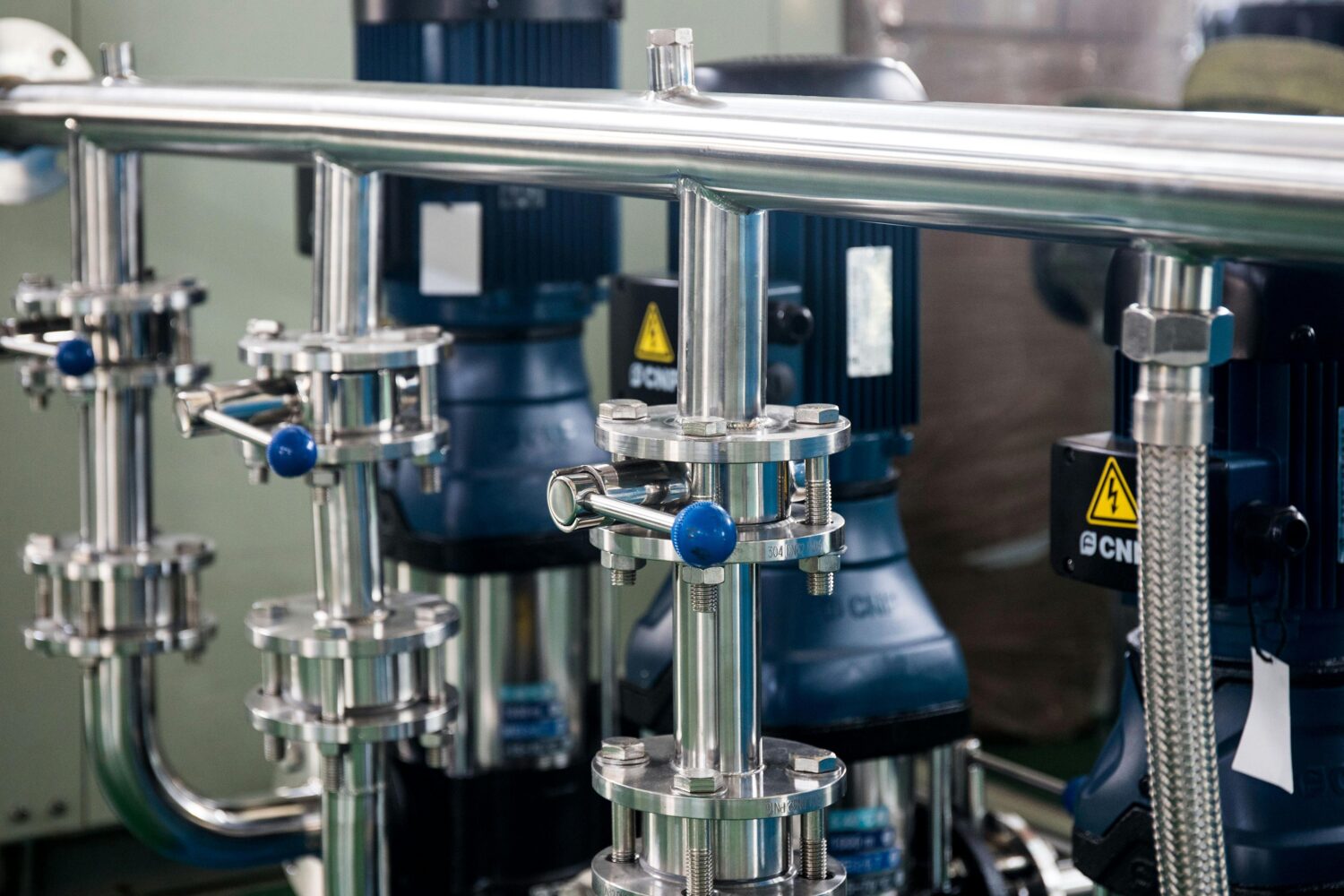
Hygienic design refers to the practices, standards and engineering solutions used to create machinery, equipment and facilities that are easy to clean, maintain and monitor for contamination. It started in industries with strict cleanliness requirements – food processing and pharmaceuticals – and its principles are now spreading to other sectors and markets worldwide. This guide explains why, how requirements differ by industry and region, and what that means when specifying equipment.
What hygienic design aims to achieve
The main objective is to reduce the risk of contamination by microorganisms, allergens or chemical residues, so that the end product is safe. It covers corrosion-resistant, non-toxic materials, smooth surfaces and the removal of harbourage points – places where residue and microorganisms survive cleaning. For the design principles in detail, see the core of hygienic design in food processing machinery.
Why hygienic design is a global trend
- Consumer demand for safety and transparency – consumers are better informed and more cautious about food, pharmaceutical and cosmetic products, putting pressure on companies to prevent contamination.
- Stricter regulation – regulators such as the FDA in the US and the EU have tightened food and drug safety requirements, so equipment sold internationally must meet several regimes.
- Innovation and competitiveness – equipment makers invest in cleanable designs to differentiate themselves and to reduce cleaning time and downtime for their customers.
- Global supply chains – retailers and brand owners audit suppliers in many countries to common food-safety schemes, and exported machines carry the same design standard into new markets.
Industries adopting hygienic design
Food processing and beverages
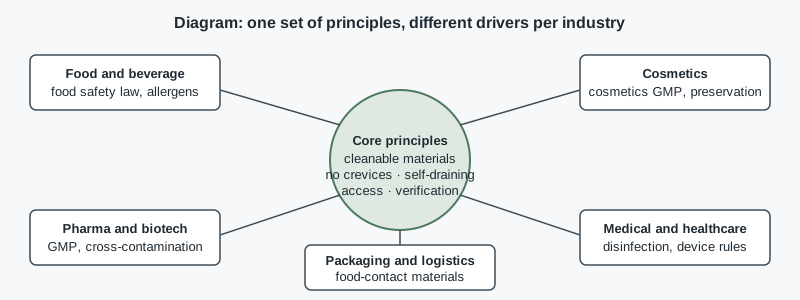
The food sector adopted hygienic design early to prevent foodborne illness. From dairy and meat processing to beverage bottling, equipment is designed to be easy to clean, corrosion-resistant and free from places where bacteria accumulate. Allergen management adds a further requirement: equipment must be cleanable enough for allergen changeover, the cleaning between products with different allergens.
Pharmaceuticals and biotechnology
Even minimal contamination can have serious consequences in pharmaceutical and biotech production. Hygienic design prevents cross-contamination between batches and products and protects the quality of medicines and vaccines. Equipment uses sealed components, minimal contact surfaces and high-grade materials, within the framework of Good Manufacturing Practice (GMP).
Cosmetics and personal care
Consumers expect creams, lotions and personal care products to be safe and free from contamination. Manufacturing equipment is designed to limit bacterial contamination and keep products consistent; ISO 22716 provides GMP guidelines for cosmetics.
Healthcare and medical devices
Medical equipment must be cleaned and disinfected regularly to prevent infection. Surgical instruments and diagnostic devices use materials and shapes that are easy to disinfect. Here the drivers are patient safety and medical device regulation rather than food law.
Packaging and logistics
Food and pharmaceutical packaging must not contaminate the product, so packaging materials and processes are controlled. In logistics, cleanable containers and conveyor systems help goods reach consumers without contamination.
How requirements differ by industry and market
The principles are global; the rules are not. The table summarises the main drivers. Always check the current legal text for the specific market and product.
| Industry or market | Main legal or GMP basis | Common voluntary schemes | Typical focus |
|---|---|---|---|
| Food machinery, EU | Machinery rules with EN 1672-2 and EN ISO 14159; EC 1935/2004 for food-contact materials | EHEDG certification of designs | Cleanability, materials, documentation |
| Food machinery, US | FDA food safety rules; 21 CFR for food-contact substances (e.g. 177.2600 for rubber) | 3-A Symbol (dairy and food), NSF | Sanitary design, material compliance |
| Plastics in contact with food, EU | EU 10/2011 in addition to EC 1935/2004 | – | Migration limits, declaration of compliance |
| Pharma and biotech | GMP (EU and FDA) | Industry design standards for process equipment | Cross-contamination, validation |
| Cosmetics | Cosmetics regulations; ISO 22716 GMP | – | Microbial control |
| Other markets | Local food and drug law; often reference EU or US practice | EHEDG, 3-A, NSF where buyers require them | Varies – check per market |
A declaration of compliance is the supplier's written statement that a food-contact material or article meets the applicable rules; buyers in regulated markets increasingly ask for it per component.
Key components of hygienic design
- Materials – stainless steel, especially AISI 304 and AISI 316 (often 316L), is widely used for corrosion resistance and cleanability. 316/316L resists chloride pitting better where chlorinated cleaning agents or salty products are present. Non-toxic, non-porous materials that do not react with cleaning agents are also used.
- Smooth surfaces and minimal seams – continuous surfaces and rounded corners remove small spaces where contaminants collect. EHEDG guidance gives Ra ≤ 0.8 µm for product-contact surfaces, where Ra is the average surface roughness.
- Easy cleaning and disassembly – parts that come apart easily are cleaned more thoroughly, important where cleaning is frequent.
- Self-draining design – angled surfaces prevent water from standing and promoting microbial growth.
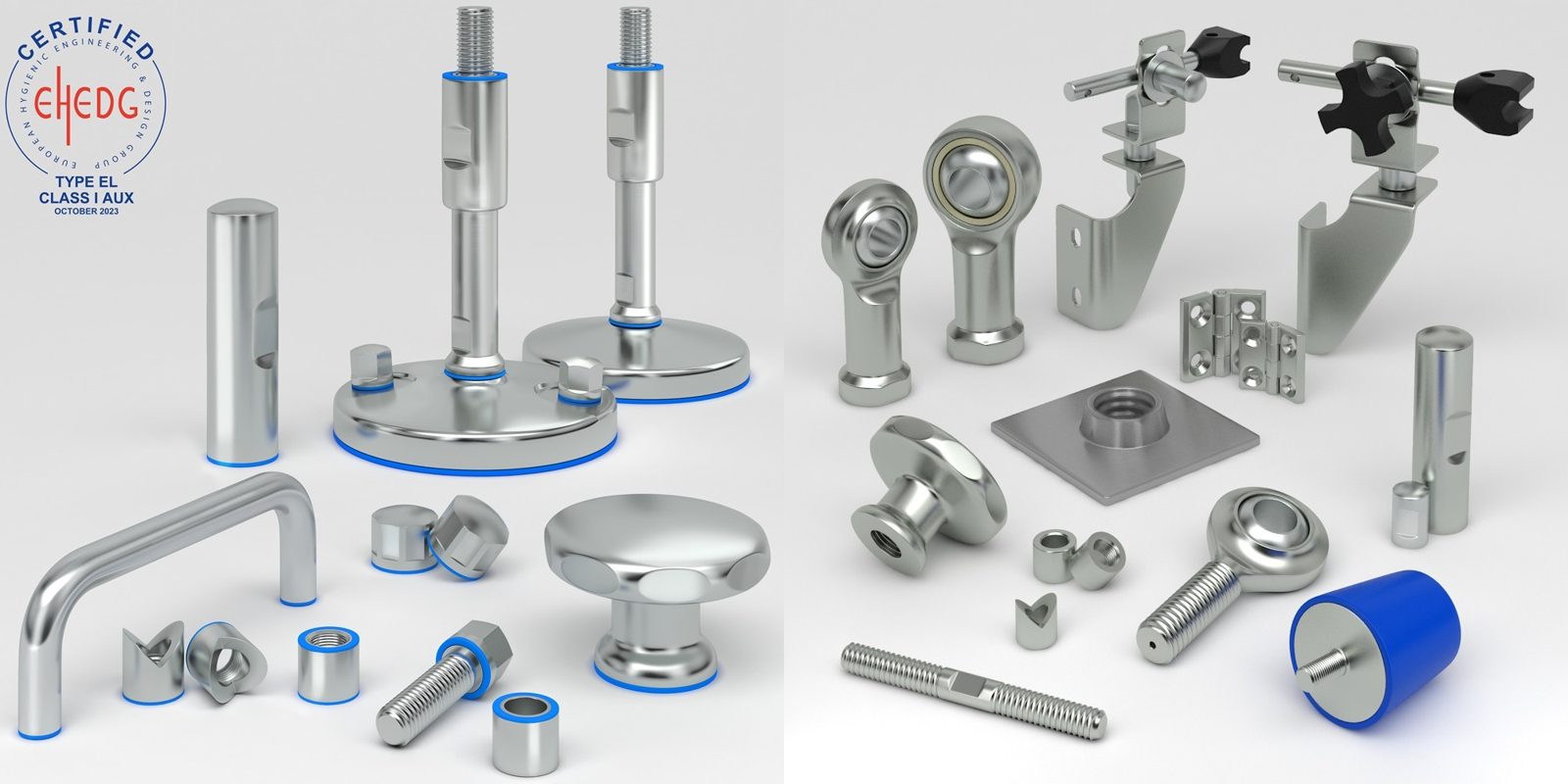
- Standards and certifications – EHEDG certification and NSF or 3-A programmes give independent evidence that a specific design meets hygienic criteria. They are voluntary and apply to the certified design only.
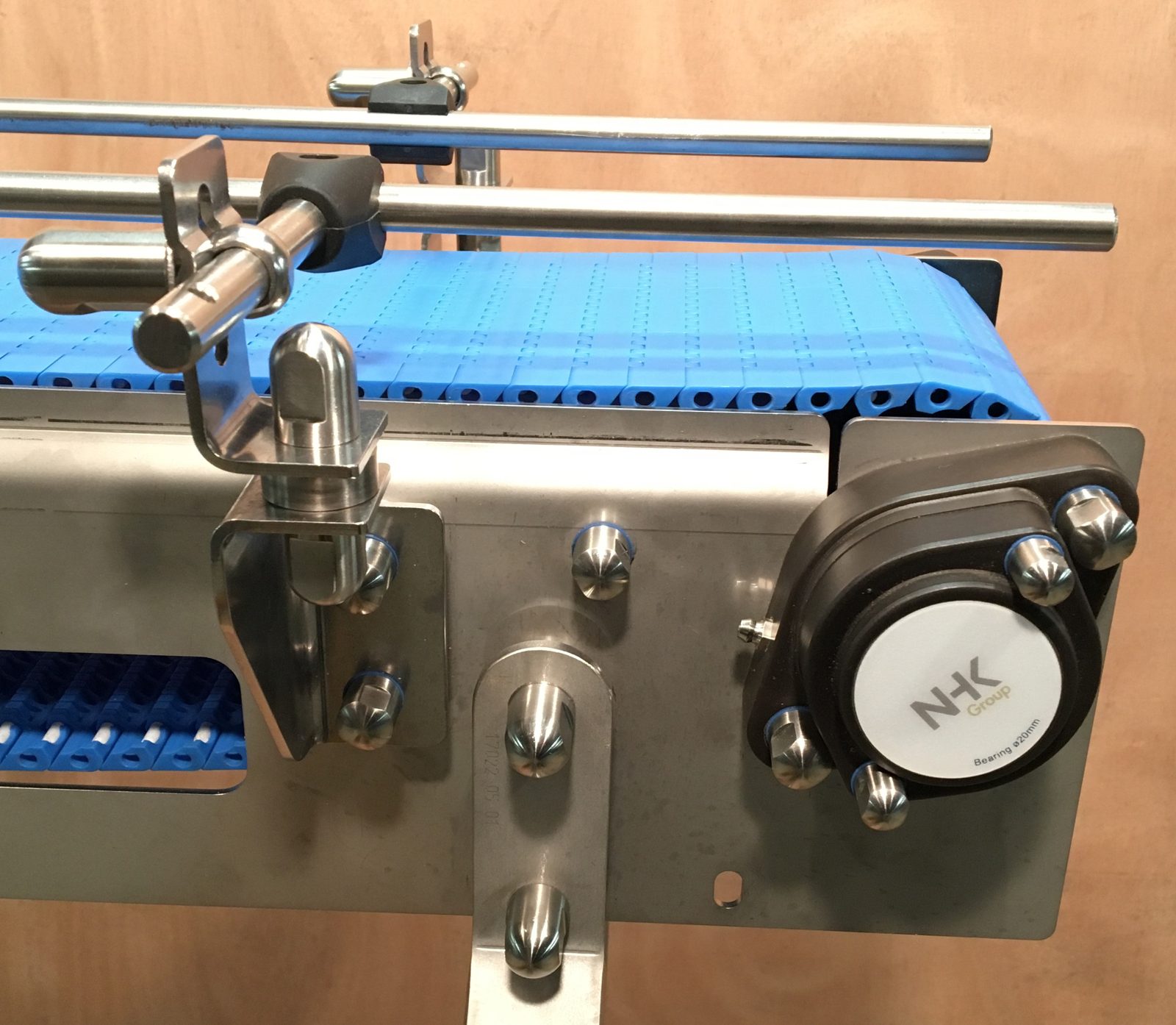
These principles extend to the parts that carry and move the machine: levelling feet with sealed threads, sealed bearing units and crevice-free fasteners. NHK's ranges are listed on the product line overview.
Specifying equipment for several markets
- List target markets and industries for the machine.
- Identify the legal basis in each – machinery, food-contact, GMP.
- Note buyer expectations – which voluntary certifications customers in each market ask for.
- Design to the strictest requirement where possible, so one build serves all markets.
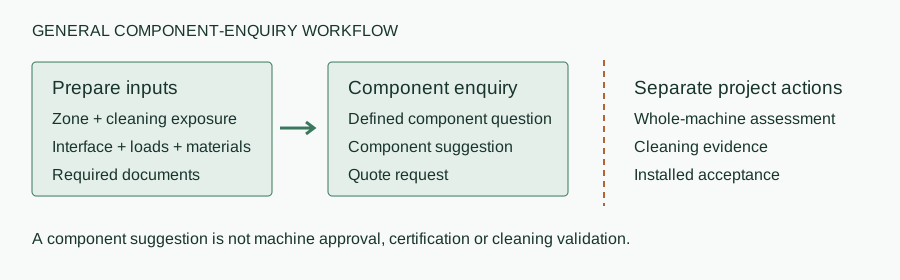
- Select components with documentation recognised in each market – material certificates, declarations of compliance, design certificates where they exist.
- Define the cleaning method and chemicals the machine must withstand, since these vary between plants and regions.
- Document – technical file, cleaning instructions and component certificates per market and language.
Example
Assumptions (illustrative only): an OEM builds a conveyor for meat processors in the EU and the US. EU customers ask for designs following EHEDG guidelines; US customers ask about 3-A or NSF.
- Legal basis: EU machinery rules with EN 1672-2 and EC 1935/2004; US FDA food-contact regulations.
- Design: crevice-free frame, self-draining surfaces, sealed bearing units and sealed-thread levelling feet in AISI 316L for chlorinated cleaning.
- Materials: belts and seals with documentation for both EU food-contact rules and the relevant FDA regulations.
- Evidence: component design certificates listed where they exist; the conveyor itself described as "designed to EHEDG guidelines" unless certified as a whole.
Benefits for companies
- Compliance and lower risk – fewer non-compliance findings and lower recall risk.
- Reputation and customer trust – audited buyers prefer suppliers who can document hygiene.
- Operational efficiency – easier cleaning and maintenance reduce downtime over the equipment's life.
The future of hygienic design
Adoption will keep spreading across industries. Developments include antimicrobial coatings (which supplement but do not replace cleaning), sensors for monitoring cleaning and contamination, automated cleaning systems, and more efficient cleaning that uses less water, energy and chemicals. For how the standards themselves are changing, see hygienic machine design standards in 2025.
For which marks and documents components need for export to different markets, see influence the global sustainable development and growth.