Hygienic design principles are the methods and standards that prevent contamination, improve cleanliness and make cleaning more efficient. For machine manufacturers they are more than a regulatory checkbox: applied well, they lower customers' production costs, open regulated markets and differentiate equipment in tenders. This guide shows how to turn the principles into a business case buyers can verify.
Understanding hygienic design principles
Hygienic design is essential wherever contamination is a health risk – food processing, pharmaceuticals and biotechnology. Its core aspects are:
- Material selection – stainless steel and other corrosion-resistant, non-toxic materials that do not support bacterial growth or react with cleaning agents.
- Smooth surfaces – free from pores and crevices (narrow gaps that trap residue); EHEDG guidance gives Ra ≤ 0.8 µm for product-contact surfaces.
- Sealed components – moving parts such as bearings are sealed against water, product and cleaning agents.
- Efficient drainage – self-draining shapes let cleaning solutions run off and prevent residue build-up.
- Modular design – parts that are easy to disassemble and reassemble for thorough cleaning.
For how these principles apply to individual components, see the core of hygienic design in food processing machinery.
Why hygienic design matters for competitiveness
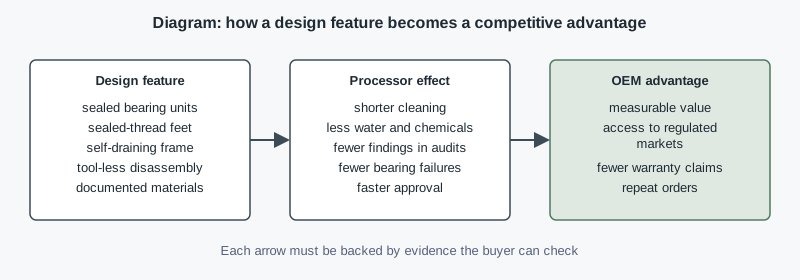
- Product safety and quality – food and pharmaceutical equipment is subject to strict regulations. Hygienic design helps buyers meet them, with safer lines and more consistent product.
- Lower operating costs – equipment that is easy to clean needs shorter, less frequent and less labour-intensive cleaning, with less water and chemicals.
- Durability – stainless steel resists corrosion and stands up to high-stress environments, so equipment lasts longer and needs replacing less often.
- Reputation and sustainability – buyers in hygiene-critical industries prefer suppliers they trust; durable materials and lower resource use also support their sustainability targets.
The table shows how a buyer typically judges these points – and what an OEM must supply to be believed.
| Buyer concern | Hygienic design answer | Evidence the buyer can check |
|---|---|---|
| Cleaning time and labour | Accessible, crevice-free, self-draining construction | Cleaning trial or time study on a demonstration unit |
| Water, chemical and energy use | Fewer harbourage points, shorter rinse | Consumption measured during trial |
| Food-safety audits | No exposed threads, sealed bearings, inspectable surfaces | Design review against EN 1672-2 / EHEDG guidelines |
| Material compliance | Stainless steel, compliant plastics and elastomers | Declarations of compliance (EC 1935/2004, EU 10/2011, FDA) |
| Independent proof | Certified designs where available | EHEDG certificate or 3-A authorisation for the specific design |
| Equipment life | Corrosion-resistant materials, sealed moving parts | Material certificates, component specifications |
Harbourage points are places where residue and microorganisms survive cleaning. A declaration of compliance is the supplier's written statement that a food-contact material meets the applicable rules.
Quantifying the business case
Generic claims like "reduces cleaning costs" rarely win a tender. A simple model with the buyer's own figures does.
Annual cleaning cost = cleans per year × (labour hours × hourly rate + water + chemicals + energy + lost production per clean)
Compare the current or competing design with the hygienic one. The difference is the annual saving; divided into the price difference, it gives a payback period.
Example
Assumptions (illustrative only, using placeholder figures the buyer would replace): a conveyor is cleaned once per day, 300 days a year. The existing design takes 2 labour hours per clean; a hygienic design with sealed bearing units, sealed-thread feet and an open frame is estimated at 1.5 hours after a cleaning trial. Labour costs 40 currency units per hour; utilities and production loss are left out to keep the example simple.
- Existing: 300 × 2 × 40 = 24,000 per year.
- Hygienic: 300 × 1.5 × 40 = 18,000 per year.
- Labour saving: 6,000 per year.
- If the hygienic version costs 9,000 more, payback on labour alone is 1.5 years – before counting water, chemicals, production time or reduced risk.
The figures are placeholders; the method is what the OEM brings. Measure on a real trial before quoting any number to a customer. A related cost model for certified designs is in EHEDG-certified design and energy savings.
Key industries
Food processing
Contamination prevention is central. Hygienic equipment reduces cross-contamination and the risk of costly recalls, from dairy to meat processing, and supports allergen changeover – cleaning between products containing different allergens.
Pharmaceuticals
Pharmaceutical manufacturing requires strict contamination control. Hygienic equipment protects the efficacy and safety of medicines and is part of meeting Good Manufacturing Practice (GMP).
Biotechnology
Biotech processes are sensitive to contamination, which can spoil batches and research results. Hygienic equipment improves reliability and repeatability.
How manufacturers implement hygienic design principles
Adopt recognised standards
Design to EN 1672-2 and EN ISO 14159, EHEDG guidelines, 3-A Sanitary Standards and FDA regulations as relevant to the target market. EHEDG certification and 3-A Symbol authorisation (after Third Party Verification) are voluntary and apply to specific designs, but buyers often ask for them.
Choose hygienic components
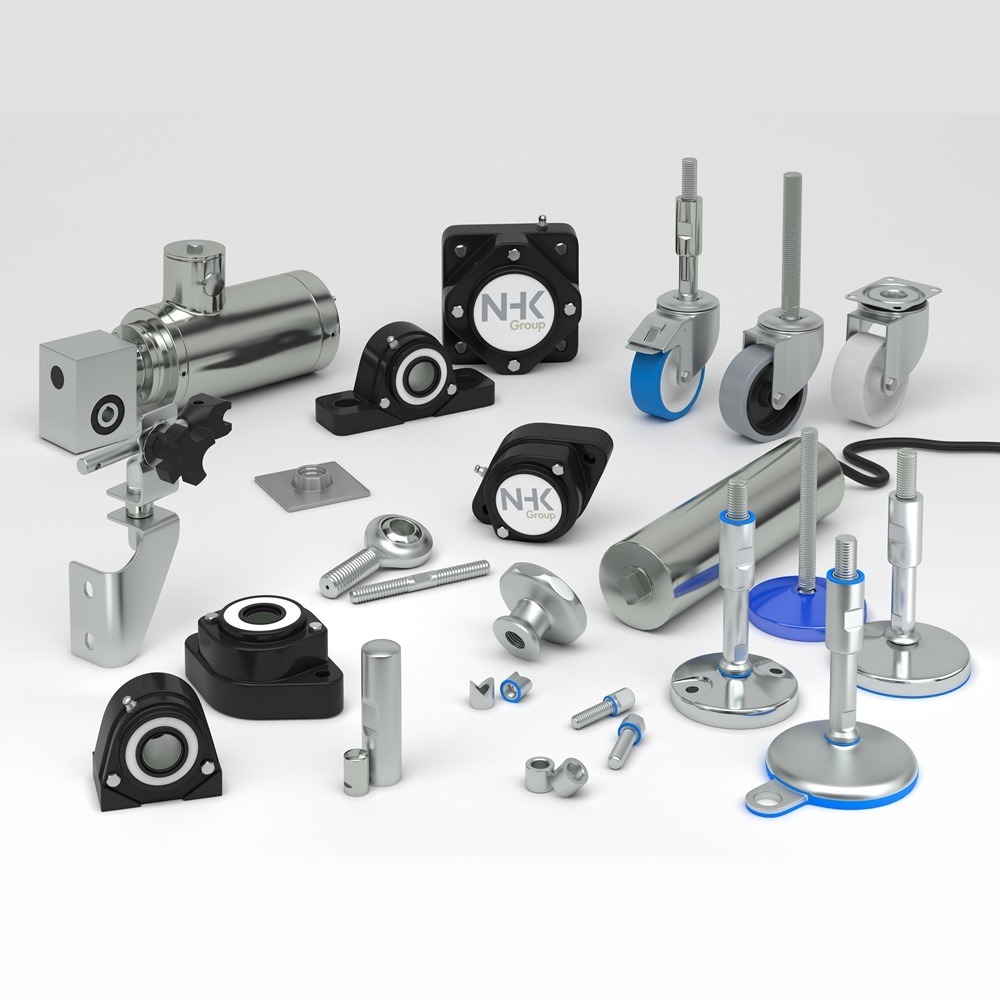
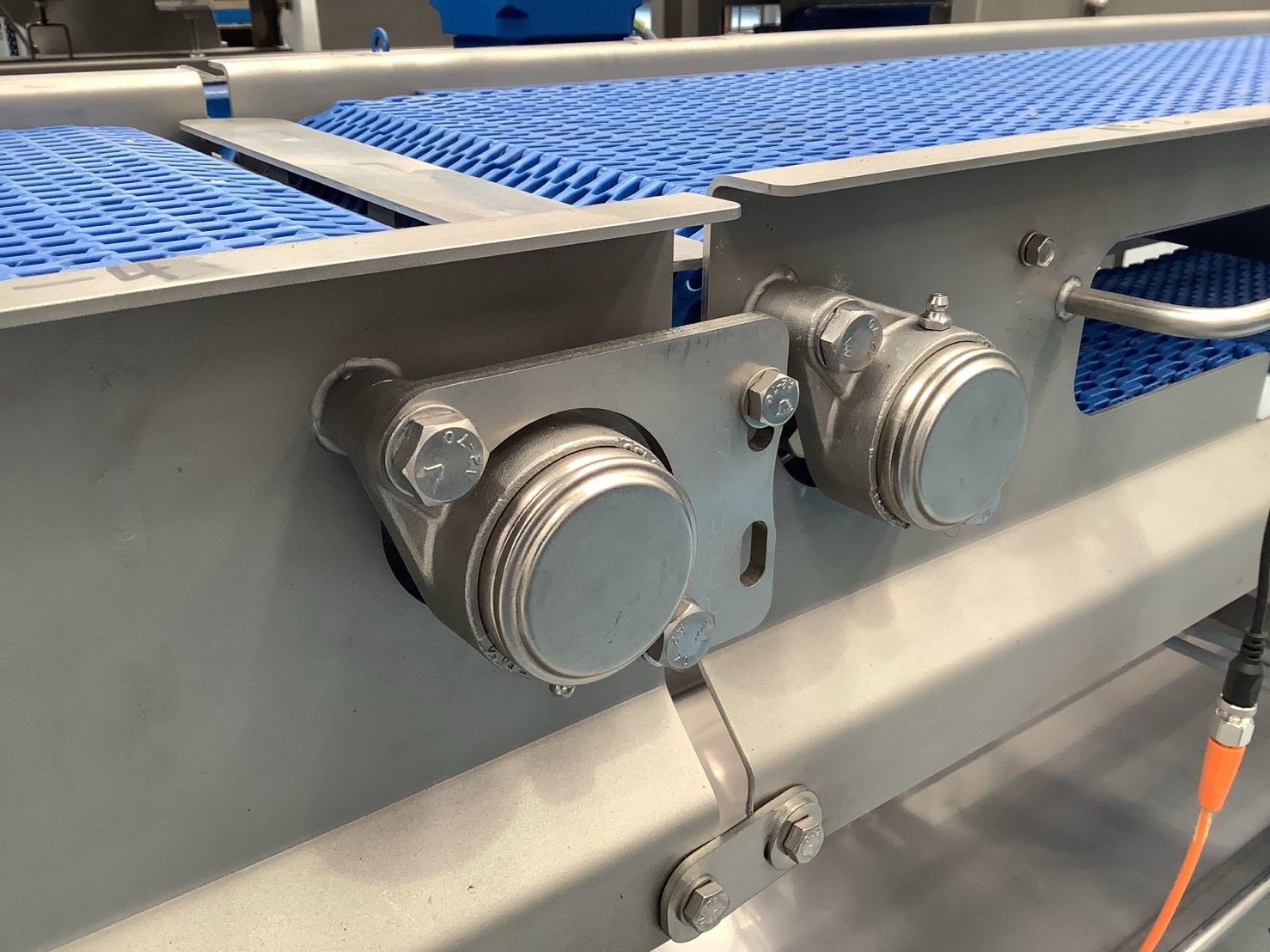
Levelling feet, bearing units and fasteners are small cost items that strongly affect how a whole machine cleans. Sealed stainless bearing units, feet with sealed threads and self-draining bases, and crevice-free hygienic bolts remove many harbourage points. Match ingress ratings to the cleaning method: IP67 is a temporary immersion test, while IP69K (ISO 20653) covers high-pressure, high-temperature spray – neither is a hygiene certificate. Use "certified" only for components holding a certificate for that design. NHK's ranges are on the product line overview.
Train staff
Design engineers, production staff and sales teams should understand hygienic design – engineers to apply it, production to build it without introducing crevices, and sales to explain it accurately to customers.
Work with experts
Hygienic design bodies, test institutes and experienced component suppliers provide insight into best practice and can support certification of specific designs.
For a zone-by-zone guide to which hygienic component families to use, see competitive advantage by optimized hygienic design.
Implementation steps for an OEM
- Identify target markets and their legal and buyer requirements.
- Review the current design against EN 1672-2 / EHEDG guidelines and list harbourage points.
- Replace non-hygienic components – open bearings, threaded feet with lock nuts, standard fasteners – with hygienic alternatives.
- Run a cleaning trial and record time, water and chemicals.
- Build the cost model with the buyer's figures.
- Collect documentation: design basis, declarations of compliance, certificates for specific designs.
- Train sales and service staff to present the evidence consistently.
Long-term benefits
- Access to new markets – regulated industries open to suppliers who can document hygiene.
- Customer retention – hygiene-critical customers tend to stay with suppliers whose equipment performs in audits.
- Differentiation – a documented, quantified hygienic design is hard for competitors to match with claims alone.
- Return on investment – fewer warranty claims from corrosion and ingress, longer product life and lower maintenance for customers.
For which industries expect certified parts from machine builders and how to use them in tenders, see ensure the competitive edge by using certified parts.