Elastomer seals for food processing equipment are deformable sealing elements selected for the food, cleaning exposure and installed joint—not merely for their polymer name. This guide addresses replacement and specification decisions for gaskets and O-rings. Begin with the seal-seat finish and surface acceptance guide: a compatible compound cannot compensate for a scratched seat or an inaccessible gap.
EPDM vs FKM vs silicone: shortlist by exposure
EPDM means ethylene-propylene-diene rubber; FKM identifies fluoroelastomers; VMQ identifies silicone rubber. Cure system, fillers, hardness and formulation change their behaviour. The following tendencies are drawn from general technical compatibility references listed in Standards and sources. They narrow the shortlist; they do not approve a finished seal.
| Family | Reason to screen it | Exposure or duty to challenge | Evidence to request |
|---|---|---|---|
| EPDM | Water-based service, steam and many aqueous cleaning duties | Mineral oils, hydrocarbon exposure and the actual food-fat composition; do not extrapolate compatibility between all fats | Exact compound response to food and the full cleaning sequence |
| FKM | Oils, fats and other duties needing hydrocarbon resistance | Hot water, steam, hot alkalis and particular solvents; grade matters | Media-specific limits and repeated cleaning/steam evidence |
| Silicone / VMQ | Flexible static gaskets where thermal cycling matters | Cutting, tearing, abrasion and actual steam/chemical exposure | Compound-specific recovery, mechanical suitability and intended-contact evidence |
Send your application data and get a component recommendation
Choose an EPDM candidate when aqueous duty dominates and its specific food and cleaner evidence supports the application. Choose an FKM candidate when oils or fats drive the shortlist, only after checking cleaning and steam. Consider silicone for a suitably designed static joint, not as an automatic substitute for a rubbing shaft seal. Mixed exposures can rule out all three ordinary candidates.
NHK's compound-family reference for food-equipment seals is the secondary reference path. Its general guidance is not an identified component’s rating. No NHK seal material, stock item or thermal limit is inferred here.
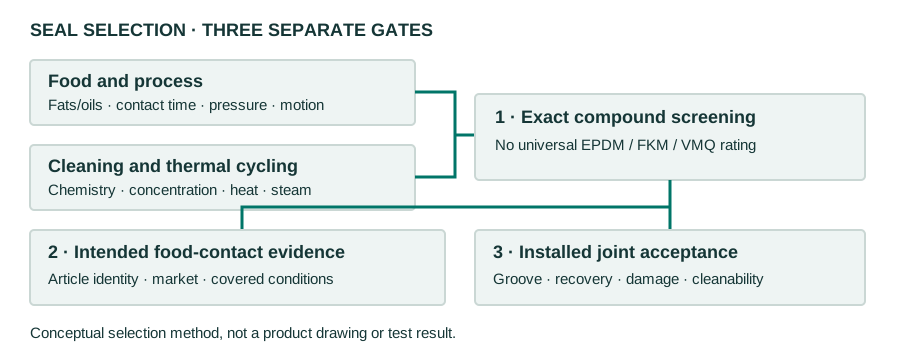
Selection method: combine food, cleaning and steam
- Map contact and transfer. Identify direct product contact, splash exposure and whether condensate or fragments could reach food. Include the hidden underside of the seal, not only the visible face.
- Describe the food. Record water, fats/oils, acids, alcohol, flavourings and additives, plus contact time. A product name such as “dairy” is insufficient: different formulations create different exposures.
- Record every cleaning stage. Include cleaning-in-place (CIP), which cleans installed equipment, and cleaning-out-of-place (COP), which cleans removed parts. Record detergent and sanitiser identities, concentrations, dwell, temperature, rinsing and frequency.
- Add thermal and pressure transitions. Include steam, cooling, vacuum and pressure changes. Capture actual conditions at the seal; a tank setpoint does not necessarily describe a joint’s exposure.
- Confirm mechanical duty. Identify static or moving contact, groove dimensions, pressure differential, assembly compression, friction and permitted movement. Ask for the exact compound’s data under those conditions.
- Agree evidence and acceptance. Obtain supplier confirmation, food-contact documentation and an application-appropriate validation plan before releasing the specification. Escalate unsupported combinations rather than assigning a family from a colour chart.
Food-contact suitability and chemical resistance are separate gates. The finished-article compliance and traceability guide explains the documentation route. Keep mechanical acceptance separate as well: a compliant compound that extrudes into the product path is not an acceptable installed seal.
Temperature, fats and cleaning chemicals: define the envelope
Do not specify a family’s advertised temperature range as a wet-service limit. Dry heat, hot liquid and steam can produce different ageing mechanisms. Ask whether the proposed limit concerns continuous exposure, short peaks or cycling, and which medium and mechanical compression were assessed. This guide deliberately supplies no universal temperature ranges.
Steam requires pressure, duration, frequency and cooling details, not merely “steam resistant.” An FKM compound selected for oil resistance may still be unsuitable for the steam or alkaline cleaning step. An EPDM candidate screened for aqueous service still needs confirmation against the actual fatty product. Silicone’s flexibility does not establish resistance to every sanitiser or repeated steam cycle.
Inspect changes to cleaning recipes, including stronger changeover treatment and incomplete rinsing. A compatibility chart for one chemical alone does not necessarily describe alternating chemicals, mixtures or concentrated residues trapped behind a seal. Request exposure-sequence evidence where the risk warrants it.
Assess the metal interface independently. Use the finished stainless-part material checklist for the related stainless-steel cluster. Changing the elastomer does not correct corrosion damage, a distorted flange or scratches crossing the sealing path.
Food grade seal materials: FDA and EU evidence
For US repeated-use rubber articles, FDA 21 CFR 177.2600 addresses permitted formulation and applicable extraction requirements. It distinguishes dry, aqueous and fatty-food provisions. A statement for water exposure cannot simply be treated as evidence for fatty food. Request the exact article/compound identity, applicable compliance basis and intended-use restrictions; do not accept “FDA approved EPDM” as a blanket family approval.
Regulation (EC) No 1935/2004 provides the EU framework for food-contact materials, including rubber and silicone. Its general requirements concern constituent transfer under normal or foreseeable use, and it requires traceability. Applicable national provisions can also matter because rubber and silicone lack a harmonised EU-specific measure. EU 10/2011 is the plastics measure, not an automatic compliance route for every polymeric seal.
Ask for supporting food-contact documentation tied to the delivered article and conditions. Do not claim that an identical harmonised declaration format is mandatory for all rubber under the framework alone. Record the supplier’s legal basis, destination market, foods, times, temperatures and restrictions, with batch traceability. EC 2023/2006 concerns manufacturing GMP, not sealing performance.
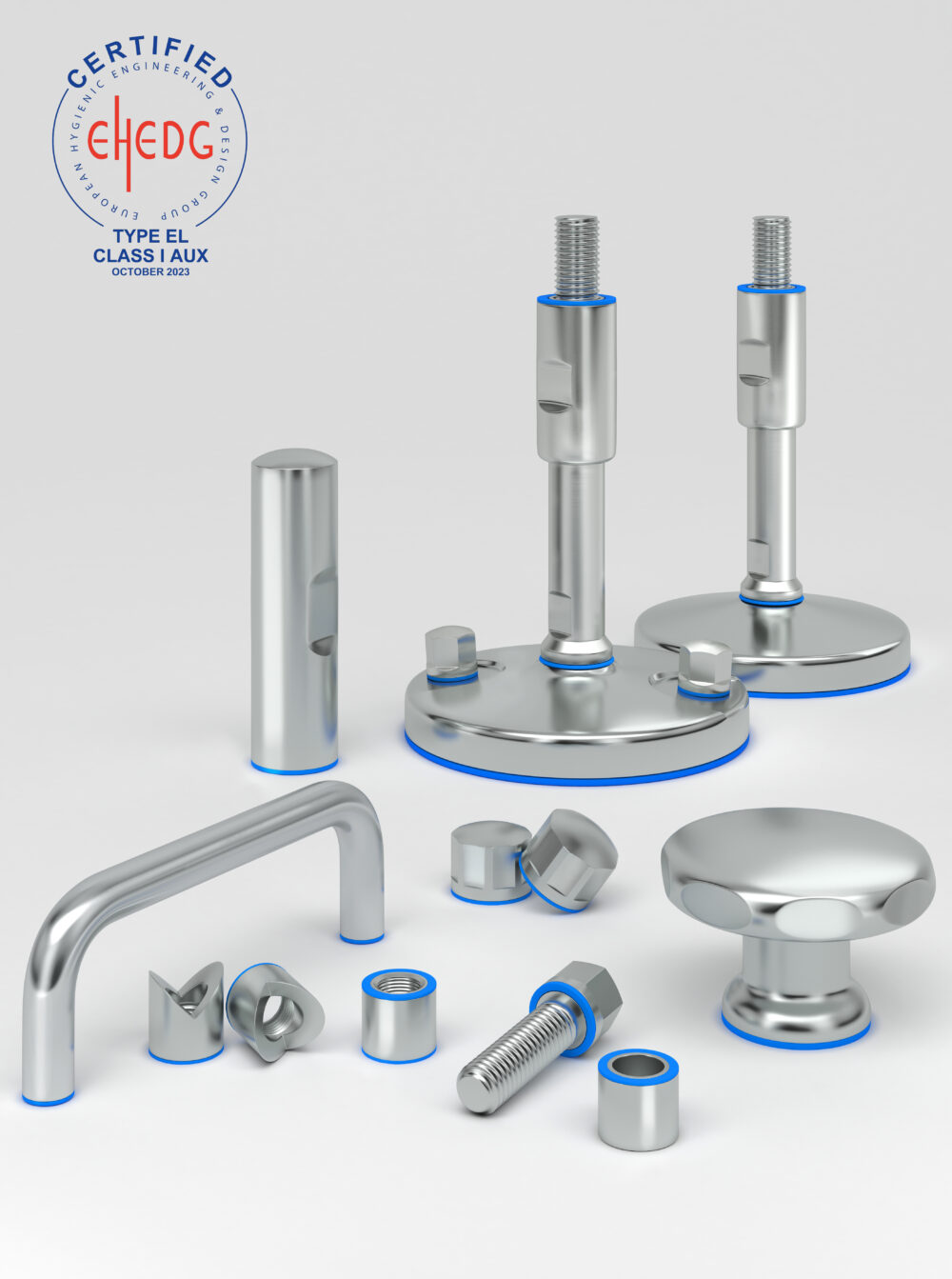
EHEDG certifies specific equipment designs, not elastomer families. 3-A Symbol authorization follows Third Party Verification; both schemes are voluntary. Neither replaces food-contact evidence or proves resistance to the plant’s cleaning recipe. Certifications for another NHK component are not evidence for an unspecified replacement seal.
Use the EU and US document-scope comparison before accepting a plastics declaration or generic FDA claim for a rubber seal.
O-ring material selection for food: check the joint
An O-ring depends on controlled deformation within its groove. Compression set is residual deformation after compressive loading; it can reduce recovery when a joint opens or conditions change. Extrusion is displacement into a clearance under pressure. Neither is resolved simply by choosing a harder rubber without checking the design.
Verify groove dimensions and condition, squeeze, stretch, volume allowance for swelling and thermal expansion, and pressure-side clearance against the approved seal design. No universal squeeze percentage, groove clearance or hardness is prescribed here. A standard O-ring size fitting into a groove does not demonstrate a hygienic interface.
Before assembly, safely isolate and depressurise equipment. Clean the groove; reject cuts, burrs or damaged sealing surfaces against agreed criteria. Use only an approved compatible assembly lubricant with the required food-contact basis where relevant. Prevent twisting, dragging over sharp threads and pinching; follow the equipment’s clamp or fastening instructions instead of adding torque to overcome leakage.
A harborage point retains residue through cleaning; a crevice behind an unseated gasket can create one. The migrated installed cleaning-access inspection guide helps check residue paths and drainage. Confirm that a flush-looking seal is seated throughout and inspect removable joints after the agreed cleaning procedure.
Failure signs: diagnose before replacing
| Sign | Possible cause, not a diagnosis | Check | Corrective route |
|---|---|---|---|
| Swelling, softening or tackiness | Chemical uptake or degradation | Compound identity, food/cleaner changes and retained specimens | Confirm compatibility and groove allowance; replace compromised parts |
| Hardening, cracking or permanent flattening | Ageing, exposure or compression history | Temperature/steam records, recovery and installed squeeze | Address exposure or geometry before selecting a replacement |
| Cuts, twists or pinched edges | Assembly damage or misalignment | Groove edges, fitting route and flange seating | Correct assembly and replace damaged seals |
| Extruded edge or missing fragments | Pressure/clearance problem, swelling or damage | Pressure events, groove dimensions and fragment accounting | Isolate, apply contamination controls and review the seal design |
| Residue behind the gasket | Poor seating, inaccessible geometry or cleaning failure | Safely dismantle at planned inspection points | Correct joint access and validate the cleaning procedure |
Follow the plant’s product-hold and contamination procedures where fragments are missing or a product-contact boundary fails. Retain evidence before disposal when investigating. Do not assume every leak is chemical incompatibility: wrong size, flange distortion and installation damage can produce similar symptoms.
Example: fatty product with aqueous cleaning and steam
Example — hypothetical assumptions, not NHK field data. Assume a static gasket touches a fatty emulsion, sees alkaline and acid cleaning, and occasionally sees steam. No compound grade, temperatures, concentrations or test results are supplied. The selection remains open; none of the families is declared suitable.
Record the food composition and every exposure stage first. An FKM candidate merits screening for the fatty product, but requires specific cleaning and steam evidence. An EPDM candidate merits aqueous-service screening, but its actual food compatibility must be resolved. Silicone remains conditional on chemistry and mechanical requirements. If no candidate has supporting evidence, ask for a different compound or revised interface instead of weakening the sanitation procedure.
Agree an assessment using the proposed finished seal and relevant exposure sequence. Establish permissible dimensional change, recovery, damage and leakage criteria with the design owner and supplier; no arbitrary pass thresholds are invented. Trial acceptance does not replace regulatory documentation.
Specification and enquiry: send the exposure sequence
Copy and complete: “Component/part number, drawing revision and quantity: __. Zone and transfer paths: __. Food composition, fats/oils and contact time: __. Static/dynamic duty, motion, pressure/vacuum and groove dimensions: __. Process and cleaning temperatures, including peaks: __. CIP/COP chemical names, concentration, dwell, rinse and frequency: __. Steam pressure, duration, cycling and cooling: __. Exact compound and market-specific documents: __. Current failure signs and inspection evidence: __. Delivery country: __.”
Use the buyer’s component-specification guides for purchasing context; no seal calculator or dedicated seal RFQ tool is currently published. Request batch-linked food-contact evidence, compound identity, compatibility limits and installation instructions. A generic certificate without article identity or covered use conditions is insufficient.
Send these details to NHK
An NHK technician can clarify component options and quote requirements through this site’s existing form. Availability of separate seals, exact compounds and supporting documents must be confirmed; the product-category link beside the form is a secondary browsing path, not proof that NHK supplies every seal considered above.