Hygienic components are machine parts – levelling feet, bearing units, fasteners, seals, enclosure parts – designed so that cleaning fluid can reach and drain from every surface, leaving nowhere for residue, bacteria or allergens to survive. In food, dairy, beverage, cosmetics and pharmaceutical processing, easy-to-clean components and parts decide how quickly and reliably a machine can be cleaned. This guide explains which features make the difference and how to check a component before you specify it.
For the broader principles behind machine design, see the core of hygienic design in food processing machinery.
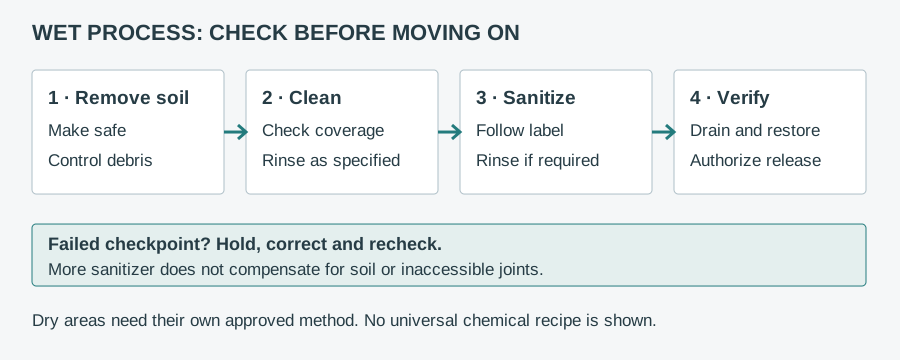
Use the cleaning and sanitation of food processing equipment guide to connect those features with method selection, checkpoints and release evidence.
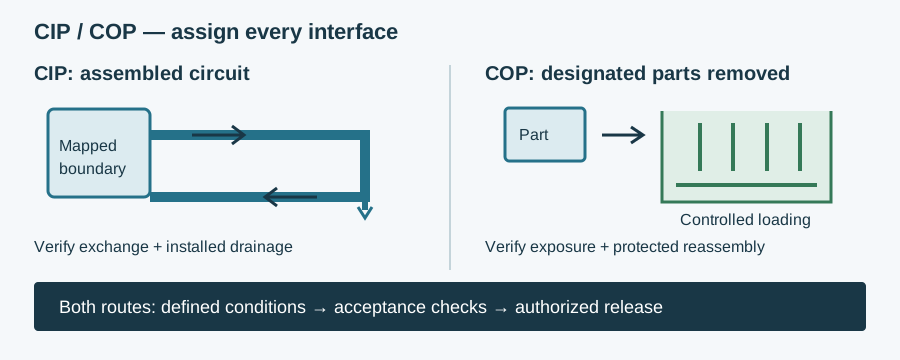
For assembled circuits and removable parts, use the in-place coverage and out-of-place loading checklist to assign each interface a cleaning route.
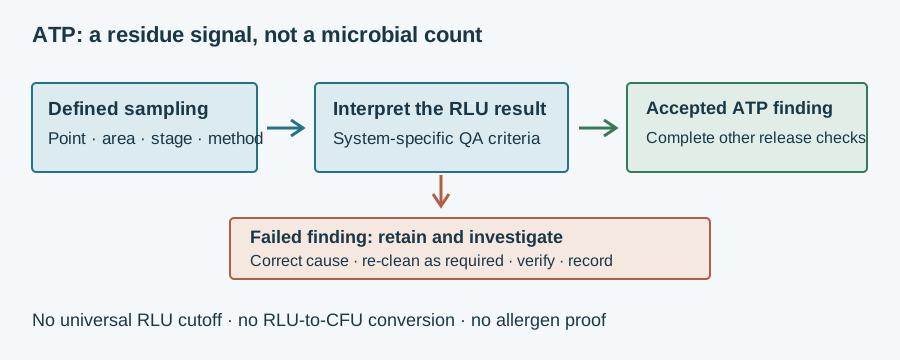
The machine-interface sampling and recurring-residue investigation guide connects component access with controlled ATP verification.
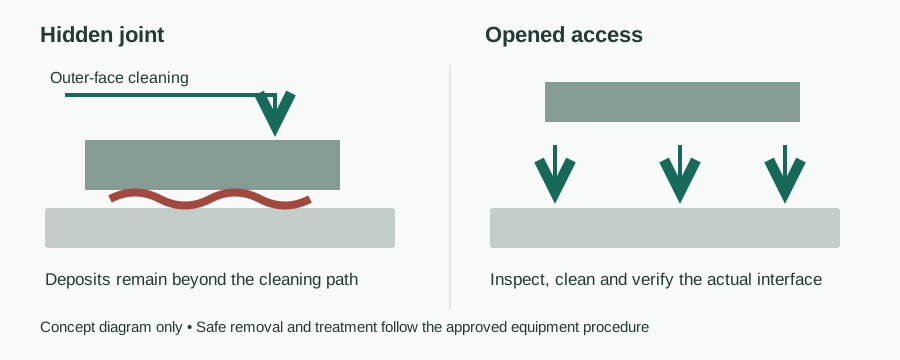
The persistent-niche inspection and prevention route connects those interfaces with removal access and hazard-appropriate verification.
What makes hygienic components easy to clean?
Cleanability comes from geometry, surface and material together:
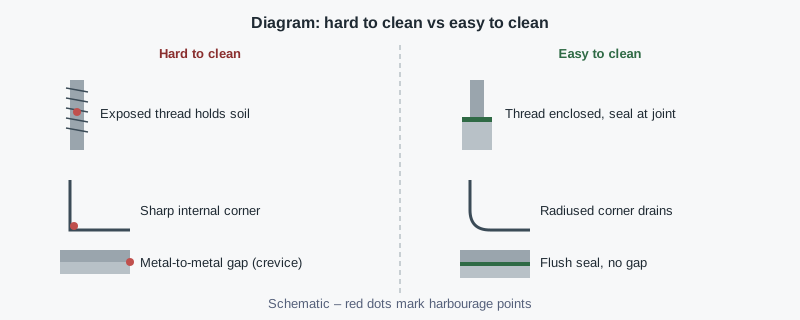
- No harbourage points – places where residue and microorganisms survive cleaning, such as exposed threads, crevices (narrow gaps, for example metal-to-metal joints) and dead spaces (pockets where liquid stands).
- Smooth surfaces – surface roughness Ra is the average height of surface irregularities. EHEDG guidance refers to Ra ≤ 0.8 µm for product-contact surfaces; rougher surfaces can be acceptable if verified cleanable.
- Self-draining shapes – sloped tops and no horizontal ledges, so water and chemicals run off.
- Radiused internal corners – sharp corners trap soil and resist spray.
- Flush seals – seals that close gaps without creating new ones, made from an elastomer compatible with product and chemicals (EPDM for hot water and many cleaners but not fats; FKM for oils and many chemicals; VMQ/silicone for wide temperature ranges).
- Resistant materials – stainless steel such as AISI 304, or 316L where chlorides are present, and suitable composites with a declaration of compliance for food contact.
Use the seal compatibility and failure-sign checklist when the joint needs compound-specific food, cleaning and steam evidence as well as correct seating.
If damage is already visible, use the inspection route for corrosion in food processing equipment to distinguish retained-liquid attack from cracking before specifying replacements.
Hard to clean vs easy to clean: feature by feature
| Feature | Hard to clean | Easy to clean | Why it matters |
|---|---|---|---|
| Threads | Exposed thread, lock nut | Thread enclosed, sealed at joint | Threads hold soil that spray cannot reach |
| Joints | Metal-to-metal contact | Continuous weld or flush seal | Gaps form crevices and corrosion sites |
| Corners | Sharp internal corners | Radiused corners | Soil collects in corners |
| Surfaces | Rough, horizontal ledges | Smooth, sloped, self-draining | Standing liquid supports growth |
| Fasteners | Hex socket heads, exposed threads | Hygienic bolts with sealed head | Sockets are hard to clean |
| Bearings | Open housing, gap to frame | Sealed unit, sealed to frame | Grease-water mix in gaps |
| Seals | Incompatible elastomer | Compatible, flush-fitting | Swollen or cracked seals open crevices |
| Base of machine | Flat foot on floor | Sealed base, clearance to floor | Floor area must be reachable |
Certification: EHEDG and 3-A
The European Hygienic Engineering & Design Group (EHEDG) develops guidelines and certifies equipment designs for hygienic design. Its aim is to improve food safety through better hygienic engineering. EHEDG-certified components have been evaluated – and, for some types, tested – as cleanable, preventing build-up of residues that could harbour bacteria or allergens.
3-A Sanitary Standards, Inc. (3-A SSI) sets standards for dairy and food equipment, widely used in the United States. Its standards aim for equipment that is cleanable to a microbiological level. Equipment conforming to a 3-A Sanitary Standard may carry the 3-A Symbol after a Third Party Verification.
Both schemes are voluntary and apply to the specific design named on the certificate or authorisation. "Designed to EHEDG guidelines" is not the same as certified – ask for the document.
Components to check
Hygienic levelling feet
Adjustable leveling feet stabilise equipment on uneven floors. Easy-to-clean versions enclose the thread, use a smooth, sloped body and seal the base. NHK's stainless steel machine levelling feet include hygienic designs; check which models carry an EHEDG certificate.
Sealed bearing units
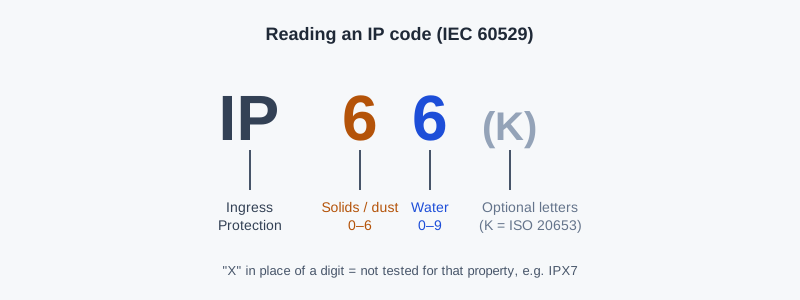
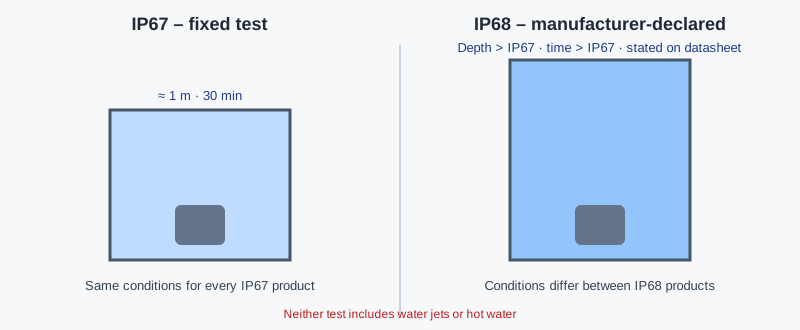
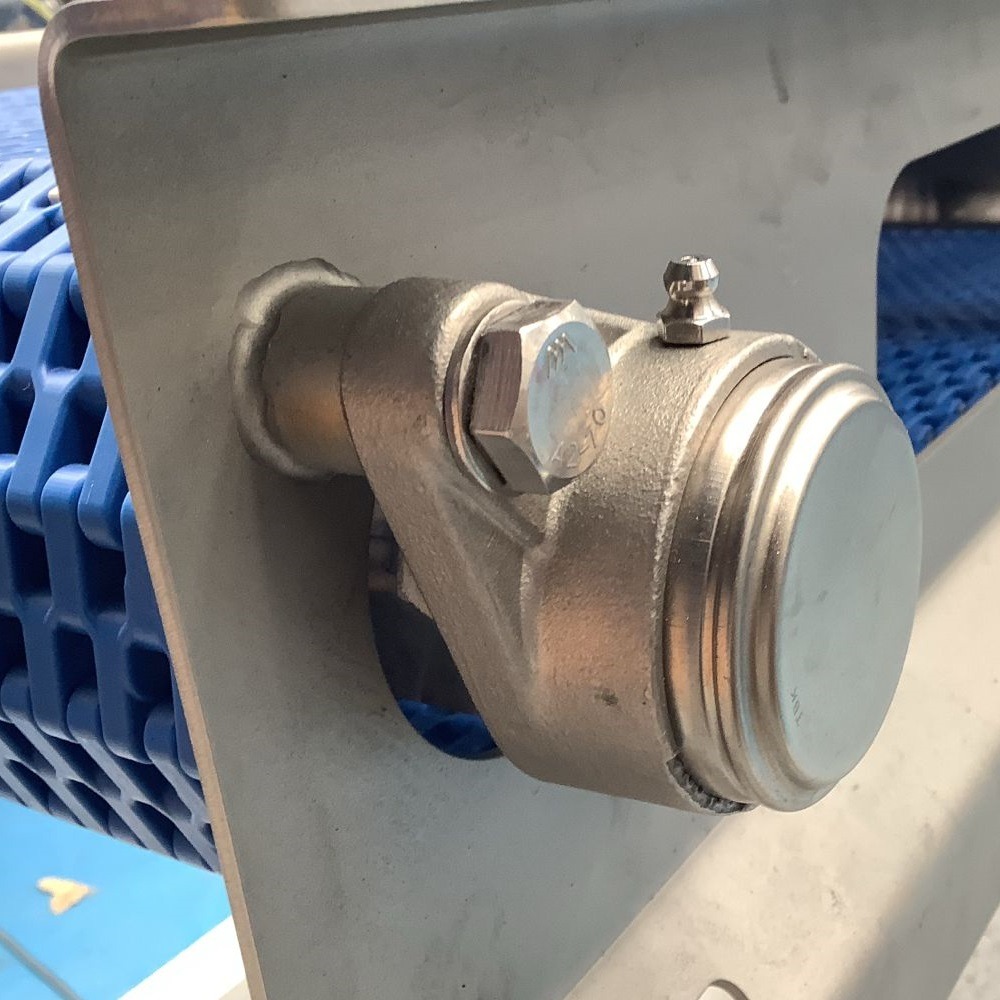
Sealed bearing units keep water and dust out. IP67 (IEC 60529) confirms dust-tightness and temporary immersion – it is not a washdown test. High-pressure, high-temperature spray is tested as IP69K (ISO 20653) or IP69 (IEC 60529). Neither tells you whether the housing exterior is easy to clean; look at housing shape, gaps to the frame and seal design.
Sanitary enclosure parts
Enclosure parts protect sensitive equipment from contamination and must themselves be easy to clean and sanitise: sloped tops, no exposed fasteners, flush gaskets.
How to assess a component before you buy
- Define the zone – product-contact (touches product), splash zone (wetted by spray but not product) or non-contact. Requirements rise towards the product.
- Define the cleaning method – manual, foam, high-pressure washdown, CIP (clean-in-place) or COP (clean-out-of-place) – and the chemicals and temperatures.
- Inspect the geometry on a drawing or sample: threads, joints, corners, ledges, gaps to the frame.
- Check surface finish – ask for Ra values on product-contact surfaces.
- Check materials – stainless grade, elastomer, plastics – and request declarations of compliance (EC 1935/2004; EU 10/2011 for plastics; FDA 21 CFR 177.2600 for rubber).
- Ask for certificates – EHEDG certificate or 3-A authorisation naming the exact model, where claimed.
- Check installation – can it be sealed to the frame, levelled so surfaces drain, and reached for cleaning?
Example
Assumptions (illustrative only): an OEM is replacing feet and bearings on a meat-tray conveyor cleaned daily with chlorinated foam and high-pressure rinse.
- Zone: splash zone near product; chlorides present → AISI 316L.
- Feet: sealed-thread hygienic levelling feet with sealed base; EHEDG certificate requested for the chosen model.
- Bearings: sealed stainless units fitted with a gasket to the frame; rating checked against the high-pressure rinse.
- Fasteners near the product: hygienic bolts.
- Verification: swab points agreed with the customer at commissioning to confirm cleanability in practice.
Why it pays off
- Cleanability: shorter, more reliable cleaning cycles and fewer re-cleans.
- Compliance: easier evidence for hygiene audits and customer approvals, lower risk of non-conformities.
- Durability: components that withstand cleaning chemicals last longer and fail less often – but durability must be checked on the product data, as certification covers cleanability only.
The same features apply across food and beverage, dairy and bakery, pharmaceutical and healthcare, and cosmetics and chemical processing; the cleaning method and chemicals decide which materials to choose. For the effect on cleaning resources, see reducing water and cleaning detergent usage. For zone-by-zone requirements for food processing parts, see hygienically optimized machine parts.
NHK's related pages: EHEDG and 3-A SSI certified components and easy to clean components and parts.