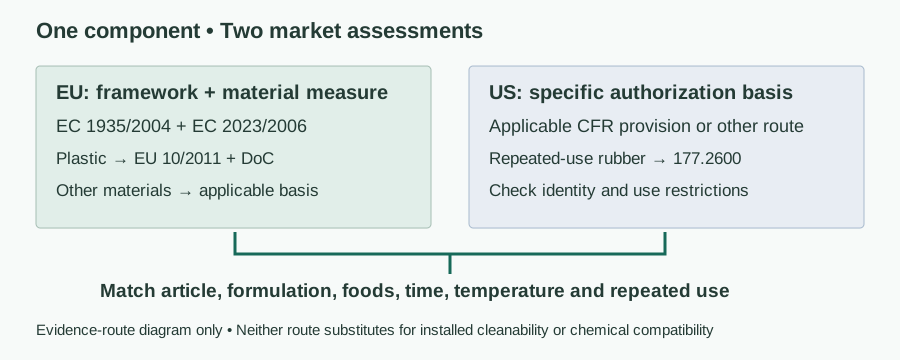
EC 1935/2004 vs EU 10/2011 vs FDA 21 CFR compares an EU framework, an EU plastics-specific measure and US material/use-specific provisions—not three interchangeable certificates. For a machine builder, the useful question is which legal basis and supporting evidence cover the delivered component under its intended food-contact conditions.
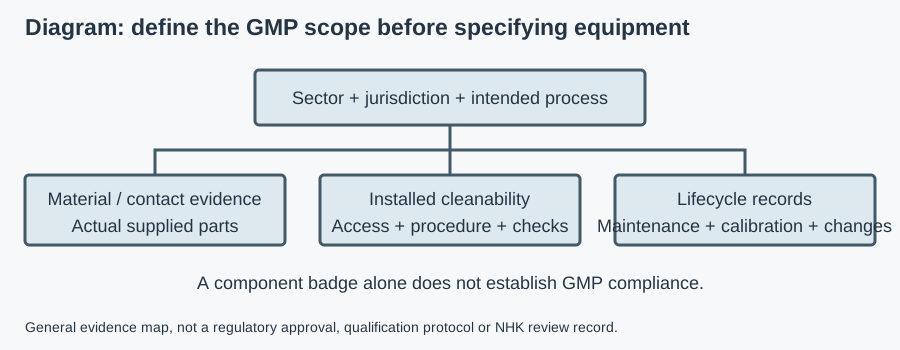
Start with the material-selection and contact-zone framework. This spoke focuses on accepting supplier documents rather than selecting steel grades or seal families. Identify the destination market, actual article and foreseeable transfer to food before choosing the documentation route. Neither an EU statement nor a US statement automatically establishes the other market’s compliance.
EC 1935/2004 vs EU 10/2011 vs FDA 21 CFR: scope comparison
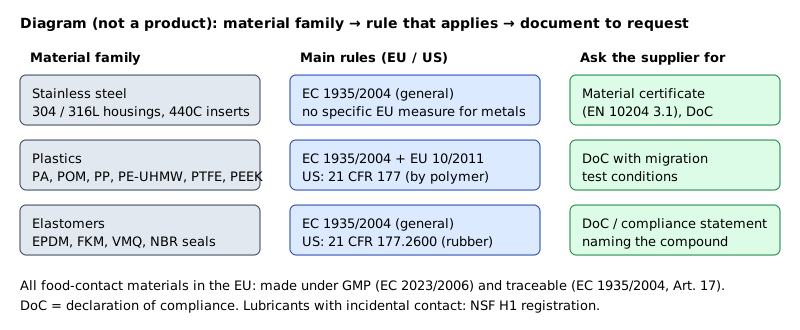
The EU plastics measure operates under the framework; it is not an alternative to it. EC 2023/2006 adds manufacturing controls. FDA 21 CFR contains different provisions, and other US authorisation routes can also apply. Do not request a single generic “EU/FDA certificate” for an assembly containing several materials.
| Basis | Scope and materials | Documents to check | Migration or extraction evidence | Who must address it |
|---|---|---|---|---|
| Regulation (EC) No 1935/2004 | EU food-contact framework across material families, under normal or foreseeable use | Article identity, intended-use suitability and traceability; formal DoC obligations depend on specific measures and national rules | Evidence of relevant constituent transfer and safety; no universal plastics test for every material | Business operators handling in-scope materials/articles; builder must assess its supplied configuration |
| Regulation (EU) No 10/2011 | In-scope plastic materials/articles and specified plastic layers; not rubber, silicone or stainless steel as such | Written DoC under Article 15 and Annex IV at applicable non-retail stages; supporting documentation under Article 16 | Applicable composition restrictions, specific/overall migration and intended-use/repeated-use assessment | Manufacturers, importers and downstream operators within the relevant supply chain |
| Regulation (EC) No 2023/2006 | GMP for in-scope food-contact materials/article manufacturing, processing and distribution, excluding production of starting substances | Relevant quality assurance, quality control and records; not a product approval badge | Manufacturing controls support compliance but do not replace required material evidence | Operators carrying out activities within its scope |
| FDA/US food-contact basis | Applicable US provisions or other authorisation route for substances and intended use | Exact CFR provision, effective FCN or other applicable basis, identity and restrictions | Requirements of the cited route; §177.2600 includes applicable finished-rubber extraction provisions | Relevant substance/article suppliers and downstream users must establish lawful intended use |
Send your application data and get a component recommendation
DoC means declaration of compliance: a supplier statement with required identity, legal and use information where applicable. GMP means good manufacturing practice: controlled manufacturing, not a certificate that all materials or the whole machine are approved. Keep those documents separate from material identity and installed hygienic-design evidence.
Food contact regulations for machine components: map each material
Mark the product-contact zone, which directly touches food, and the splash zone, which receives product or cleaning liquid. A non-contact label does not settle legal scope if constituents can foreseeably transfer to food. Include overhead guards, seal undersides, coatings, assembly substances and possible drip paths in the assessment.
For a mixed assembly, list every relevant material and finished surface. A stainless bracket may hold a plastic guide and a rubber gasket; the guide’s plastics declaration does not cover the gasket or establish stainless suitability. EU 10/2011 can cover specified plastic layers in multilayer constructions, but it is not blanket approval of the other layers. Confirm the actual construction and applicable provisions.
Rubber and silicone do not fall under the plastics measure merely because they are polymers. Applicable national measures and other relevant EU requirements can matter where there is no harmonised material-specific measure. The related compound-specific seal evidence guide explains why EPDM, FKM or VMQ family identity is not sufficient documentation for a delivered seal.
Metal grade evidence answers a different question. An EN 10204 inspection document can support alloy identity and traceability; it is not a plastics migration report or proof of every finished article’s food-contact suitability. Use the related finished stainless-part selection and evidence guide when welds, surface condition and cleaning exposure also need review.
Declaration of compliance for food contact: check identity and use
For in-scope EU plastic materials/articles, Article 15 and Annex IV specify declaration requirements at applicable non-retail stages. Annex IV is a content requirement, not a universal one-page certificate template. Ask whether the document identifies the issuer, manufacturer/importer and material or article, gives a date and confirms compliance with the relevant provisions.
Then review the information that downstream operators need: restricted substances, relevant specifications, intended foods, contact time and temperature, and the surface-area-to-food-volume basis where used to establish compliance. Include functional-barrier information where relevant. A functional barrier is a layer intended to limit constituent transfer; its presence is not permission to ignore every restriction.
Do not reduce the check to a list of regulation numbers. Match the document to the part number, drawing revision, compound/formulation and colour or additives as applicable. A declaration for the natural resin does not automatically establish a blue, filled or coated finished guide. Upstream documents support the assessment, but conversion, machining, assembly or changed formulation may require additional evidence.
Reject or hold acceptance when the document covers a different grade, food type or use envelope. Ask the supplier to resolve the mismatch before the machine is released. Supplier declarations for metals or rubber can be useful, but do not claim that the framework alone imposes the plastics Annex IV format on every material.
Migration testing: compare the evidence with the real use
Migration is transfer of constituents from a material/article into food or a test medium. Overall migration concerns the aggregate transfer under the specified method; specific migration concerns identified substances with applicable restrictions. A food simulant represents a defined food-contact testing category—it is not a universal substitute for every food or cleaning chemical.
Ask what was assessed: finished article or representative sample, formulation, tested surfaces, food/simulant basis, time, temperature, contact geometry and restrictions. EU plastics compliance can use permitted testing and other assessment approaches; Article 16 supporting documents may include results, calculations, modelling, analysis and reasoning. Do not insist that every component must have an identical laboratory protocol regardless of its legal route.
The plastics rules include repeated-use testing and stability assessment. Under Annex V, the applicable approach generally uses successive contacts with fresh simulant, assesses the third result and considers whether migration increases, with specified exceptions and performance criteria. A lone third-test value is not the whole assessment. Ask a competent laboratory to apply the current provisions rather than improvising a pass rule.
Food-processing equipment has specific testing provisions and representative-use documentation considerations within Annex V. Whole-equipment or part testing must have a defensible relationship to foreseeable use. Do not select an arbitrary surface-to-volume ratio or copy packaging conditions into a conveyor assessment without justification.
For repeated-use parts, request instructions and deterioration/replacement criteria where required. Separately assess cleaning resistance: a food-contact migration statement does not establish resistance to alkaline cleaner, sanitiser, steam or mechanical wear. A crack or swollen seal can be unacceptable even where a prior material test was satisfactory.
Supporting documents and GMP 2023/2006: different jobs
A DoC is not the entire supporting dossier. Article 16 of EU 10/2011 requires appropriate compliance documentation to be available to competent authorities on request. That does not automatically mean every downstream buyer receives every confidential formulation or raw laboratory record. Agree the evidence and downstream information needed to establish the intended use, and an escalation route for unresolved restrictions.
Ask for a traceable document set and responsible issuer, not a badge copied onto a catalogue. GMP 2023/2006 concerns documented quality assurance, quality control and records appropriate to the operation. Supplier change controls should keep the delivered formulation, process and evidence aligned. A GMP system cannot turn an unsupported food-contact use into a lawful one.
The sibling equipment GMP and installed-acceptance guide separates food-contact manufacturing controls from food-plant and pharmaceutical equipment requirements. Neither EC 2023/2006 nor a material declaration qualifies an entire pharmaceutical line. Identify the actual sector and activity before borrowing documentation requirements.
FDA 21 CFR: request the exact authorisation basis
For the US, “FDA compliant” should point to a substantiated basis for each relevant substance and intended use, not a blanket equipment approval. FDA describes routes including applicable CFR regulations, effective food contact notifications (FCNs), threshold-of-regulation exemptions, prior sanctions and relevant GRAS bases. The supplier must establish which route applies; a buyer should not guess it from polymer identity.
An FCN is a food contact notification. Effective notifications are specific to the identified manufacturer/supplier and authorised conditions; matching chemical identity from a different source is not sufficient by itself. Request the notification identity, supplier connection, substance and use restrictions where that route is claimed.
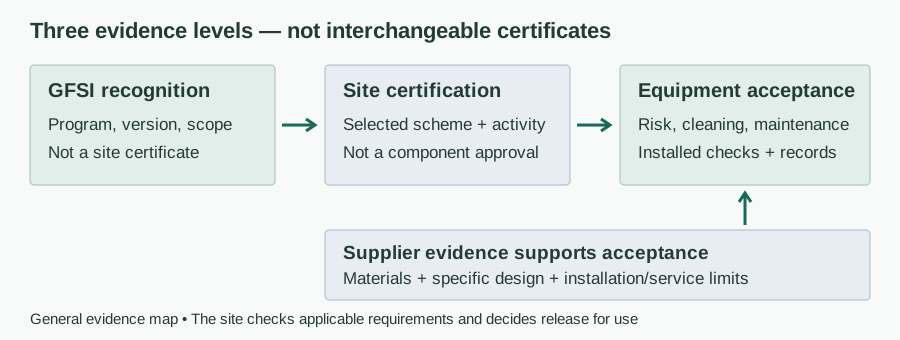
Use the site-certification and equipment-evidence distinction when these material documents support a food plant's scheme audit; the site certificate does not replace intended-use evidence.
For repeated-use rubber, 21 CFR 177.2600 addresses formulation and applicable finished-article extraction requirements. Dry, aqueous and fatty-food provisions differ. A water-extraction statement is not automatically a fatty-food statement, and naming EPDM or silicone is not evidence that all formulation constituents and applicable requirements are met.
US and EU tests serve their own provisions. Passing one does not automatically satisfy the other. Keep the US regulatory basis, EU declaration and chemical/mechanical service limits distinct in the component file. No “FDA approved machine” claim is made here.
Amendments and change control: check the applicable version
Ask which applicable amendments and transition basis the supplier used. Regulation (EU) 2025/351 amended plastics and GMP provisions. Its Article 4 allows qualifying plastic materials/articles first placed on the market before September 16, 2026 to continue until stocks are exhausted, subject to the stated compliance conditions. This is not a blanket exemption for newly placed articles or every upstream material.
As of this guide’s November 2026 update, that first-placement date has passed. Confirm article identity, placement evidence and the precise transition conditions instead of accepting “old stock” as sufficient. Separate measures, including the bisphenol restrictions in Regulation (EU) 2024/3190, have their own scope and transitions; one amendment does not resolve every restriction.
A changed resin, seal compound, colorant, coating, supplier or intended food/contact condition triggers review of the evidence. Keep superseded documents identifiable and agree notification of relevant changes. Assess installation and maintenance changes too: the migrated component contamination-pathway checklist links wear, leakage and fragments to food exposure.
Example: a plastic guide and rubber seal for EU and US use
Example — hypothetical assumptions, not NHK product data. An OEM specifies a plastic guide and repeated-use rubber seal touching a fatty food, with a separate cleaning cycle. The machine is intended for EU and US markets. No material grade, temperature, test result or compliance outcome is assumed.
Request the guide’s article/formulation identity, EU plastics DoC, intended-use restrictions and supporting assessment basis. Request the seal’s EU framework and applicable national basis separately, plus its relevant US rubber formulation/extraction evidence. For the guide’s US use, obtain its exact applicable authorisation route instead of applying the rubber provision.
Compare the food/contact conditions and repeated-use assumptions with both document sets, then assess cleaning compatibility and mechanical function separately. If the document covers only a different food or temperature, leave acceptance open and resolve the gap. Do not substitute a catalogue family description for finished-item evidence. NHK’s conveyor hardware families for item-specific document enquiries are a browsing route, not a declaration for the example.
Supplier acceptance checklist and enquiry fields
- Identify each supplied article, revision, relevant material and formulation.
- Map intended food contact and foreseeable transfer, with destination markets.
- Record food types, contact time/temperature, repeated use and cleaning exposure separately.
- Match each legal basis and declaration to the actual article and covered conditions.
- Resolve restricted substances, supporting evidence, traceability and applicable amendment/transition questions.
- Agree change notification, installation instructions and deterioration/replacement checks.
- Keep material-contact acceptance separate from mechanical fit and hygienic-design certificates.
Use the migrated sibling component corrective-action and evidence route when a material mismatch is discovered during an incident. EHEDG certifies specific equipment designs; 3-A Symbol authorisation follows Third Party Verification. Both are voluntary and neither replaces food-contact evidence or certifies every material in an assembly.
Copy and complete: “Component/part number, drawing revision and quantity: __. Destination market and material rules: __. Zone and transfer paths: __. Exact material, compound, colour/additives and condition: __. Food types, contact time and temperature: __. Repeated use and cleaning exposure: __. Existing declaration/basis and restrictions: __. Required supporting evidence, traceability and change notification: __. Mechanical duty and exact-design certificate if required: __. Delivery country: __.”
Send these details to NHK
Use the buyer’s component-document and RFQ guides to organise the request. NHK can clarify available components and supporting documents, recommend a part and prepare a quote; the responsible compliance team assesses lawful use. Browse stainless hygienic component families for document review as the secondary path. No category-wide declaration or guaranteed acceptance is inferred.