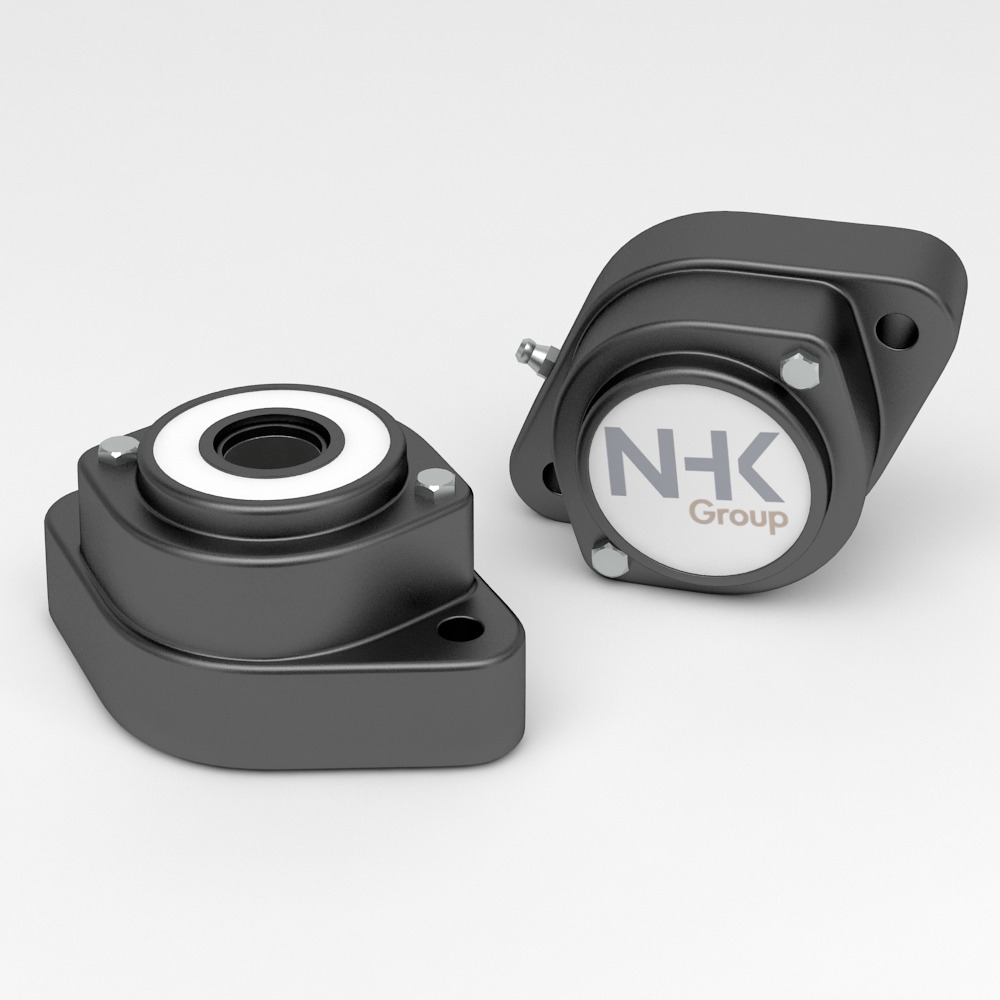
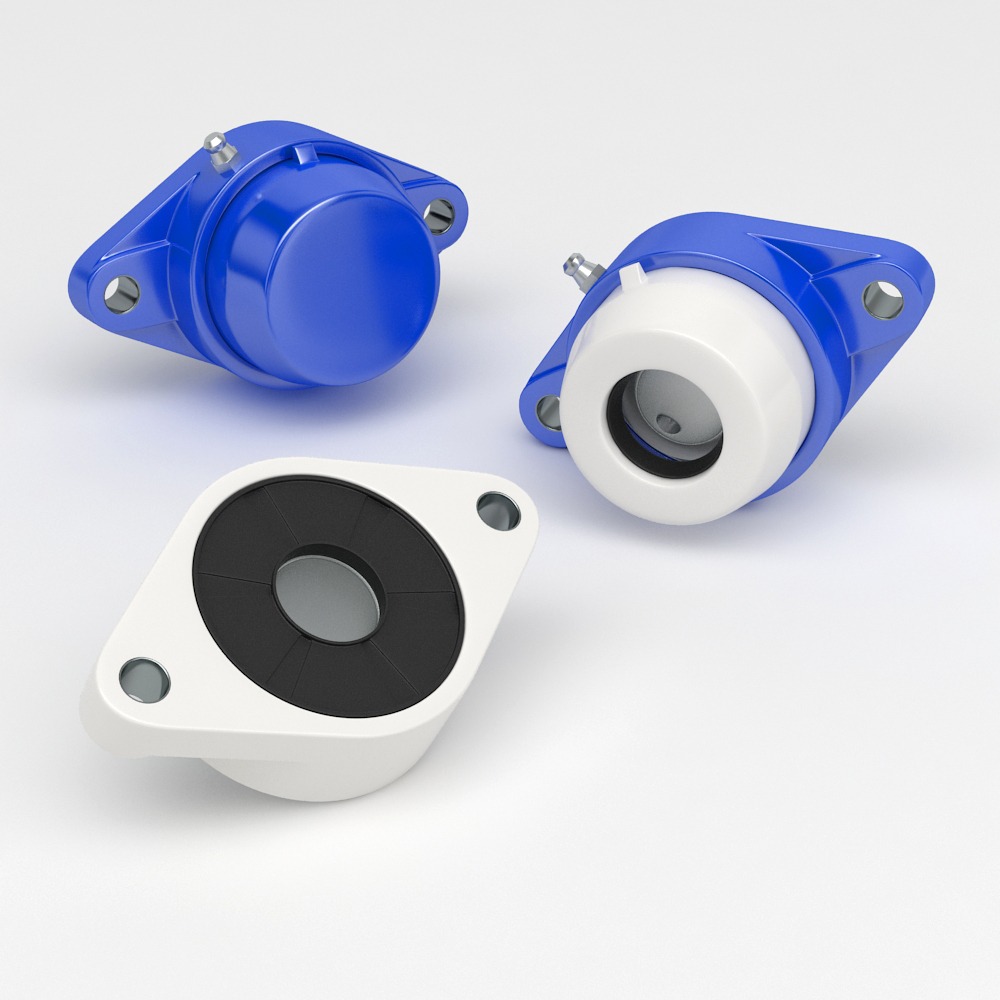
Industrial oval bearings are oval 2-bolt flange bearing units – a standard round ball bearing insert held in an oval housing that is bolted to a wall or machine frame with two bolts. The name refers to the housing shape, not the bearing: inside, the rolling elements and raceways are round like in any ball bearing. This guide explains what oval flange units do well, how they compare with other housing types, where to use them and how to select and install them.
For a comparison of base-mounted housings, see pillow block bearings: the complete guide.
What are industrial oval bearings?
An oval flange unit consists of:
- an oval housing with two bolt holes – cast iron, stainless steel or thermoplastic;
- a bearing insert, usually a deep-groove ball bearing with a spherical outer ring, which allows some initial misalignment;
- a locking method – set screws or an eccentric collar – to fix the inner ring to the shaft;
- seals on the insert and, on some designs, an end cover.
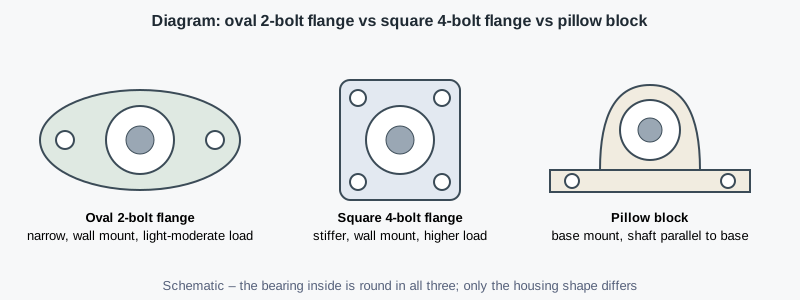
The shaft passes through the housing perpendicular to the mounting surface. The oval shape gives a narrow footprint, so the unit fits frames where a square flange would not.
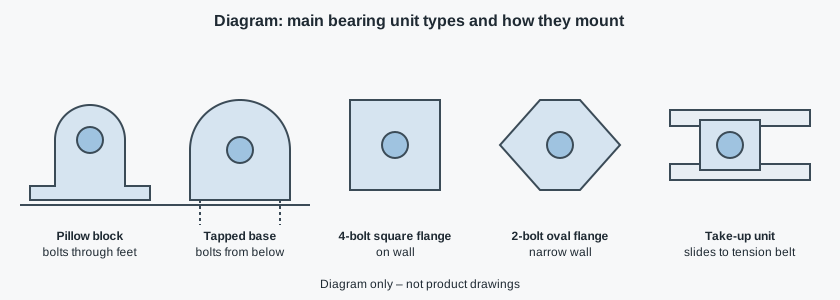
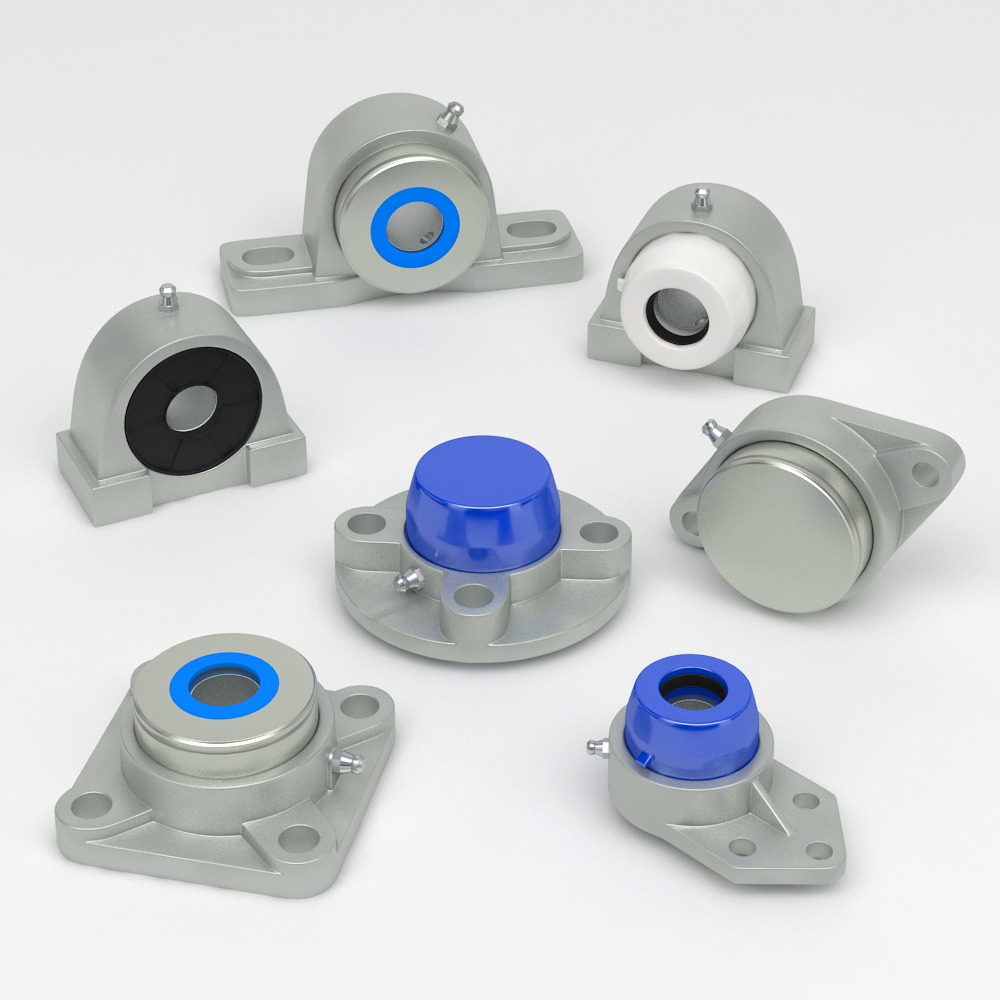
Oval vs square flange vs pillow block
| Housing type | Mounting | Bolts | Strengths | Limitations | Typical use |
|---|---|---|---|---|---|
| Oval 2-bolt flange | Wall or frame, shaft perpendicular | 2 | Narrow, light, quick to fit | Lower stiffness; less suited to heavy or shock loads | Conveyor side frames, packaging, light machinery |
| Square 4-bolt flange | Wall or frame, shaft perpendicular | 4 | Stiffer, higher load and moment capacity | Larger footprint | Heavier conveyors, drives |
| Triangular 3-bolt flange | Wall or frame | 3 | Compromise of size and stiffness | Less common | Compact machinery |
| Pillow block | Base, shaft parallel to base | 2 | Robust; easy alignment on a base | Needs a base surface | Long shafts, heavier loads |
The housing type does not change the bearing's own load rating, but a less stiff housing or a two-bolt fixing can limit the load the unit should carry. Use the unit rating from the supplier, not only the insert rating.
Where to use oval flange bearing units
- Manufacturing equipment: conveyor systems, transfer units and light machinery where shafts pass through side frames.
- Packaging machines: compact frames and many shafts; narrow housings ease layout.
- Agricultural machinery: implements and lighter drives in dusty, muddy and wet conditions – choose sealed inserts and corrosion-resistant housings; heavy, shock-loaded drives need stiffer housings.
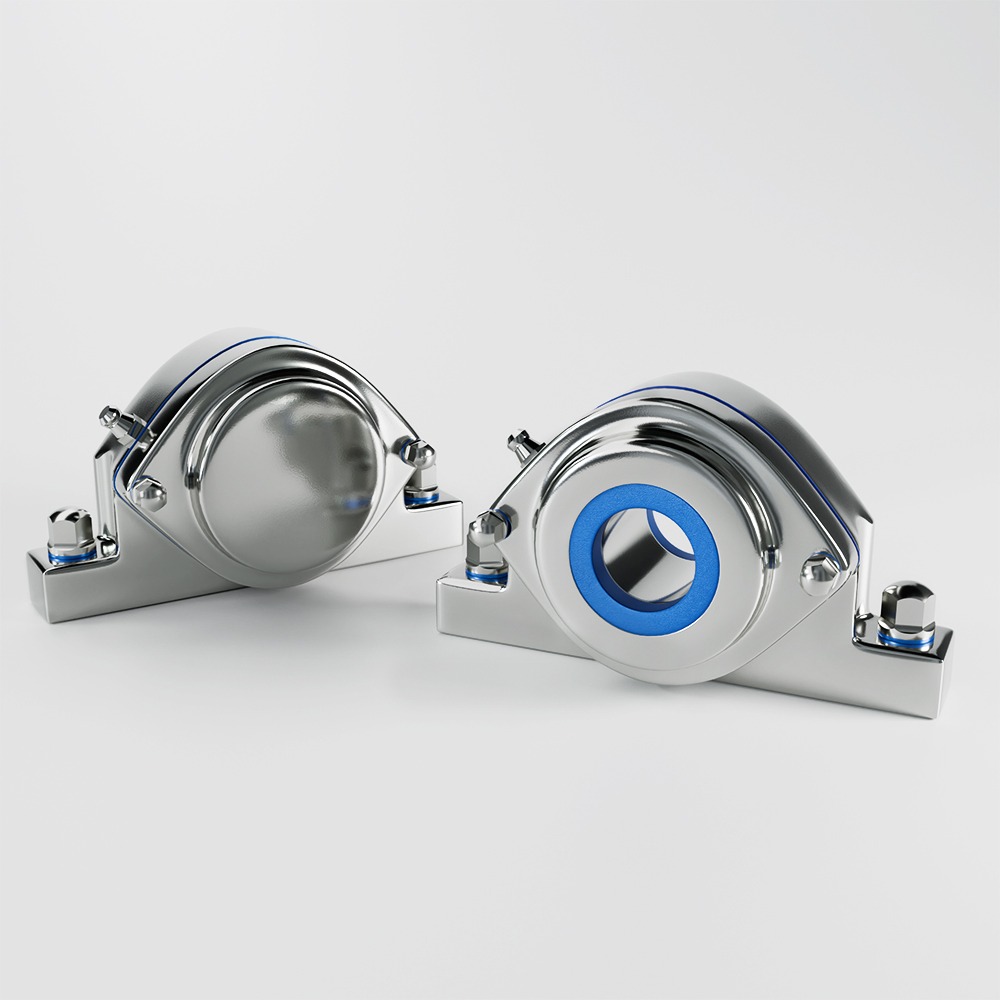
- Food and beverage: conveyors in wet areas – stainless or thermoplastic housings with stainless inserts, closed covers and food-grade grease.
- Cosmetics, biotech and chemical processing: cleaned with disinfectants or exposed to chemicals – check chemical compatibility of housing, seals and grease.
How to select an oval flange unit
- Check space and mounting: shaft perpendicular to a wall or frame; space for two bolts.
- Check load and speed: radial and axial load, shock, speed; compare with the unit rating.
- Decide oval vs square: if load, vibration or overhung moments are significant, choose a square 4-bolt flange or pillow block.
- Choose housing material: cast iron for dry areas; stainless steel for washdown and chemicals; thermoplastic for wet areas with moderate loads.
- Choose the insert: chrome steel for dry areas; stainless for wet areas – remembering stainless inserts usually carry less load.
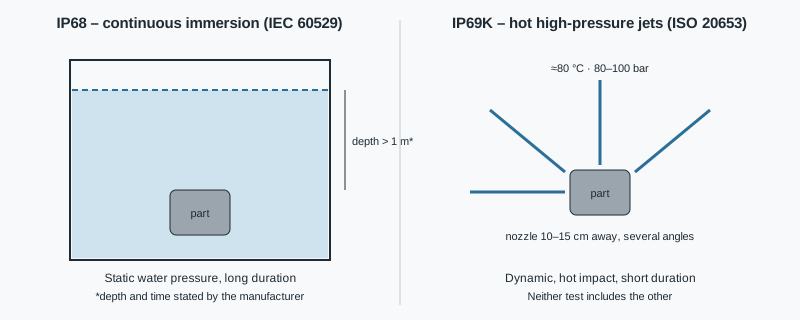
- Choose sealing: contact seals and end covers for wet and dusty areas; check the stated IP rating against the cleaning method (IP67 immersion, IP69K high-pressure spray).
- Choose locking: set screws or eccentric collar; consider shaft hardness and direction of rotation.
- Request documents: unit load ratings, material data, IP test evidence and food-contact declarations of compliance where relevant.
Example
Assumptions (illustrative only): a 25 mm shaft carries a tensioning roller on a light-duty bakery conveyor, passing through a 40 mm-wide side frame; the line is wiped and rinsed at low pressure.
- Space: a square flange would overhang the frame; an oval 2-bolt flange fits.
- Load: light radial load, no shock – within a typical oval unit rating after checking supplier data.
- Material: thermoplastic or stainless housing with stainless insert because of rinsing.
- Sealing: contact seals and end cover on the free shaft end.
- If the roller is later used for heavier product, the load is rechecked and a 4-bolt unit considered.
Installation checklist
- Mount on a flat, rigid surface; a flexible frame plate reduces the unit's effective stiffness.
- Use bolts of the specified size and grade; tighten to the supplier's torque; stainless bolts in wet areas.
- Align the shaft; the spherical insert absorbs only initial misalignment, not running misalignment.
- Lock the insert to the shaft in the correct sequence; tighten set screws to specification.
- Fit end covers on free shaft ends.
- Check after the first running period for loosened bolts and noise.
Failure modes and prevention
| Failure | Typical cause | Prevention |
|---|---|---|
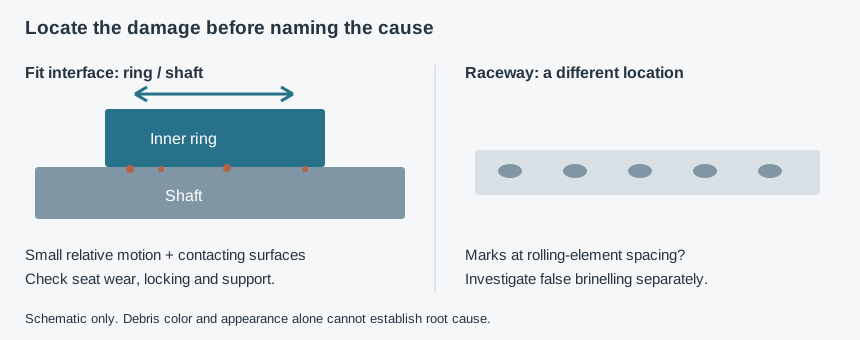
| Loose housing, fretting | Two-bolt fixing on a flexible plate, bolts not torqued | Rigid mounting, correct torque, consider 4-bolt unit |
| Bearing noise, early wear | Overload or misalignment | Check load against unit rating; align shafts |
| Corrosion | Cast iron or chrome steel in wet areas | Stainless or plastic housing, stainless insert |
| Grease washout | Unsealed or shielded insert in washdown | Contact seals, end covers, suitable grease |
| Shaft wear under set screws | Soft shaft, vibration | Eccentric collar or harder shaft |
When damage appears at a ring seat or mounting face, use the fit-interface investigation checklist before assigning the cause to vibration or washdown alone.
For how oval flange units and machine feet work together on a machine's load path, see where to use machine feet and oval bearings.
NHK example: oval 2-bolt flange unit FLPL; more at NHK Machinery Parts.