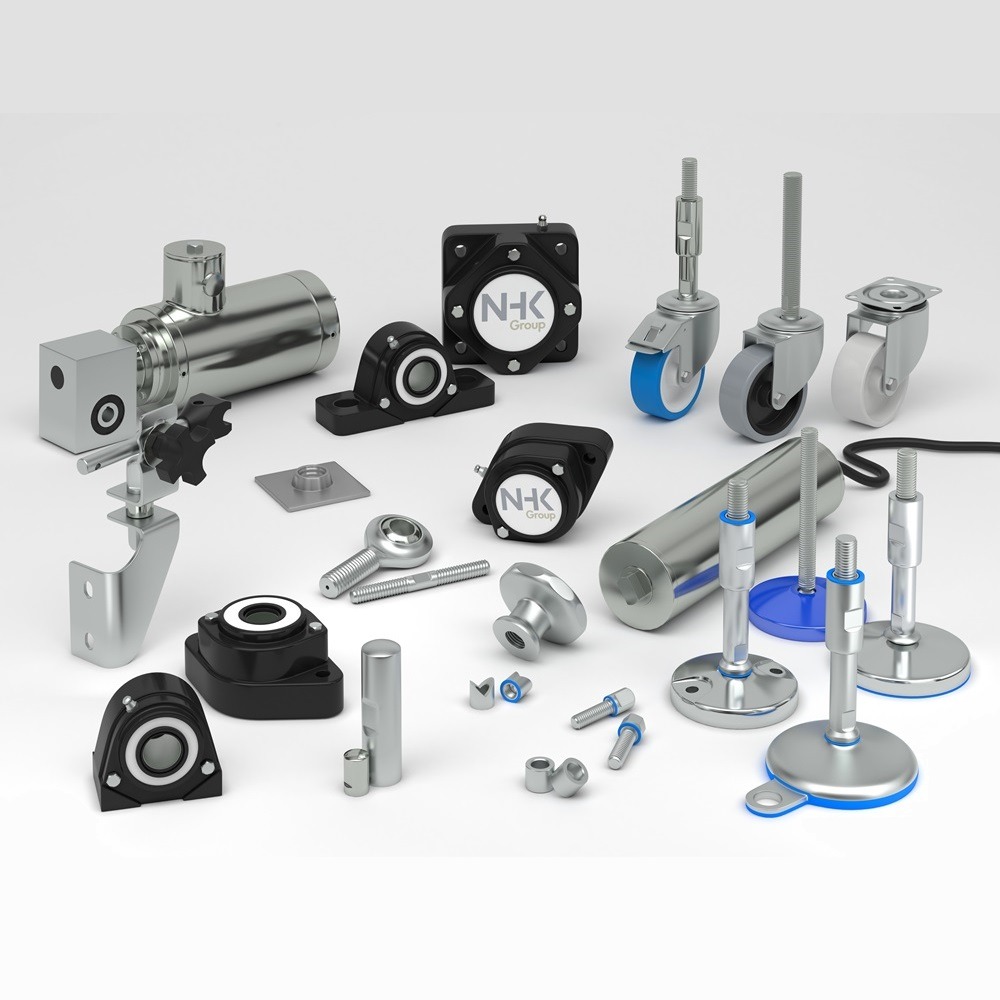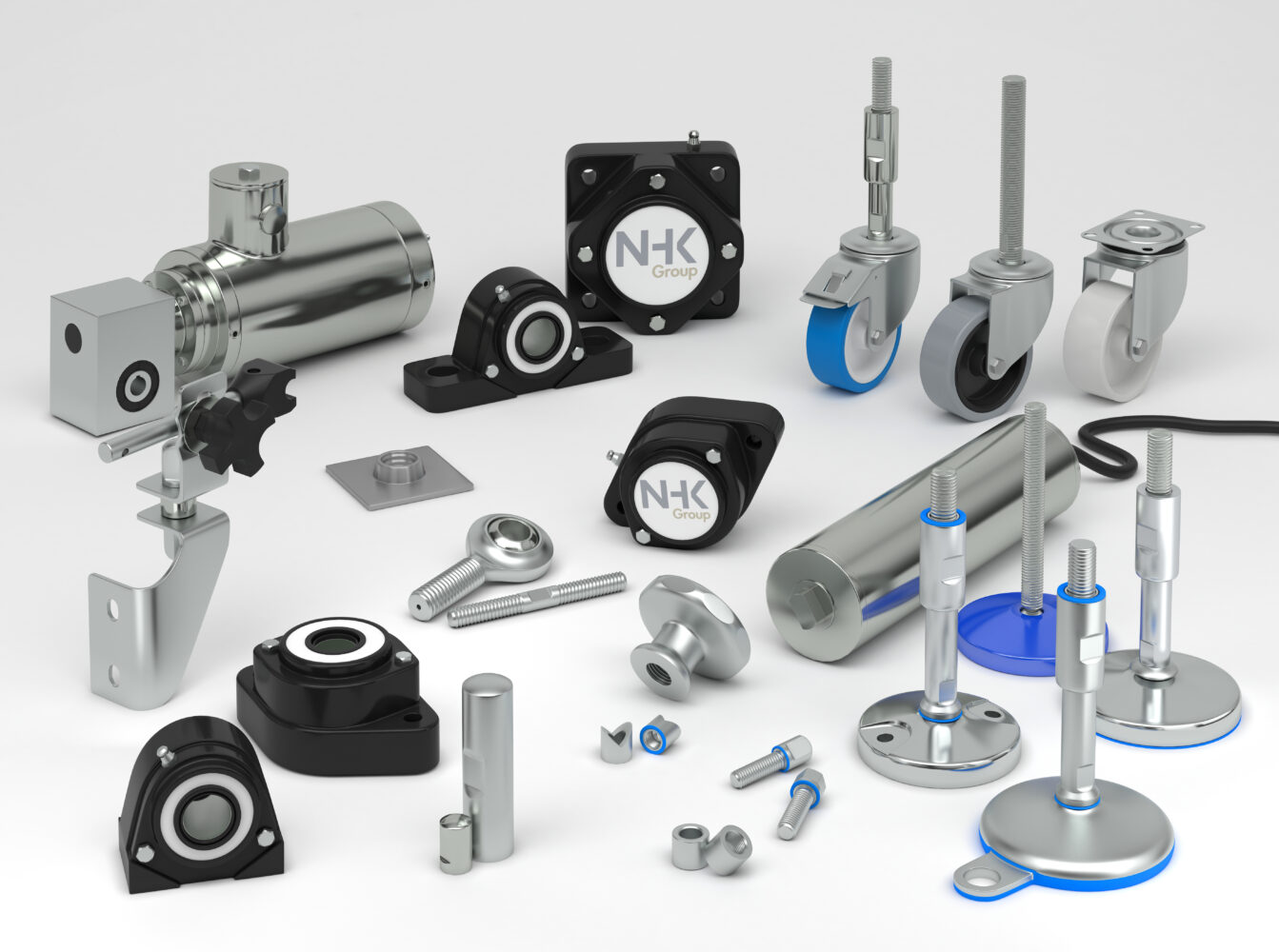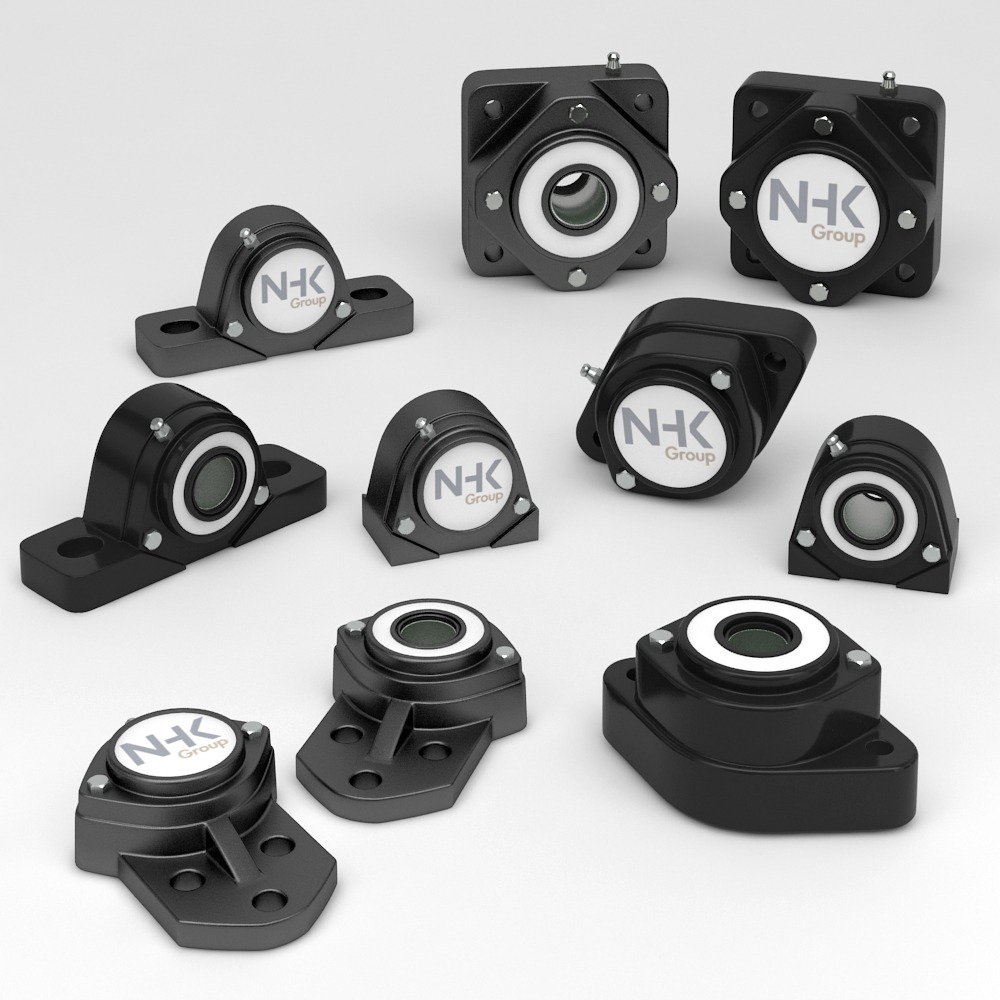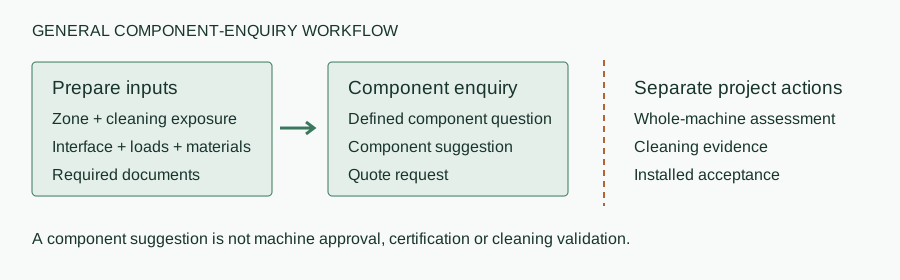
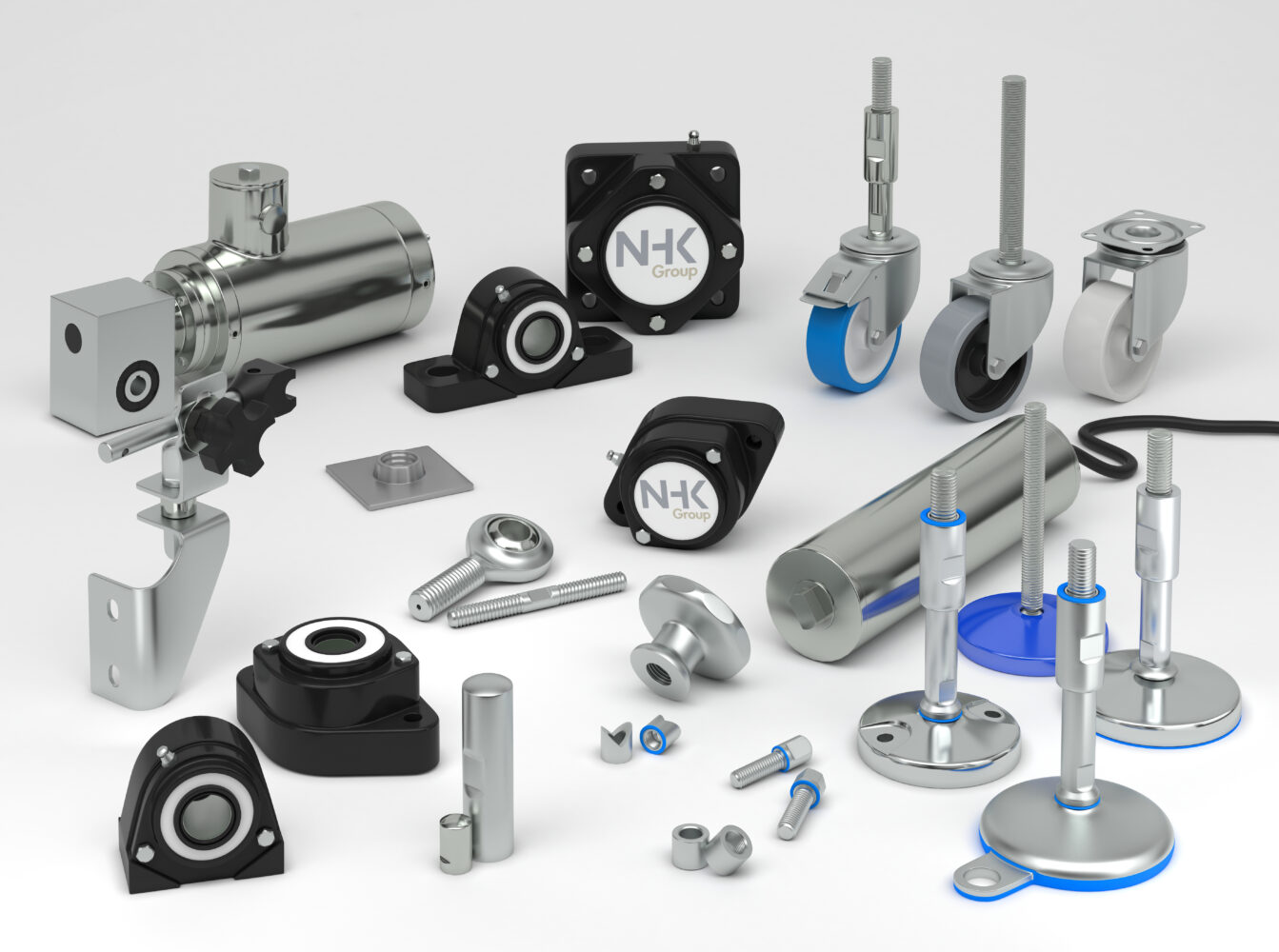
Industrial components are the standard parts a machine is built from; two of the most basic are machine feet, which carry the frame into the floor, and oval flange bearing units, which carry rotating shafts into the frame. This guide explains where and why each is used, how the environment changes the choice, and how to size and specify them.
For the broader range of industrial equipment parts – castors, conveyor parts, fasteners and seals – see industrial machinery parts and components. For which industries and machine positions each component suits, see where and why to use oval bearings and machine feet.
Why machine feet and oval bearings are chosen together
Both sit on the machine's load path. If a foot is undersized or a flange unit is badly aligned, the result is the same: vibration, wear and early failure of parts that were not the cause. Designers often specify them in the same step because frame stiffness, floor conditions and the cleaning regime affect both.
Where are machine feet used?
Hygiene-sensitive industries
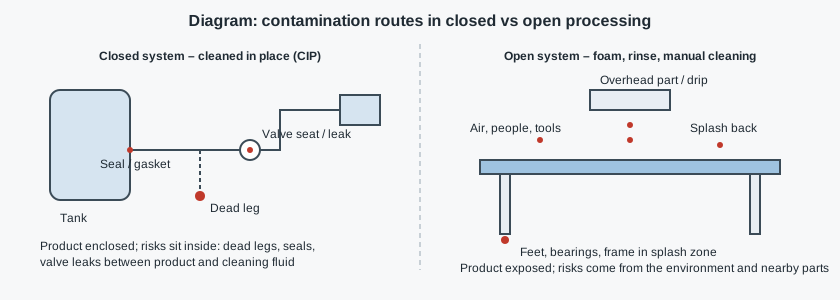
In food, dairy, beverage and pharmaceutical plants, feet stand in the splash zone – the area where product and cleaning solution reach the part and drain back. Here the foot must be cleanable: no exposed thread, no crevices (narrow gaps that trap soil), no harbourage points (places where microbes survive cleaning) and self-draining surfaces. Stainless steel stems, sealed designs and base materials with a declaration of compliance under EC 1935/2004 are typical. Some designs carry an EHEDG certificate for the specific model; EHEDG certification is voluntary and covers that design only.
Precision and vibration-sensitive machines
Where the support also measures load, see the weighing-foot installation and cleaning checks for sensor interfaces and external connection forces.
Weighing, filling, inspection and machining equipment needs a level, stable stance. Adjustable levelling feet compensate for uneven floors; anti-vibration bases or elastomer pads reduce transmitted vibration. Articulation (a swivel joint in the base) lets the base sit flat on a sloping floor, but reduces stiffness compared with a fixed base.
Heavy-duty applications
In manufacturing, packaging and logistics, the foot must carry high static loads and sometimes impact. Larger stems, larger base diameters and floor anchoring through one or two fixing holes are the usual responses. Anchoring also prevents a machine from walking under vibration.
Where are oval flange bearing units used?
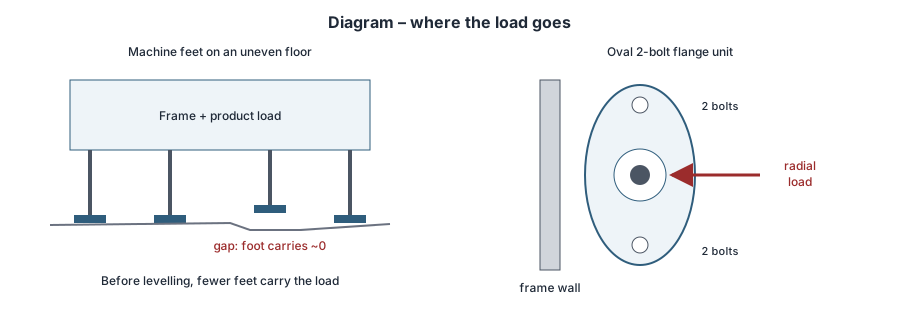
An oval bearing in this context is an oval two-bolt flange unit: an insert ball bearing in a housing with an oval flange and two bolt holes. The source article described oval bearings as distributing load more evenly than traditional bearings; in practice the oval shape describes the housing, and it is chosen mainly for its narrow footprint on a frame side.
Typical uses are conveyor shafts, drive and idler rollers, and light-to-moderate shafts on packaging and processing machines. For higher loads or moment loads, a square four-bolt flange or a pillow block is often a better fit. Our industrial oval bearings guide covers selection and installation in detail.
Corrosion resistance depends on the material: cast iron housings need coating in wet areas; stainless steel or thermoplastic housings with stainless inserts suit washdown and corrosive environments. In chloride-rich environments, AISI 316 grades resist chloride pitting (local corrosion attack) better than AISI 304.
Selection table: industrial parts by environment
| Environment | Machine feet | Oval flange bearing units | Watch for |
|---|---|---|---|
| Dry, indoor | Zinc-plated or stainless, adjustable | Cast iron housing, standard seals | Floor unevenness, vibration |
| Wet, splash zone | Stainless AISI 304, sealed thread | Stainless or thermoplastic housing, contact seals | Water ingress, rust on fasteners |
| High-pressure washdown | Stainless, sealed, crevice-free; hygienic design | Stainless or thermoplastic, IP69 / IP69K-tested sealing | Exposed threads, grease washout |
| Chlorides / salt / aggressive detergents | AISI 316L | Stainless housing and insert | Chloride pitting, galvanic corrosion with mixed metals |
| Heavy load / impact | Large stem and base, anchored | Consider 4-bolt or pillow block instead | Overload, bolt loosening |
How to size machine feet: load per foot
Load per foot = total load ÷ number of feet that actually carry it × safety factor.
A four-legged frame on an uneven floor rests on three feet until it is levelled, and a stiff frame may rock on two diagonal feet. Size on the realistic number of carrying feet, not on the total.
Example – assumptions stated, not product data. A packaging machine weighs 900 kg with product and stands on four feet. Assume three feet carry the load before levelling and a safety factor of 1.5: 900 ÷ 3 × 1.5 = 450 kg per foot. Choose a foot rated at or above 450 kg static load, not 900 ÷ 4 = 225 kg.
How to select both components: step by step
- Define the zone: product-contact, splash or non-contact.
- Define the cleaning method: dry wipe, foam, COP (cleaning out of place) or high-pressure washdown.
- Choose material: AISI 304 for mild wet areas, AISI 316L for chlorides and aggressive chemicals.
- Calculate load per foot and bearing loads (radial, axial, speed).
- Check frame space: an oval two-bolt flange for narrow members, four-bolt for higher loads.
- Choose sealing: sealed foot threads; bearing seals and elastomers (EPDM, FKM or VMQ) compatible with your detergents and product fats.
- Specify fixing: free-standing, one or two holes, or floor anchoring.
- List the documents: model certificates if claimed, declaration of compliance for food-contact materials, material certificates, grease specification.
Failure modes and prevention
- Rocking or walking machines: feet not levelled or not anchored – level under load and lock nuts.
- Corrosion under the base: standing water and crevices – use sealed, self-draining designs.
- Bearing seal failure: high-pressure jets aimed at seals – choose suitable sealing and train cleaners.
- Housing cracking: oval unit used under moment or impact load – switch to four-bolt or pillow block.
- Galvanic corrosion: stainless parts bolted to plain steel in wet areas – isolate or match materials.
What to check in quality and certification claims
The old page said the products "undergo rigorous testing to ensure they meet international standards" and that NHK "holds various certifications". For engineering use, ask for the certificate covering the exact model and check its scope. EHEDG certifies specific designs; 3-A Symbol authorisation follows a Third Party Verification; IP ratings (IEC 60529, IP69K in ISO 20653) are ingress tests, not hygiene certifications.
Where to look in the NHK range
Examples of the components discussed are NHK's machine feet and the full NHK product line, which includes bearing units; for levelling feet specifically see stainless steel machine levelling feet. Product ratings and certificates should be taken from the individual product pages, and application questions can go to NHK contact.