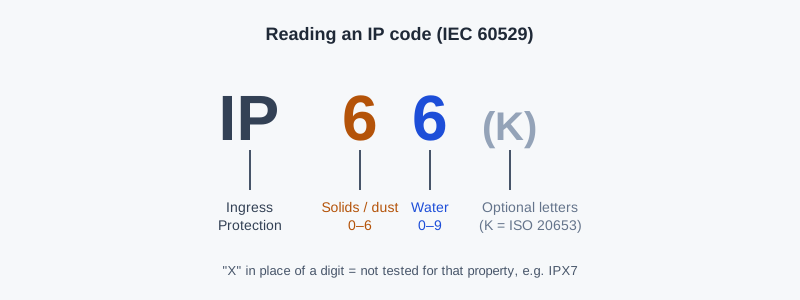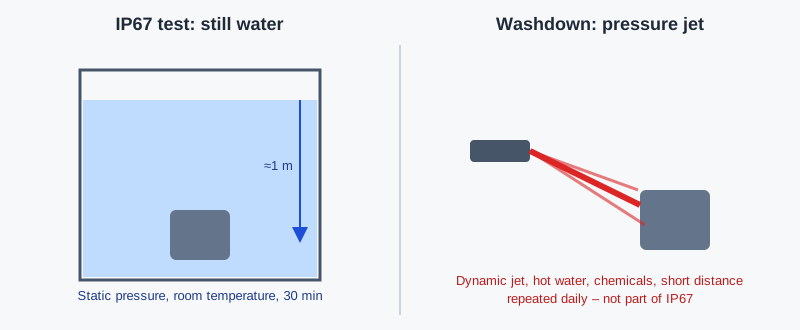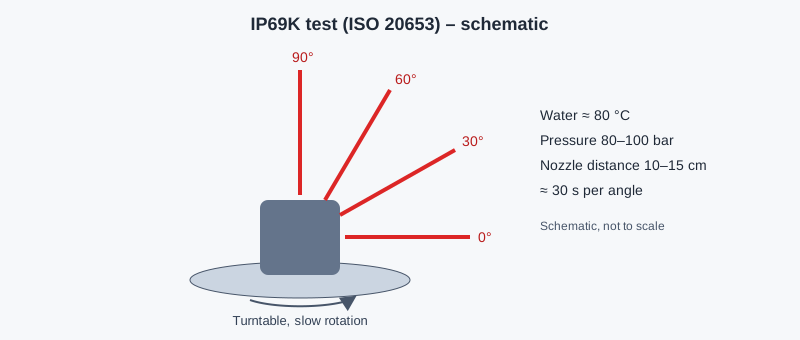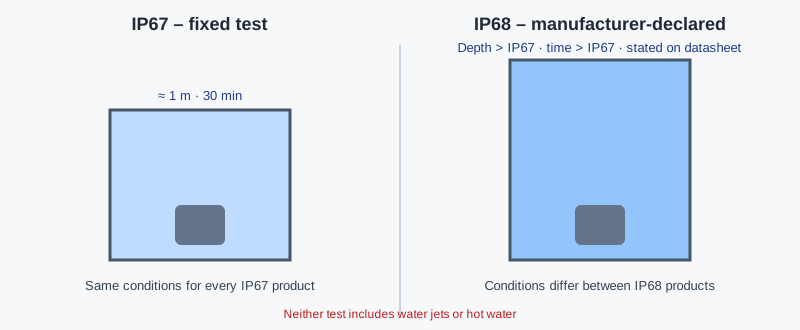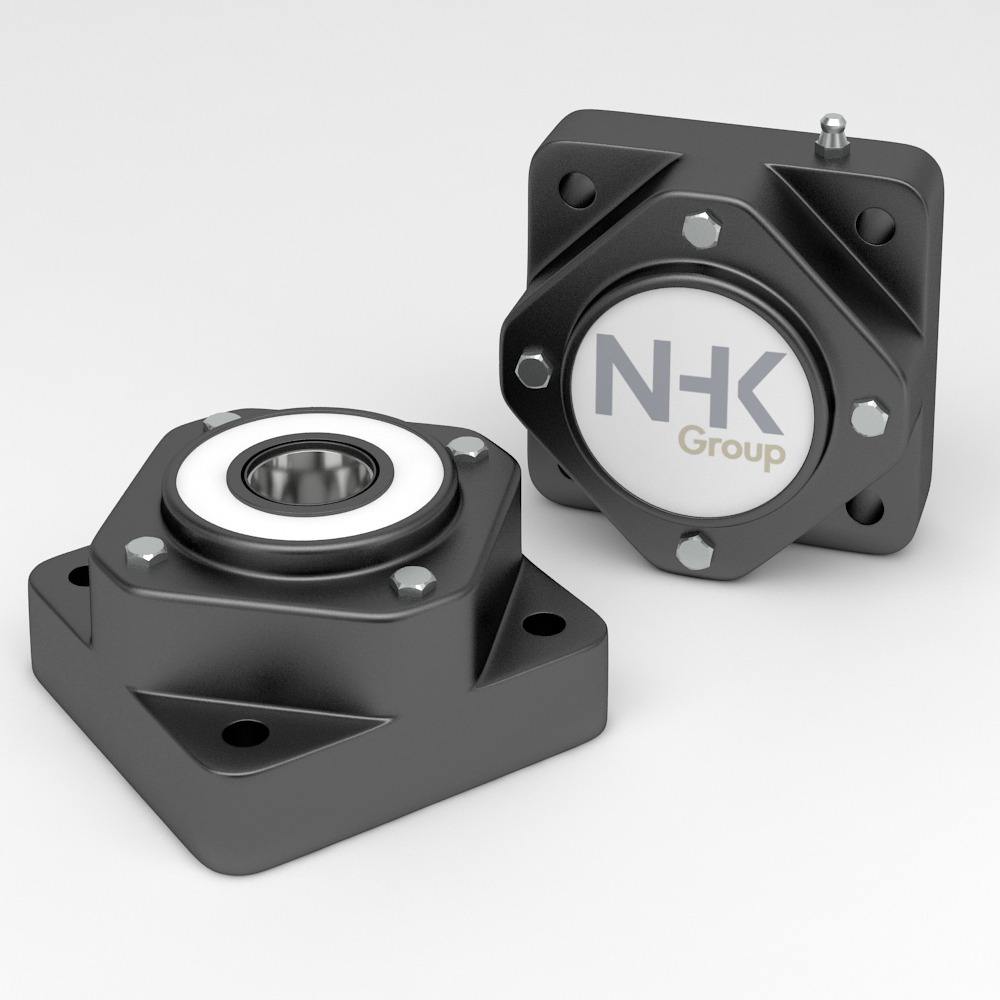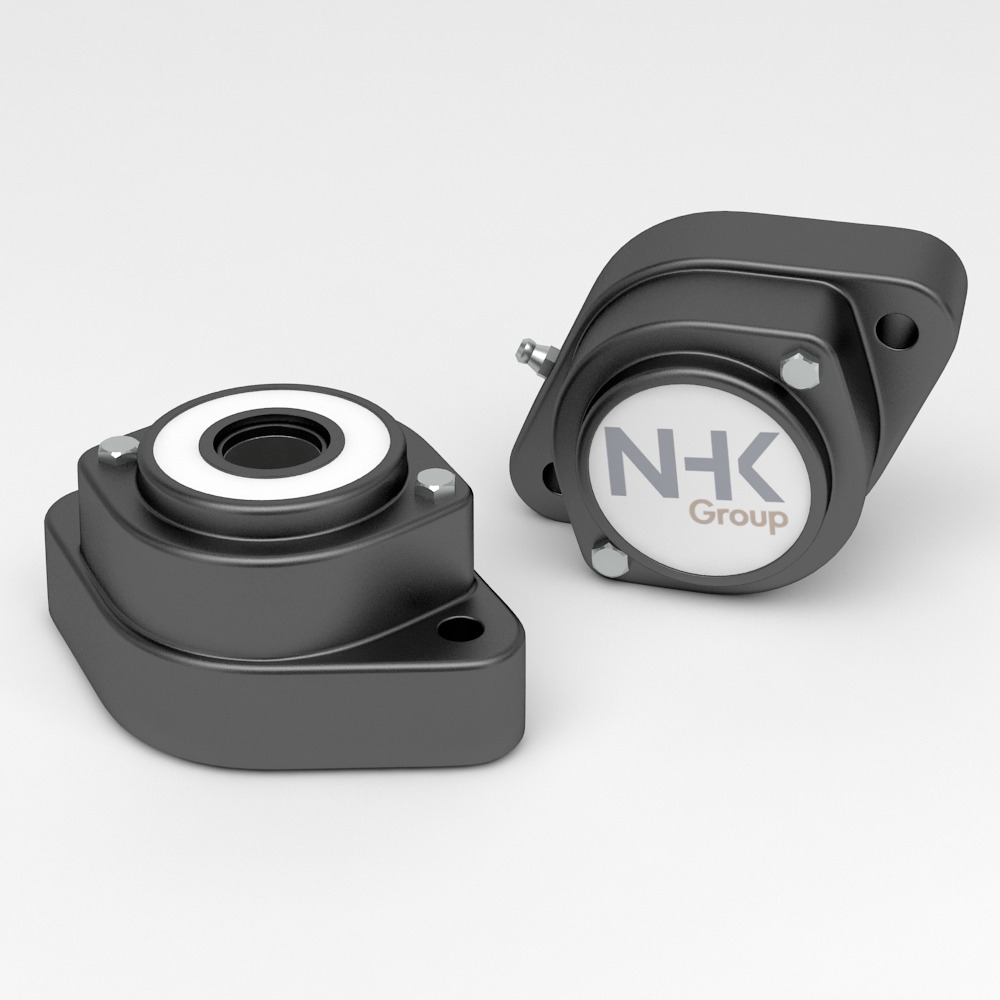
IP67 vs IP69K is a comparison of two ingress protection ratings that test different water loads: IP67 (IEC 60529) is a still-water immersion test, while IP69K (ISO 20653) is a hot, high-pressure, close-range jet test. Both include dust-tightness. In a food plant the question is rarely "which is higher?" but "what does each component actually see during cleaning?" – and the answer differs for a bearing at floor level, a sensor above the belt and a drive in a flooded tray.
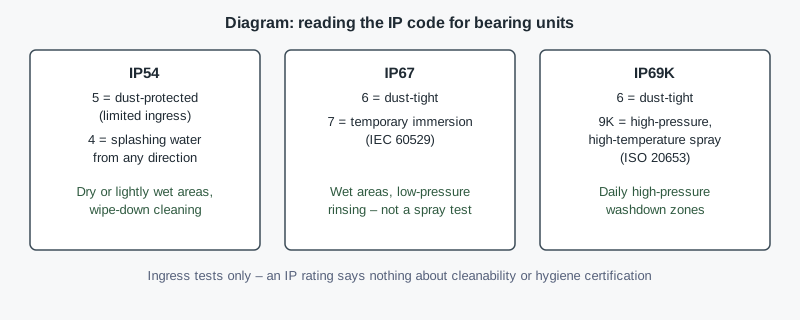 machine zones with typical IP54, IP67 and IP69K requirements for bearing housings. Schematic, not a product test report.
This comparison is part of the IP rating guide, which explains every digit of the code.
IP67 vs IP69K at a glance
| IP67 | IP69K | |
|---|---|---|
| Standard | IEC 60529 | ISO 20653 (IP69 in IEC 60529 is similar) |
| Dust | Dust-tight (6) | Dust-tight (6) |
| Water load | Temporary immersion | Hot high-pressure jets |
| Test conditions | About 1 m deep, 30 minutes, still water | About 80 °C, 80–100 bar, 10–15 cm, several angles |
| Resembles in a food plant | Flooding, soaking, brief submersion | Hand-lance or fixed high-pressure washdown |
| Includes the other test? | No jets | No immersion |
| Hygiene assessment? | No | No |
Send your application data and get a component recommendation
For each rating in depth, see the IP67 rating explained and the IP69K rating explained.
Why one does not replace the other
Immersion and jets load a seal differently. Under still water, pressure is low and even; a lip seal is pushed gently against its counterface. Under a hot jet, pressure is concentrated on a small area, the water is hot enough to soften elastomers, and the impact can lift a seal lip for a moment. A component can pass one test and fail the other.
The difference also shows after cleaning. A warm housing that has been lanced with hot water cools down; the air inside contracts and can draw in water that is still standing on the seal. Neither test reproduces that cycle exactly, which is why seal design and drainage matter as much as the rating.
Which components need which rating
| Component and position | Typical cleaning load | Rating to look for | Also check |
|---|---|---|---|
| Conveyor bearing unit, splash zone, daily lance washdown | Hot jets at close range | IP69K | Seal material vs chemicals, relubrication, hygienic housing |
| Bearing unit in drained tray that floods during cleaning | Flooding plus jets | IP67/IP69K or IP68/IP69K | Drain design |
| Sensor above the product, foam and hot rinse | Jets, thermal cycling | IP69K (often IP67/IP69K) | Cable gland rating, connector |
| Gear motor at floor level | Jets, standing water | IP69K or IP66/IP67 with protective cover | Breather, condensate |
| Junction box on frame, low-pressure rinse | Spray | IP65/IP66 often adequate | Gland and cover gaskets |
| Pump or sensor in a water bath or flume | Continuous submersion | IP68 (declared depth/time) | Add IP69K if lanced |
| Components in dry zones | Dust, wipe-down | IP54 or higher | Dust protection |
In the splash zone – surfaces reached by spray or product splash – most components see jets, not submersion; IP69K is the more relevant test there. In the product-contact zone, hygienic design (no crevices, self-draining surfaces, smooth finish) and food-contact materials come before any IP digit. For bearings specifically, see waterproof bearing house units; for components designed for quick, thorough cleaning, see easy-to-clean components and parts.
How to decide: IP67, IP69K or both
- Map the cleaning per position. Foam, low-pressure rinse, high-pressure lance, fixed nozzles, CIP (cleaning in place) or dry.
- Record pressure, water temperature and distance for wet cleaning. Hot lances at close range point to IP69K.
- Check whether the part can be submerged or flooded. If yes, add IP67 – or IP68 for longer or deeper submersion (see IP67 vs IP68).
- Check chemicals. Elastomer compatibility – whether EPDM, FKM or VMQ (silicone) seals resist your detergents and sanitizers – is not tested by either rating.
- Check the tested configuration – cable glands, connectors, covers and rotating shafts.
Example (assumptions, for method only): a poultry line uses foam, then a hot rinse from a hand lance at roughly 20–30 cm, daily. Conveyor bearings are at knee height above a floor that does not flood. Only jets reach them, so the specification asks for IP69K on the installed configuration, seal material checked against the foam and sanitizer, and a hygienic housing; IP67 adds nothing here. A sensor in the same line sits low enough to be flooded when drains block, so it is specified IP67/IP69K. No performance claim is made for any product.
Common mistakes
- Choosing IP67 for washdown because it "sounds waterproof". It is an immersion test.
- Choosing IP69K for submerged parts. IP69K includes no immersion test.
- Ignoring accessories. An IP69K housing with an IP65 cable gland is an IP65 assembly.
- Cleaning harder than the test. Lances held closer than about 10 cm or aimed at one seal for minutes exceed IP69K conditions.
- Treating either as a hygiene rating. Neither assesses harborage points – places where residues survive cleaning.
What to put in the RFQ
For any claimed hygienic certification, use the verifying certificate scope alongside dual-rating evidence before relying on it in the specification.
- Required code(s): IP67, IP69K or IP67/IP69K – and the standard (IEC 60529, ISO 20653).
- Confirmation that the rating applies to the configuration supplied, including glands, covers and shaft seals, and whether shafts were rotating.
- Seal material and its compatibility with your cleaning chemicals and temperatures.
- EHEDG certificate or 3-A authorization for the specific design, if required.
- Declaration of compliance with EC 1935/2004 for food-contact parts.
- Quantities and delivery country.
An NHK technician reviews positions and cleaning loads, suggests components and sends a quote. NHK holds EHEDG certificate C2400043 for a bearing design. To browse, see NHK's IP67 bearing house units and sealed stainless bearing units, or read NHK's own reference on the two ratings and their applications. See NHK's certifications.