Stainless steel hinges support inspection doors, covers and movable guards on food machinery. This guide concerns hygienic hinges for machine enclosures, not architectural door hardware or conveyor-belt hinge rods. The fastener and moving-fitting selection guide provides the cluster overview. Start with the door and its function, then select the hinge and its installed cleaning detail.
Stainless steel hinges: load and cleanability selection table
| Decision | Establish before selection | Evidence to request |
|---|---|---|
| Door load | Mass, center of gravity, orientation and opening forces | Permitted load directions and duty |
| Hinge layout | Spacing, mounting rigidity and actual load sharing | Drawing and attachment requirements |
| Opening | Required angle, stops and removal path | Interference and retention details |
| Pin and bush | Wear, lubrication and cleaning exposure | Materials and maintenance instructions |
| Mounting seat | Panel flatness, rear access and possible crevice | Seal or weld detail and fitting instructions |
| Cleaning | Open/closed access, chemicals and temperature | Cleaning limits for the complete assembly |
| Safety guard | Intended retention and any interlock function | Machine-level guarding assessment |
| Documentation | Required material evidence and certificate scope | Exact configuration and limitations |
Send door and cleaning data for a hinge recommendation
Hygienic hinges: pin, leaf and mounting seat
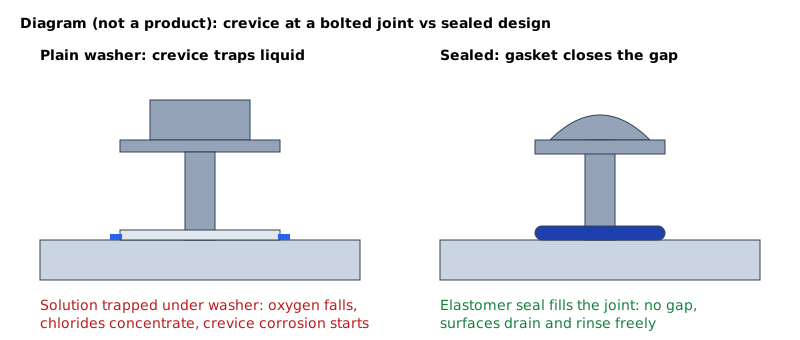
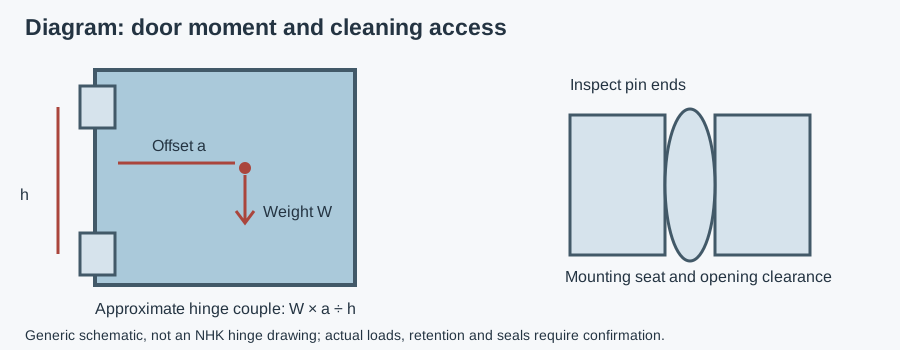
A hinge contains moving interfaces. A crevice is a narrow gap that admits soil or liquid but cannot be reached effectively by cleaning. A harborage point is a location where residue survives the cleaning procedure. Inspect pin ends, knuckle gaps, leaf undersides and the panel seat rather than judging only the polished exterior.
Some designs enclose the pin; others provide accessible moving interfaces or removal for cleaning. Neither appearance proves performance. Ask how the interface is cleaned, whether a seal is present and what happens after wear. Do not prescribe zero running clearance: a moving hinge needs its designed fit, and an inaccessible tight gap can be worse than an accessible opening.
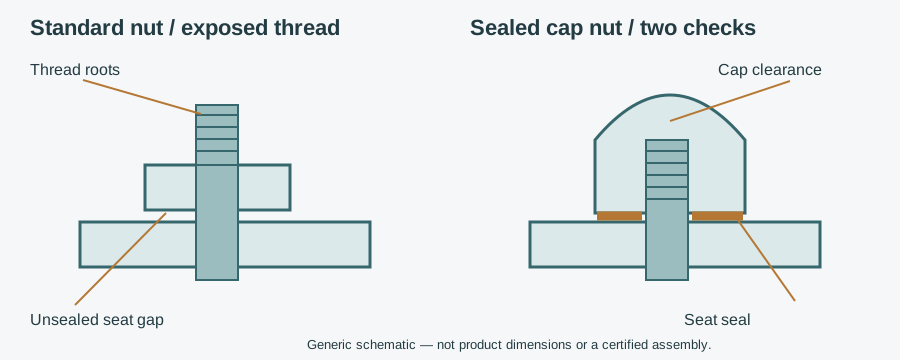
Assess the seat as well as the hinge. A rounded leaf attached to an uneven panel can leave an uncleanable perimeter. A mounting seal needs the intended compression, seating surface and chemical compatibility. A welded connection needs a documented fabrication detail; it is not automatically cleaner if it leaves discontinuities or distorts the door.
The handle and lock mounting guide addresses the other fittings on the same opening. Specify their cleanability together so a sealed handle is not paired with an inaccessible hinge recess. Include recesses behind fasteners and any holes through hollow frames in the installed review.
Stainless grades, bushes and lubrication
Confirm the material of each part: leaves, pin, bushes, seals and fasteners. A stainless leaf does not establish a stainless pin or an appropriate bush compound. General grade selection may consider 304 versus 316L, with 316L usually offering better resistance to chloride pitting; chemistry, temperature, wet exposure and finish still govern suitability.
Chloride pitting is localized attack that can leave cavities even on a stainless surface. Rinse and drain as required by the cleaning procedure and investigate persistent staining. The migrated cleaning-chemical and stainless corrosion guide adds material-selection context. Do not solve every stain by changing alloy: contamination, damaged surfaces and retained cleaner also need checking.
For plastic bushes or seals, obtain compatibility for the actual compound and cleaning cycle. Polymer names alone cannot establish wear, temperature or chemical limits. If lubrication is required, follow the hinge instructions and assess incidental product exposure. H1-registered lubricant is not a cleaning agent or permission to leave excess grease around a pin. Dry-running suitability also requires confirmation.
Door moment: why mass alone is insufficient
For a simplified vertical door with two aligned hinges, weight W acting at horizontal offset a from the hinge axis creates a moment W × a. A reaction couple across hinge spacing h gives an approximate horizontal force W × a ÷ h. Use consistent force and length units. This is a screening model, not a supplier rating or a complete guard calculation.
The hinges also carry vertical weight. Frame stiffness, attachment geometry and hinge fit affect sharing; three hinges cannot automatically be credited with one-third of every force. Include orientation, opening/closing duty, stops and any permitted external load. Do not imply that an operator may lean on a guard unless the machine design permits it.
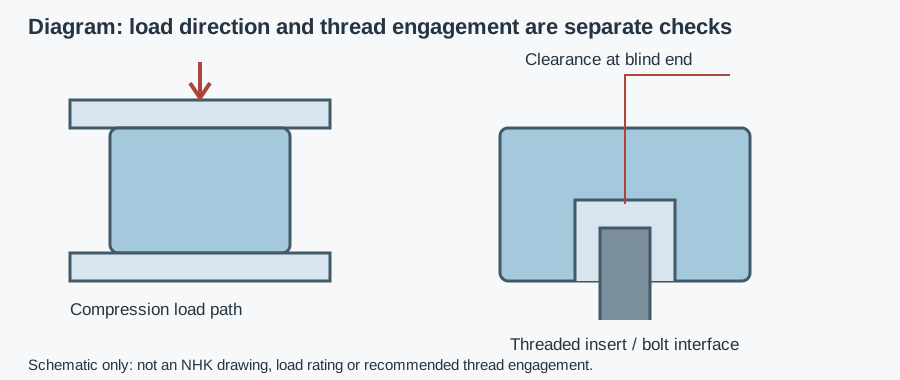
Increasing spacing can reduce the couple force in the simplified model, but the door structure and mounting must still be checked. Confirm whether the supplier rating covers radial load, axial load or a stated test arrangement. A rating without its load direction, spacing and duty conditions is incomplete selection evidence.
Mounting and opening access
Use the specified fastener, engagement and torque. Rear fixing can keep exposed heads out of the splash zone, but the rear must remain inspectable or effectively closed. Check panel thickness and local reinforcement: adding a stronger hinge to a flexible sheet may simply transfer the problem to the panel.
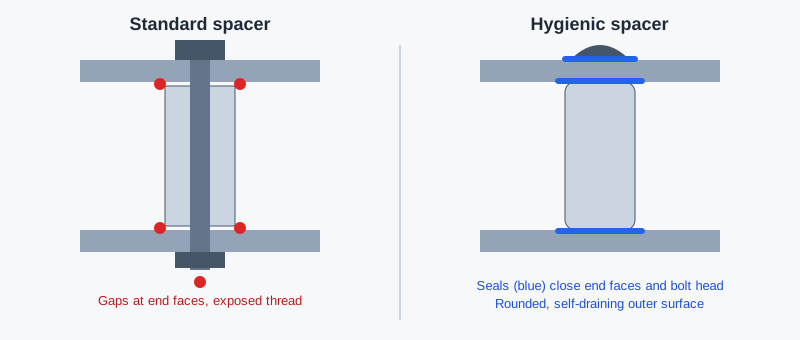
Where fitting to hollow tube, prevent the mounting from opening an inaccessible cavity. The tube-end closure and insert selection guide distinguishes structural retention from a hygienic closure. Where stand-offs or spacers are needed, the spacer and mounting-interface guide helps assess added contact faces rather than treating a spacer as a universal seal.
Check the door sweep, hinge-side clearance, adjacent pipes and removal path. An opening angle that gives access to the machine may still block cleaning of the hinge-side frame. Set stops or supports through the approved door design, not by allowing the hinge to absorb uncontrolled impacts. Include safe handling of heavy removable panels.
Guard safety is a separate assessment
A cleaning door can also prevent access to machinery. EN ISO 14120 addresses guards; EN ISO 14119 concerns interlocking devices associated with guards. Neither a stainless hinge nor a hygienic seal establishes the safety performance of that system. Retention, access, interlock mounting and defeat prevention require the machine-level assessment.
Do not replace a retained hinge with a lift-off type solely for easier cleaning. Determine whether the door could be removed unexpectedly and whether hazardous motion is controlled before access. A hinge containing a switch needs its own instructions and safety integration; no such NHK product or performance is claimed here.
Use isolation and appropriate temporary support when inspecting, removing or adjusting a guard. Keep hands away from pinch points and never rely on an improvised prop. Hygiene improvements must not weaken the guard, change its retention or bypass its safety function.
Example: a wet-cleaned inspection guard
Assumptions: a vertical inspection door is opened during planned changeovers and foam-cleaned in a splash zone. Its mass, center-of-gravity location and hinge positions will be measured. This is a hypothetical selection exercise, not an NHK case, and no product capacity or maintenance interval is invented.
The engineer calculates the door moment and checks candidate load directions and attachment strength. QA reviews the pin ends, mounting seat and open-door access against the cleaning process. Maintenance confirms a safe support/removal method and whether the approved guard requires retention. The supplier is asked for materials and cleaning limits for the actual variant.
If a lift-off design cannot meet retention requirements, the team retains an appropriate hinge and improves accessible cleaning instead. If the existing panel flexes, the frame attachment is redesigned rather than selecting from a larger hinge alone. Acceptance records the load evidence, door alignment, cleaning access and guard function together.
Inspection: symptom, check and action
| Symptom | What to check | Action before return to service |
|---|---|---|
| Door sag or seal gap | Pin wear, loose fixing, panel deformation | Restore approved attachment or replace worn parts |
| Binding during opening | Axis alignment, distortion, damaged bush | Correct alignment; do not force the door |
| Residue at pin ends | Cleaning access and retained soil | Review procedure and design; scraping outside is insufficient |
| Staining around fixings | Material, cleaner retention, contamination | Investigate cause and clean/replace as specified |
| Cracked mounting seal | Compound, compression and cleaning cycle | Replace with approved seal and inspect seat |
Record observations at scheduled inspection and after changes to cleaner or door configuration. Do not repair a worn pin with improvised packing. Replacement must preserve the approved opening, retention and mounting geometry.
Copyable RFQ and acceptance checks
- Record door dimensions, mass, center of gravity, orientation and hinge positions.
- Supply the mounting drawing, panel thickness, opening angle, stops and retention requirement.
- State zone, cleaning chemicals, temperature and access with the door open and closed.
- Request leaf/pin/bush materials, load directions, fitting instructions and maintenance limits.
- Confirm guard function and safe cleaning/removal before acceptance.
Copyable RFQ: “Please assess hinges for the attached guard drawing. Confirm permissible loads and duty for the proposed positions, materials of leaves/pin/bushes, mounting-seat sealing and cleaning limits. State retention/removal instructions and provide certificate scope only where the exact design is certified. Quantity and delivery country: …”
The component purchasing and documentation guides provide the broader buying route. For certificate questions, use the EHEDG scope and verification guide; a certificate for another fitting cannot be transferred to a hinge.
NHK’s stainless fittings category with an enclosure-hinge entry lists a hinge for enclosures and cabinets. That entry does not establish its exact alloy, load rating, seal design or certificate. Send application data for NHK to confirm the available configuration, recommend the appropriate component and prepare a quote.