Stainless steel for 3-A Sanitary Standards means corrosion-resistant steel – in practice AISI 300-series grades – used and finished the way the 3-A standards require for surfaces that touch dairy and other food products. 3-A Sanitary Standards are US-origin design criteria published by 3-A Sanitary Standards, Inc. (3-A SSI). Each standard covers one equipment type, from pumps to conveyors, and each contains the same three groups of material rules: which metals are allowed, how smooth and well-joined the surfaces must be, and which non-metallic materials may be used.
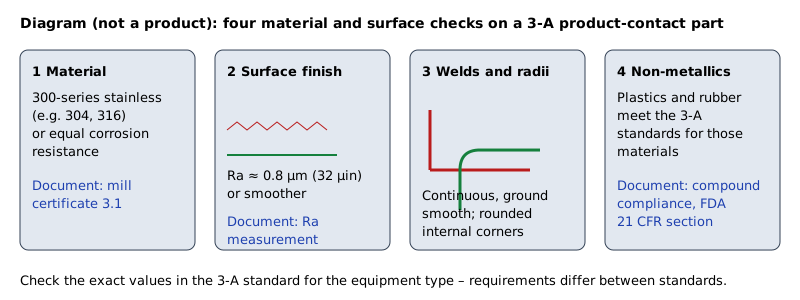 four 3-A checks: material grade, surface finish, welds and radii, non-metallic materials. Schematic, not a product test report.
This page is part of the materials and surfaces hub. It explains what the material requirements typically say, how to meet them in a design, and what to keep on file. Exact values and wording always come from the standard for your equipment; treat the figures here as the common pattern, not as a substitute. Start with the steel-family selection and supplier-evidence overview before applying the equipment-specific material requirements.
What 3-A material requirements cover
3-A divides equipment into product-contact surfaces – surfaces exposed to the product or from which product, liquid or condensate can drain back to it – and non-product-contact surfaces. The strict rules apply to the first group.
| Requirement | Typical 3-A wording (summarized) | What it means in design |
|---|---|---|
| Metals | AISI 300-series stainless steel, or materials of equal corrosion resistance | 304, 304L, 316, 316L are the usual choices; other metals need justification |
| Surface finish | At least as smooth as No. 4 ground finish, free of imperfections | Ra 0.8 µm (32 µin) or better on product-contact surfaces |
| Welds | Continuous, smooth, at least as corrosion-resistant as the parent metal | Ground and finished to match adjacent surfaces; no pits or crevices |
| Internal corners | Rounded to a minimum radius set in the standard | Avoid sharp internal corners where soil collects |
| Drainage | Surfaces self-draining | No horizontal ledges or pockets on product-contact parts |
| Plastics | Must meet the 3-A standard for multiple-use plastic materials | Compound-specific compliance, FDA reference |
| Rubber and rubber-like | Must meet the 3-A standard for those materials | Compound-specific compliance, FDA 21 CFR 177.2600 reference |
| Non-product-contact | Corrosion-resistant or durably coated, cleanable | Painted carbon steel is limited; stainless is the usual answer |
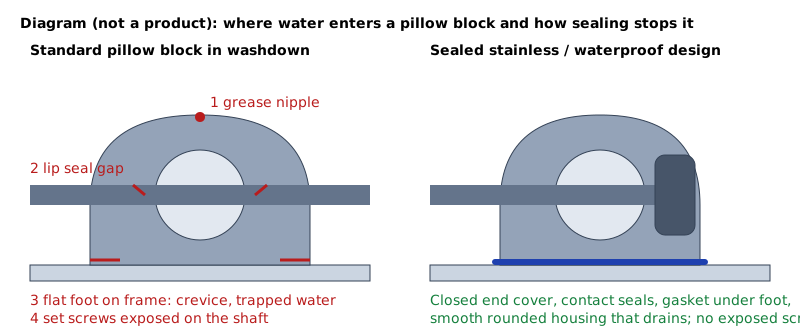
Self-draining means liquid runs off the surface by gravity without being trapped. A crevice is a narrow gap that liquid can enter but cleaning cannot reach – the main reason 3-A asks for continuous welds instead of stitch welds or overlaps.
Ask NHK's technicians about 3-A material requirements
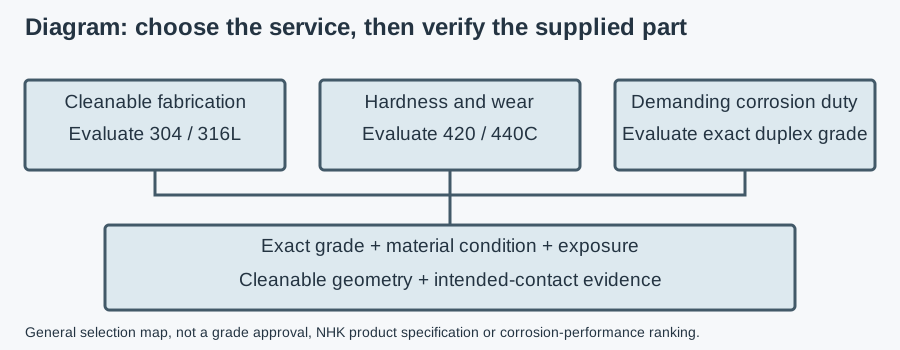
Choosing the stainless grade
All 300-series austenitic grades are normally acceptable as 3-A materials. The choice between them is driven by the product, the cleaning chemicals and fabrication.
| Grade | Use | Notes |
|---|---|---|
| 304 (1.4301) | Most dairy and food product-contact parts, frames | Lower cost; susceptible to chloride pitting (local corrosion caused by chloride ions) in brine or aggressive cleaning |
| 304L (1.4307) | Welded product-contact parts | Low carbon reduces chromium carbide formation at welds |
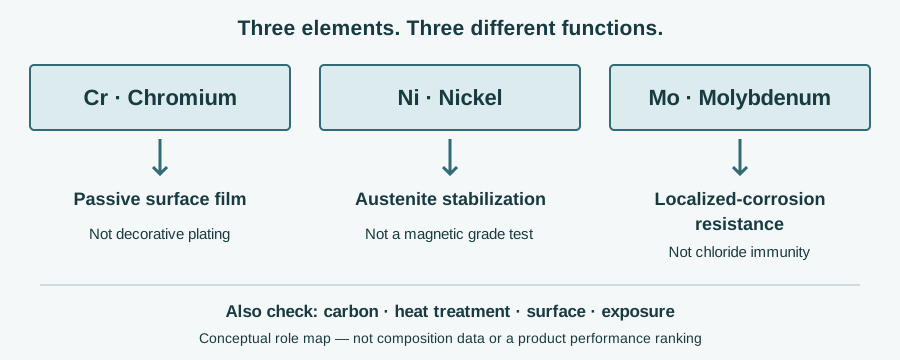
| 316 (1.4401) | Higher chloride exposure | Molybdenum improves pitting resistance |
| 316L (1.4404) | Welded parts in high-chloride service, cheese brine, salted products | The common choice for demanding product-contact work |
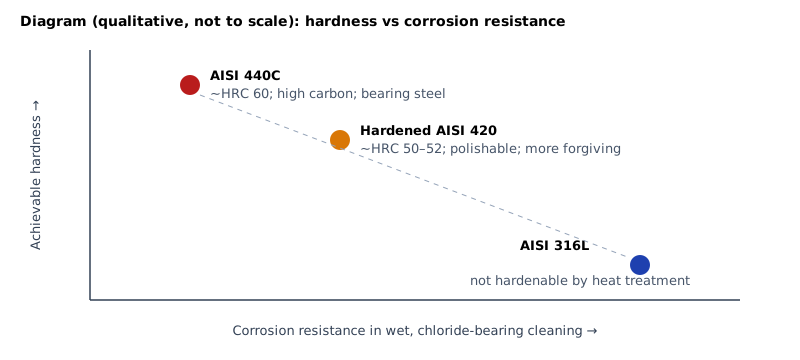
| 420 / 440C (martensitic) | Hardened parts such as bearings or blades (420 properties and limits) | Not 300-series – check whether the standard permits them for that function and where they sit |
The trade-off between the two austenitic families is covered in AISI 316L vs AISI 304 compared in practice. Where hardness is needed – bearing inserts, cutting edges – martensitic grades come in; 440C vs hardened 420 explains why they corrode more easily and how to protect them.
Grade is necessary but not sufficient. Stainless steel resists corrosion only while its chromium oxide layer is intact. Welding, grinding with contaminated discs, or contact with carbon steel tools damages it. Passivation – an acid treatment that removes free iron and restores the oxide layer – should follow fabrication of product-contact parts. How chlorides and cleaning chemicals attack stainless surfaces is set out in how chlorides and cleaning chemicals affect stainless steel parts.
Surface finish: No. 4 and Ra
3-A standards traditionally refer to a No. 4 finish – a directional ground finish made with abrasive belts – and express the requirement as a maximum roughness. Surface roughness Ra is the arithmetic average deviation of the surface profile; the commonly cited 3-A value is 32 µin, which is 0.8 µm. EHEDG guidance uses the same 0.8 µm figure for product-contact surfaces, so a part finished to that value usually satisfies both.
Practical points:
- A "No. 4" label on sheet does not guarantee the Ra after forming, welding and grinding. Measure the finished part.
- Measure across the grinding direction, where roughness is highest.
- Electropolishing lowers roughness and improves corrosion resistance, but it does not hide pits, laps or porosity – those must be removed first.
- Bead-blasted or textured finishes look clean but are often rougher than 0.8 µm. Check before using them on product-contact surfaces.
Welds and joints
3-A asks for welds that are continuous, free of pits, cracks and inclusions, and finished as smooth as the adjacent surface. In practice:
- Use the low-carbon grade (304L or 316L) for welded product-contact parts.
- Purge the root side with inert gas on tubes and closed sections, so the inside does not oxidize ("sugaring").
- Grind and finish the weld to the same Ra as the parent metal.
- Remove heat tint by pickling or mechanical finishing, then passivate.
- Inspect visually, and with a borescope inside tubes.
Bolted joints in product contact are discouraged; where they are unavoidable, they must be sealed and cleanable. Sealed hygienic fasteners follow the same principle – see hygienic bolts and sanitary fasteners.
Non-metallic materials
Plastics and rubber appear in seals, gaskets, scrapers, wear strips and belts. 3-A has separate standards for multiple-use plastic materials and for rubber and rubber-like materials. They require the material to be cleanable, to keep its properties after exposure to product and cleaning and sanitizing solutions, and to comply with the relevant FDA regulations – for rubber articles that is 21 CFR 177.2600.
The compound matters, not only the polymer. Two EPDM seals can behave differently and have different compliance status. Elastomer compatibility – resistance to the product, chemicals and temperature without swelling or cracking – is the practical test: EPDM suits hot water and alkaline cleaners but swells with fats; FKM handles fats and many acids. For the EU market, the same parts also need EC 1935/2004 compliance, and plastics EU 10/2011; the broader picture is in food contact materials for machine components.
How to document compliance
3-A Symbol authorization requires a Third Party Verification (TPV) by a Certified Conformance Evaluator, who checks the design and production against the standard. The scheme is voluntary. Material documentation is one of the things the evaluator looks at.
| Document | For | What to check |
|---|---|---|
| Mill or material certificate (EN 10204 3.1) | Stainless sheet, bar, tube | Grade and heat number match the drawing and part |
| Surface roughness records | Product-contact surfaces | Ra measured on finished parts, method and direction stated |
| Welding procedure and welder qualification | Welded product-contact parts | Low-carbon grade, purge, finishing steps |
| Passivation record | Fabricated stainless parts | Method and date |
| Compliance statement for plastics and elastomers | Seals, gaskets, scrapers | Names the compound, the 3-A standard and the FDA section |
| Component 3-A authorization | Bought-in components | Certificate names the specific product |
Example (assumptions, for method only): an OEM builds a cheese-block conveyor intended to meet the applicable 3-A standard. Product-contact frames above the belt are 316L because of brine; welds are TIG with back purge, ground to Ra ≤ 0.8 µm and passivated; wear strips are a plastic whose supplier states compliance with the 3-A plastics standard and the relevant FDA section; seals are FKM because of milk fat, with a compound-specific statement. Each item gets a line in the technical file with its certificate. Floor-level feet are bought in as components with their own 3-A authorization. No authorization result is claimed here.
Common mistakes
- Treating "304 stainless" on the drawing as complete – the finish, welds and passivation are what get rejected.
- Measuring Ra on raw sheet instead of the finished part.
- Specifying 304 instead of 304L for welded parts, then finding corrosion along the weld.
- Using elastomers chosen by polymer name with no compound statement.
- Assuming a 3-A authorized component makes the machine authorized.
- Assuming 3-A and EHEDG are interchangeable. They overlap on materials and finish but differ in method; NHK's reference article explains the difference between 3-A and EHEDG.
What to send NHK
- Equipment type and the 3-A standard you work to, if known
- Components and whether they are product-contact or non-product-contact
- Materials under consideration and the cleaning chemicals
- Documents you need for your technical file
An NHK technician answers the material question and, where components are needed, suggests suitable parts and sends a quote. NHK publishes a claim of 3-A authorized leveling feet, supports and system components; check current authorization and exact product scope before specifying. The EHEDG and 3-A standard components line is a product-category enquiry path, not evidence of blanket authorization.