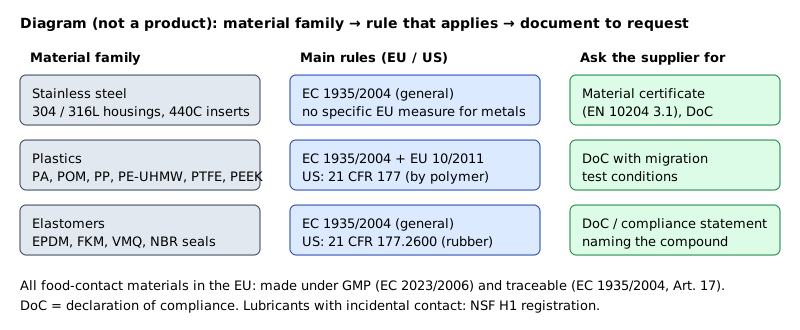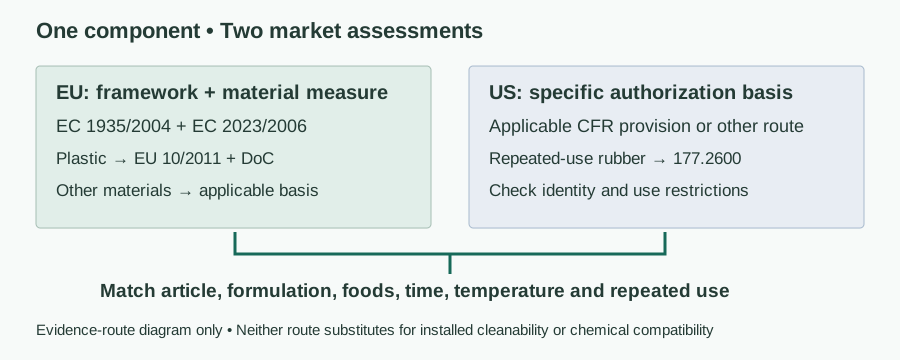
Avoiding contamination and product recall is the combination of design, procedures and monitoring that stops microbial, chemical, physical and allergen hazards from reaching the finished product – and limits the damage if one does. Contamination and recalls affect a company's finances, legal position and reputation, so food and pharmaceutical plants manage them as a programme, not a single action. This guide sets out the layers of that programme and the role equipment and components play in each. Material rules and declarations are covered in the guide to food contact materials for machine components.
Two related guides go deeper on the equipment side: safeguarding against contamination and product recalls covers how components create contamination pathways, and avoiding contamination and following product recall covers investigating components after an incident.
Understanding contamination risks
Contamination can occur at any stage, from raw material handling to final packaging. The main types are:
- Microbial: bacteria, viruses and moulds that survive where sanitation is inadequate.
- Chemical: residues of cleaning agents, lubricants or pesticides.
- Physical: foreign objects such as metal fragments, glass or plastic pieces.
- Allergen: undeclared allergens carried over between products, for example after an incomplete allergen changeover (the cleaning between products with different allergen profiles).
The layers of contamination control
Use the sector-specific equipment acceptance checklist to connect installed cleaning access with the applicable manufacturing framework.
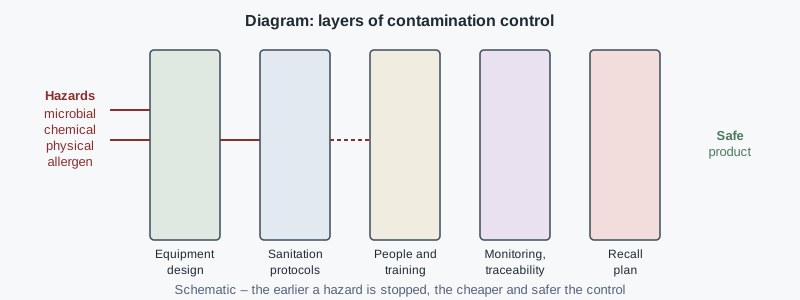
| Layer | What it controls | Main tools | Typical weakness |
|---|---|---|---|
| Hygienic equipment design | Places where hazards can collect | Crevice-free, self-draining design; sealed components; compatible materials | Retrofits and small parts left in standard design |
| Sanitation protocols | Removing soil and microorganisms | Cleaning schedules, validated methods, correct chemicals | Procedures that cannot reach poorly designed areas |
| People and training | Personal hygiene, correct cleaning | Training, hygiene rules, zoning | Staff turnover, time pressure |
| Monitoring and traceability | Detecting problems early; limiting scope | Swabs, ATP, product testing, batch records | Sampling gaps, incomplete records |
| Recall plan | Limiting harm when a hazard escapes | Recall team, communication, retrieval, root cause | Untested plans |
The layers work in sequence. Design removes hazards; the others manage what remains. A plant that relies mainly on cleaning and testing to compensate for poor design usually pays for it in cleaning time and repeated findings.
Layer 1: hygienic design of equipment
Equipment designed for hygiene is the most durable control because it does not depend on daily performance. Key features:
- No harbourage points (places where residue and bacteria survive cleaning) – no exposed threads, crevices or dead spaces.
- Self-draining surfaces so water and product run off.
- Smooth surfaces; EHEDG guidance refers to Ra ≤ 0.8 µm for product-contact surfaces.
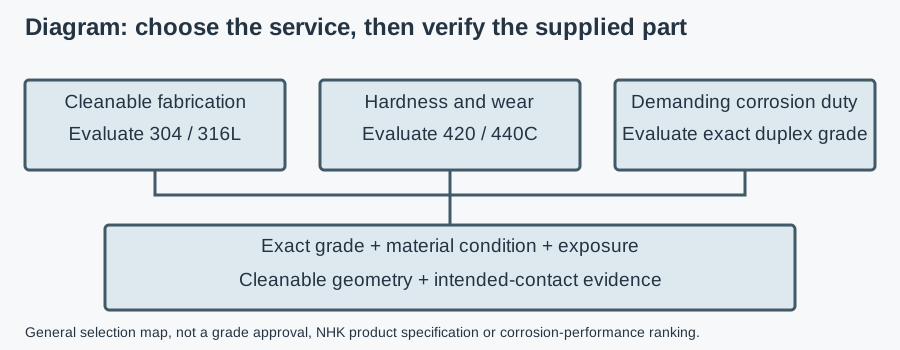
- Corrosion-resistant materials such as AISI 304, or 316L where chlorides cause pitting.
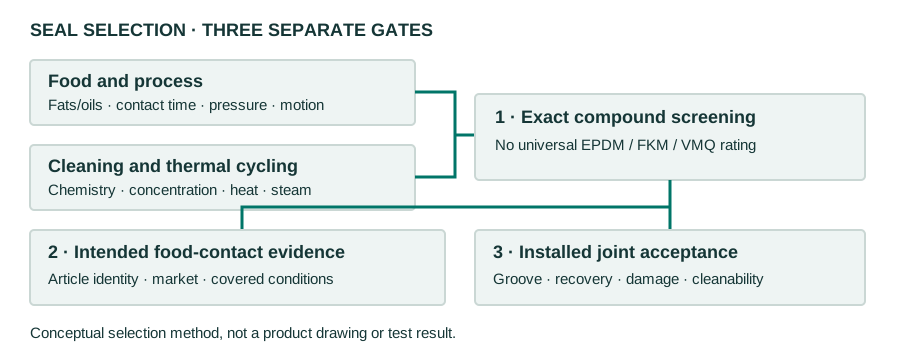
- Compatible seals (EPDM, FKM, VMQ chosen for product and chemicals) and food-contact materials with a declaration of compliance (EC 1935/2004).
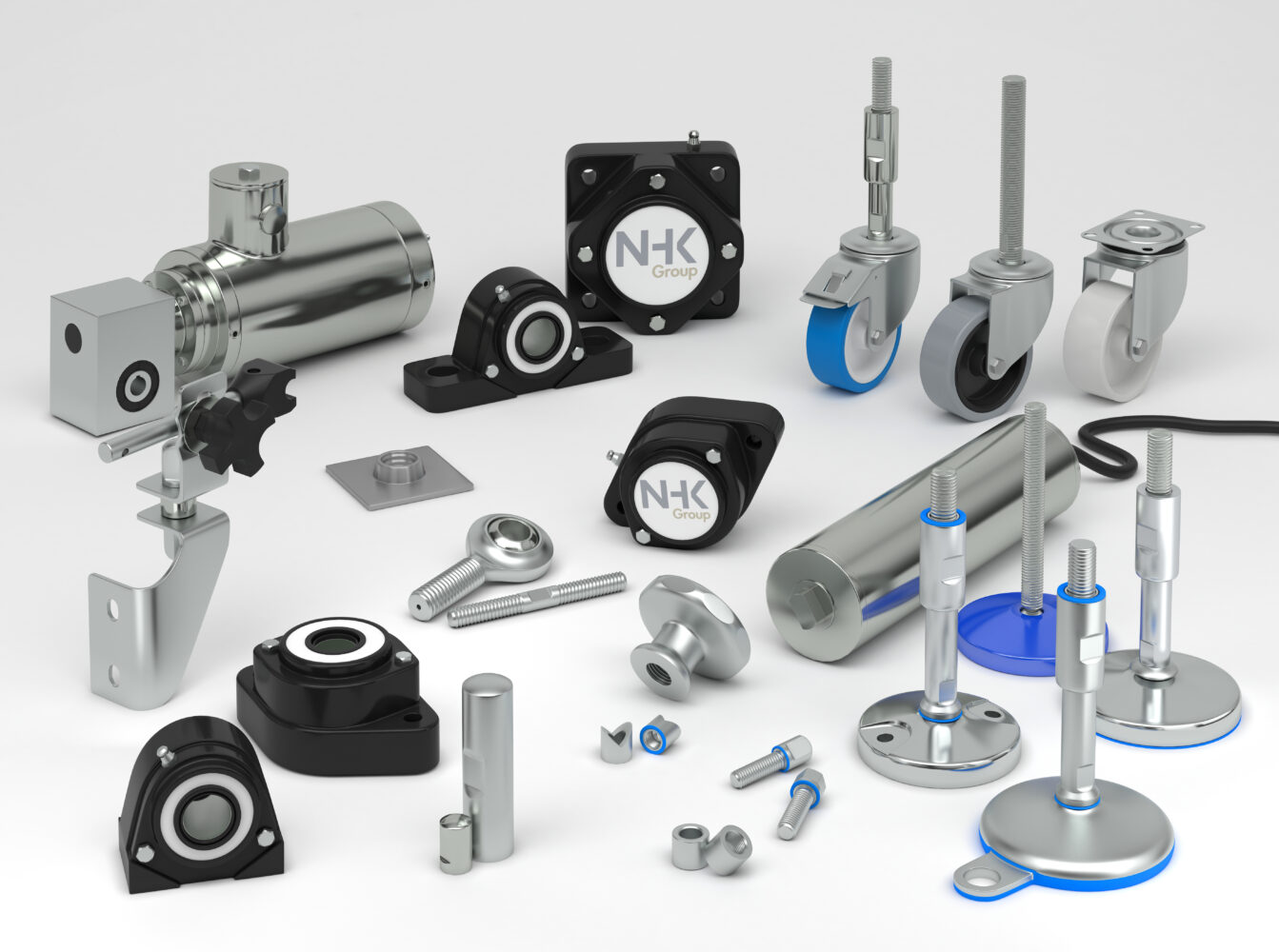
Small components matter: hygienic machine levelling feet, for instance, are designed with smooth surfaces, corrosion-resistant materials, sealed threads and easy-to-clean bases. Where certification is required, check the certificate: EHEDG certifies specific designs and 3-A authorisation follows a Third Party Verification. Both are voluntary and cover the named model.
Layer 2: sanitation protocols
Set cleaning schedules for all equipment and surfaces, use the right detergents and disinfectants, and validate that the method works. Match the method – dry cleaning, foam, high-pressure washdown or CIP/COP (cleaning in place / out of place) – to the equipment and product. Well-designed equipment makes protocols shorter and more repeatable.
Layer 3: personal hygiene and training
Enforce personal hygiene rules and zoning, and train staff regularly – including why each step matters. Involve cleaners in feedback: they see where equipment is hard to clean.
Layer 4: monitoring, quality control and traceability
- Routine inspection of equipment condition: seals, fasteners, feet, bearings.
- Environmental monitoring: swabs and ATP tests on surfaces, including hard-to-reach points.
- Product testing where required by the food safety plan.
- Traceability: link raw materials, lines, times and cleaning records to each batch so sources can be isolated quickly.
- Continuous improvement: review trends, act on repeated findings and update procedures and specifications.
Management systems vs equipment certification
ISO 22000 certifies a food safety management system and ISO 9001 a quality management system – both describe how an organisation works, not whether a product or component is hygienic. Choosing suppliers with such systems supports consistent supply; equipment design certification is a separate question.
Layer 5: the recall plan
Recalls cause financial loss, legal consequences and reputational damage. A recall plan limits them:
- Recall management: team, roles, decision criteria, product retrieval and disposal.
- Transparent communication with consumers, regulators and customers.
- Post-recall analysis: identify the root cause and implement corrective actions – including equipment changes where design was a factor.
Example
Assumptions (illustrative only): a ready-meal plant finds repeated positive environmental swabs at the base of a filling machine.
- Layer 4 detects the trend before product is affected.
- Investigation shows residue in exposed threads of the machine feet (Layer 1 weakness) that the cleaning procedure (Layer 2) could not reach reliably.
- Action: feet replaced with sealed hygienic feet; procedure updated; cleaners briefed (Layer 3).
- Result verified by swabs over following cleaning cycles; the plant's machine specification is updated so new equipment avoids the issue.
More from NHK: avoiding contamination and product recalls with NHK machinery parts.