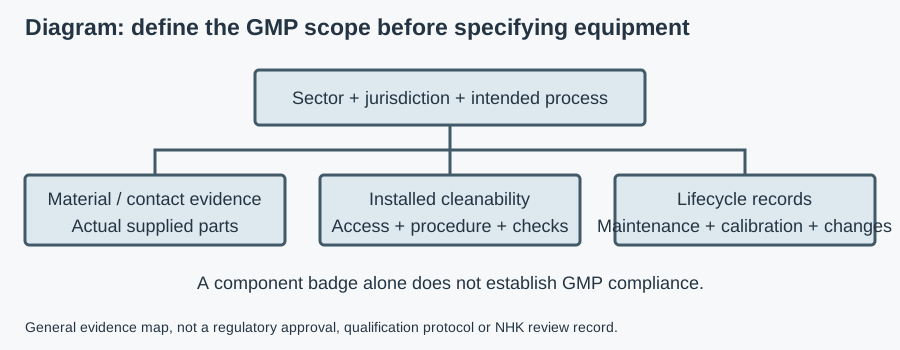
GMP equipment requirements connect the intended manufacturing process to equipment design, installation, cleaning, maintenance and documented control. GMP means Good Manufacturing Practice; it is not a universal material grade or a badge that a supplier can attach to every machine part. Start with the sector, destination market and product before requesting “GMP compliant equipment.”
For the material-contact part of the assessment, use the food-contact material and declaration guide. This page addresses the wider equipment question: what must be accessible, controlled and evidenced after the machine is installed, and which requirements differ between food and pharmaceutical operations.
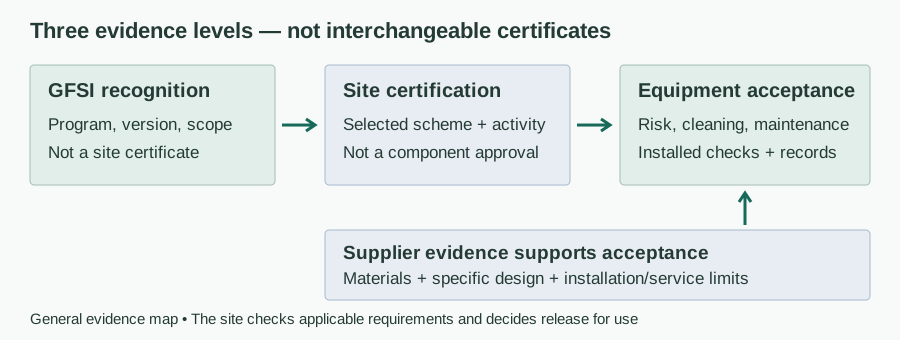
For a food site's certification program, use the scheme-to-equipment acceptance comparison rather than treating the scheme as pharmaceutical qualification.
Which GMP framework applies to the equipment?
The following references address different activities. Do not substitute a food-contact declaration for a pharmaceutical equipment assessment, or apply a sterile-manufacturing specification to every food conveyor. The operator’s quality team should identify applicable rules and acceptance criteria before the purchase specification is issued.
| Framework | Equipment or activity in scope | Practical evidence to request | What it does not establish |
|---|---|---|---|
| US 21 CFR Part 211, Subpart D | Equipment used in finished-pharmaceutical manufacture, processing, packing or holding | Intended-use design, construction evidence, written cleaning/maintenance procedures and applicable calibration/check records | A general certificate for every component or all types of pharmaceutical activity |
| US 21 CFR 117.40, Equipment and utensils | Equipment in human-food operations within the rule’s scope | Cleanable construction, maintained contact surfaces, installation access and suitable controls | Automatic pharmaceutical qualification or sterile processing approval |
| EU GMP, EudraLex Volume 4 | Medicinal-product manufacturing under the relevant GMP framework | Equipment design and operating evidence appropriate to the process; qualification/validation where applicable | A food-plant equipment approval scheme |
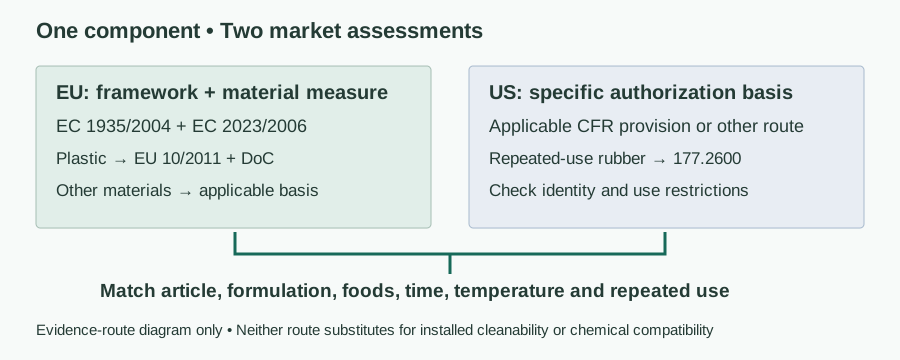
| Regulation (EC) No 2023/2006 | Manufacture, processing and distribution of materials/articles intended to contact food within its scope | Relevant quality assurance, quality control and documentation for the supplied food-contact article | A blanket GMP requirement certifying every machine in a food plant |
Ask NHK's technicians about the specified component and evidence before treating a catalogue description as acceptance evidence.
US pharmaceutical requirements are set out in 21 CFR Part 211, Subpart D — Equipment. Sections 211.63, 211.65, 211.67 and 211.68 respectively address design/location, construction, cleaning/maintenance and automatic/mechanical/electronic equipment. They must be read with the applicable manufacturing requirements, not as a complete compliance checklist by themselves.
Translate GMP equipment requirements into installed details
Materials and contamination routes
For finished-pharmaceutical operations, section 211.65 addresses product-contact surfaces that could affect drug-product safety, identity, strength, quality or purity beyond established requirements. It also addresses operating substances such as lubricants and coolants. For US food operations, section 117.40 requires food-contact materials and construction suited to intended use, with corrosion resistance and protection against contamination and allergen cross-contact.
Map the product-contact zone, where surfaces touch product or can transfer contaminants to it; the splash zone, reached by product or cleaning spray; and the non-contact zone. These are useful design-review labels, not a substitute for a regulation’s actual scope. Check overhead fasteners, cable routes and lubricant discharge points as well as the obvious vessel or belt surface. Use the component contamination-pathway guide to identify where fragments or residues can reach exposed product.
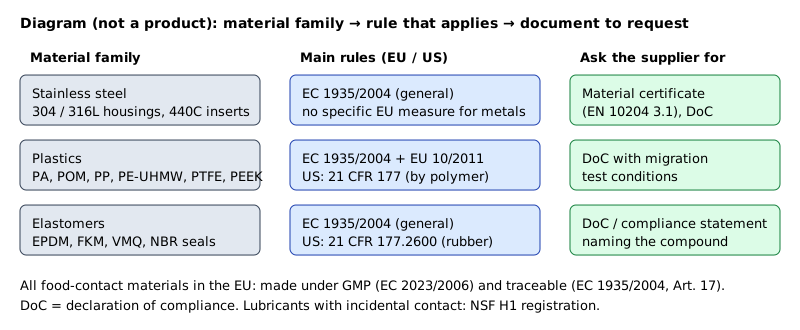
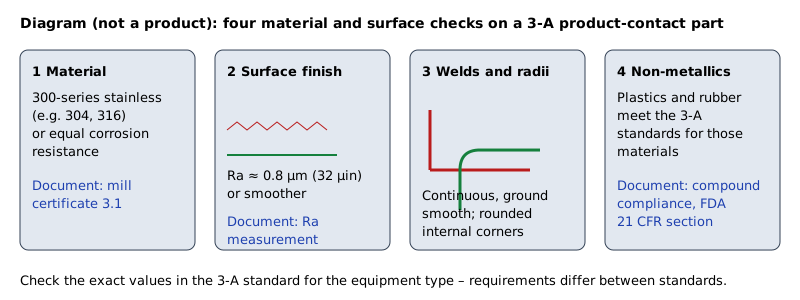
Do not specify “stainless” alone. Record the supplied alloy, fabrication condition, finish and intended exposure. The food-machinery stainless grade comparison explains why grade selection depends on corrosion and service conditions; neither 304 nor 316L makes a whole installation GMP compliant. Request evidence for actual supplied seals, coatings and plastics rather than transferring a declaration from another compound or component family.
A declaration of compliance describes suitability within stated conditions and legal references; it is not a universal promise of compatibility. For EU food contact, Regulation (EC) No 1935/2004 provides the overarching framework and Regulation (EU) No 10/2011 specifically concerns plastic materials/articles. Formal declaration obligations depend on the applicable measure. Do not describe a steel material certificate as a plastic migration assessment or an FDA approval of the whole machine.
The material-rule and supplier-declaration acceptance checks separate plastics documentation, manufacturing GMP and US authorization evidence.
Cleaning access, joints and drainage
An accessible loose component can become inaccessible behind a guard, under a frame or beside a wall. Section 117.40 expressly addresses installation that facilitates cleaning and maintenance of equipment and adjacent spaces. Inspect the final arrangement, not only a supplier’s isolated product photograph. Look for overlapping plates, recesses behind seals, open tube ends and horizontal surfaces that retain liquid.
Harborage points are places where residues or microorganisms can persist; dead spaces are pockets that do not receive the intended cleaning action or cannot empty effectively. Check whether disassembly exposes the actual retained-residue location without damaging the seal. A nominal surface roughness Ra, the arithmetic average roughness, does not demonstrate that a joint is drainable or that cleaning reaches a hidden cavity. This guide does not impose a universal finish value.
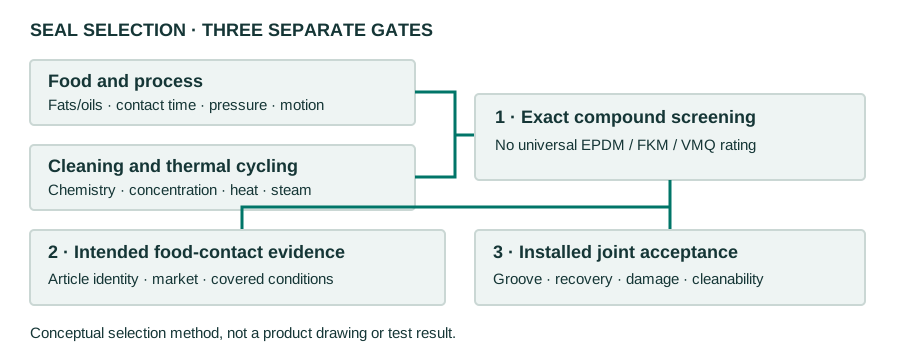
CIP means cleaning in place without routine dismantling of the relevant equipment; COP means cleaning out of place after removal or disassembly. External foam or spray cleaning is another exposure condition, not proof that internal circuits are clean. Specify which surfaces each procedure reaches, who removes parts, how they are reassembled and how unacceptable residue is detected. Use the seal-material and interface guidance when separating material compatibility from geometric cleanability.
What GMP compliant equipment does not mean
“GMP compliant equipment” is useful only when the specification states the applicable framework, intended process and evidence. A supplier can describe an equipment feature or provide test documentation; the manufacturer still has to assess installation and operating controls. A component certificate does not qualify an entire production line or demonstrate the effectiveness of the plant’s cleaning procedure.
EHEDG certification concerns an identified equipment design and scope; guideline use alone is not certification. A 3-A Symbol authorization likewise applies within a defined sanitary scope. IP ratings address ingress testing, not residue removal, material-contact suitability or cleaning validation. An immersion designation cannot be used as evidence that a bearing or electrical connector tolerates the proposed hot-pressure cleaning regime.
Sterilization is not a default requirement for all GMP equipment. Section 211.67 refers to sanitizing or sterilizing when appropriate for the nature of the drug. EU GMP Annex 1 addresses sterile medicinal-product manufacture; it must not be presented as mandatory for all food machinery or every nonsterile drug process. Ask the quality team to establish the actual contamination-control objective.
A six-step equipment acceptance method
- Define scope before selecting parts. Record product, jurisdiction, process boundaries, contact zones and the requirement owner. List open questions rather than selecting the strictest-looking badge and assuming it resolves them.
- Map interfaces on an installed drawing. Include support feet, guard brackets, bearings, cable glands and adjacent structures. Mark possible paths for lubricant, condensate, particles and cleaning residues to reach product.
- Agree service conditions. State product chemistry, cleaning agents and concentrations, exposure time, temperature, cleaning method and mechanical duty. Request supplier limits for the actual assembly; this guide assigns none.
- Define cleaning and maintenance evidence. Identify access, dismantling instructions, replacement parts and checkpoints. For pharmaceutical operations, connect written procedures and records to the equipment identity and intended use. Qualification and validation requirements should be determined under the applicable quality system.
- Check controls and records. Identify measurements that govern the process and their required checks. Section 211.68 addresses calibration, inspection or checks under a written program; food section 117.40 addresses accuracy, precision and maintenance of relevant instruments and controls. Do not invent a universal calibration interval.
- Close deficiencies before acceptance. Compare installed details with the agreed specification and record unresolved deviations. Define who can release the equipment for use, what changes require reassessment and where the current documents are kept.
Example: reviewing a guarded filling machine
Example — hypothetical assumptions, not an NHK installation or test. An OEM proposes a guarded filling machine with a stainless frame, polymer transfer guides and sealed bearings beneath the product path. External surfaces receive spray cleaning; internal product passages have a separate cleaning procedure. The quality team has not yet confirmed whether the destination process is food or finished-pharmaceutical manufacture.
First resolve that scope ambiguity. Then mark which guide surfaces contact product, whether fluid can drip from guards onto the filling path and whether bearing lubricant can escape toward it. Request the supplied polymer identity and contact evidence, seal compatibility and the bearing’s actual service limits. Check that removing the guard gives access to retained-residue locations and that reassembly does not create a new gap.
For a food application, assess construction and maintenance against the applicable food requirements. For a finished-pharmaceutical application, add the applicable Part 211 equipment controls and the site’s qualification/validation decisions. Neither assessment is completed by changing the RFQ heading to “GMP compliant.” A satisfactory design drawing remains only one element of documented acceptance.
Inspection points and documents to send with the enquiry
| Checkpoint | Look for | Action before acceptance |
|---|---|---|
| Installed access | Guard, frame or wall prevents required cleaning | Revise clearance/access or approved dismantling method |
| Contact evidence | Declaration identifies a different compound or use condition | Obtain evidence for supplied part and intended exposure |
| Contamination path | Lubricant outlet, loose fastener or trapped liquid above product | Resolve the path and document the installed arrangement |
| Cleaning procedure | Hidden interface is omitted from the procedure | Add an appropriate access and verification checkpoint |
| Instrument control | Required measurement has no defined maintenance/check program | Assign responsibility and acceptance requirements |
| Replacement/change | New seal or fitting lacks traceability to approved configuration | Assess the change before returning equipment to service |
Use the contamination-control and inspection checklist for the food-specific prevention layers. For supplier document requests, the buyer's guides provide the purchasing next step rather than treating an enquiry as technical approval.
Copy into the enquiry: “Equipment and destination market; applicable food or pharmaceutical framework; component drawing and contact zone; product and cleaning conditions; material/contact documents needed; certificate scope, if required; maintenance and inspection access; unresolved acceptance question; quantity and delivery country.” NHK’s stainless machinery-component category is a secondary browsing path. Category identity does not establish GMP conformity or pharmaceutical validation for a supplied part.
Send these details to NHK for a component-specific question. Direct contact is HMP@nhkgroup.eu and (+45) 2492 5030. Ask which part and supporting documents are available; no response time, approval outcome or blanket compliance guarantee is promised. The plant’s responsible quality team must evaluate the proposed component in the intended installation.