Avoiding contamination and following product recall is the work of finding why contamination happened, stopping it and preventing it from recurring – and in many incidents, part of the answer lies in a machine component. This guide covers the engineering side: which components to suspect, how to investigate them, how to correct and verify, and what to change in specifications so the same failure does not return. Material rules and declarations are covered in the guide to food contact materials for machine components.
For the contamination pathways themselves – microbial, physical, chemical and allergen – and how to select components to prevent them, see safeguarding against contamination and product recalls.
Why components matter in a recall
A recall is usually handled by quality and food safety teams: product hold, traceability, communication with authorities and customers. Equipment is often treated as a cleaning problem. But if a component has a crevice, an exposed thread or a degraded seal, more cleaning will not remove the cause; bacteria or allergen residue can survive in places detergent and water do not reach. Fixing the component is then the only durable corrective action.
The component loop after an incident
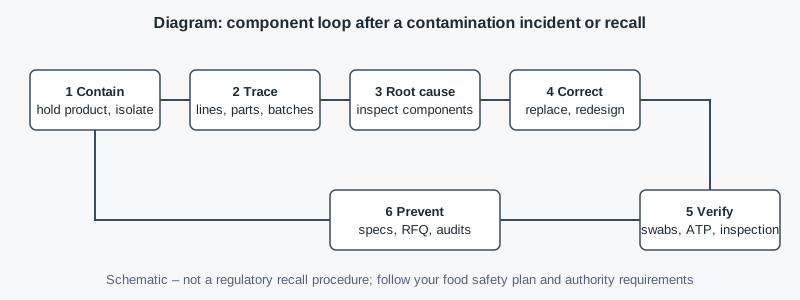
The loop above runs alongside the plant's own recall procedure and food safety plan, which always take priority.
Which components to suspect
| Contamination type | Typical component cause | What to look for |
|---|---|---|
| Microbial (e.g. Listeria) | Harbourage points: exposed threads, gaps under washers, open bearing housings, hollow frames | Residue, biofilm, positive swabs at the same spot |
| Allergen | Crevices and dead spaces that hold product through an allergen changeover | Visible residue after cleaning, positive allergen swabs |
| Physical (foreign body) | Loose fasteners, worn plastic guides, cracked seals, damaged castor wheels | Missing bolts or nuts, fragments, wear marks |
| Chemical | Incompatible lubricant or elastomer, corrosion products | Swollen seals, grease leaks, rust staining |
Terms used: a harbourage point is a place where residue and microorganisms survive cleaning; a crevice is a narrow gap that cleaning fluids cannot flush; a dead space is a pocket where liquid stands.
The biofilm diagnosis limits and interface-investigation guide helps distinguish a persistent niche from ongoing reintroduction.
How to investigate components
- Contain: hold affected product and take the line out of production according to the recall plan.
- Trace: identify lines, machines, production dates and batches; note which components were replaced or maintained recently.
- Map the product flow: mark the product-contact zone, the splash zone (wetted by spray but not product) and non-contact zones around the affected flow.
- Swab systematically, including hard-to-reach points, before and after dismantling.
- Dismantle and inspect feet, fasteners, bearings, seals, conveyor joints and frames; photograph findings.
- Check materials: elastomer type (EPDM, FKM, VMQ) against product fat, temperature and chemicals; stainless grade against chlorides – chloride pitting in AISI 304 suggests 316L may be needed.
- Record the root cause with evidence and decide on correction.
Corrective actions: clean more, repair or redesign?
| Finding | Cleaning change only | Repair/replace like for like | Redesign with hygienic component |
|---|---|---|---|
| Residue on a smooth, accessible surface | Usually sufficient | – | – |
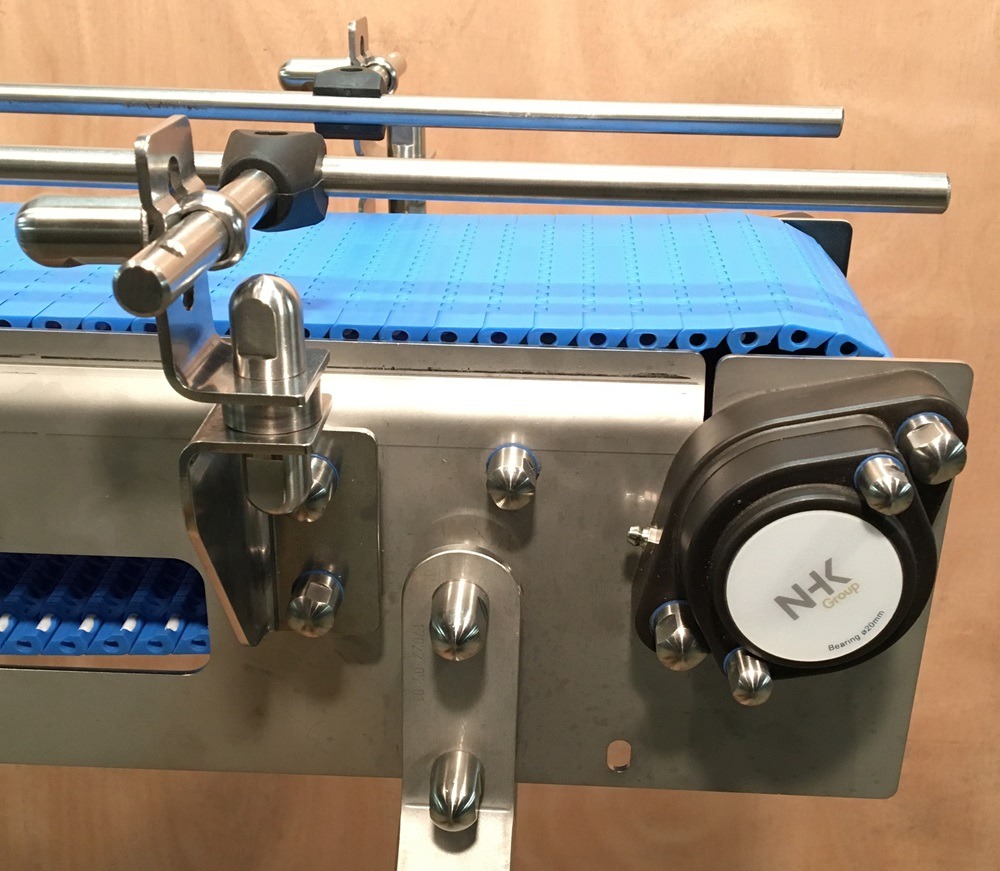
| Exposed thread on a levelling foot | Not durable | Not durable | Sealed hygienic foot |
| Socket-head bolt in splash zone | Not durable | Not durable | Hygienic bolt with seal |
| Swollen seal | Not durable | Only if material is right | Compatible elastomer |
| Open bearing housing with grease leak | Not durable | Temporary | Sealed stainless bearing unit |
| Loose fasteners | – | With locking method | Fewer, accessible fasteners |
It depends on whether the cause is the procedure or the geometry: if residue can be removed with correct cleaning, change the procedure; if the geometry holds residue, change the part.
Verifying the fix
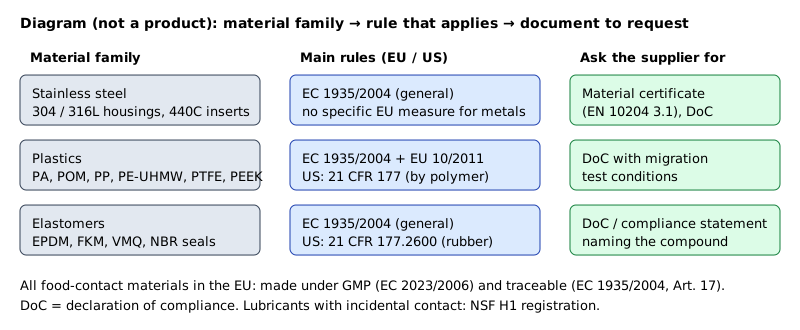
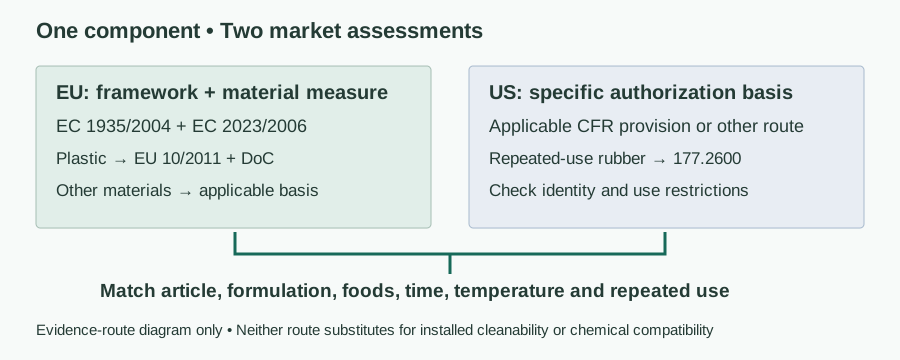
Before returning to normal production, verify with swabs and ATP tests at the original positive locations and nearby, over several cleaning cycles. Check that replacement parts have the documents you need: certificate for the named design where certified, material certificates, and a declaration of compliance for food-contact materials (EC 1935/2004; EU 10/2011 for plastics; FDA 21 CFR 177.2600 for rubber). EHEDG certifies specific designs and 3-A Symbol authorisation follows a Third Party Verification; both are voluntary and cover the named model only.
Example
Assumptions (illustrative only): repeated positive Listeria swabs near the infeed of a ready-meal packing line lead to a product hold.
- Investigation: residue found in the exposed threads of four levelling feet in the splash zone and behind socket-head bolts on a guard.
- Correction: sealed hygienic levelling feet and hygienic bolts installed; floor-level cleaning procedure updated.
- Verification: swabs at the same points over several cleaning cycles before release.
- Prevention: the plant's machine specification now requires sealed feet and hygienic fasteners in the splash zone.
Preventing recurrence in specifications and RFQs
- Require crevice-free, sealed designs for feet, fasteners and bearings in product-contact and splash zones.
- Ask for certificates by design name, material certificates and declarations of compliance.
- State cleaning method (CIP, foam, high-pressure washdown), chemicals and temperatures so materials and seals can be chosen.
- Add component checks to hygiene audits and maintenance plans.
See also durability in harsh and extreme environments for material and seal degradation. More from NHK: EHEDG certified components and 3-A SSI standard parts and hygienicmachineryparts.eu. Packaging machinery parts and processing equipment components are also covered by NHK Group (nhkpackagingmachinery.com).