Contamination is the presence of anything in a product that should not be there – microorganisms, foreign bodies, chemicals or undeclared allergens – and it is the most common reason food and pharmaceutical products are recalled. Recalls bring cost, brand damage and, in the worst case, harm to consumers. Much of the risk can be traced to machine components that are hard to clean, wear out or fail. This guide explains how components contribute to contamination, which designs reduce the risk, and how to inspect for it. Material rules and declarations are covered in the guide to food contact materials for machine components.
The same principles apply across food, dairy, beverage, bakery, confectionery, meat, fish and seafood, cosmetics, veterinary, chemical, medical and pharmaceutical production.
How machine components cause contamination
For equipment specifications, distinguish contact evidence from food and pharmaceutical equipment controls before relying on a supplier badge.
The food-scheme purchasing and change-control guide connects these component hazards to site certification and installed acceptance records.
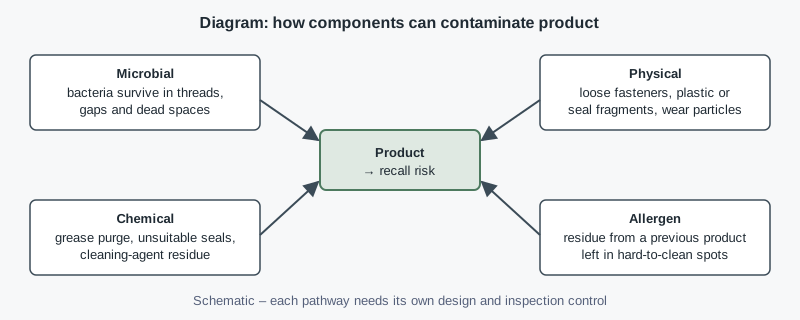
Poorly designed equipment can harbour bacteria and other contaminants. Components contribute through four pathways:
- Microbial – residue and water collect in harbourage points (places where microorganisms survive cleaning), such as exposed threads, gaps under housings or dead spaces where liquid stands. Bacteria such as Listeria can establish there and spread to product.
- Physical – loose fasteners, broken plastic or seal fragments and wear particles fall into product as foreign bodies.
- Chemical – grease purged from bearings, incompatible seal materials or residues of cleaning agents reach the product.
- Allergen – residue from a previous product remains in hard-to-clean spots and contaminates the next one, defeating allergen changeover (the cleaning between products with different allergens).
Component failure modes and controls
| Component | Failure mode | Contamination type | Hygienic design control |
|---|---|---|---|
| Levelling feet | Exposed thread, lock nut, flat base | Microbial, allergen | Sealed thread, self-draining base, base seal to floor |
| Bearing units | Open housing gap, seal failure, grease purge | Microbial, chemical | Sealed stainless units, gasket to frame, lubrication planned |
| Fasteners | Hex socket and thread crevices, loosening | Microbial, physical | Hygienic bolts with sealed heads, secured against loosening |
| Seals and gaskets | Swelling, cracking from chemicals or fats | Chemical, physical, microbial | Compatible elastomer (EPDM, FKM, VMQ), replacement interval |
| Plastic parts | Cracking, fragments | Physical | Robust material, coloured or detectable plastic where required |
| Enclosures and covers | Overlapping plates, hollow sections | Microbial | Continuous welds, sloped tops, removable covers |
Elastomer compatibility means the seal material resists the product, cleaning chemicals and temperature it meets: EPDM handles hot water and many cleaning agents but swells in fats and oils; FKM resists oils and many chemicals; VMQ (silicone) covers wide temperature ranges but has lower mechanical strength.
For replacement-part documentation, use the finished-article declaration and intended-use checks rather than relying on a food-grade label.
EHEDG certification
The European Hygienic Engineering & Design Group (EHEDG) publishes guidelines and certifies specific equipment designs used in food and pharmaceutical production. A certified design has been evaluated – and, depending on type, tested – to show it is easy to clean, with smooth surfaces, minimal joints and corrosion-resistant materials. EHEDG certification is widely recognised but voluntary, and it applies only to the certified model.
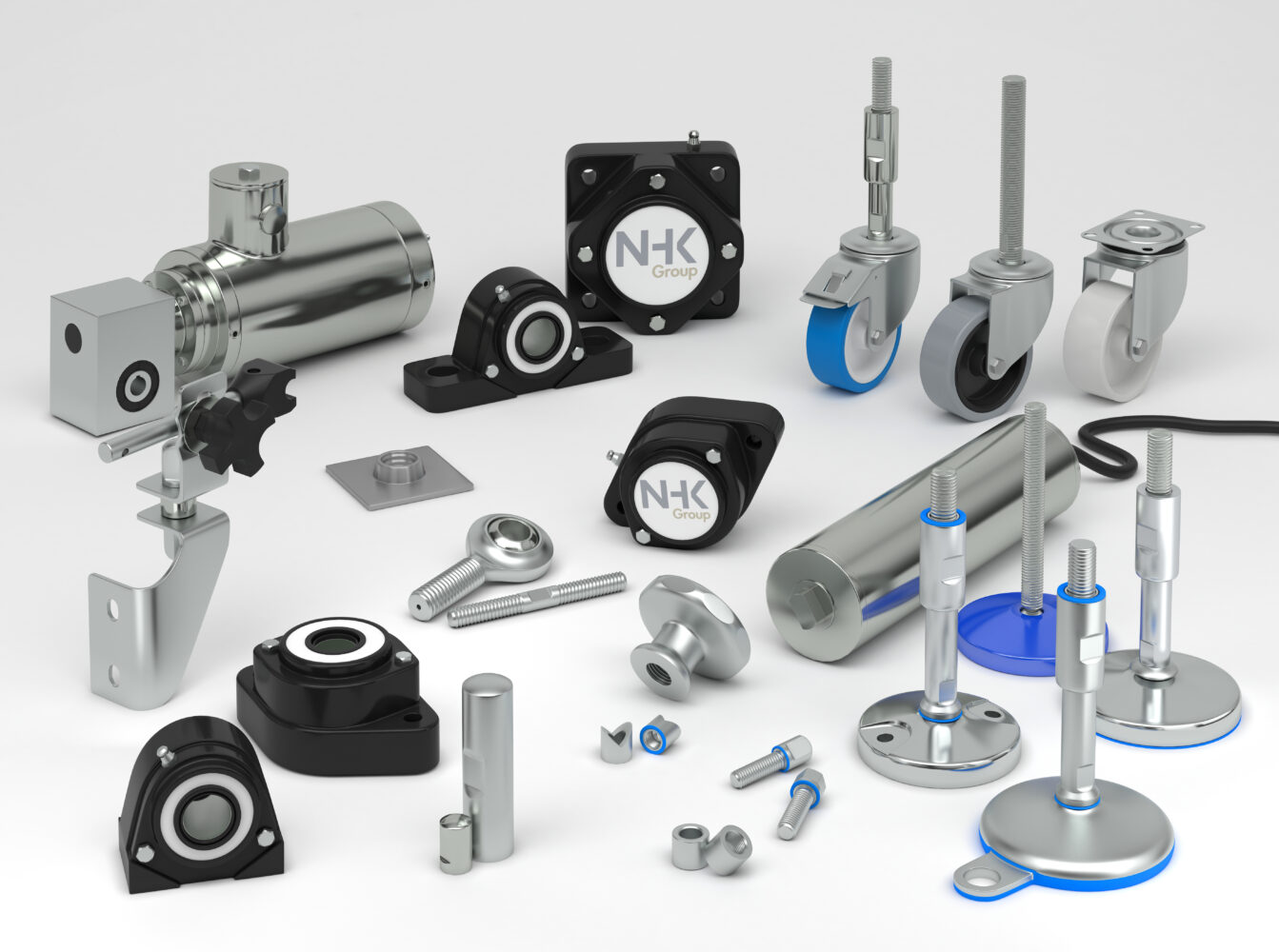
Hygienic adjustable leveling feet are a typical example: a sealed thread and smooth, sloped body prevent residue build-up while keeping the machine stable. NHK's SHAF adjustable feet in sealed hygienic design are an EHEDG-certified design.
3-A SSI authorisation
3-A Sanitary Standards, Inc. (3-A SSI) develops sanitary standards mainly for dairy, food and beverage equipment in the United States. A design conforming to a 3-A Sanitary Standard may carry the 3-A Symbol after a Third Party Verification. Sanitary enclosure parts designed to 3-A standards are robust yet easy to clean; a claim of 3-A authorisation should be supported by the authorisation for the specific part.
For the meaning of compliance claims versus certificates, see EHEDG and 3-A SSI certified components and parts.
Sealed bearing units in wet environments
Sealed bearing units keep water and other liquids out, which matters in meat and seafood processing. IP67 means dust-tight and protected against temporary immersion to a defined depth, which helps prevent ingress in wet areas. It does not test high-pressure, high-temperature washdown; that is IP69K under ISO 20653. Neither rating is a hygiene certificate – housing shape, seal design and gaps to the frame decide how cleanable the unit is. See sealed stainless bearing units.
Industry differences
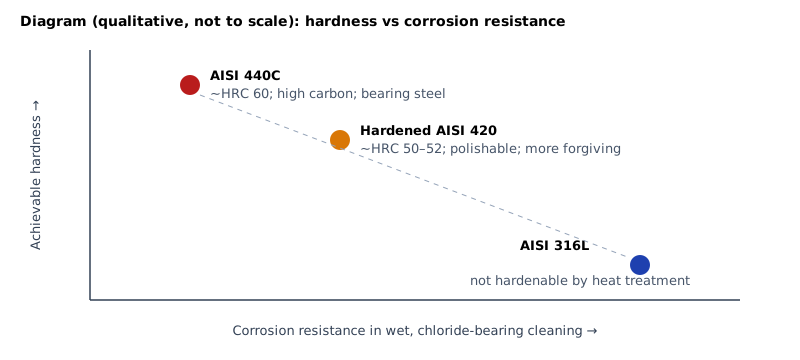
- Meat, poultry and seafood – daily wet cleaning with chlorinated agents; Listeria control in cold, wet areas; AISI 316L preferred where chlorides persist because it resists chloride pitting better than 304.
- Dairy – CIP (clean-in-place) of product lines; 3-A standards originated here.
- Bakery and confectionery – largely dry cleaning; allergen changeover and foreign-body control dominate.
- Pharmaceuticals – Good Manufacturing Practice (GMP), cleaning validation and documentation of every product-contact material.
Contamination prevention checklist for components
- Map zones – product-contact, splash zone (hit by spray but not product contact) and non-contact.
- Walk the line and list exposed threads, open housings, overlapping plates and hollow parts.
- Replace high-risk components with sealed, crevice-free designs; prefer certified designs in product-contact and splash zones.
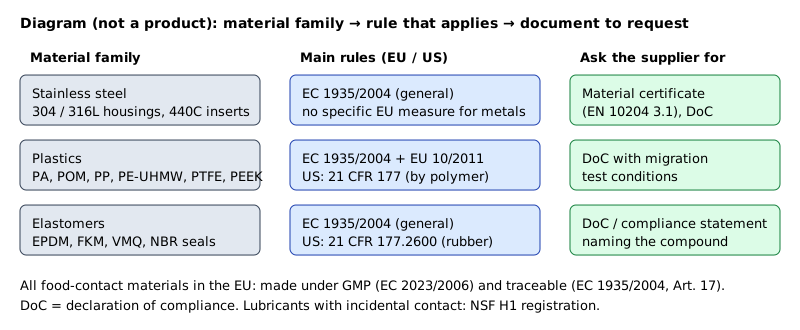
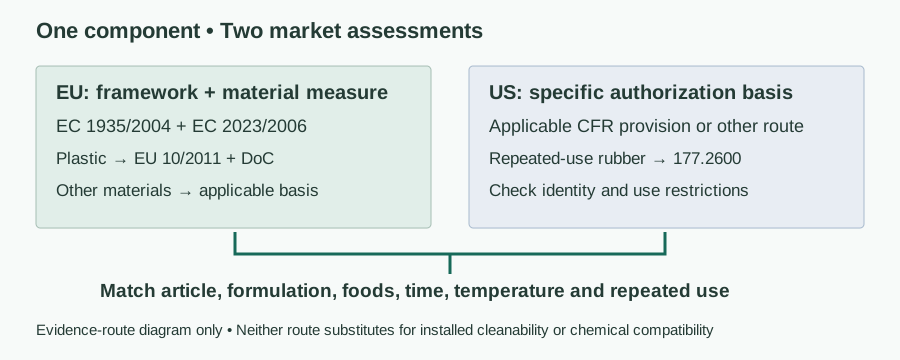
- Check materials – stainless grade, elastomers and plastics with declarations of compliance (EC 1935/2004; EU 10/2011 for plastics; FDA 21 CFR 177.2600 for rubber in the US).
- Secure fasteners and specify detectable or coloured plastics where foreign-body detection relies on them.
- Plan lubrication – sealed or lubricated-for-life bearings, food-grade lubricants where contact is possible.
- Verify cleaning with visual inspection, ATP (a rapid test for organic residue) or swabs after changes.
- Inspect routinely for seal damage, cracks, corrosion and loose parts; record findings.
Example
Assumptions (illustrative only): during an internal audit of a seafood packing line, swabs from under a conveyor return repeated positive results at the same points. Inspection finds threaded feet with lock nuts and open bearing housings with grease and water at the housing gap.
- Feet: replaced with sealed-thread levelling feet with self-draining bases in AISI 316L, re-levelled so frame surfaces drain.
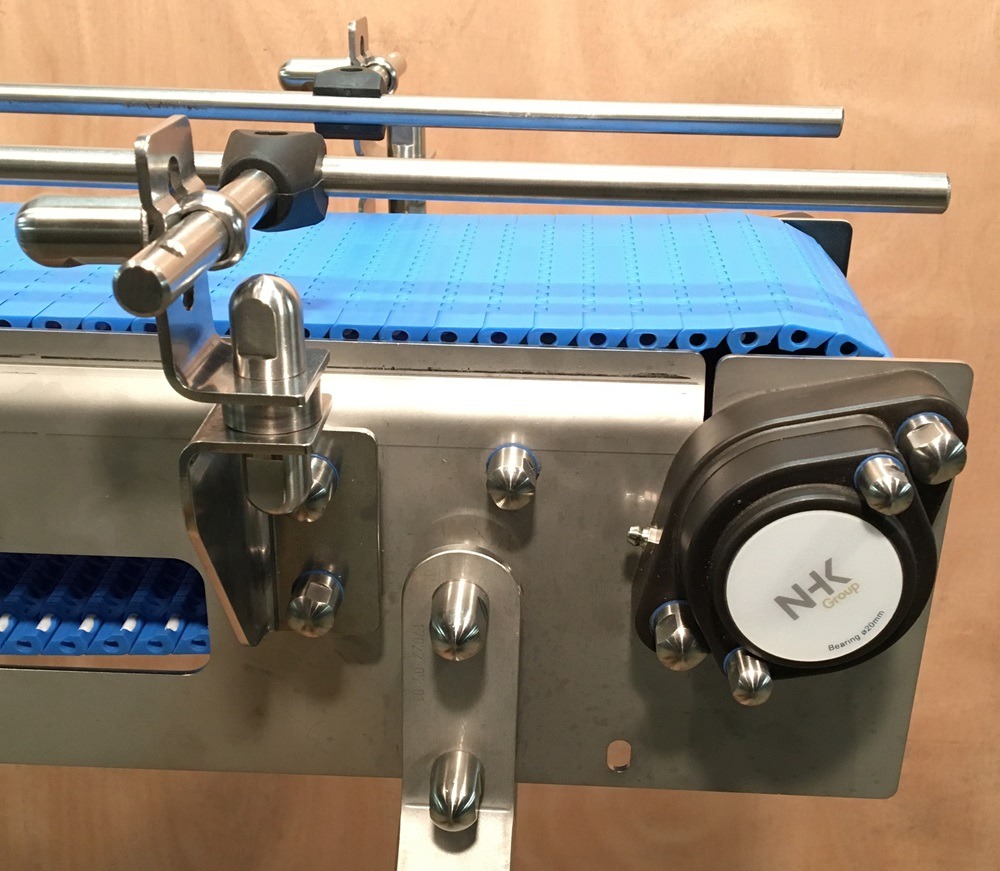
- Bearings: replaced with sealed stainless units fitted with a gasket to the frame.
- Fasteners near the product: changed to hygienic bolts.
- Verification: swabbing at the same points after cleaning over several weeks, with results recorded – the effect is confirmed by measurement, not assumed.
Benefits of hygienic and certified components
- Safety – lower risk of contamination and recalls.
- Compliance – easier evidence for audits and customer approvals; legal obligations such as EN 1672-2 and EC 1935/2004 still apply to the machine and its materials.
- Cost – less downtime and maintenance linked to cleaning and contamination control.
- Efficiency – components designed for easy cleaning shorten sanitation.
For the cleaner's view of where contamination hides, see challenges faced by cleaners in food production. NHK's article on the topic: avoiding contamination and preventing product recall.