Convincing clients of technical challenge value means showing each decision-maker how solving a technical problem – often by changing to certified or hygienic design components – reduces a risk or cost they own. The arguments are the same ones the old page listed: reliability, contamination control, durability, compliance, downtime, cleaning, cost and sustainability. What makes them work is matching each to the right person and backing it with evidence.
For the five-step framing of a single problem, see the value in technical challenges. For what certification covers in detail, see ensuring quality and reliability of certified components. This page focuses on which arguments hold up, with whom, and what evidence to bring.
Who needs to be convinced?
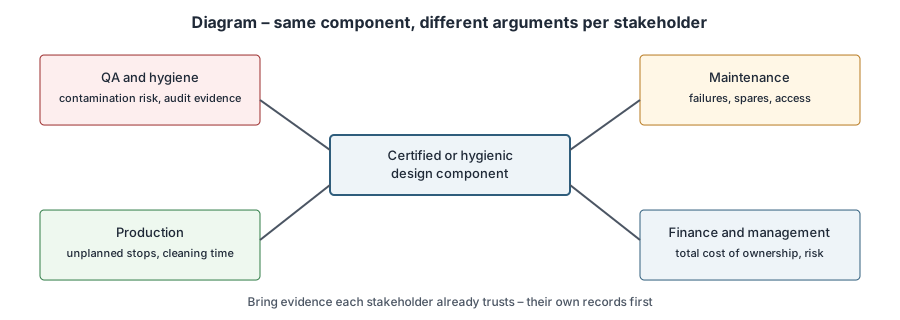
A component upgrade in a food or pharma plant usually needs agreement from four groups:
- QA and hygiene: owns contamination risk and audits.
- Maintenance: owns failures, spare parts and installation.
- Production: owns output, unplanned stops and cleaning windows.
- Finance and management: owns budget and overall risk.
An argument that is decisive for one group may be irrelevant to another. A cleanability argument convinces QA; a spare-parts argument convinces maintenance.
Which arguments hold up – and which to avoid?
| Argument | Who it convinces | Holds up when you can show | Avoid saying |
|---|---|---|---|
| Contamination control | QA, management | Specific harbourage points (places where microbes survive cleaning) removed, such as exposed threads or crevices; swab results | "Eliminates contamination" |
| Certification | QA, client's customers | The certificate for the exact model, its scope and validity | "Certified, so it complies with all standards" |
| Reliability | Maintenance, production | Failure history of the current part and the root cause the new part addresses | "Certified parts don't fail" |
| Durability in harsh environments | Maintenance | Material and seal matched to the chemicals – e.g. AISI 316L against chloride pitting, compatible elastomers (EPDM, FKM, VMQ) | "Withstands extreme conditions" |
| Ease of cleaning | Production, QA | Fewer crevices and dead spaces, self-draining surfaces, measured cleaning time | Unmeasured time savings |
| Reduced downtime | Production, finance | Stop logs linked to the current part | Promised percentages |
| Regulatory compliance | QA, management | Which requirement applies (e.g. EN 1672-2 hygienic design, EC 1935/2004 for food-contact materials) and how the part helps meet it | "Avoids all fines" |
| Long-term cost savings | Finance | Total cost of ownership with stated assumptions | ROI figures without data |
| Sustainability | Management | Measured water, detergent or energy use in cleaning; fewer replacements | "Eco-friendly materials" |
What does a certificate prove – and not prove?
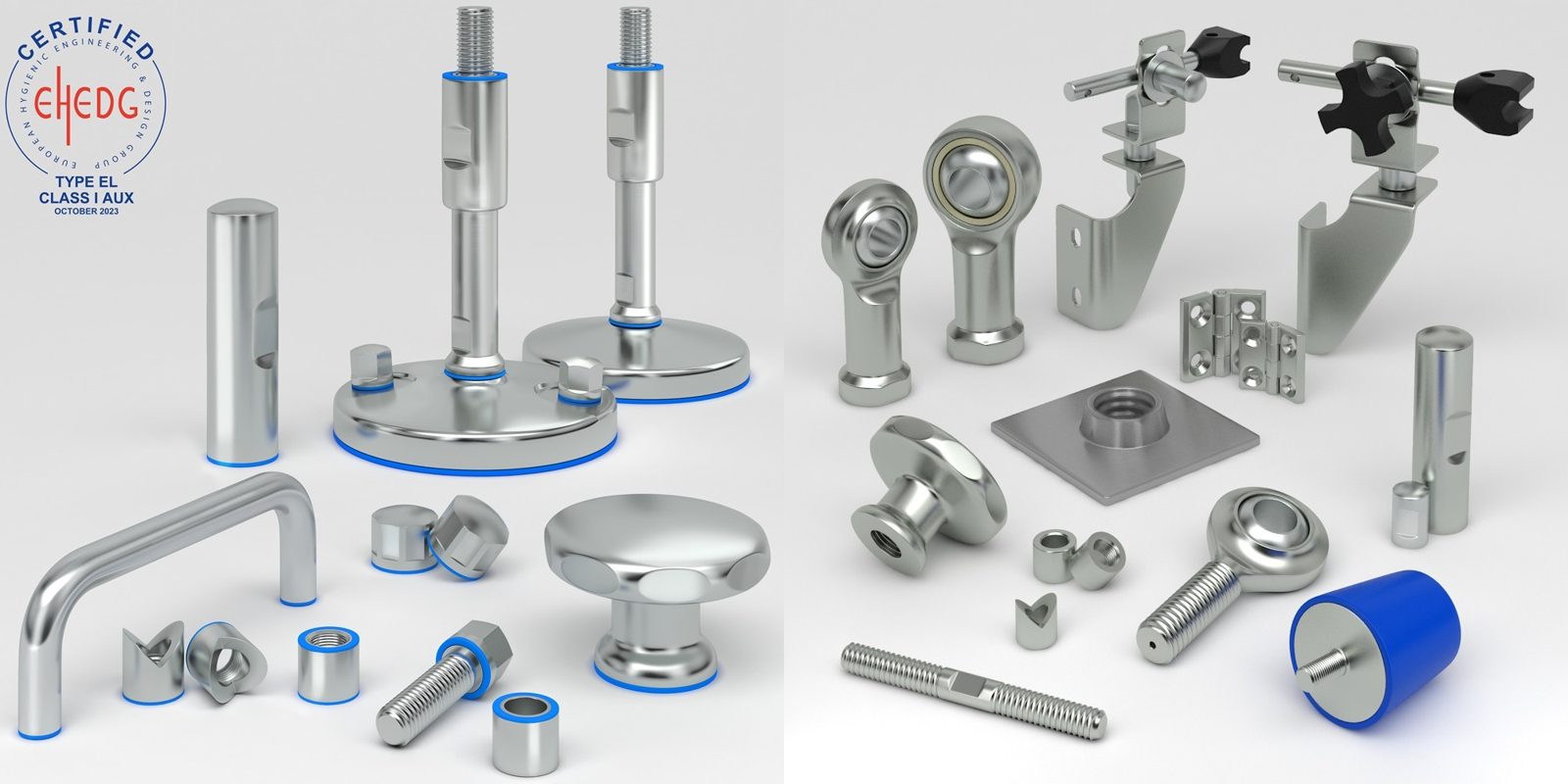
This is where most client arguments overreach. EHEDG certifies the cleanability of a specific equipment design; it does not certify companies, materials or reliability. 3-A Symbol authorisation follows a Third Party Verification of a design against a 3-A Sanitary Standard. Both are voluntary. IP ratings (IEC 60529; IP69K in ISO 20653) are ingress tests, not hygiene certificates, and IP67 is an immersion test, not a washdown rating.
So "certified" supports the cleanability argument strongly, supports the audit argument well, and says nothing on its own about load capacity, temperature range or life. Those need datasheets and application data.
What evidence should you bring?
- The client's own records – stop logs, maintenance orders, cleaning times, audit findings, swab results. This is the most persuasive evidence because nobody can dismiss it.
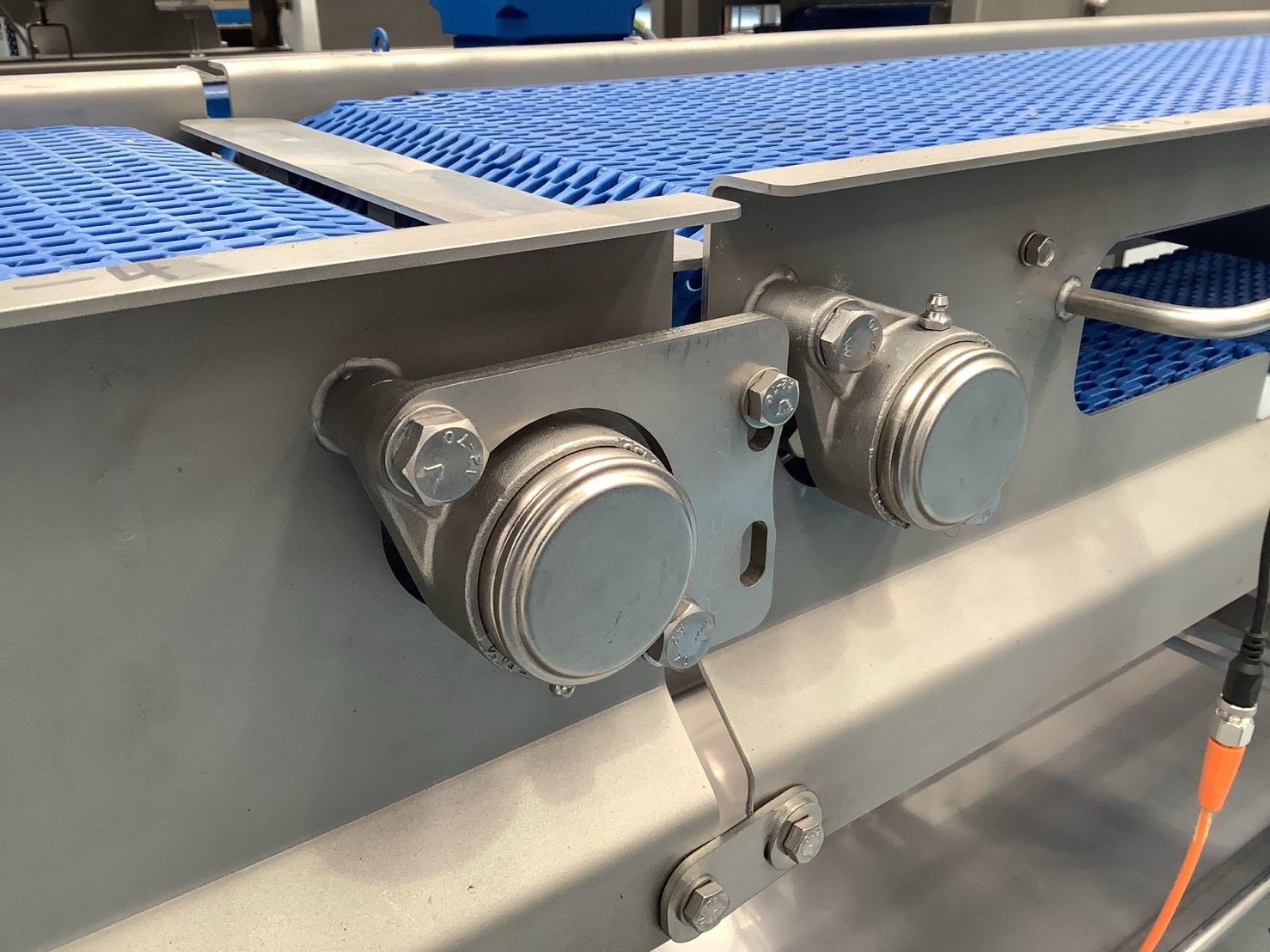
- Failed parts – a corroded foot thread or a bearing full of grease emulsion makes the problem visible.
- Certificates and datasheets for the proposed part, exact model.
- A total cost of ownership comparison – purchase, installation, cleaning, maintenance, spares, downtime – with assumptions written out.
- A pilot proposal – one machine, a defined success measure, a review date.
The old page suggested case studies and testimonials. They help only when they are verifiable and from a comparable application; otherwise the client's own data is stronger.
How to build a total cost of ownership comparison
Total cost of ownership (TCO) per component over a period = purchase price + installation + (cleaning time × labour rate) + maintenance and spares + (downtime caused × cost per hour of stop).
Example – assumptions stated, not real prices or data. A plant replaces painted levelling feet with exposed threads in a washdown area. Assumptions: the current feet are replaced every couple of years because of corrosion; cleaners spend extra minutes per shift on the threads; the hygienic replacement costs more per foot. Fill in the plant's own figures for each line. If extra cleaning time and replacements over the period exceed the price difference, the upgrade pays back; if not, the argument must rest on hygiene risk instead – and that is fine, as long as it is stated honestly.
For the full method and break-even calculation, see ensuring long-term cost savings.
Failure modes when convincing clients
- Overclaiming certification: the client's QA team knows what EHEDG covers; one overstatement costs credibility.
- Generic benefits lists: reliability, durability and sustainability without evidence read as a brochure.
- Ignoring the cheaper option: if a procedure change would solve the problem, say so; it builds trust for the next proposal.
- Wrong audience: a TCO table shown to QA, or a swab result shown to finance, misses.
- No pilot: asking for a full rollout before showing results makes approval harder.
Checklist before the client meeting
- Problem defined with what, where, when and how often
- Root cause identified (design, material, installation, use, load)
- Arguments mapped to each stakeholder
- Client records and failed parts collected
- Certificates for the exact proposed models
- TCO comparison with stated assumptions
- Pilot proposal with success measure
Where to start in the NHK range
For certified designs the relevant NHK line is EHEDG certified and 3-A SSI standard components; other components are in the full NHK product line. Check the certificate for each specific model on its product page, and send application questions to NHK contact.