Ensuring quality and reliability of components and parts means making sure that each part delivered to a machine meets its specification and keeps performing for its intended life. Certification is one important tool – an independent body checks a design against a standard – but it covers only part of the job. This guide explains how certification works, what it proves and what it does not, and the checks engineers and buyers add to make components reliable in hygienic food and pharmaceutical machinery.
For a comparison of what each type of certificate or document proves, see advantages of certified components and parts.
For how component quality shows up in hygiene verification results – visual checks, ATP and swabs – see high-quality components ensuring hygienic production.
Why certification matters
Certification means a component's design has been tested or assessed against an established standard by an independent organisation. It matters for four reasons:
- Quality assurance – the design has met defined criteria, verified by someone other than the manufacturer.
- Safety and compliance – it supports the machine builder's and plant's own compliance, for example with food hygiene requirements.
- Reliability under defined conditions – the design has been tested in specified conditions, which reduces uncertainty.
- Market trust – customers and auditors recognise the mark, and some markets or customers require it.
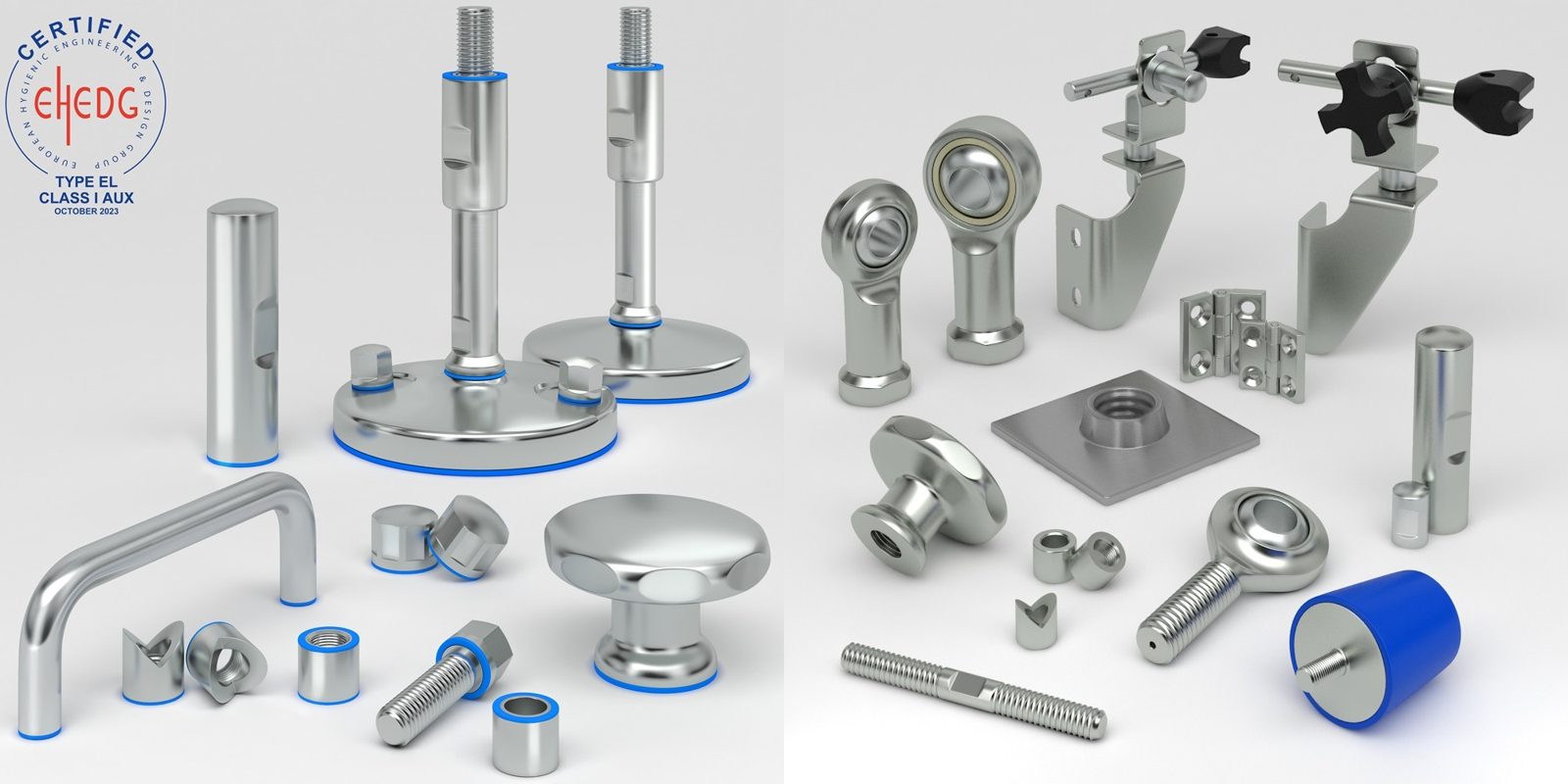
Certification is used in many sectors – automotive (ISO standards and AIAG requirements), aerospace (FAA and EASA), medical devices (IEC standards and FDA) – each with its own bodies and rules. In hygienic machinery, the main design certifications are EHEDG and 3-A.
How the certification process works
- Application and documentation review: the manufacturer submits drawings, materials and manufacturing information. Issues are identified before testing.
- Testing and evaluation: the design is tested or inspected. For EHEDG this includes assessment against hygienic design criteria and, for many equipment types, a cleanability test.
- Compliance verification: results are compared with the standard; deviations must be corrected before approval.
- Certificate issuance: the certifying body issues a certificate, often with a mark that may be used for the named product.
- Ongoing surveillance: certificates are time-limited or subject to periodic review, so compliance is re-evaluated over time.
EHEDG certifies specific equipment designs – not companies, factories or materials. The 3-A Symbol is authorised after a Third Party Verification against a 3-A Sanitary Standard. Both are voluntary.
What certification proves – and what it doesn't
| Question | Answered by design certification? | Where the answer comes from |
|---|---|---|
| Is this design cleanable to a defined standard? | Yes, for the named model | EHEDG certificate, 3-A authorisation |
| Is this exact delivered part made correctly? | No | Supplier quality system, batch records, incoming inspection |
| Are the materials food-contact compliant? | Not on its own | Declaration of compliance (EC 1935/2004; EU 10/2011 for plastics; FDA 21 CFR 177.2600 for rubber) |
| Which material grade was used in this batch? | No | Material certificate (e.g. EN 10204 3.1) |
| Will it last under my loads and chemicals? | No | Supplier data, correct selection, field experience |
| Is it installed so it stays hygienic? | No | Installation instructions, commissioning checks |
| Is it protected against water ingress? | No – that is a different test | IP rating (IEC 60529; IP69K in ISO 20653) |
The four layers of quality and reliability
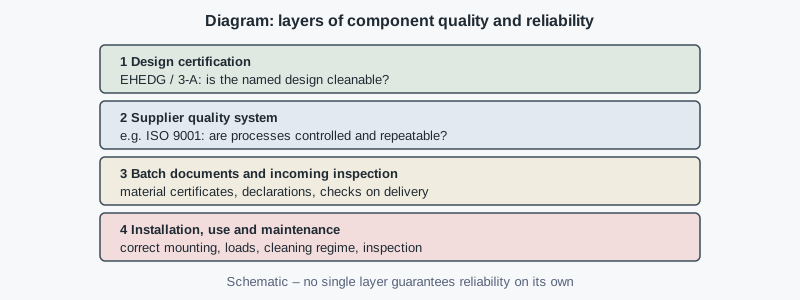
1. Design
Choose certified or verified designs where hygiene matters, and check the scope: the certificate must name the model and variant you are buying.
2. Supplier quality system
A controlled quality management system (for example ISO 9001) makes manufacturing repeatable: controlled drawings, material traceability, process checks and handling of non-conformities.
3. Batch documents and incoming inspection
Request batch-level documents and inspect on delivery. This catches wrong grades, damaged seals, poor surface finish or missing markings before the part is in the machine.
4. Installation, use and maintenance
Many field failures come from the wrong part for the conditions or incorrect installation: overloaded feet, misaligned bearings, wrong elastomer for the product, or galvanic corrosion (corrosion when two different metals touch in the presence of water). Follow installation instructions and inspect regularly.
Incoming inspection checklist
- Part number, model and variant match the order and the certificate.
- Markings and traceability (batch or heat number) are present.
- Material certificate and declaration of compliance are included and match the batch.
- No visible damage, scratches in product-contact surfaces, burrs or contamination.
- Seals are the specified material (EPDM, FKM or VMQ) and undamaged.
- Key dimensions (thread size, stem length, bore) are within tolerance, on a sample basis.
- Surface finish meets the requirement where specified; EHEDG guidance refers to Ra ≤ 0.8 µm for product-contact surfaces.
- Packaging protects the parts; stainless parts are kept away from carbon-steel contamination.
Example
Assumptions (illustrative only): a machine builder orders hygienic levelling feet and sealed bearing units for a dairy filling machine.
- Design: certificates checked on the issuer's list; model names match the order.
- Supplier: quality management system certificate on file.
- Delivery: material certificates match the heat numbers marked on the parts; one bearing unit's seal is damaged and is rejected.
- Installation: feet are loaded within the supplier's stated rating and bearings are aligned; first inspection is scheduled after a defined number of cleaning cycles.
Investing in certified components
Certified components are a sound basis for quality and reliability when combined with supplier checks, documents and correct use. For the hygienic design side, see secure sustainable development and growth for selecting component families by environment, and NHK's EHEDG certified and 3-A SSI standard components. For the practical ordering side – specification table, RFQ checklist and when a shop order is enough – see how to choose and order hygienic components.