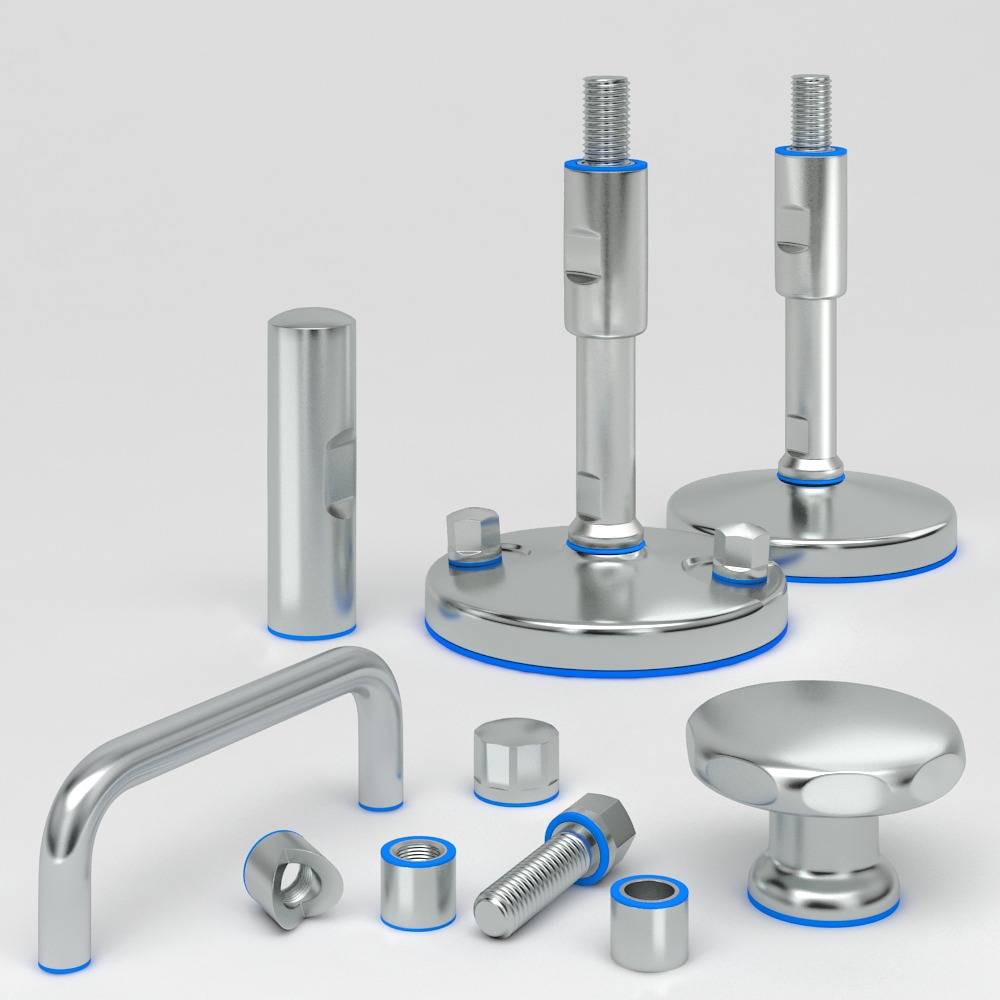
EHEDG-certificated components in meat processing are machine parts – hygienic handles, spacers, bolts, nuts and star knobs – whose specific design has been certified by EHEDG (the European Hygienic Engineering & Design Group) as cleanable, and which meat hygiene machinery manufacturers use to build slicers, grinders, conveyors, injectors and packaging lines that can be cleaned reliably. Meat processing is closely regulated, and equipment must support strict hygiene and safety requirements.
This page is written for the engineers who design such machines and the plant teams who maintain them. It covers why meat is demanding, where each hardware type belongs, and how to specify it. For the materials and seal side in more depth, see EHEDG-certified components in harsh environments.
Why meat processing is demanding for machine components
For poultry lines specifically, the choice between manual and automated stations is covered in manual labor vs automation in poultry processing.
- High-risk product: raw meat and poultry can carry pathogens such as Salmonella, Listeria and E. coli.
- Difficult soils: fat, protein and blood adhere to surfaces and form biofilms – layers of microorganisms protected by a slime matrix that resists cleaning.
- Intensive cleaning: daily foam cleaning with alkaline detergents, high-pressure rinsing and often chlorinated or acidic disinfectants.
- Salt and brine: in curing and injection, chlorides attack stainless steel.
- Cold, wet conditions: chilled rooms slow drying, so water stands longer in crevices.
Every harbourage point – a place where residue and microorganisms survive cleaning – is a risk of cross-contamination to the next batch. On meat machines, many of them are in small hardware: hex bolts on guards, exposed threads on adjusters, knobs with recesses.
What EHEDG certification means for meat machine components
EHEDG certifies specific designs after review against its hygienic design guidelines, typically including a cleanability test. A certified handle or bolt has been shown to be cleanable: smooth surfaces, rounded edges, no crevices or exposed thread, sealed joints.
What it does not do:
- It does not certify a material for every chemical, or a manufacturer's whole range.
- It is voluntary and does not by itself make a machine compliant. HACCP is the plant's food safety management system and ISO 22000 a management-system standard – neither certifies equipment. In the EU, machinery law and standards such as EN 1672-2 set hygiene requirements for food machinery, and food-contact materials must comply with EC 1935/2004; in the US, FDA rules apply.
Where each component belongs on a meat machine
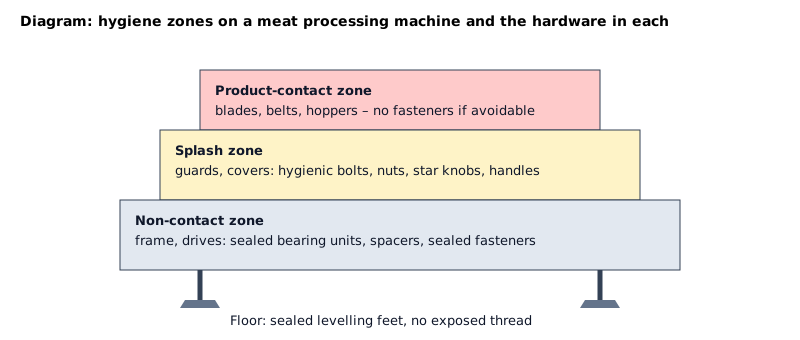
Hygienic design distinguishes three zones:
- Product-contact zone: surfaces the meat touches. Avoid fasteners here wherever possible; where unavoidable, use fully sealed, certified designs.
- Splash zone: surfaces where meat, juice or cleaning water can splash and drip back onto the product – guards, covers, hoppers' outer faces. Most hygienic hardware belongs here.
- Non-contact zone: frames and drives away from the product. Still cleaned daily in meat plants, so still needs to drain and resist chemicals.
| Component | Typical use on meat machines | Zone | Hygienic design features |
|---|---|---|---|
| Hygienic handles | Guards, access doors, removable parts | Splash | Smooth, no crevices, sealed mounting |
| Hygienic spacers | Gaps between frame parts, stand-offs | Splash / non-contact | Rounded edges, polished, sealed ends |
| Hygienic bolts | Guards, covers, frame joints | Splash / non-contact | Rounded head without recess, sealing washer |
| Hygienic nuts | Closing bolt ends, studs | Splash / non-contact | Domed, thread fully enclosed, sealed |
| Star knobs | Tool-free adjustment and clamping | Splash | Smooth, sealed threaded insert |
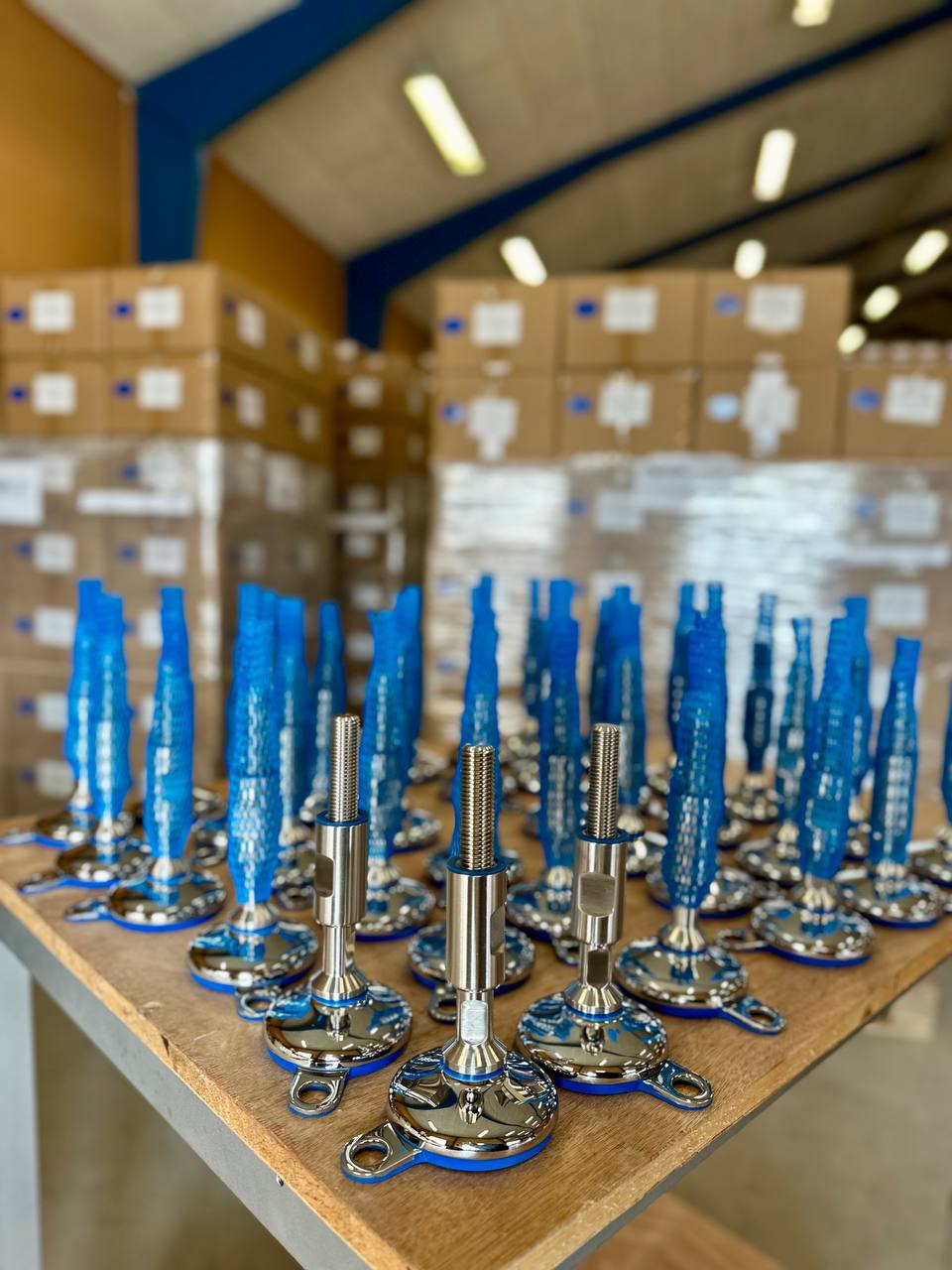
| Levelling feet | Machine support at floor | Floor zone | Sealed spindle, no exposed thread |
Hygienic handles
Handles on guards and access doors are touched by gloved hands and soiled with product. Hygienic versions have smooth surfaces, generous radii and sealed mounting points, and are made of corrosion-resistant stainless steel.
Hygienic spacers
Spacers keep defined distances between machine parts – for example, a stand-off that creates a cleanable gap between a cover and the frame instead of a metal-to-metal crevice. EHEDG-certified spacers have rounded edges and polished surfaces for cleaning in hard-to-reach areas.
Hygienic bolts and nuts
Bolts and nuts are exposed to every cleaning cycle. Hygienic versions use an elastomer sealing washer under a rounded head and domed nuts that enclose the thread, so water and residue cannot enter. See the hygienic bolts M5 to M30.
Hygienic star knobs
Star knobs allow tool-free adjustment and clamping – useful where parts are removed for cleaning. Hygienic versions have smooth, ergonomic surfaces and a sealed threaded insert.
Materials and seals for meat processing
- AISI 304 suits many meat applications with standard alkaline cleaning.
- AISI 316L is the safer choice where salt, brine or chlorinated disinfectants are used, because its molybdenum content improves resistance to chloride pitting (local corrosion caused by chlorides). Rinse after disinfection so chlorides do not dry on surfaces.
- Surface finish: smooth, polished surfaces release fat and protein more easily. EHEDG guidance gives Ra (average surface roughness) ≤ 0.8 µm for product-contact surfaces.
- Seals: elastomer compatibility decides seal life. FKM resists fats and oils; EPDM suits hot water and alkaline cleaners but swells in fats; VMQ (silicone) handles wide temperatures but is mechanically weak.
- Documents: ask for a declaration of compliance for every food-contact material.
Cleaning conditions to design for
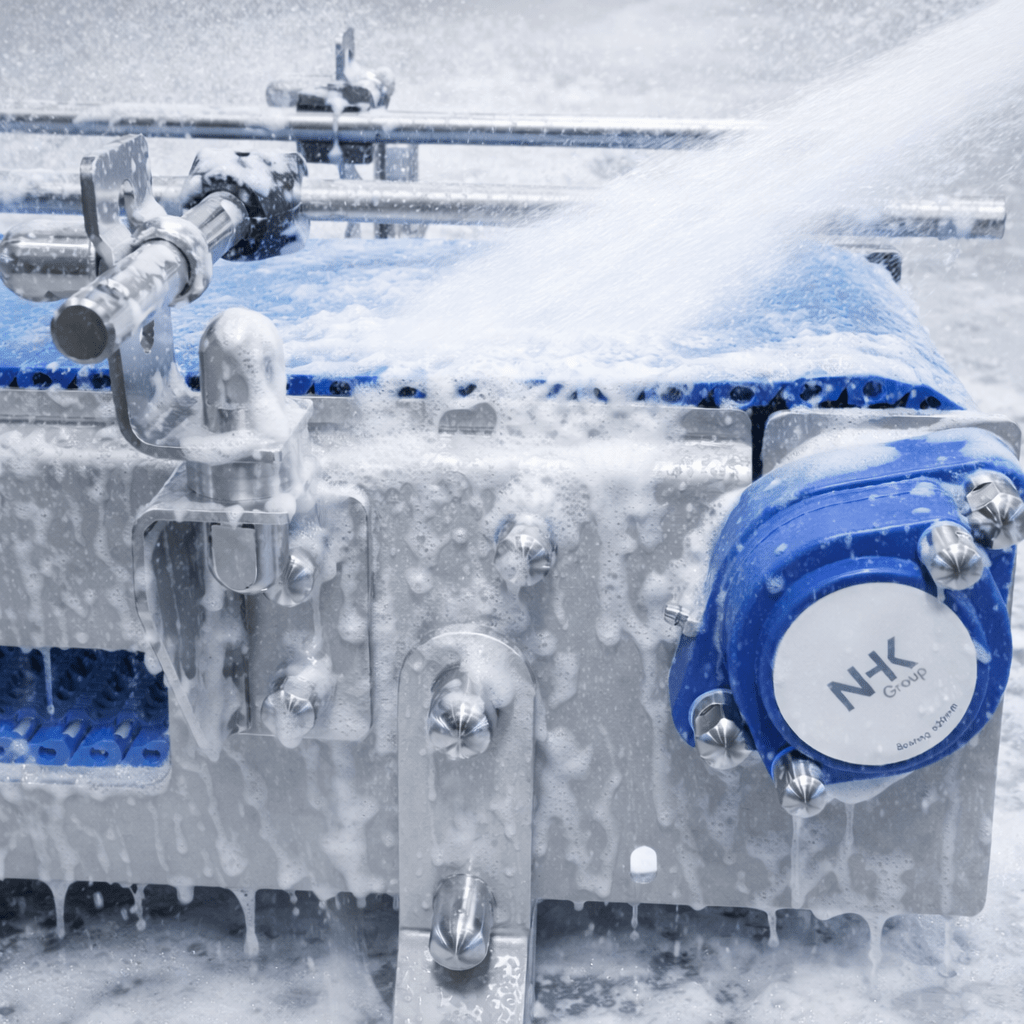
Meat plants mostly clean open equipment with foam and high-pressure rinsing rather than CIP (cleaning in place). This affects component choice:
- High-pressure jets force water into any gap; sealed joints must stay compressed.
- Ingress ratings: IP69K (ISO 20653, also written IP69) tests high-pressure, high-temperature water jets and is relevant for meat-plant washdown; IP67 (IEC 60529) is an immersion test and not a washdown rating. Neither is a hygiene certification. Background: IP67 vs IP69K.
- Allergen and species changeover: cleaning between products – for example, from a seasoned product to a plain one – requires that no residue remains in hardware.
How to specify hygienic hardware for a meat machine
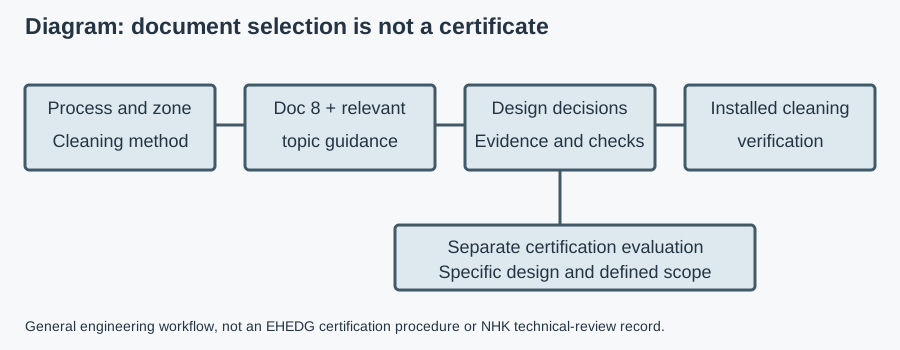
- Map the zones on the machine drawing: product-contact, splash, non-contact, floor.
- Minimise fasteners in the product-contact zone; move them outside or use welded or removable designs.
- List cleaning chemicals and temperatures from the target plant.
- Choose the grade: AISI 316L where salt, brine or chlorine is present.
- Choose the seal elastomer for fat contact and cleaning chemicals.
- Specify the parts by type and size, with EHEDG certificate numbers where certified designs are required.
- Request documents: certificates, material certificates, declarations of compliance, tightening torques.
Example: guard fasteners on a meat slicer
Assumptions (illustrative): a slicer guard held by six M6 socket-head screws; daily alkaline foam, high-pressure rinse and chlorinated disinfectant; fat residue found in the screw recesses at hygiene checks.
- Zone: splash zone above the product.
- Change: hygienic bolts with rounded heads and sealing washers in AISI 316L; FKM seals for fat contact, after checking compatibility with the alkaline cleaner.
- Alternative: star knobs for tool-free guard removal, so the area behind the guard is cleaned daily.
- Verification: swab tests at the former screw positions after the change; seal inspection at each planned maintenance stop.
Installation, inspection and maintenance
- Install sealed fasteners to the supplier's specified torque – over-tightening extrudes the seal, under-tightening leaves a gap.
- Inspect seals for swelling, cracking or extrusion and surfaces for pitting at defined intervals.
- Keep hygienic spares at the line so standard bolts are not fitted by mistake after maintenance.
- Record findings to spot repeating failures.
Developments in meat machine hygiene
Condition-monitoring sensors, designs that clean with less water and chemical, and new composite materials are being developed. Assess each on evidence for meat-plant conditions – see innovations in hygienic design.