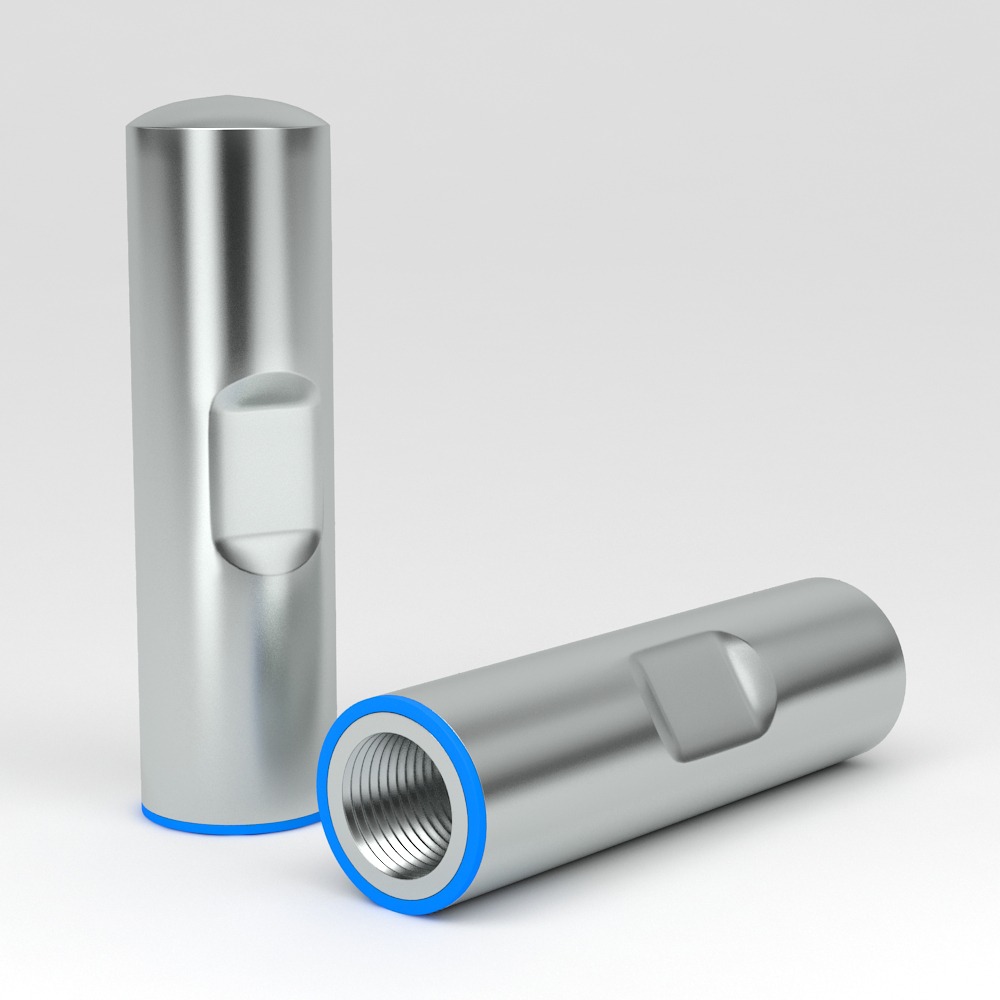
EHEDG-certified components are machine parts whose specific design has been certified by EHEDG (the European Hygienic Engineering & Design Group) as cleanable – and in harsh environments they must also withstand aggressive cleaning chemicals, chlorides, heat and high-pressure water. Food processing, pharmaceutical, biotechnology, chemical and cosmetics production all combine strict hygiene with these conditions.
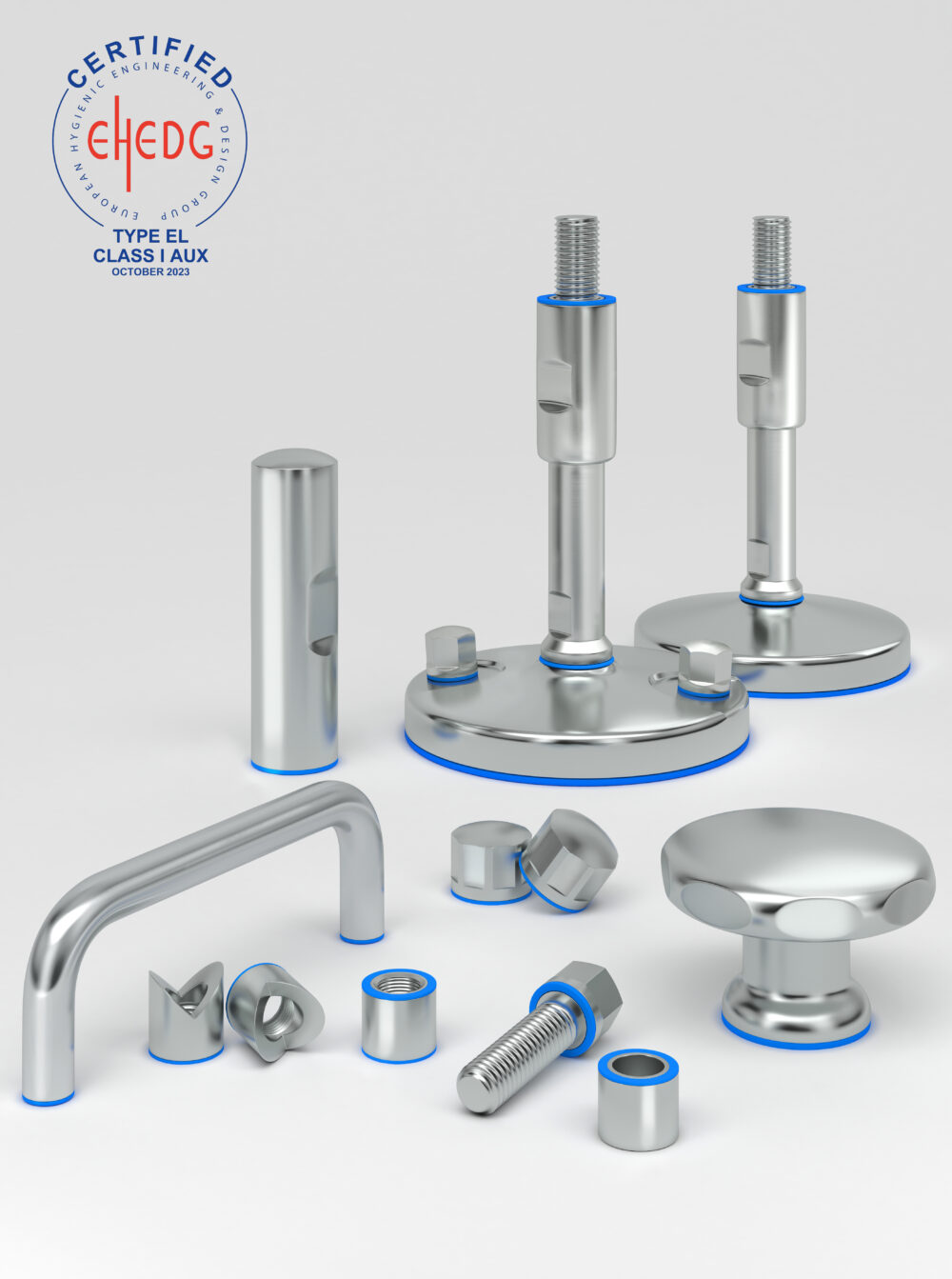
Typical examples are hygienic spindle top covers, nuts, bolts, corner nuts, star knobs and spacer nuts. This page explains what "harsh" does to such hardware and how to choose materials and seals so a certified design stays hygienic in service. For the basic hygienic design of fasteners and small hardware, see safe food production with EHEDG components and parts.
For the foot-specific interface, use the spindle closure selection and compatibility checks before choosing a retrofit cover.
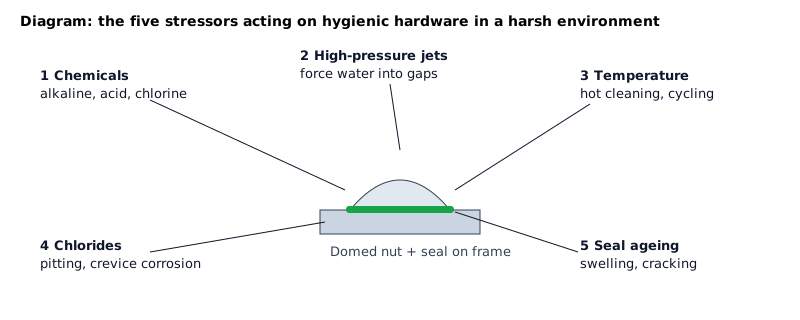
What makes an environment "harsh" for hygienic components
| Stressor | Where it occurs | Effect on components |
|---|---|---|
| Alkaline and acid cleaning agents | Daily foam cleaning, CIP | Attack on elastomers, aluminium and some plastics |
| Chlorinated disinfectants and salt | Meat, fish, dairy, brine processes | Chloride pitting and crevice corrosion on stainless steel |
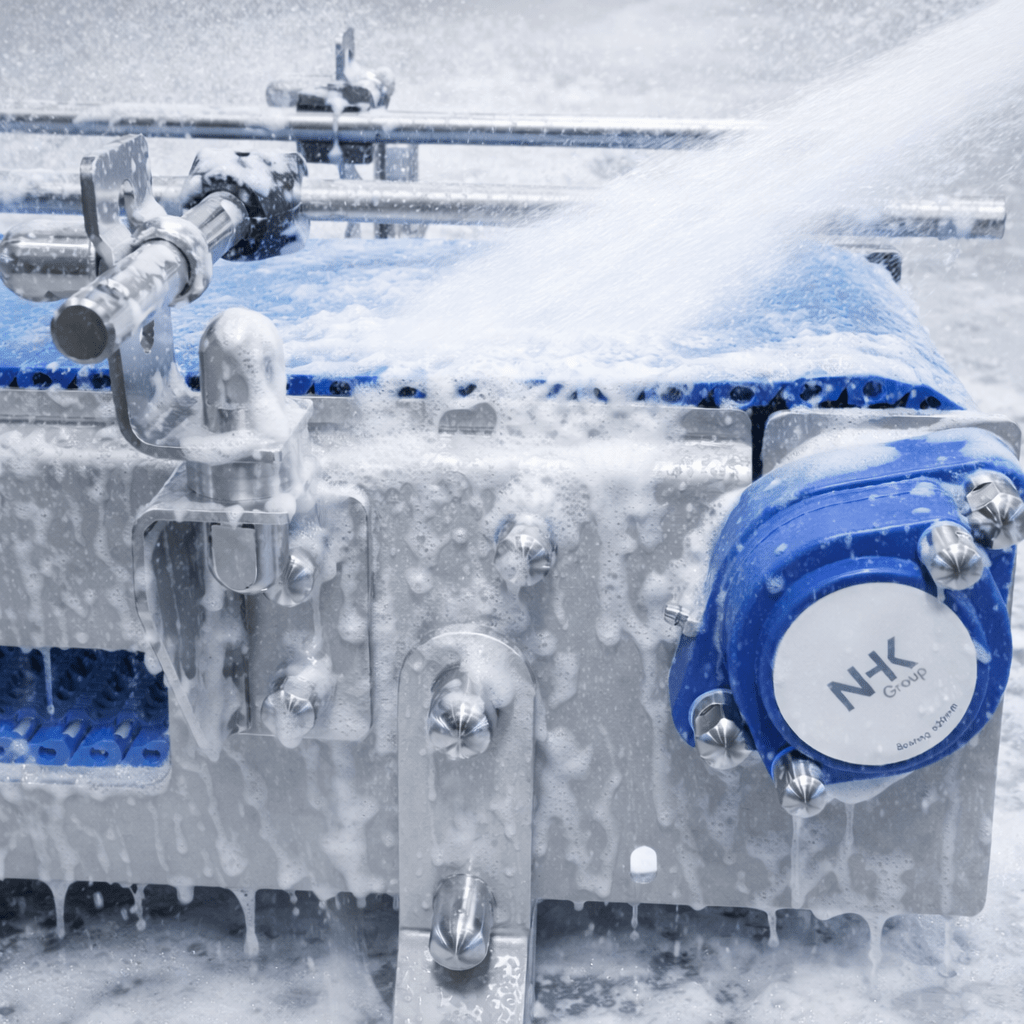
| High-pressure water jets | Open-equipment washdown | Water forced into gaps, seals, threads and bearings |
| Heat and thermal cycling | Hot cleaning, steam, ovens, freezers | Seal hardening or softening, loss of seal compression |
| Mechanical wear and impact | Handling, adjustments, tools | Damaged surfaces and seals that then trap soil |
CIP (cleaning in place) circulates cleaning solutions through closed equipment without dismantling it; open equipment is usually cleaned by foam and high-pressure rinsing.
What EHEDG certification covers – and what it does not
EHEDG certifies a specific design after review against its hygienic design guidelines. A certified nut, bolt or spindle cover has been shown to be cleanable: no crevices, no exposed thread, rounded edges and self-draining shapes. Certification is voluntary.
It does not:
- Certify a material for every chemical or temperature.
- Cover a whole product range or a company.
- Replace legal requirements – in the EU, food-contact materials must comply with EC 1935/2004 (and EU 10/2011 for plastics); in the US, FDA rules apply, such as 21 CFR 177.2600 for rubber.
In harsh environments, the question is therefore twofold: is the design certified, and are the material and seal suited to the conditions? Background: EHEDG components and parts.
Material selection for harsh conditions
Hygienic hardware is commonly made from AISI 316L stainless steel. It offers:
- Corrosion resistance against most alkaline and acidic cleaning agents.
- Better resistance to chloride pitting (local corrosion caused by chlorides) than AISI 304, thanks to its molybdenum content.
- Good mechanical strength and durability.
- Smooth, non-porous surfaces that can be polished to a low roughness.
Limits to know:
- Dried chlorides: chloride disinfectants that dry on a surface or concentrate in a gap can pit 316L too. Rinse after disinfection.
- Crevice corrosion: stainless steel corrodes faster in tight gaps where oxygen is depleted – another reason for crevice-free design.
- Galvanic corrosion: contact between dissimilar metals in a wet environment makes the less noble metal corrode; avoid mixing stainless with carbon steel or aluminium.
Surface finish
Polished and electropolished surfaces are easier to clean and resist corrosion better. Surface roughness Ra is the average deviation of a surface profile from its mean line; EHEDG guidance gives Ra ≤ 0.8 µm for product-contact surfaces. Passivation – chemical treatment that restores the chromium oxide layer – is advisable after machining, welding or mechanical damage.
Seal elastomers
In harsh environments the seal usually fails before the steel. Elastomer compatibility decides seal life:
| Elastomer | Strengths | Weaknesses | Typical harsh-environment use |
|---|---|---|---|
| EPDM | Hot water, steam, most alkaline and acid cleaners | Swells in fats and oils | Dairy, beverage, general washdown |
| FKM | Oils, fats, many chemicals, higher temperatures | Less suited to steam and some alkaline cleaners | Meat, oily products, chemical contact |
| VMQ (silicone) | Wide temperature range | Low tear strength, poor abrasion resistance | Hot or cold zones with little mechanical load |
Ask for a declaration of compliance for each food-contact elastomer.
Applications by sector
Food processing
Meat, poultry, fish and dairy plants combine fat, salt or brine with daily foam and high-pressure cleaning. For the meat-specific design view, see EHEDG-certificated components in meat processing. Hygienic spindle top covers, nuts, bolts and spacer nuts keep threads closed and protect frame joints from soil and water. A spindle top cover caps the threaded end of a levelling foot spindle where it passes through the frame, removing an exposed thread.
Pharmaceutical and biotechnology
Equipment is cleaned and often sanitised with validated procedures. Corner nuts and star knobs designed without cavities and crevices support cleaning validation; documentation and material traceability matter as much as the part.
Chemical and cosmetics processing
Aggressive chemicals and high temperatures can degrade standard components. Stainless bolts, nuts and spacer nuts with compatible seals hold their function where zinc-plated steel or unsuitable elastomers would fail. Check chemical compatibility for the specific substances.
Design features that matter in harsh conditions
- Rounded edges and domed shapes: no flat tops or sharp edges where soil collects; water runs off.
- Self-draining geometry: no pockets where liquid stands and concentrates chlorides.
- Sealed joints: an elastomer seal between part and frame closes the gap; correct compression keeps it closed under pressure jets.
- No exposed thread: covers and domed nuts enclose threads completely.
- Hygienic spindle covers: cap levelling-foot spindles at the frame – see the example of a hygienic spindle top cover.
How to specify components for harsh environments
- List the chemicals: product, cleaning agents, disinfectants, concentrations.
- Define temperatures: process, cleaning and any thermal cycling.
- Define the cleaning method: foam, high-pressure washdown, CIP, steam.
- Choose the steel grade: AISI 316L where chlorides, salt or acids are present.
- Choose the seal elastomer from the compatibility table, confirmed by supplier data.
- Check the design certificate: EHEDG certificate (and 3-A authorisation if required) for the exact part.
- Request documents: material certificate, declarations of compliance for food-contact materials, installation torque.
Example: frame fasteners on a brine-injection line
Assumptions (illustrative): a meat brine injector; salt brine splashes the frame; daily alkaline foam cleaning followed by chlorinated disinfectant; standard stainless hex bolts show pitting and residue at the heads.
- Stressors: chlorides from brine and disinfectant, alkaline cleaner, high-pressure rinse, fats.
- Choice: hygienic bolts and domed nuts in AISI 316L with sealed joints; FKM seals because of fat contact, after confirming compatibility with the alkaline cleaner (otherwise EPDM with closer inspection).
- Procedure change: final rinse after disinfection so chlorides do not dry on surfaces.
- Inspection: seals and surfaces checked at each planned maintenance stop; pitting or seal swelling recorded.
Inspection and failure modes
| Failure mode | Cause | Prevention |
|---|---|---|
| Seal swelling | Elastomer incompatible with fats or chemicals | Choose elastomer for the chemicals; check data |
| Seal cracking or hardening | Heat, ozone, ageing | Temperature-suited elastomer; replace at intervals |
| Seal extrusion | Over-tightening | Install to specified torque |
| Pitting or rust staining | Chlorides, wrong grade, dried disinfectant | AISI 316L, rinse after disinfection |
| Residue at joints | Damaged or missing seal | Replace seals; keep hygienic spares at the line |
Developments to watch
Work continues on improved sealing technologies, surfaces that reduce bacterial adhesion and monitoring of cleaning. Evaluate any such feature on evidence for your conditions – see innovations in hygienic design.
For why components wear out in these conditions and how to specify for service life, see durability in harsh and extreme environments.