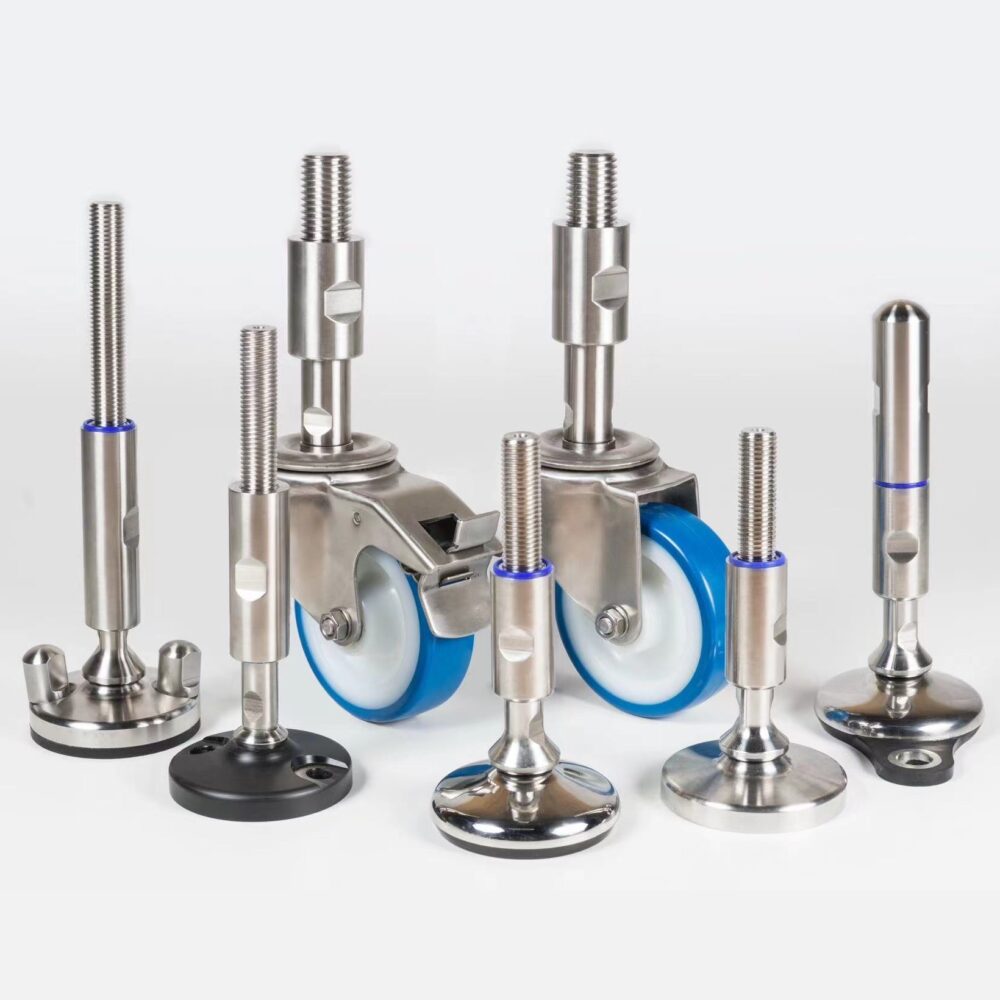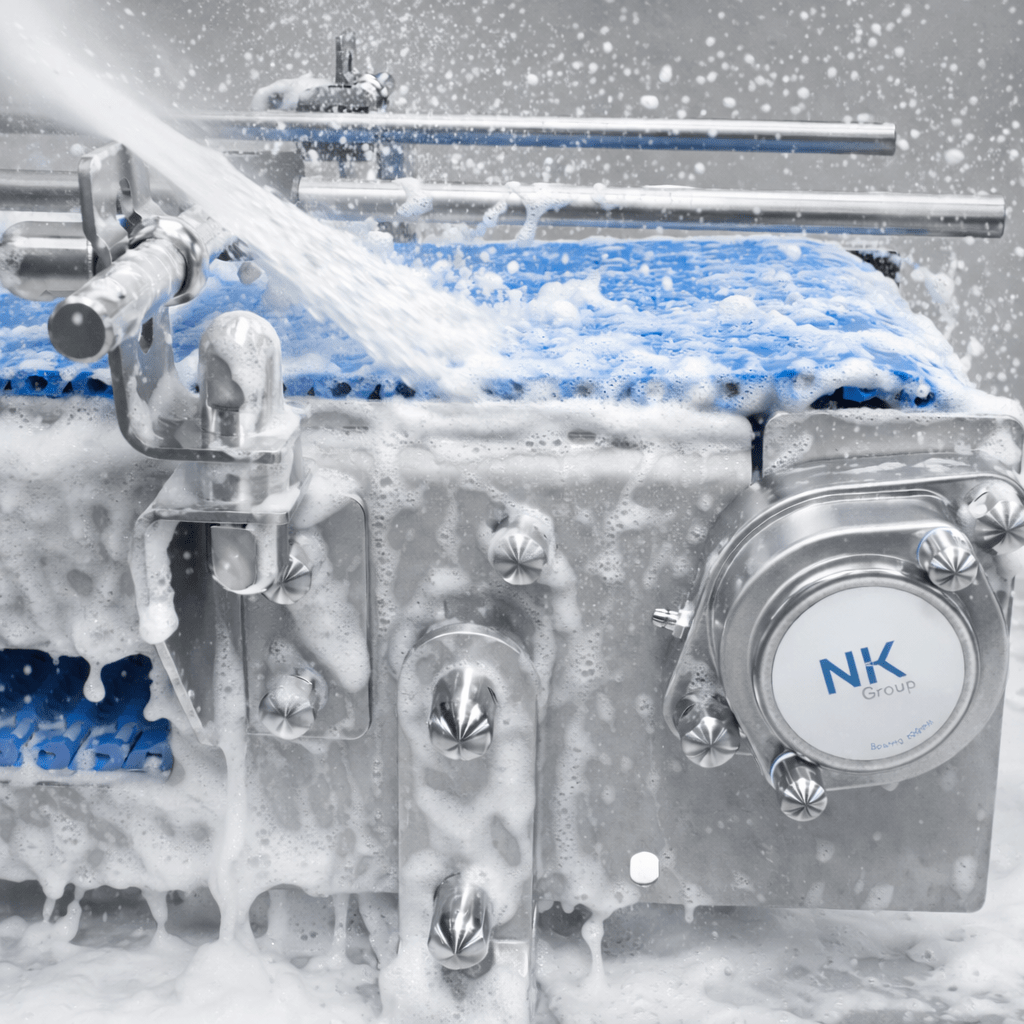
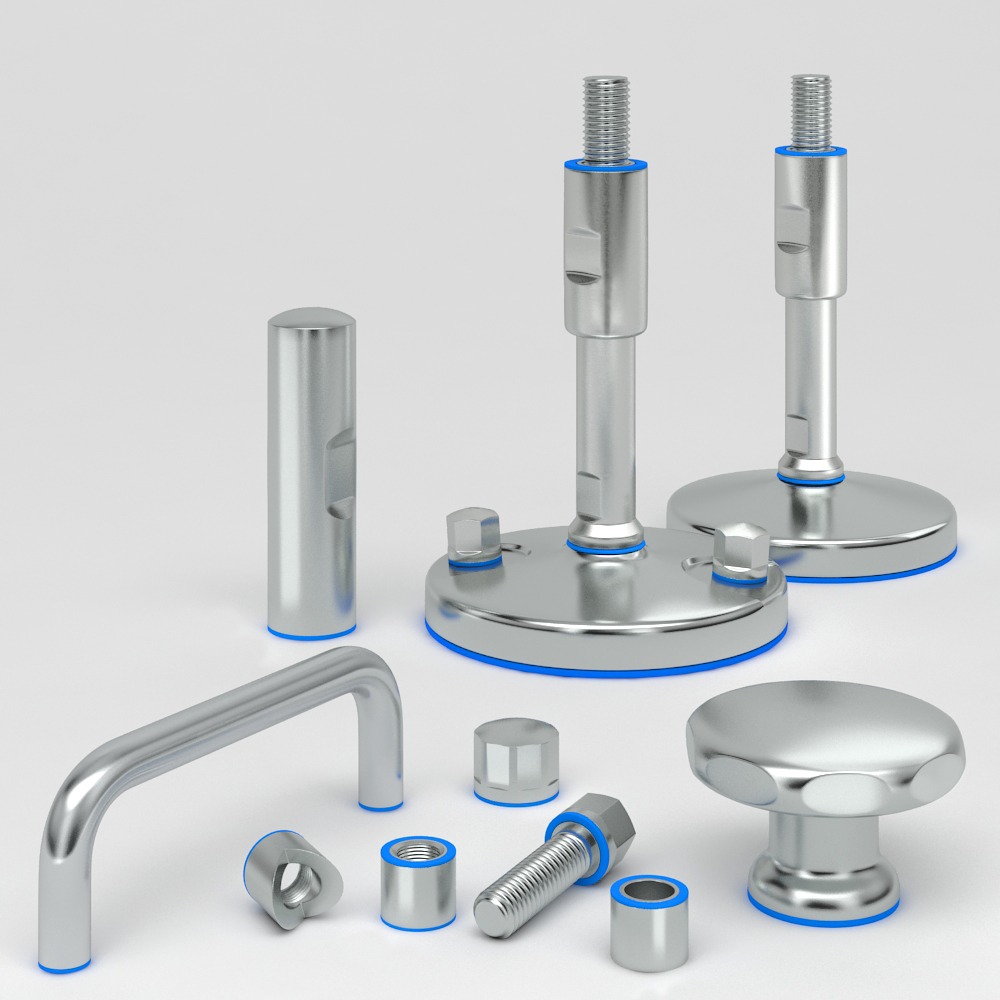
Sanitary adjustable feet are machine levelling feet designed so they can be cleaned reliably at floor level – stainless steel, no exposed thread, sealed joints and a smooth, self-draining base. Hygienic machine feet like these are used under equipment in food processing, beverage, dairy and pharmaceutical plants and in healthcare and laboratory settings, where floors and machine bases are washed down frequently. This guide explains why the foot matters for hygiene, compares the main types and shows how to choose and specify them.
For the geometry details of hygienic feet – thread covers, seal lines and base shapes – see clean design from the ground up.
Why hygienic machine feet matter
For the general selection method – load per foot, thread, base and anchoring – see the industrial leveling feet selection guide.
The floor zone is cleaned with high-pressure water, foam and aggressive chemicals, and it collects spillage, splashes and residues from the line. A standard foot puts several crevices (narrow gaps cleaning fluid cannot flush) into that zone: the exposed thread, the lock nut, the joint between stem and base, and the rubber pad. These become harbourage points – places where bacteria survive cleaning – and corrode over time.
Hygienic machine feet address three needs:
- Hygiene and safety: minimal dirt accumulation and easy cleaning, so the foot does not become a source of contamination.
- Corrosion resistance: stainless materials that withstand frequent washdowns with cleaning agents.
- Stability and durability: a stable, level foundation that keeps the machine aligned and reduces wear.
Types of sanitary adjustable feet compared
If the terms themselves are unclear, adjustable feet vs leveling feet explains how adjustable, levelling, machine and solid base feet differ.
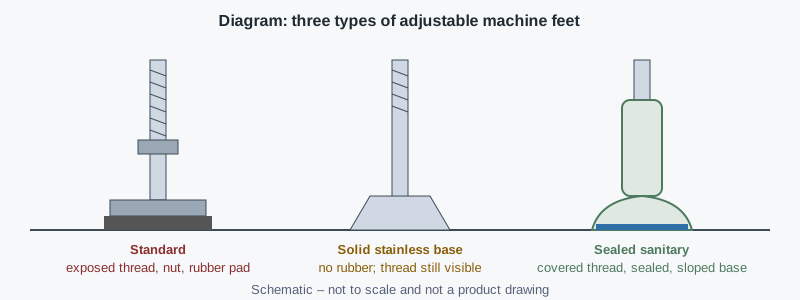
| Type | Design | Hygiene | Typical use | Limitations |
|---|---|---|---|---|
| Standard adjustable foot | Threaded stem, lock nut, steel or plastic base, rubber pad | Poor: exposed thread, nut crevices, pad absorbs liquid | Dry, non-hygienic areas | Not suitable for washdown zones |
| Solid stainless base foot | Stainless stem and solid stainless base, no rubber | Better: no pad; thread still exposed | Wet areas with moderate hygiene demands | Exposed thread must be cleaned; may slip on wet floors |
| Sealed sanitary adjustable foot | Thread enclosed or sealed, smooth stainless body, sealed or sloped base, food-grade seals | Good: no exposed thread or crevices | Food, dairy, beverage and pharma washdown areas | Higher cost; seals need inspection |
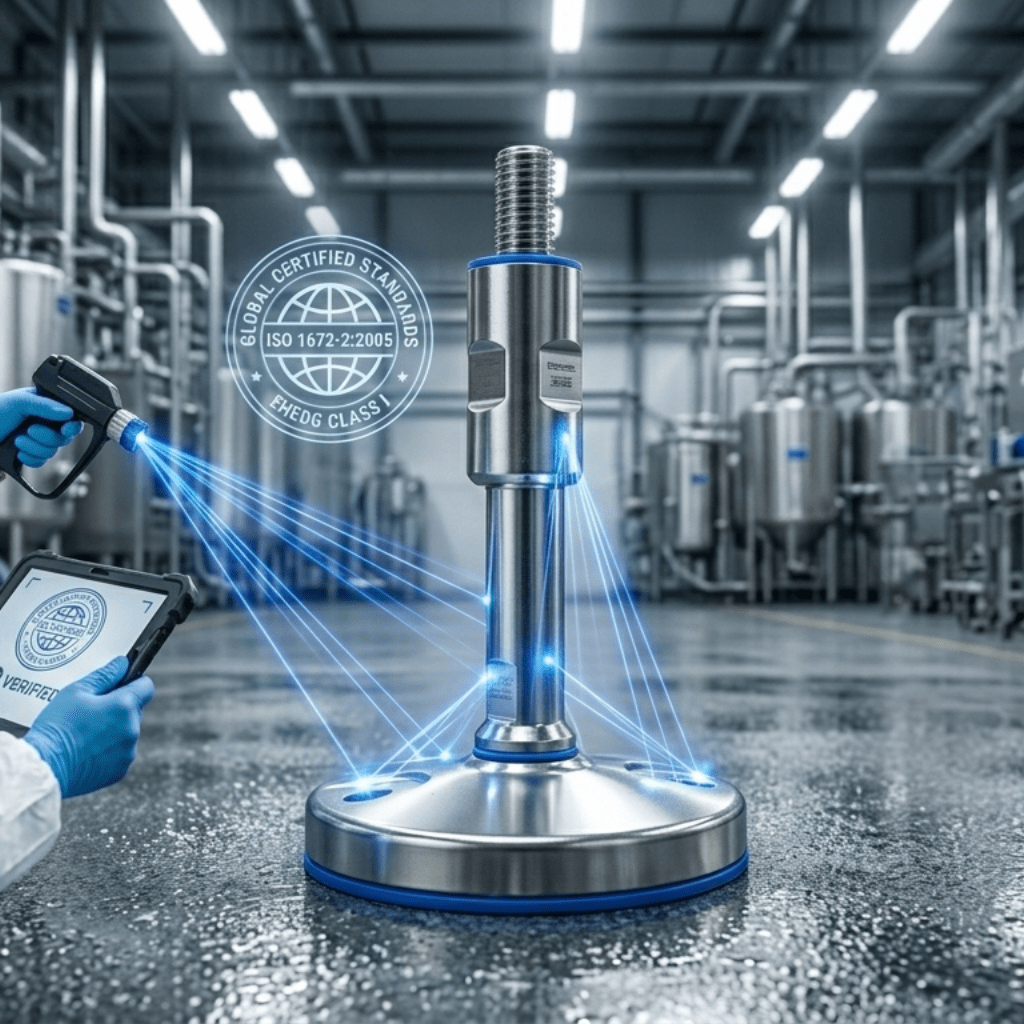
| Certified hygienic foot | Sealed design with EHEDG certificate or 3-A authorisation for the named model | Design assessed for cleanability | High-hygiene zones, customer specifications | Certificate covers that model only |
Where to use sanitary leveling feet
For equipment that must be moved for cleaning, see when to choose casters instead of leveling feet.
- Food processing plants: machines cleaned daily with foam and high-pressure water; sealed sanitary feet keep floor-level cleaning short and reliable.
- Beverage production: wet floors and frequent cleaning; corrosion-resistant feet with self-draining bases.
- Dairy: hot water and alkaline/acid cleaners; check seal temperature and chemical compatibility.
- Pharmaceutical manufacturing: clean, stable foundations supporting strict regulatory requirements; smooth surfaces that tolerate disinfectants.
- Healthcare and laboratories: medical and lab equipment where cleanliness and stability are both needed.
How to choose sanitary adjustable feet
- Define the zone: floor zone in a wet hygienic area, splash zone (wetted by spray but not product) or dry area.
- Define cleaning: foam, high-pressure washdown, chemicals, temperature.
- Choose material: AISI 304 for most areas; 316L where chlorides cause chloride pitting.
- Choose design: sealed sanitary foot for washdown zones; certified design where the customer specifies it.
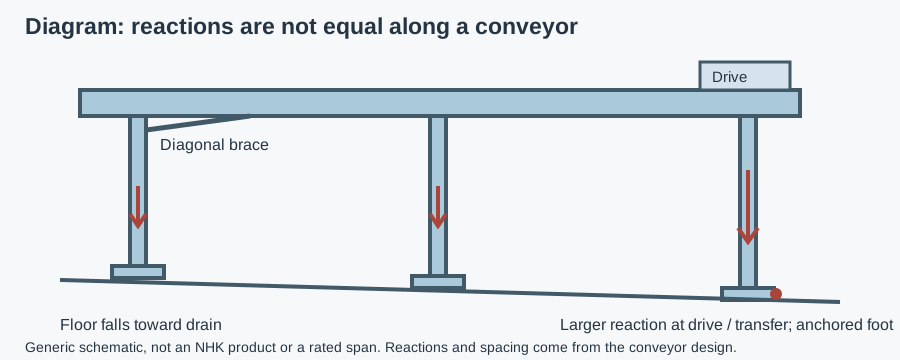
- Calculate load per foot: load per foot = total load ÷ number of feet that actually carry it × safety factor. On an uneven floor only three of four feet may carry the load until the machine is levelled.
- Choose thread size and stem length for the load and the levelling range needed; longer stems reduce lateral stiffness.
- Choose articulation: a swivel base compensates for floor slope; check the allowed angle. Use the joint-sealing checks at the installed angle when specifying an articulated base for wet cleaning.
- Choose fixing: free-standing, or one or two fixing holes for floor anchoring where vibration or seismic loads require it.
- Check base material and seals: food-contact compliance for seals (EPDM, FKM or VMQ) and any plastic parts.
Example
Assumptions (illustrative only): a 1,200 kg filling machine on four feet in a dairy, cleaned daily with foam and hot water; the floor slopes towards drains.
- Load per foot: 1,200 kg ÷ 3 carrying feet × 1.5 safety factor = 600 kg per foot required rating.
- Design: sealed sanitary adjustable feet in stainless steel with articulating base to follow the floor slope.
- Material: 304 adequate for alkaline/acid cleaning without chlorides; 316L if chlorinated cleaners are used.
- Fixing: two-hole anchored base because of vibration from the filler.
- Seals: compatible with hot alkaline cleaners; checked with the supplier.
What to write in the specification
- Zone and cleaning method (chemicals, temperatures, pressure).
- Load per foot including safety factor; thread size and stem length; levelling range.
- Material grade (304 or 316L) and surface finish.
- Sealed thread, no exposed lock nut, sealed or self-draining base.
- Articulation angle and fixing (free-standing, one or two holes).
- Documents: EHEDG certificate or 3-A authorisation by model where required, material certificates, declarations of compliance for seals and plastic parts (EC 1935/2004; FDA 21 CFR 177.2600 for rubber).
Certification and compliance
EHEDG certifies specific equipment designs as cleanable, and the 3-A Symbol is authorised after a Third Party Verification; both are voluntary. FDA regulations such as 21 CFR 177.2600 cover food-contact rubber materials, not the foot as a whole. Ask for the certificate of the exact model rather than relying on a general claim of compliance.
Installation and adjustment
- Level the machine so all feet carry load – check by trying to turn each foot by hand.
- Lock adjustment as specified, without exposed lock nuts in hygienic zones.
- Seal or anchor bases as designed; do not leave gaps between a sealed base and the floor.
- Re-check level and seals at planned inspections.
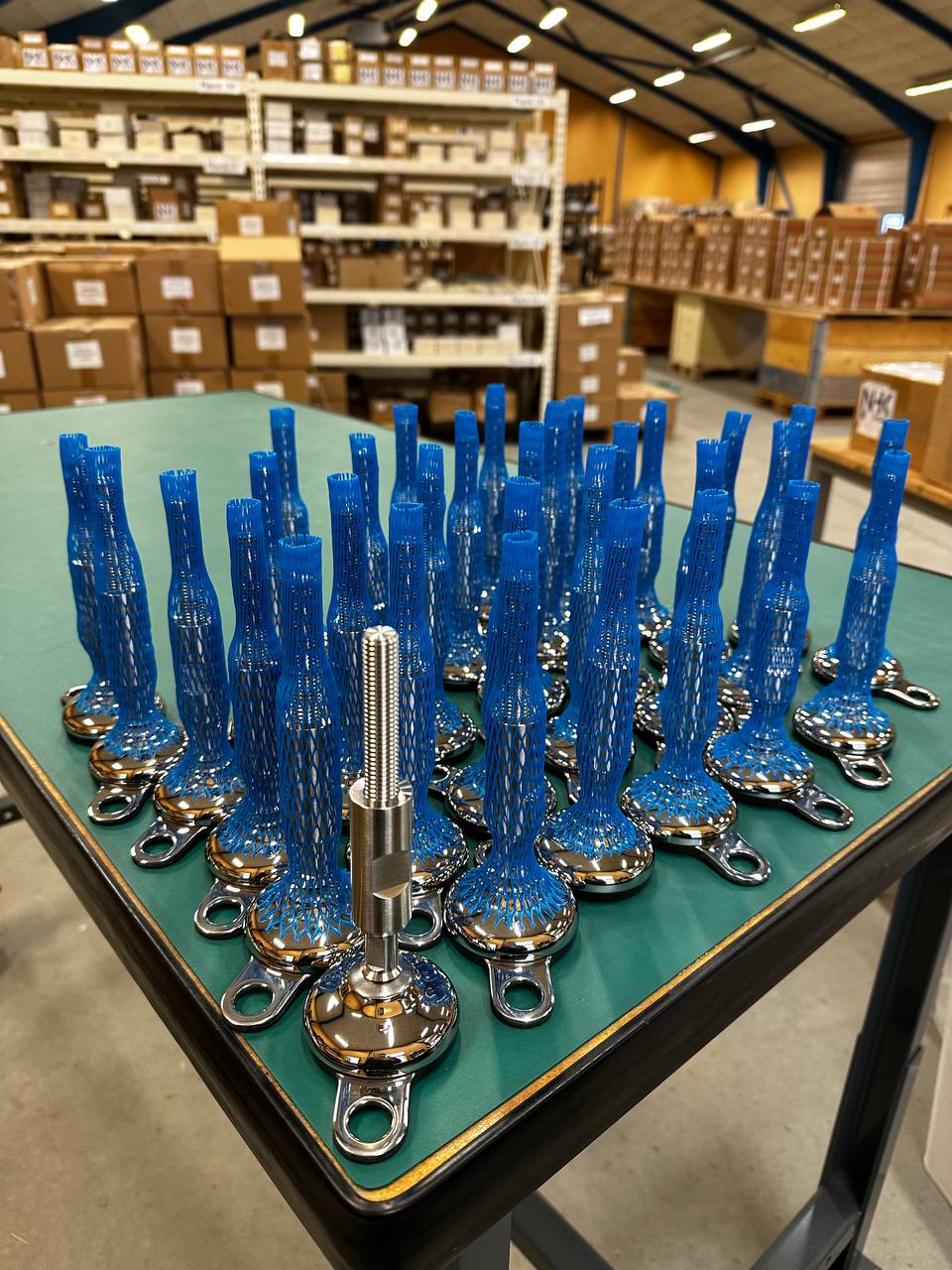
NHK examples: machine leveling feet with solid base plate, the SHAF adjustable feet in sealed hygienic design (EHEDG-certified design), and more at NHK Machinery Parts.