Conveyor legs are the vertical stands that carry a conveyor frame to the floor. Most end in conveyor feet with an adjustable stem, so conveyor leveling feet (levelling feet in British English) and the leg are specified together. The industrial leveling feet selection guide covers the foot on its own; this page covers the leg as a support path: reactions, adjustment, bracing, anchoring and the floor under the line.
What a conveyor support leg has to do
A leg carries vertical load, keeps the frame at transfer height and resists side forces from pushing, product impact and cleaning. It also sets how much floor is left to clean. Three parts share those jobs: the leg (tube, profile or stand), its connection to the frame, and the foot. A weak link in any one of them limits the whole support.
Treat the leg and the foot as different questions. A foot catalog states a foot rating; it says nothing about the leg tube, the bracket, the brace or the frame between legs. Ask the conveyor designer for those, and use the foot rating only for the foot. Identify whether the complete stand uses a welded frame, a bolted profile or a telescoping leg. Those constructions have different adjustment, connection and cleaning interfaces. Changing only the foot does not establish the stand's capacity or stability.
Conveyor legs and conveyor leveling feet: selection table
| Criterion | What to establish | Ask for or check |
|---|---|---|
| Reaction per leg | Largest vertical load at each leg, including drive, product and overhang | Designer's reaction list, not total weight ÷ legs |
| Leg spacing | Allowable span for the frame section and load | Conveyor maker's support spacing for the actual frame |
| Height range | Nominal height plus transfer tolerance and floor fall | Leg telescoping range and foot stem extension |
| Foot thread and stem | Thread size, engagement and extension in use | Foot rating at that extension and swivel angle |
| Bracing | Single-post, two-leg or H-stand; height-to-width ratio | Brace arrangement and connection details |
| Fixing | Free-standing or anchored, and at which legs | Base type (one or two holes) and sealed anchor detail |
| Hygiene | Zone, cleaning method, chemicals | Enclosed thread, sealed joints, closed tube ends |
| Materials | Leg and foot grade; base pad compound | AISI 304 or 316L; food-contact declaration for the pad where relevant |
| Evidence | Certificate needed or not | EHEDG certificate or 3-A authorization for the exact foot design |
Send your leg reactions and cleaning conditions for a foot recommendation
Load per leg: find the governing reaction
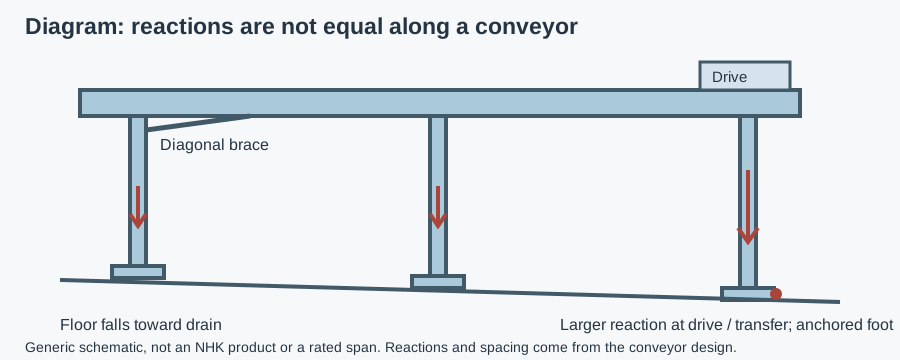
Conveyors are long and comparatively light, so engineers often divide total weight by the number of legs. That hides the leg that actually governs. Reactions concentrate where the drive unit sits, where a section overhangs the last leg, at transfers that carry part of the next machine, and where product accumulates or is loaded by hand or by a feeder.
Use the designer's reactions where available. For an initial screen of a simple straight section, build them from the frame mass per length, conveyed load per length, drive mass and any point loads, then distribute them to the legs by position. Do not assume the load is shared equally between the two feet of an H-stand on a sloped floor.
Uneven floors change the share again. With rigid frames, one foot can lift slightly and carry little until it is adjusted. A screening method for feet is: load per foot = governing load ÷ (number of feet assumed to carry it) × a justified application factor. The designer must validate that load-sharing assumption; no universal factor is specified. The stability, soft foot and vibration guide adds contact and alignment context. Do not loosen or rotate a loaded support by hand to test its reaction.
Compare the result with the foot rating at the stem extension you will actually use. Ratings usually fall as the stem is extended or the base is tilted; check the datasheet rather than assuming the headline value.
Adjustable conveyor legs: height adjustment is not frame correction
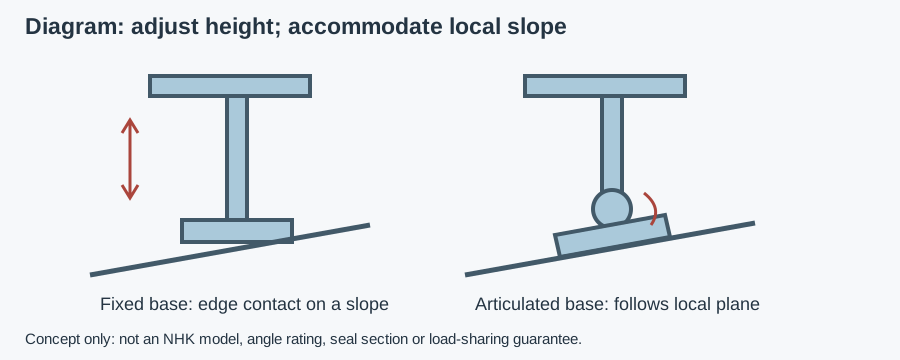
Adjustable conveyor legs have two adjustment stages: a coarse range in the leg (telescoping tube or slotted bracket) and a fine range in the foot stem. Use the leg for nominal height and the foot for leveling and floor fall. Running a foot near the end of its stem to make up height reduces thread engagement and stiffness and leaves more exposed thread to clean.
Leveling sets the frame height at each leg. It does not remove sag between legs. If the frame deflects between supports, add a leg or stiffen the frame. Jacking one foot up to lift a sag shifts load onto that leg and can twist the frame, which shows up as belt tracking or chain wear problems rather than as an obvious support fault.
Use the designated transfer datum and the conveyor maker's leveling sequence. Record final stem extensions so maintenance can return to them after cleaning or repairs. Establish acceptable height and alignment tolerances from the connected equipment; there is no universal transfer tolerance. Recheck with the relevant operating load because a correctly leveled empty frame can still deflect under product accumulation. Avoid forcing a twisted frame into line by tightening a single support.
Bracing, sloped floors and anchoring
Check single-post stands and tall legs for the bracing required by their selected design; manufacturer stand instructions show model-specific arrangements. An H-stand still needs assessment along and across the conveyor. Each brace adds a joint, so keep connections accessible for cleaning. Do not omit a structural brace to improve access without redesigning the support. The conveyor designer must check sideways forces, connection stiffness and overturning, not just vertical foot capacity.
On floors that fall toward drains, a swivel base keeps the foot pad flat while the stem stays vertical. The swivel leveling feet guide explains how to measure local slope and read articulation angles.
Determine anchoring from positional, lateral and uplift load cases, including transfers and cleaning forces; do not prescribe anchors at every transfer without the design assessment. Choosing between single- and double-hole bases is covered in how to choose one or two fixing holes. Where earthquake loads apply, the seismic foot sizing method addresses shear and uplift. Free-standing feet require demonstrated stability, not merely a straight conveyor. Check floor construction, anchor edge distances, embedment and sealing through the approved installation detail. A base with fixing holes is not an anchor rating.
Hygienic design of legs and feet
Conveyor legs stand in the splash zone, the area reached by product, water and cleaning spray, even when the belt itself is the only product-contact surface. Residue that collects at floor level can be carried back onto the line by spray and hoses.
Check these points on every leg:
- Tube ends and leg profiles. Open tubes and hollow sections fill with water. Close them with welded caps or sealed inserts so no cavity can hold liquid.
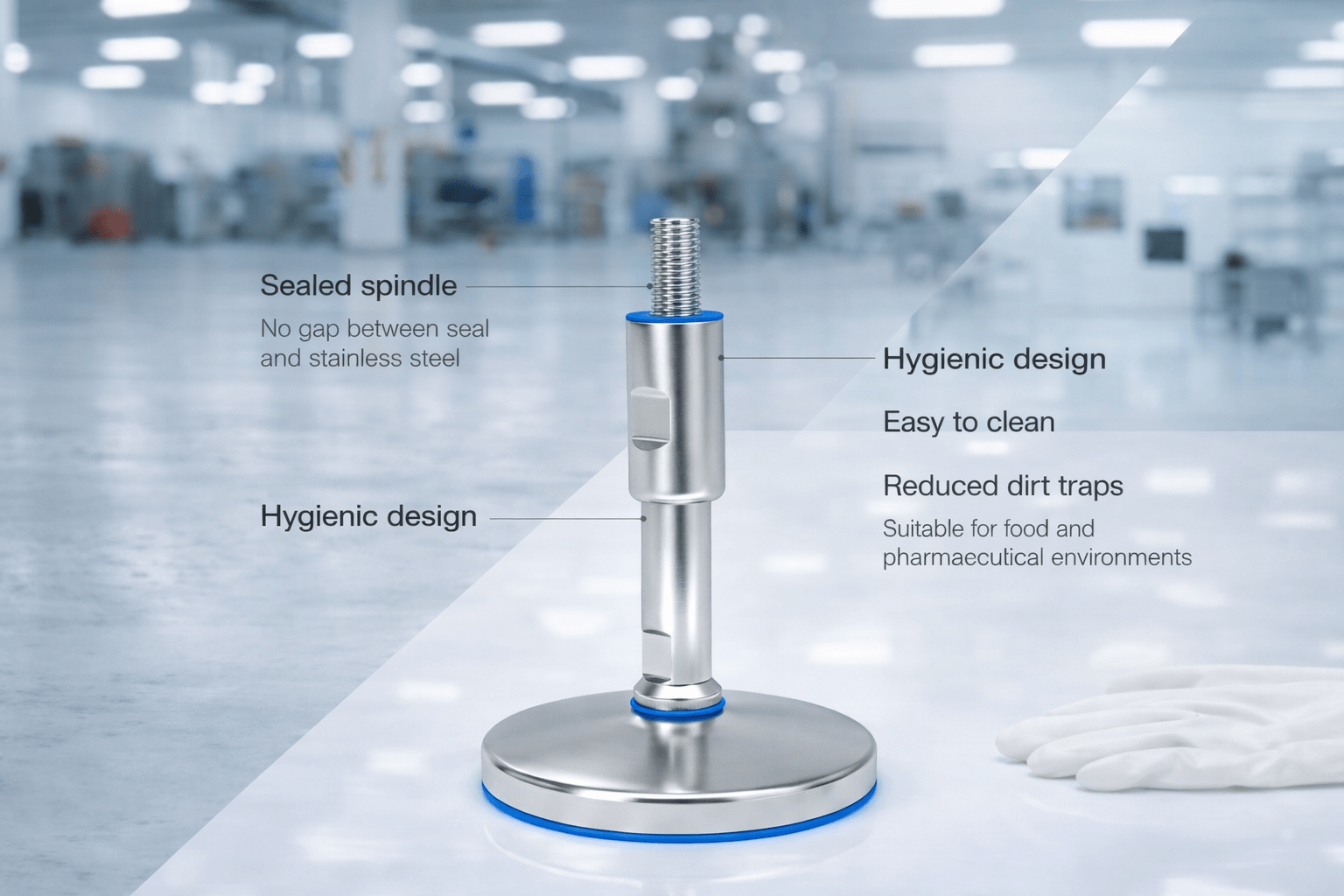
- Foot threads. Exposed threads can form harborage points, places where residue survives cleaning. Assess the installed enclosure, seals and cleaning access.
- Check cover fit at the leg-to-spindle connection when reviewing the upper enclosure and adjustment access.
- Base and pad. A pad that traps water at its edge, or a base with an underside recess, holds residue. Prefer self-draining bases and sealed pad joints.
- Brackets and braces. Flat horizontal surfaces, lap joints and bolt heads collect debris. Use sloped surfaces, continuous welds and hygienic fasteners where joints are needed.
- Floor under the line. Leave enough height and open space for the cleaning method used, so the floor can be reached and inspected.
Use AISI 304 for general wet-cleaned areas and consider AISI 316L where chlorides from brine or chlorinated cleaners cause chloride pitting. Confirm that elastomer pads and seals suit the cleaning chemicals and temperatures, and request a declaration of compliance where the pad falls within the scope of EC 1935/2004.
EHEDG certifies specific designs; 3-A Symbol authorization follows Third Party Verification. Both are voluntary. NHK holds EHEDG certificate C2400039 for a levelling foot design, but that does not certify any leg, bracket or frame it is fitted to. The EHEDG certification guide explains what a certificate covers. See NHK's certifications.
Example: a straight packing conveyor
Example (assumed values, method only): a 6 m belt conveyor with the drive at the discharge end stands on four H-stands in a wet-cleaned packing area. The floor falls toward a drain along one side.
- The designer supplies reactions; the discharge stand carries the drive and part of the transfer and governs.
- On the sloped floor, each H-stand foot is sized as if one foot of the pair carries the stand's full reaction until adjusted, times the foot maker's safety factor.
- The foot rating is checked at the stem extension needed for the floor fall, with a swivel base.
- The discharge and infeed stands are anchored with sealed two-hole bases; the middle stands are free-standing.
- Leg tubes are capped, feet have enclosed threads, and clearance under the frame is set for the plant's cleaning method.
No load, span or clearance value is given here; they come from the conveyor design and the selected products.
Installation and acceptance checklist
- Confirm thread size and engagement between foot and leg before installation.
- Set nominal height with the leg adjustment; keep the foot stem near mid-range.
- Level from the transfer outward with a laser or spirit level.
- Verify intended support contact using the designer's safe procedure; do not rotate a loaded foot as a test.
- Tighten lock nuts and fit anchors where specified, sealing anchor points.
- Check frame straightness between legs; add support rather than jacking a sag.
- Inspect tube ends, exposed thread and pad edges; reject open cavities.
- Re-check level, lock nuts and anchors after initial running and at planned maintenance.
What to send in an RFQ
Copyable RFQ: "Conveyor legs for [conveyor type, length]. Largest reaction per leg: [value, source]. Leg tube/bracket and foot thread: [size]. Height range and floor slope: [values]. Fixing: [free-standing / anchored at …]. Zone and cleaning: [foam / high-pressure, chemicals, temperature]. Required documents: [EHEDG certificate or 3-A authorization for the foot design, material certificates, food-contact declaration for pads]. Quantity and delivery country: […]."
The buyer's guides explain supplier documents more broadly. For rollers and other parts on the same line, see the conveyor roller selection guide.
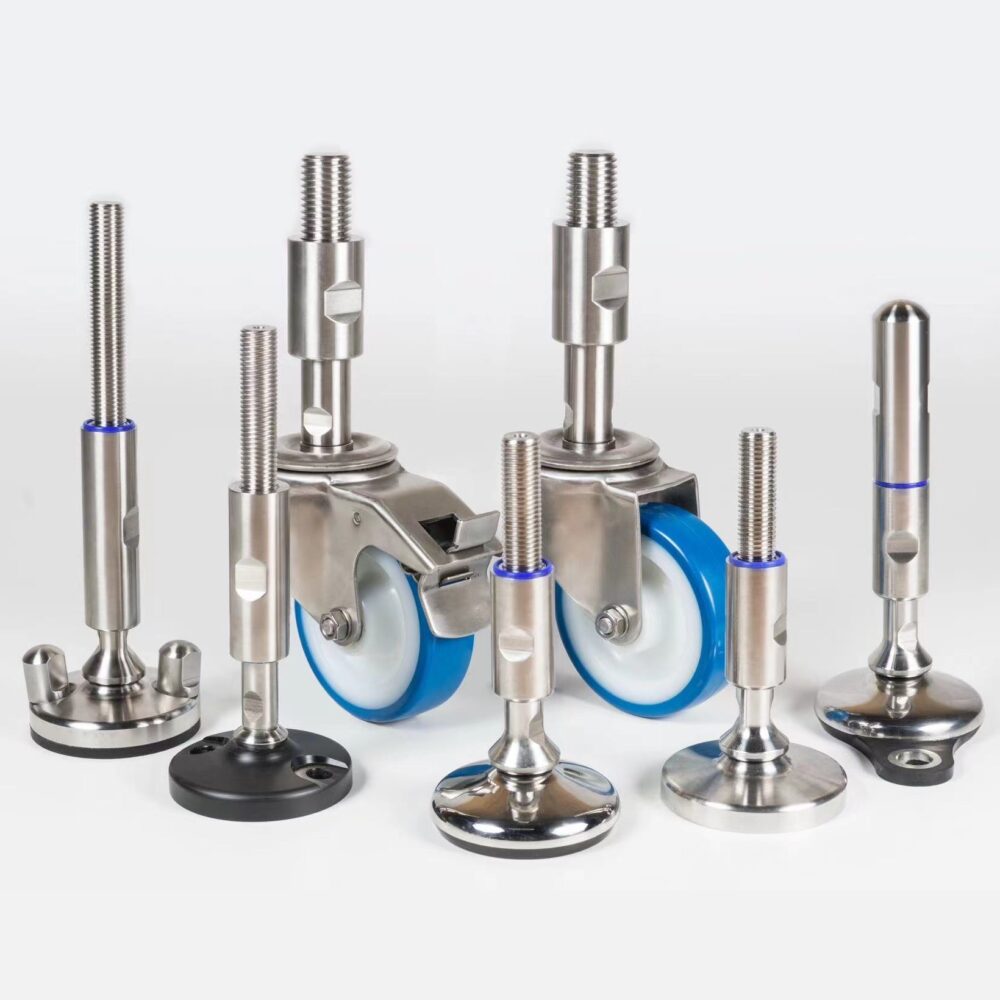
NHK's range of stainless machine leveling feet for conveyor stands lists foot variants, including hygienic and anchoring types. It does not list complete conveyor-leg assemblies. Send your reactions and cleaning conditions, and an NHK technician will suggest suitable feet and send a quote.