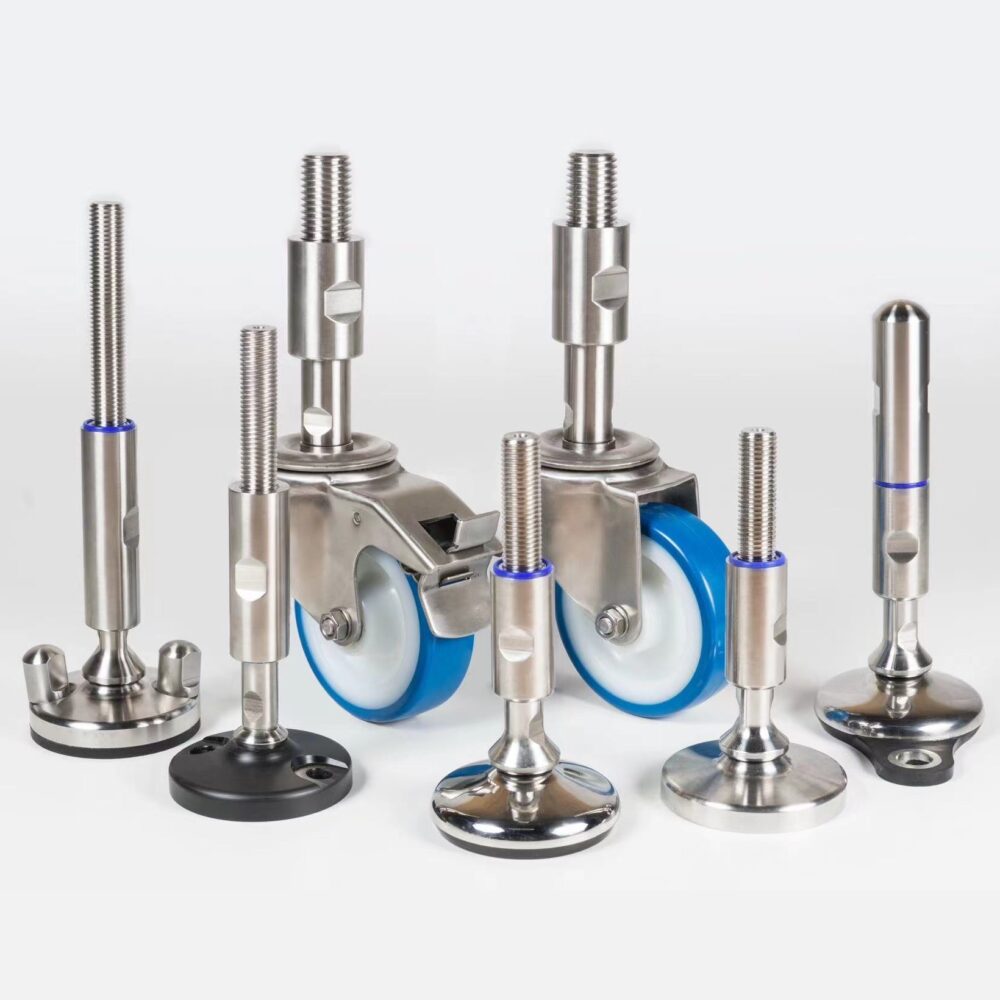
Casters vs leveling feet is the choice between a machine that can be moved and one that stands fixed and level: casters (castors in British English) give mobility, leveling feet give stability, height adjustment and a defined load path, and leveling casters combine both. This guide compares the three on mobility, stability, vibration, load and cleaning under the machine, and gives a decision table for hygienic production areas. It belongs to our levelling feet and castors section.
For caster materials, wheels, brakes and load calculation, see the industrial casters selection guide.
Casters vs leveling feet vs leveling casters: comparison
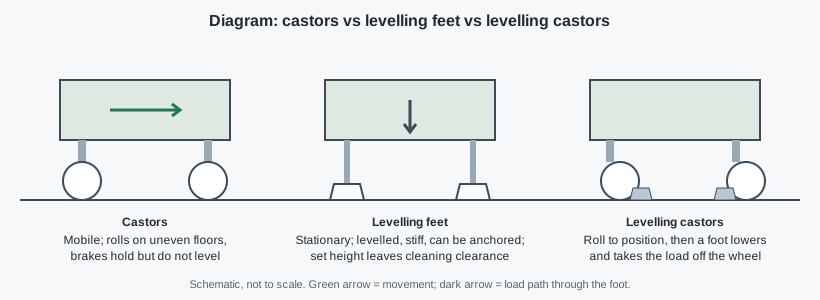 casters, leveling feet and leveling casters. Schematic, not a product test report.
| Criterion | Casters | Leveling feet | Leveling casters |
|---|---|---|---|
| Mobility | Moved by hand or tug | None once installed | Rolled to position, then fixed |
| Leveling on an uneven floor | No – the frame follows the floor | Yes, by spindle adjustment | Yes, through the integrated foot |
| Stability in operation | Limited; brakes stop rolling, not rocking | High; can be anchored | High once the foot is down |
| Vibration and dynamic loads | Wheel tread and swivel play let the machine move | Stiff support; rubber-damped bases available | Good when the foot carries the full load |
| Load path | Through wheel, axle and swivel bearing | Straight through spindle and base | Through the foot when lowered |
| Cleaning under the machine | Machine can be rolled away to clean the floor | Needs enough clearance and a cleanable foot | Can be rolled away, but has more parts to clean |
| Harborage points | Wheel hub, swivel bearing, brake mechanism | Exposed thread on non-hygienic designs | Combination of both |
| Typical use | Trolleys, mobile tables, tanks moved for changeover | Fixed process lines, conveyors, fillers | Equipment moved between lines but run fixed |
Harborage points are gaps, threads and joints where product residues and microbes survive cleaning. Every extra moving part adds some, which is why the hygienic case for casters depends on how often the machine really moves.
Send your application data and get a recommendation on casters or feet
When to choose casters
Choose casters when the machine must be moved regularly – for example a mobile ingredient tank, a trolley-mounted mixer, a cleaning station or a table moved for allergen changeover (cleaning between products with different allergens). The deciding questions:
- Does the machine move at least weekly, or for every cleaning? If yes, casters save lifting equipment and the risk of dragging.
- Does the process tolerate small movements? Weighers, slicers and machines with precise transfers usually do not.
- Can the floor take point loads? A wheel puts the load on a small contact patch; soft or damaged floors crack.
For stainless and hygienic casters, the features that matter in wet zones are a sealed or open, cleanable swivel bearing, a wheel material such as polyurethane that withstands the cleaning chemicals, stainless steel brackets (AISI 304 for mild zones, 316L where chlorides are present) and a brake that does not trap residues. NHK's range of stainless noise-reducing castors shows one example of a stainless caster line.
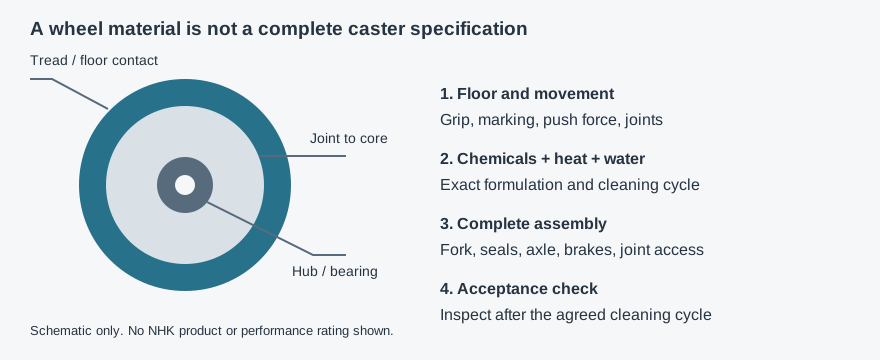
Use the wheel-material comparison for washed carts to check tread construction, floor effects and the cleaning limits of the specific wheel.
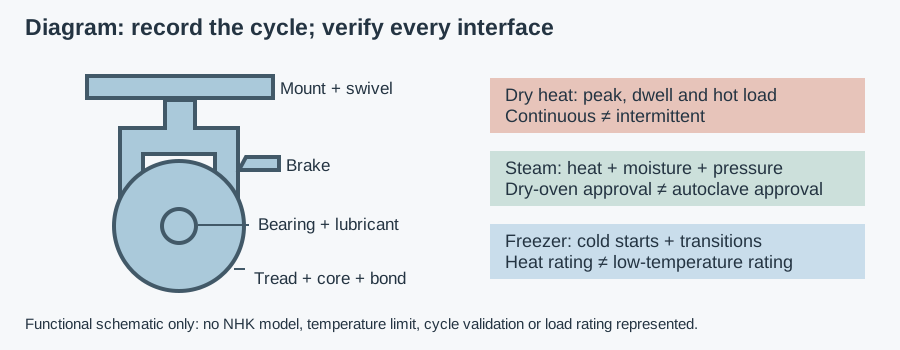
Once mobility is required, check stainless mounting, swivel and brake interfaces before approving the complete wet-cleaned assembly.
When to choose leveling feet
Choose leveling feet when the machine stands in one place in production. They are the default for process lines because:
- They level the machine on sloped, drained floors – food plant floors slope towards drains on purpose.
- They give a stiff, defined load path, so conveyors stay aligned and fillers and weighers stay accurate.
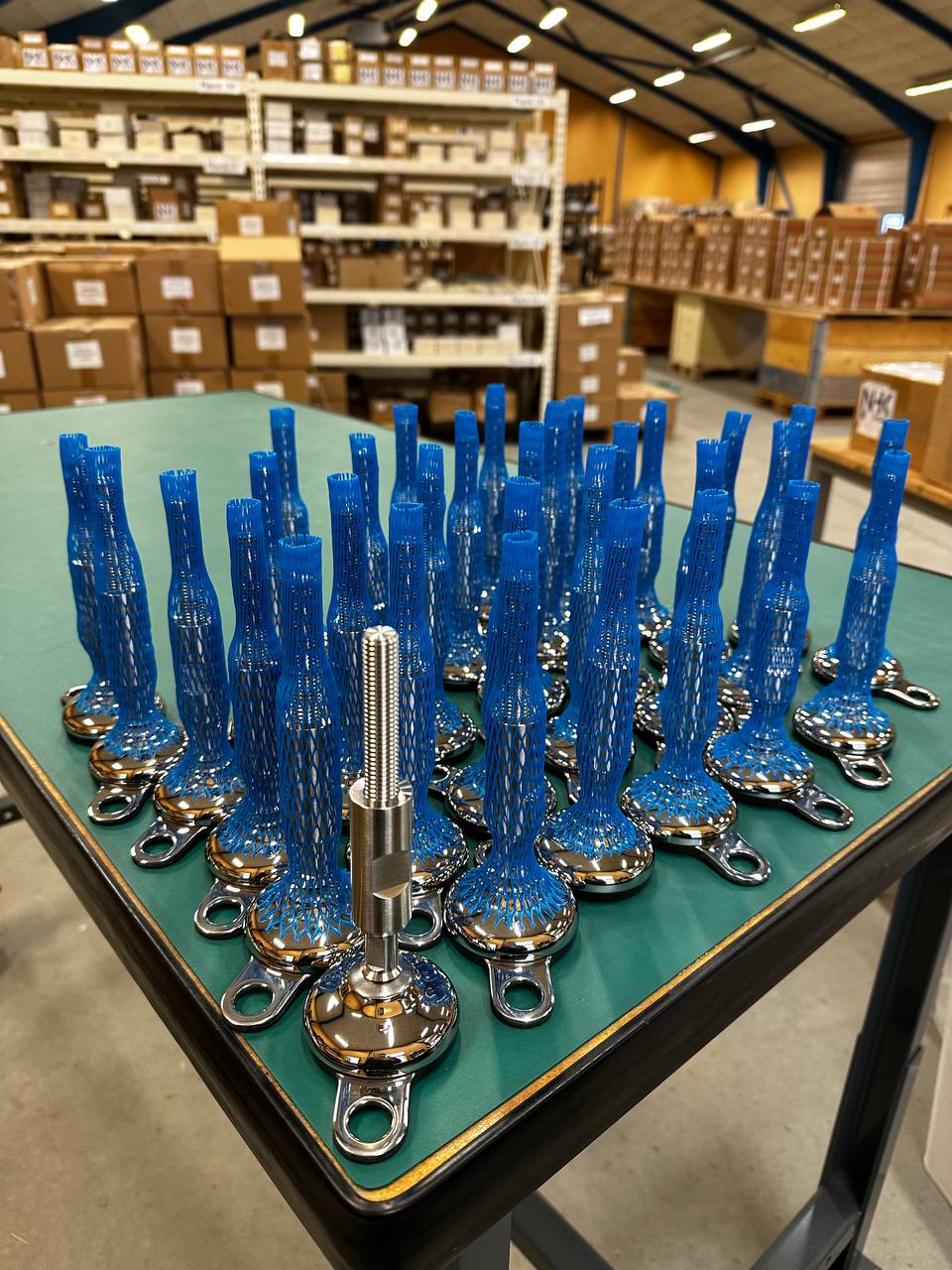
- They can be anchored to the floor with one or two fixing holes where seismic, tipping or vibration loads require it; see how to choose an anchoring foot with one or two fixing holes.
- A hygienic foot with a sealed thread and no crevices is easier to clean than any caster. Which type of foot to ask for is covered in adjustable, leveling and solid base feet compared.
The floor connection also affects vibration and equipment lifetime; how machine feet affect stability and vibration covers the load and vibration side in detail.
When to choose leveling casters
Leveling casters are a caster with an integrated foot that is screwed or pushed down until it lifts the load off the wheel. Use them when equipment is repositioned between campaigns or lines but must run level and stable – mobile packaging units, modular conveyors, portable CIP units. Check two things: the foot must carry the full load on its own, and the mechanism must be cleanable, because leveling casters combine the harborage points of both a caster and a foot. For the combined option, use the integrated support selection and load-transfer guide to check adjustment travel and both rated states.
Decision table: casters or leveling feet
| Your situation | Choose |
|---|---|
| Machine moves daily or for every cleaning | Casters with brakes |
| Machine fixed; floor sloped for drainage | Leveling feet |
| Precise process (weighing, slicing, filling) | Leveling feet, possibly anchored |
| Repositioned between campaigns, runs fixed | Leveling casters |
| High dynamic loads or vibration | Leveling feet, anchored, damped base if needed |
| Daily high-pressure washdown, high-care zone | Hygienic leveling feet; casters only if mobility is essential |
| Floor must be cleaned completely under the machine | Casters (roll away) or feet with enough clearance |
Load: calculating per caster or per foot
On an uneven floor, a rigid frame on four supports does not share load equally – one support often carries little or nothing. A common design practice is therefore to size each caster or foot as if only three of four carry the load:
Load per support = total load ÷ (number of supports − 1) × safety factor
The safety factor covers dynamic effects – starting, stopping and rolling over thresholds for casters; vibration and impacts for feet. The value depends on the application; take it from the component maker's guidance.
Example (assumed values, for method only): a mobile mixing tank weighs 600 kg full and stands on four casters. Load per caster = 600 kg ÷ (4 − 1) = 200 kg before the safety factor. With an assumed factor of 1.5 for rolling over floor drains and thresholds, each caster needs a rated capacity of at least 300 kg. If the same tank stood fixed on four leveling feet that are carefully leveled, the load would share more evenly, but the same three-of-four rule protects against a foot that was not adjusted.
Hygiene and cleaning under the machine
The floor area under a machine is part of the splash zone – cleaning water and product reach it and can splash back onto equipment. Whatever you choose, plan for:
- Clearance: enough height under the frame for a cleaning lance or foam applicator to reach the floor.
- Cleanable supports: no exposed threads, sealed joints between foot and frame, self-draining surfaces where water runs off.
- Materials: stainless steel suited to the chemicals; elastomers such as EPDM, FKM or VMQ chosen for chemical compatibility, with a food-contact declaration of compliance where relevant.
- Certificates where claimed: EHEDG certifies specific designs; ask for the certificate of the exact foot or caster. Our EHEDG certification guide explains what a certificate covers. For certified feet, see the guide to hygienic machine feet.
Common mistakes
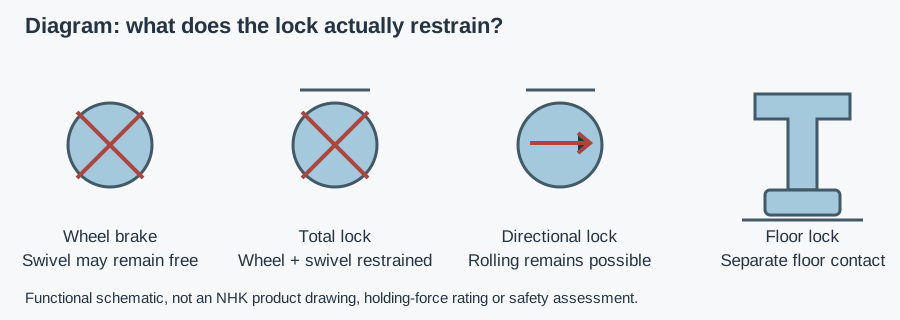
Use the caster brakes and floor locks comparison to distinguish parking restraint from a leveling foot's operating load path.
- Using caster brakes as a substitute for leveling – the machine rocks and the brake wears.
- Putting a precise machine on casters to "keep options open" and then fighting misalignment.
- Sizing casters on total load ÷ 4 and overloading them on the first threshold.
- Leveling feet set too low for cleaning access, creating a dead space under the frame.
- Leveling casters whose foot is never lowered, so the wheels carry the running load.
What to send for a recommendation
Before asking for certification evidence, use the evidence to check before buying a certified support.
- Machine type and total weight (empty and full)
- How often it moves, and over what floor (drains, thresholds, slope)
- Zone and cleaning method: foam, high-pressure washdown, chemicals, temperature
- Required clearance under the frame
- Material grade (AISI 304 or 316L) and any certificate needed (EHEDG, 3-A)
- Quantity and delivery country
Send these details to NHK
An NHK technician suggests the right caster, leveling foot or leveling caster and sends a quote.