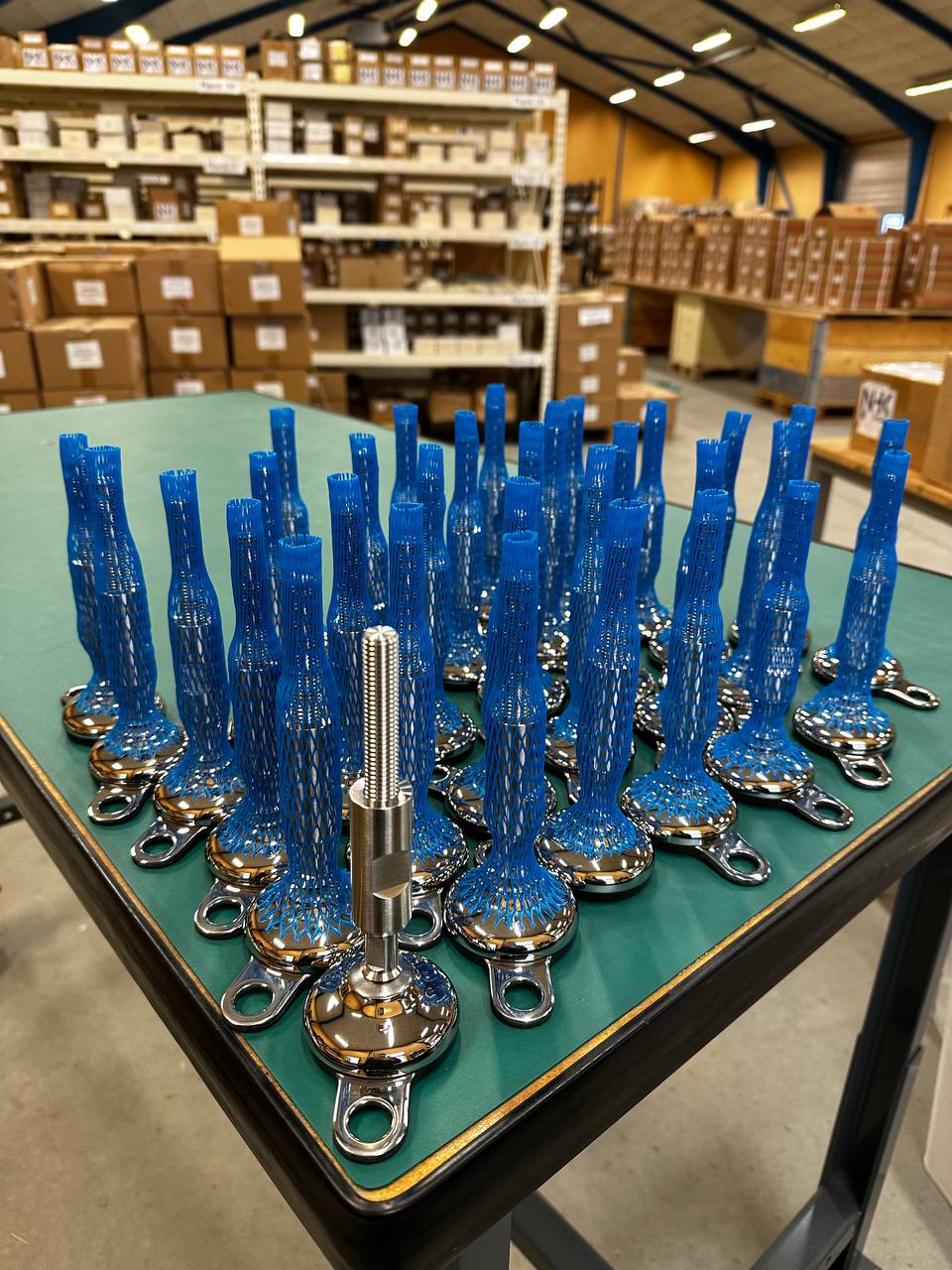
Industrial leveling feet are adjustable supports – a threaded stem with a base, often on a swivel joint – that carry a machine's weight to the floor, level it, and in many cases anchor it. Choosing them comes down to five decisions: load per foot, thread and stem, base, anchoring, and whether the application needs a hygienic or a standard design. This guide covers each, with a load method, an example and an RFQ checklist. (In British English the term is "levelling feet".) All guides on supports are collected in the levelling feet and castors section.
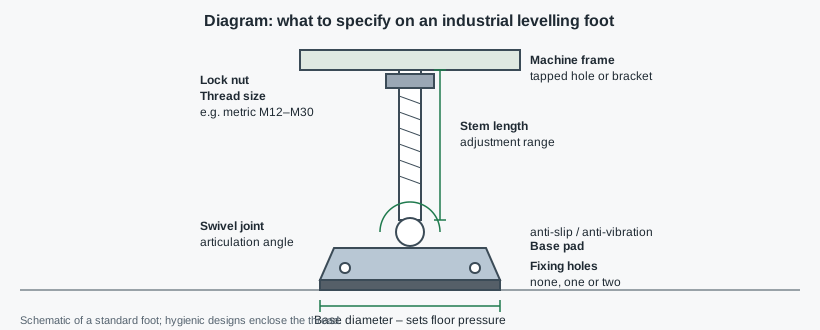 what to specify on an industrial leveling foot. Schematic, not a product test report.
Mobile machines need casters instead; the guide to industrial casters for washdown areas covers that choice.
Where building codes require equipment anchorage, see seismic leveling feet and how to specify them.
Selection criteria at a glance
For supports that also measure the machine load, use the load cell feet selection guide to assess force paths, cables and weighing requirements.
| Criterion | Options | How to decide |
|---|---|---|
| Load per foot | Rated static load of the foot | Total load ÷ (feet − 1) × safety factor – see below |
| Thread size | Metric (e.g. M12–M30) or inch | From the frame's tapped hole or bracket; larger threads for heavier loads and longer stems |
| Stem length | Short to long adjustment range | Floor slope and height tolerance; keep exposed stem short |
| Base | Fixed or swivel; diameter; steel, stainless or plastic | Swivel for sloped floors; diameter for floor pressure |
| Base pad | None, rubber or plastic | Anti-slip and vibration damping; food-contact declaration if relevant |
| Fixing | Free-standing, one or two holes | Vibration, tipping and seismic requirements |
| Material | Zinc-plated steel, AISI 304, 316L | Environment and cleaning chemicals |
| Design | Standard or hygienic (enclosed thread, sealed base) | Zone and cleaning method |
| Documents | Datasheet with rated load; certificate if required | EHEDG or 3-A for specific hygienic designs |
Send your application data and get a leveling foot recommendation
1. Load per foot
A rigid frame on four feet rarely shares its load equally. On a real floor – especially a sloped food-plant floor – one foot often carries little or nothing until it is adjusted, and adjustment drifts. A common sizing method is therefore:
Load per foot = total load ÷ (number of feet − 1) × safety factor
- Total load is the machine plus product, fixtures and anything placed on it – the heaviest real case, not the empty weight.
- Minus one accounts for the foot that does not carry its share. For long frames on six or more feet, uneven sharing can be worse; consider the frame's stiffness.
- The safety factor covers dynamic loads: vibration, impacts, start-stop of drives. Its value depends on the application; follow the foot maker's guidance.
Compare the result with the foot's rated static load on its datasheet. If a datasheet gives several values (for example with and without swivel, or at different stem extensions), use the one that matches your installation. More on load distribution and vibration is in how machine feet affect stability and vibration.
2. Thread and stem
The thread size usually follows the frame: the tapped hole, nut or bracket already defines it. Larger threads are stiffer and carry more load; they also resist bending better when the stem is extended. Keep two rules:
- Extend as little as possible. A long exposed stem bends under side load and, in a standard design, exposes thread that collects dirt.
- Lock the adjustment. A lock nut or locking feature stops the foot turning under vibration. Feet that "walk" lose level and load sharing.
3. Base: swivel, diameter and pad
For the joint-specific checks, use the swivel leveling feet selection guide to distinguish floor angle, loaded articulation and seal clearance.
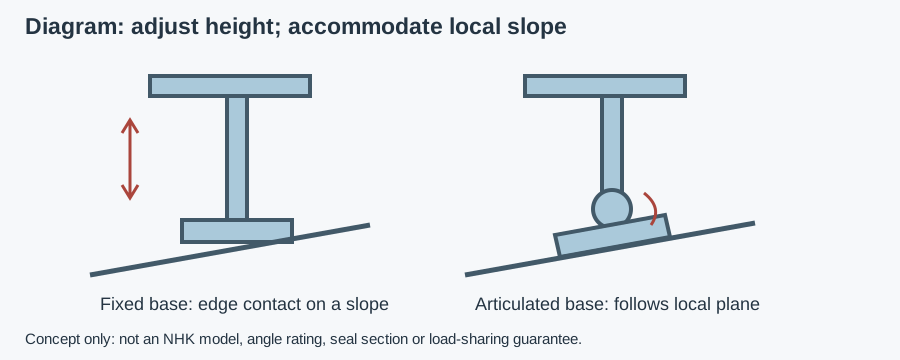
- Swivel (articulated) bases follow sloped or uneven floors so the whole base sits flat. Check the articulation angle on the datasheet against the floor slope.
- Base diameter sets the pressure on the floor. Heavy machines on small bases can crack tiles or resin floors.
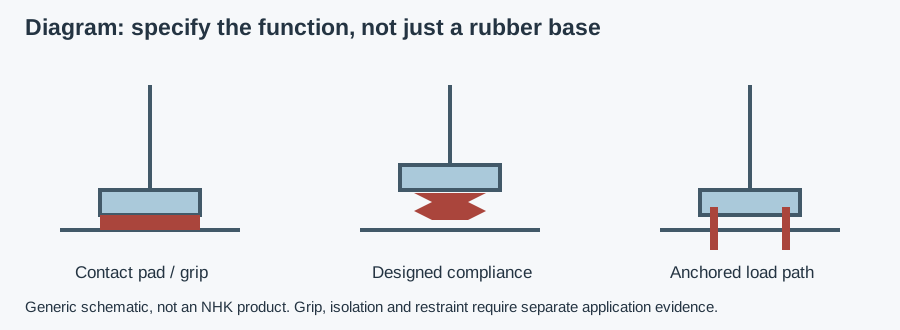
- Pads in rubber or plastic add grip and damp vibration, but they compress, age and can trap water at the edge. In food areas, ask for a food-contact declaration of compliance if the pad material could contact product, and check compatibility with cleaning chemicals. For the evidence behind those functions, use the rubber leveling feet selection guide to distinguish floor contact, isolation and restraint.
- Adjustable base plates – a flat plate with a leveling stem – spread load on weak floors and give room for fixing holes.
4. Anchoring
Free-standing feet are enough for most static machines. Anchor them when:
- The machine vibrates or has dynamic loads that make it walk.
- It is tall or narrow and could tip.
- Local regulations require seismic anchoring.
- Conveyors must stay aligned with the machines they connect.
Feet with one fixing hole resist sliding; two holes also resist rotation. See one or two fixing holes: choosing an anchoring foot. In wet food areas, sealing around the anchor bolt matters as much as the bolt itself.
5. Hygienic or standard design
For the upper frame interface, use the hygienic top cover selection and retrofit guide to check thread closure, seating and adjustment clearance.
A standard leveling foot – zinc-plated or stainless, with exposed thread and an open joint between nut and frame – is fine in dry, non-food areas. In food and pharma production, the thread, nut and base pad become harborage points: gaps where residues and microbes survive cleaning. Choose a hygienic design when the foot is in the splash zone (the area reached by product splash and cleaning water) or is cleaned wet:
| Feature | Standard foot | Hygienic foot |
|---|---|---|
| Thread | Exposed | Enclosed in a sleeve or covered |
| Joint to frame | Open nut | Sealed with a gasket |
| Base | Open edge, pad may trap water | Sealed or self-draining base |
| Material | Steel or 304 | 304 or 316L; elastomers declared for food contact |
| Evidence | Datasheet | Datasheet; EHEDG certificate or 3-A authorization for specific designs |
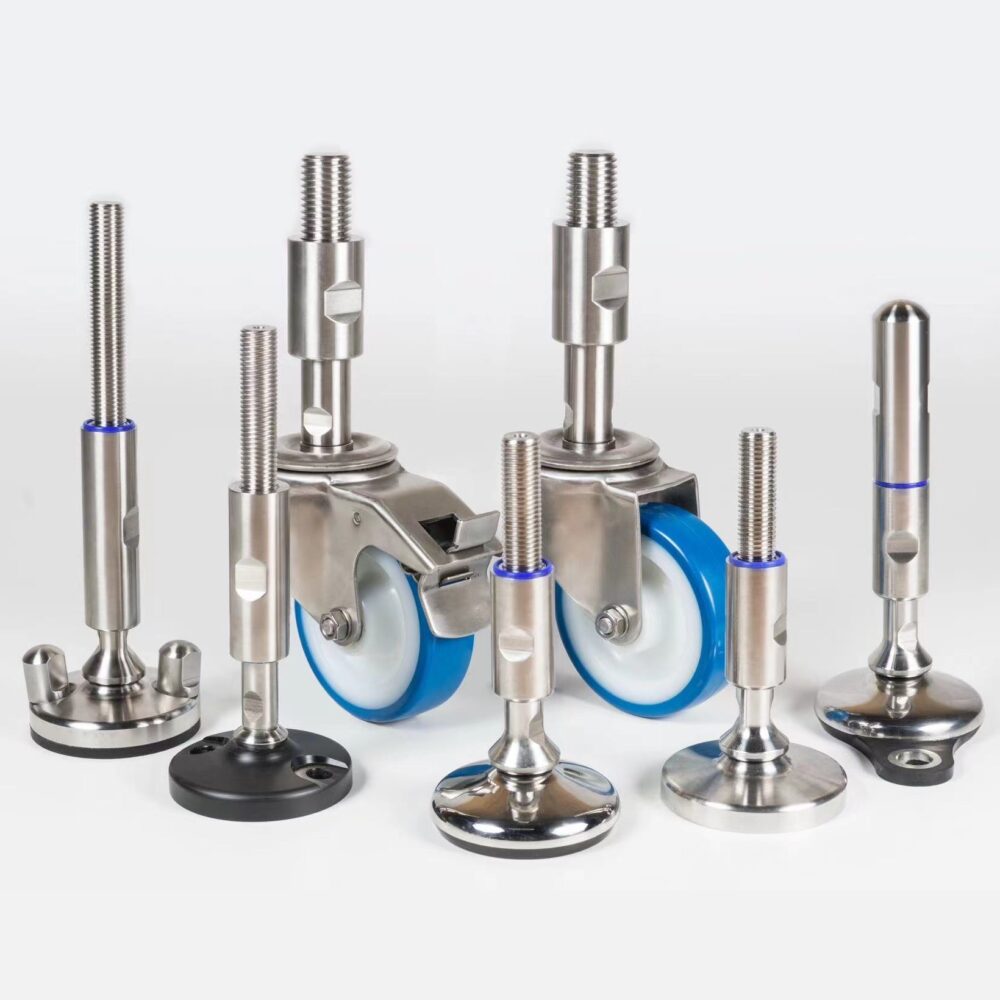
Use AISI 316L where chlorides from brine or chlorinated cleaners risk chloride pitting. Hygienic design is a property of the foot; certification is evidence for a specific design. The guide to sanitary adjustable feet covers hygienic designs in detail, and adjustable vs leveling feet sorts out the terminology. For hygienic options, NHK's stainless steel machine levelling feet are one range.
Conveyor leveling feet
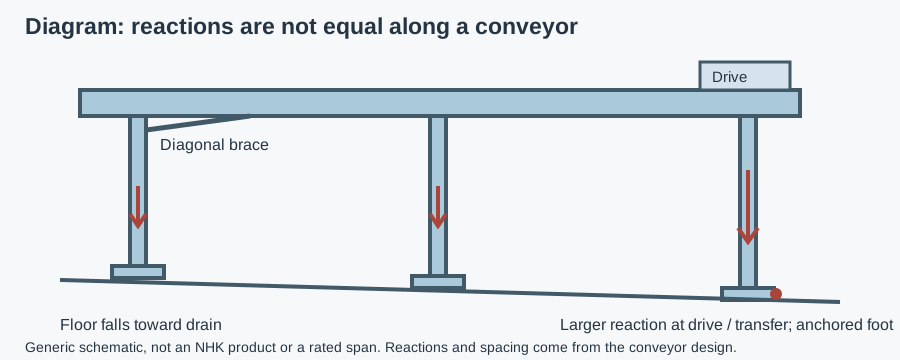
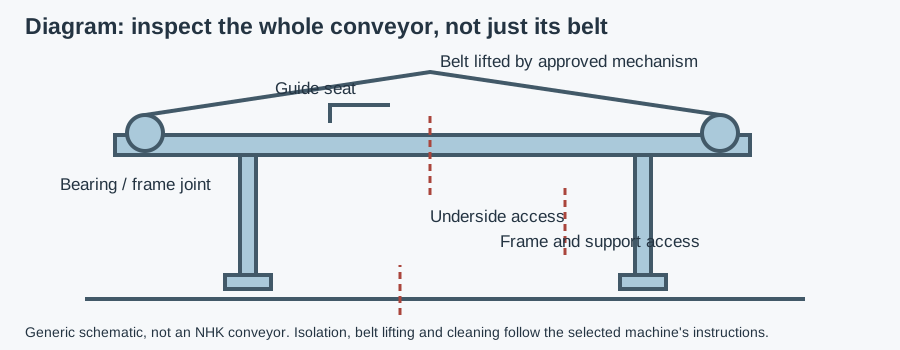
Conveyors are long and light, with many feet. Two points differ from single machines: alignment along the length matters more than individual load, and transfers to other machines must stay at the same height. Use swivel bases on sloped floors, anchor at least the transfer ends, and level from the transfer point outwards. If the conveyor must be moved for cleaning, compare with casters and leveling casters. For the leg itself – reactions at drives, bracing and closing tube ends – see the conveyor support leg guide.
Example
Assumed values, for method only: a 1,200 kg filling machine (including product in the bowl) stands on four feet in a beverage plant with daily foam cleaning and a floor that slopes towards a drain. Load per foot = 1,200 ÷ (4 − 1) = 400 kg before safety factor. With an assumed factor of 1.5 for vibration from the filler, each foot needs a rated static load of at least 600 kg at the chosen stem extension. The floor slope calls for a swivel base; daily foam cleaning calls for a hygienic design with enclosed thread in AISI 304. The filler vibrates, so two-hole feet are anchored to the floor with sealed anchor points.
Installation and inspection checklist
- Check the frame's thread and the foot's thread before installation.
- Set the machine roughly level with all feet in contact, then fine-level with a spirit level or laser.
- Check that every foot carries load – a foot that turns freely by hand carries nothing.
- Tighten lock nuts; anchor if specified.
- Keep exposed stem to a minimum; record the final heights.
- Re-check level and lock nuts after the first weeks of running and at planned maintenance.
- In food areas, inspect pads and seals for cracks, gaps and corrosion during hygiene audits.
Common mistakes
- Sizing on total load ÷ number of feet.
- Using the rated load without checking the stem extension it applies to.
- Fixed bases on sloped floors, so only the base edge touches.
- Exposed-thread feet in washdown zones.
- Mixing stainless feet with zinc-plated nuts or anchors, causing galvanic corrosion where the metals touch in wet conditions.
What to send for a recommendation
Before asking for certification evidence, use the checking the certificate against the supplied foot.
- Machine or conveyor type, total load and number of feet
- Thread size and required stem length or height range
- Floor: slope, material, drains
- Fixing: free-standing, one or two holes
- Zone and cleaning method; material grade (304 or 316L)
- Certificate needed (EHEDG, 3-A), quantity and delivery country
Send these details to NHK
An NHK technician suggests a suitable leveling foot and sends a quote.