Artificial intelligence (AI) in equipment is the use of data-driven models that learn from sensor, camera and process data to detect, predict or adjust machine behaviour. In manufacturing it is used to make machinery more precise, more efficient and less dependent on manual checks. This guide looks at what that means for food, beverage and pharma machinery – and at the mechanical components the data comes from.
Why precision and efficiency matter on hygienic lines
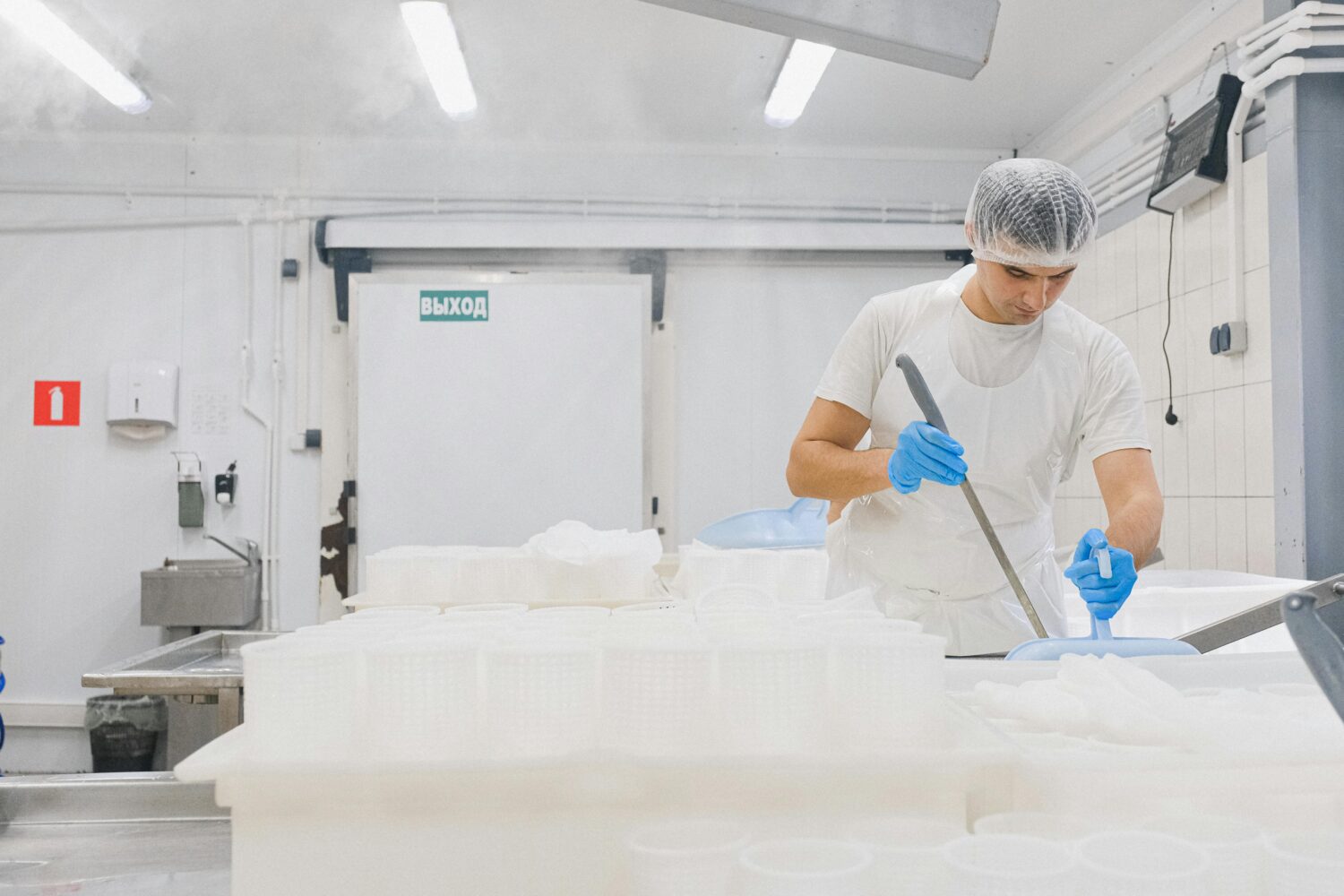
Equipment errors cost money, compromise safety and reduce output. On hygienic lines they also carry a food-safety dimension: a bearing that runs hot may be a lubrication failure about to leak, a misaligned conveyor may damage product, and an unplanned stop often means an extra cleaning cycle before restart. Precision here means holding tolerances – fill weight, cut size, seal quality – consistently over a shift. Efficiency means producing that output with the least downtime, energy, water and chemicals.
The same pressures apply across industries. The original version of this article covered manufacturing, healthcare, agriculture and logistics; this version focuses on processing machinery, where the link between components and data is most direct.
How AI enhances equipment precision
Predictive maintenance
Predictive maintenance plans work from the measured condition of a component rather than a calendar. Sensors on bearing units, motors and gearboxes record vibration, temperature or motor current; a model compares the signal with normal behaviour and flags wear before it becomes failure. The concept is the P-F interval: the time between a defect becoming detectable (P) and functional failure (F). Monitoring is only useful if it detects defects early enough within that interval to plan a stop. For the underlying failure modes, see optimising industrial machinery performance.
Advanced quality control
Machine-vision systems with AI models analyse camera images to detect defects – foreign bodies, mis-shaped products, poor seals, wrong labels – that people can miss at line speed. Unlike fixed rule-based vision, a trained model can tolerate natural variation in products such as meat or bakery items. It still needs consistent lighting, clean lenses and enough labelled examples of real defects.
Adaptive learning
Adaptive models update as conditions change: product temperature, raw-material variation, belt wear. This helps equipment hold accuracy under varying conditions, but it also means the model's behaviour changes over time. In regulated production, changes to a model that makes quality decisions should go through the same change control as any other process change.
Boosting efficiency through AI
| Use | Typical data | What improves | Main prerequisite |
|---|---|---|---|
| Predictive maintenance | Vibration, temperature, motor current | Fewer unplanned stops, planned spare parts | Components with a measurable wear signal |
| Vision quality control | Camera images | Fewer defects passed or false rejects | Stable lighting, labelled defect images |
| Process automation | PLC states, recipes | Less manual intervention, fewer handling errors | Reliable, repeatable mechanics |
| Energy optimisation | Power meters, drive data, CIP records | Lower energy, water and chemical use | Sub-metering per machine or cleaning circuit |
| Scheduling and routing | Orders, stock, line status | Shorter changeovers, better throughput | Integrated planning data |
Process automation takes repetitive tasks away from operators, reducing intervention and handling errors. Energy optimisation monitors consumption in real time and adjusts drives, heating or cleaning cycles; in food plants cleaning is often a large share of utility use. Smart decision-making applies the same idea to planning – in logistics, routing vehicles to cut fuel and time; in a plant, sequencing products to reduce allergen changeovers.
Applications across industries
- Manufacturing: CNC machines, robots and assembly lines gain precision and throughput, and predictive maintenance keeps them running longer between failures.
- Food and pharma processing: condition monitoring of conveyors, pumps and bearing units; vision inspection of products and packs; optimisation of CIP (clean-in-place) cycles.
- Healthcare: robotic surgical systems and AI-assisted diagnostic tools support precision and earlier detection.
- Agriculture: autonomous tractors and drones support planting, irrigation and harvesting with less resource use.
- Logistics and warehousing: automated guided vehicles (AGVs), sorting systems and stock forecasting.
Components come first: the hardware behind the data
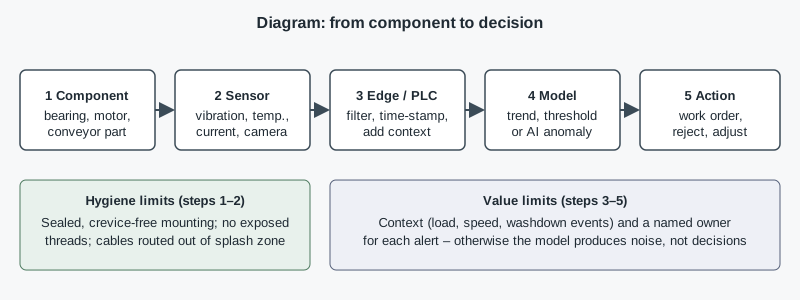
A model can only report what the hardware does. If a bearing unit is undersized, or its seals let washdown water in, the model will correctly predict repeated failures – it will not prevent them. Fix the specification first: load and speed rating, seal and housing type for the cleaning method, material grade, and lubrication. See differences between pillow block and flange bearing housings for housing selection.
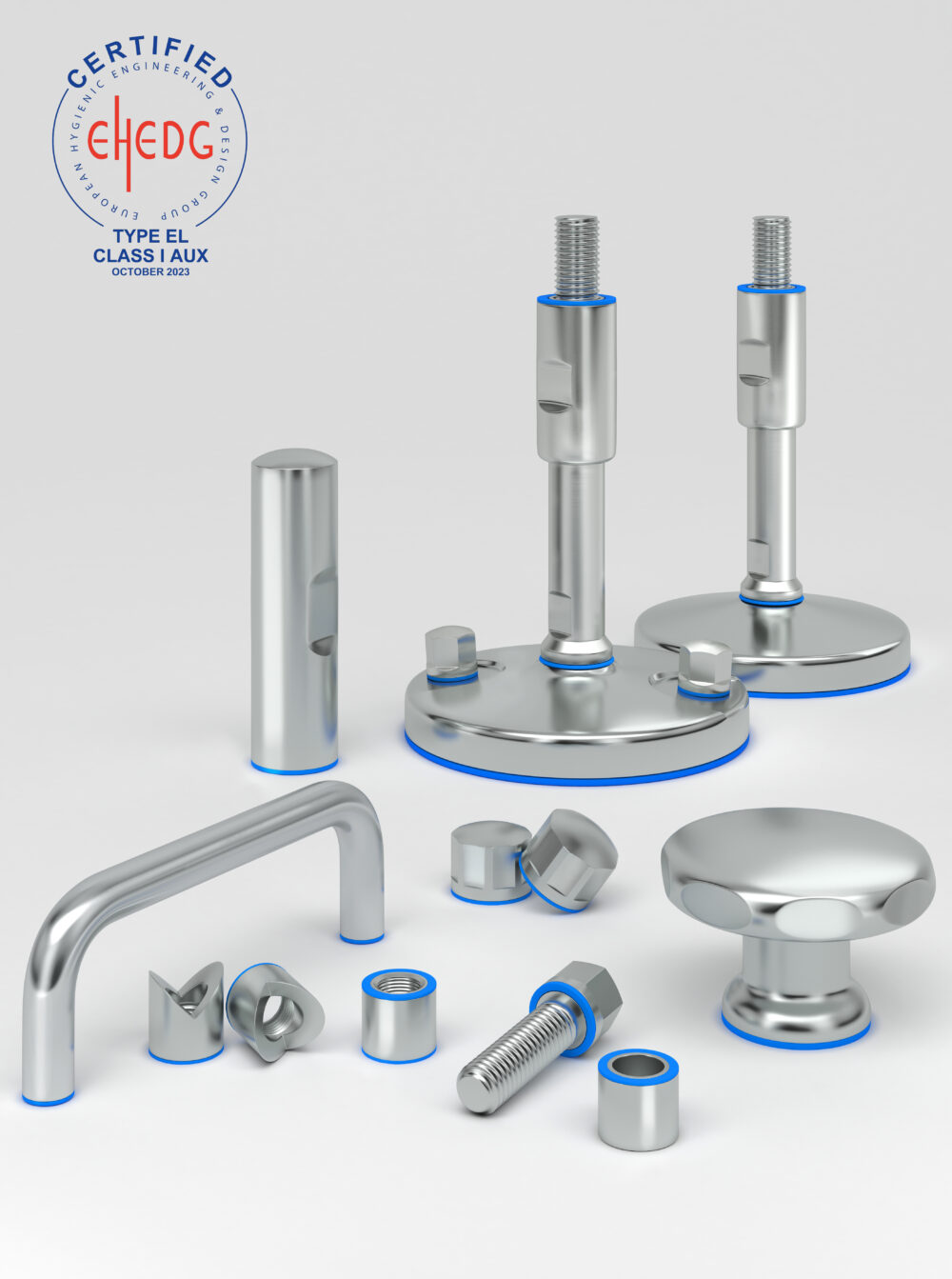
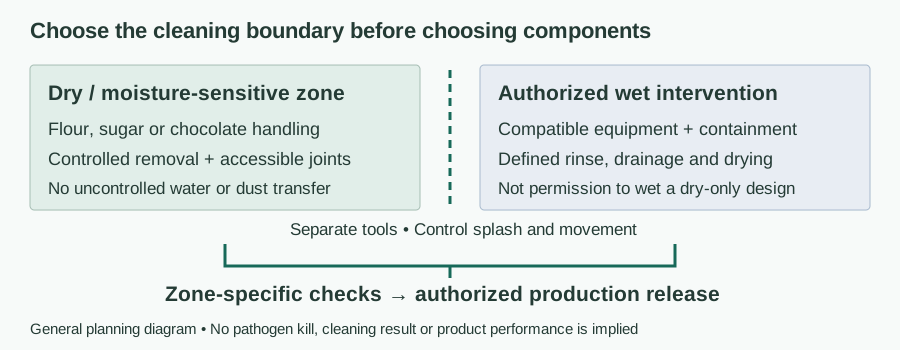
In hygienic zones the monitoring hardware itself becomes part of the machine. Every sensor, bracket and cable can create harbourage points – places where product residue and microorganisms collect and survive cleaning – unless it is mounted flush, sealed, without exposed threads and with self-draining surfaces. Housings and seals must resist the cleaning chemicals and temperatures used, and the ingress rating must match the test: IP67 is a temporary immersion test, while IP69K (ISO 20653) covers high-pressure, high-temperature spray. Neither is a hygiene certification. Mounting details are covered in automated hygienic components.
How to decide where AI or condition monitoring is worth it
- List candidate assets – drives, bearing units, pumps, gearboxes, vision-inspected stations.
- Rate consequence of failure – lost production per hour, scrap, extra cleaning and food-safety risk.
- Check detectability – does the failure give a measurable signal (vibration, heat, current) before it happens?
- Estimate the P-F interval – if it is shorter than a realistic response time, monitoring will not help; redesign or carry spares instead.
- Check the mechanics – resolve recurring failures caused by wrong specification before adding sensors.
- Define action and owner – who receives each alert, and what they do within which time.
- Pilot, then scale – run on a few assets, compare alerts with actual findings at teardown, adjust thresholds.
Example
Assumptions (illustrative only): a conveyor line has twelve stainless bearing units on drive and tail shafts, washed down daily. Two drive-shaft bearings have failed unexpectedly in a year, each causing a stop plus a full re-clean.
- Consequence: high for the two drive-shaft positions (line stops), low for idler positions (redundant, quick to swap).
- Detectability: bearing damage normally shows as rising vibration and temperature before seizure.
- Mechanics check: teardown shows water ingress – the housing seals do not match the washdown method. Action: change to sealed units suited to washdown first.
- Monitoring: wireless vibration/temperature sensors on the two drive positions only, with an alert to the maintenance planner and a replacement at the next planned stop.
- Idler positions: covered by a monthly inspection checklist instead of sensors.
The decision rests on consequence and detectability, not on fitting sensors everywhere.
Overcoming challenges in AI integration
High implementation cost, lack of skilled people and data security are the barriers most businesses meet. Others are specific to processing: sensors damaged by washdown, data without context (was that vibration spike during cleaning?), too few recorded failures to train a model, and alert fatigue. Collaboration between AI developers and the engineers who know the machine is essential, as is training operators and maintenance staff to work with the systems rather than around them.
What to write in a specification or RFQ
- Signals required (vibration, temperature, current) and sampling rate, plus where data is processed (edge or central).
- Ingress rating and test standard, housing and seal materials, and the cleaning method and chemicals they must resist.
- Mounting: flush, crevice-free, no exposed threads; cable routing out of the splash zone.
- Food-contact compliance declarations (EC 1935/2004) for any part in the product zone.
- Data ownership, cybersecurity requirements and integration with existing PLC or maintenance systems.
The future of AI in equipment
Edge computing – processing data on or near the machine – and faster networks such as 5G allow quicker responses and less dependence on central servers. Collaborative robots (cobots) are expected to work alongside people on more tasks, and analytics will spread further in agriculture and healthcare. For machine builders and plants, the practical question remains the same: which decisions improve when better data is available, and are the components producing that data fit for the environment?